Why Data and AI Skills Are Becoming Essential Across Every Industry
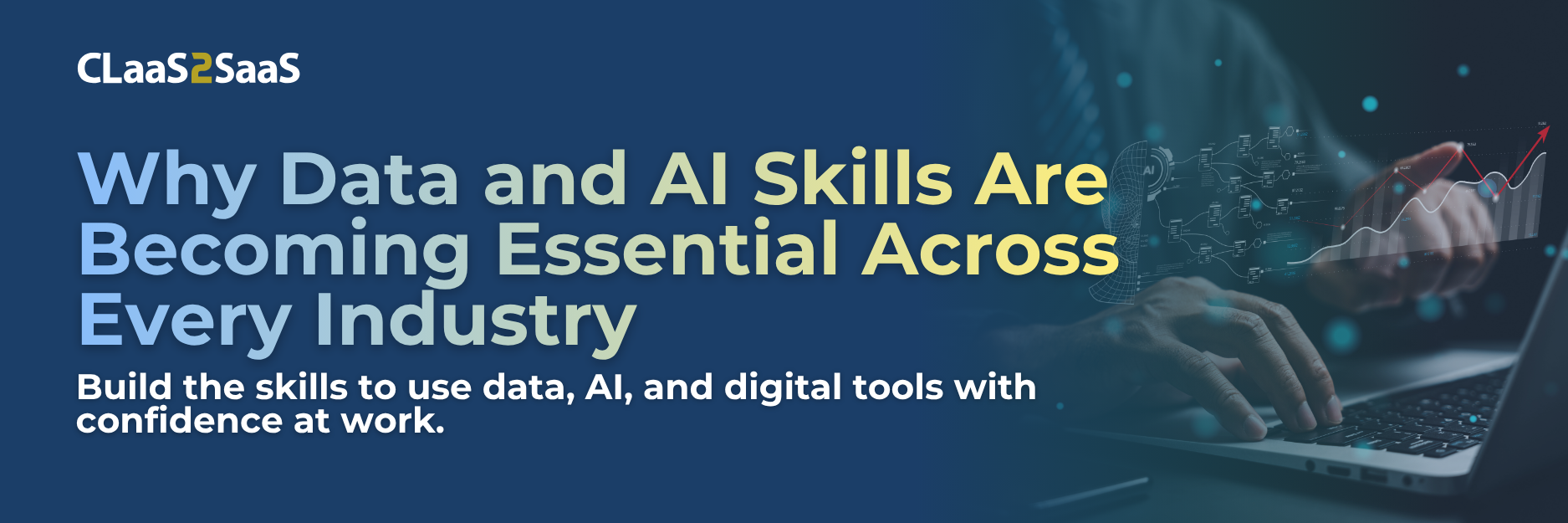
Why Data and AI Skills Are Becoming Essential Across Every Industry
Content
Content
Data and AI skills are becoming essential across every industry because digital tools are no longer limited to technical teams. Marketing, finance, human resources, operations, sales, and management roles increasingly involve dashboards, automated recommendations, generative AI, forecasting, or data-driven decision-making.
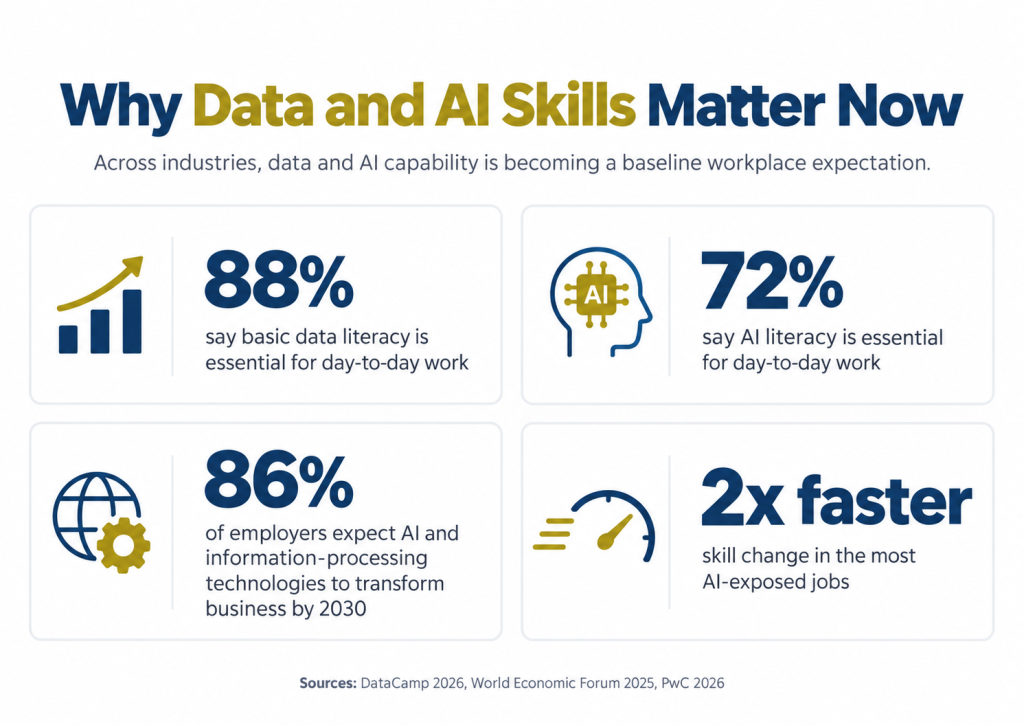
This does not mean every professional needs to become a data scientist or AI engineer. It means more people need enough data literacy to interpret information correctly and enough AI literacy to use intelligent tools with judgment. DataCamp’s 2026 State of Data & AI Literacy research, based on more than 500 enterprise leaders in the United States and United Kingdom, found that 88% consider basic data literacy important for day-to-day work, while 72% say the same about AI literacy.
For professionals, the practical question is how to build the right level of capability to work confidently with both.
What Does ‘Data and AI Skills’ Actually Mean for a Non-Technical Professional?
Data and AI skills combine interpretation, decision-making, tool use, and critical thinking. Data literacy is the ability to read, understand, question, analyze, and communicate information from data. At work, that can mean reading a dashboard, comparing performance over time, recognizing a meaningful trend, or noticing when available data is incomplete.
AI literacy is the ability to understand what AI tools can and cannot do, use them for suitable tasks, evaluate their outputs, and apply human judgment before acting. A professional does not need to understand the mathematics behind a large language model, but they should recognize that AI-generated output can be incomplete, outdated, biased, or incorrect.
The two capabilities reinforce each other. AI can summarize information, identify patterns, generate options, or automate repetitive steps. Data literacy helps a professional decide whether those outputs are credible and relevant. For example, a marketing manager might use AI to summarize campaign performance, then check whether the suggested explanation for a conversion drop is supported by the numbers.
How Do These Skills Show Up Differently Across Industries?
The tools vary by function, but the underlying capability is similar: understand the problem, use relevant data, apply an appropriate tool, validate the output, and make a responsible decision.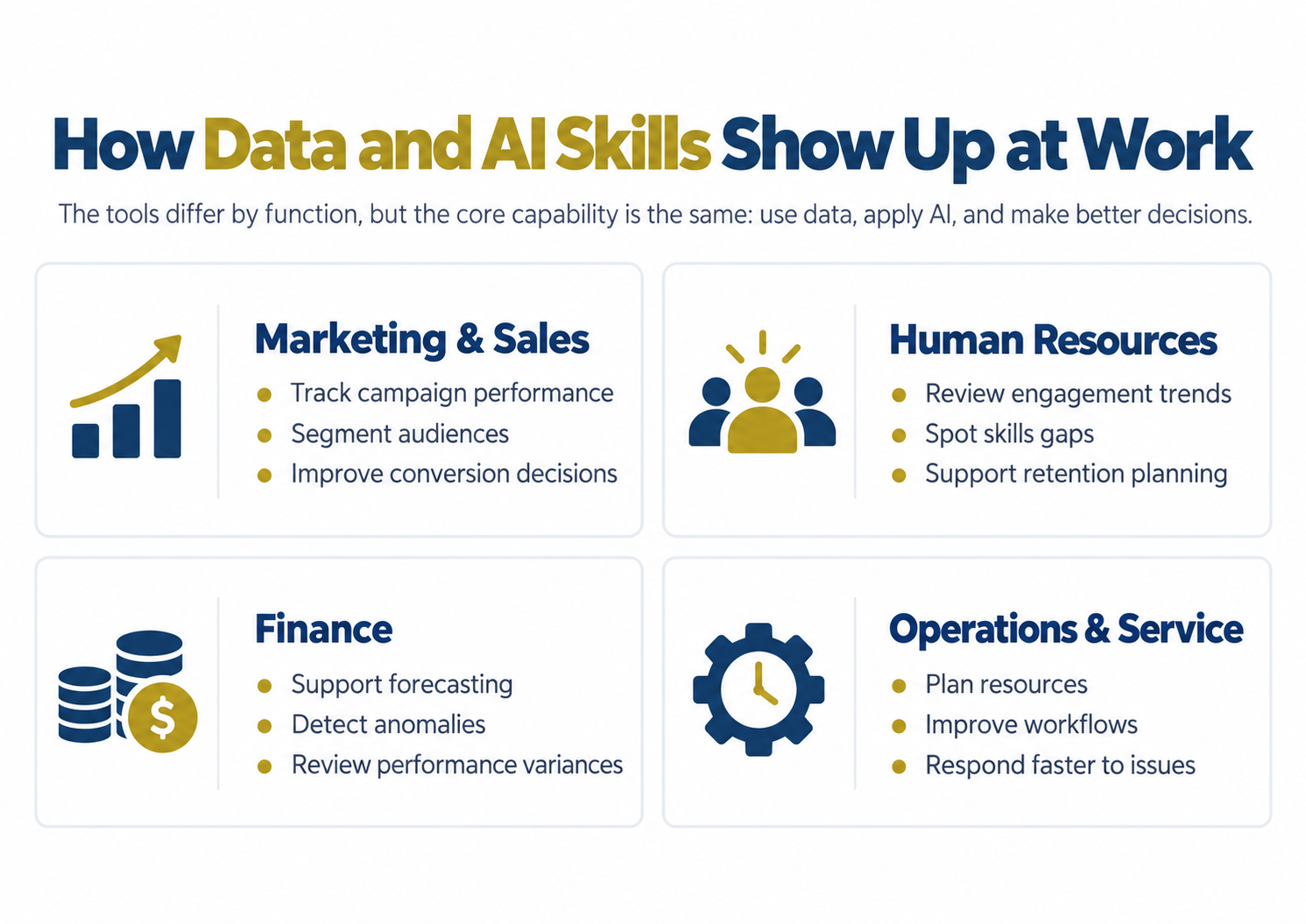
In marketing and sales, professionals use campaign data, CRM activity, conversion rates, search performance, and customer behavior to understand what is working. AI can support research, content variations, segmentation, and analysis, while data literacy helps teams focus on meaningful metrics rather than simply generating more information.
In human resources, data and AI skills can support recruitment, workforce planning, learning and development, engagement, and retention. AI may summarize survey comments or organize skills information, but HR professionals still need to examine evidence and context before acting on an automated explanation.
In finance, teams work with forecasts, budgets, transactions, and variance reports. AI can support anomaly detection, document review, and repetitive reporting. The key skill is checking assumptions and deciding whether an output makes financial sense.
In operations and customer service, teams use data to manage capacity, delivery, inventory, workflows, and service issues. AI can help with summarization, routing, knowledge retrieval, and responses, while people determine when automation is appropriate and when human escalation is needed.
Why Are Employers Prioritizing This Now?
Employers are prioritizing data and AI literacy because AI tools are moving into everyday business software faster than many workforces are adapting. The World Economic Forum’s Future of Jobs Report 2025 identifies AI and big data among the fastest-growing skill areas and reports that 86% of surveyed employers expect AI and information-processing technologies to transform their businesses by 2030.
DataCamp’s research also found that 60% of enterprise leaders report a data skills gap and 59% report an AI skills gap. These findings reinforce why data and AI literacy matter for career growth across business functions, not only within specialist technology teams.
The pace of skill change is also accelerating. PwC’s 2026 Global AI Jobs Barometer found that skills required in the most AI-exposed jobs are changing more than twice as fast as those in the least AI-exposed jobs.
For non-technical professionals, this means AI upskilling is not simply about learning one new tool. It also means strengthening judgment, data interpretation, problem-solving, and communication, while building the confidence to progress into more advanced analytics and AI applications where relevant.
How Can a Non-Technical Professional Start Building These Skills?
Start with the work you already do. Choose one recurring report, dashboard, spreadsheet, or dataset and learn what each metric means, where the information comes from, and which decisions it should support. Then practice asking better questions about the data instead of only reading the numbers.
Next, identify one appropriate AI-supported task. You might use an approved AI tool to summarize customer feedback, organize information, draft a report, classify recurring issues, or generate questions to investigate. Compare the output with the original information and check important claims before using them.
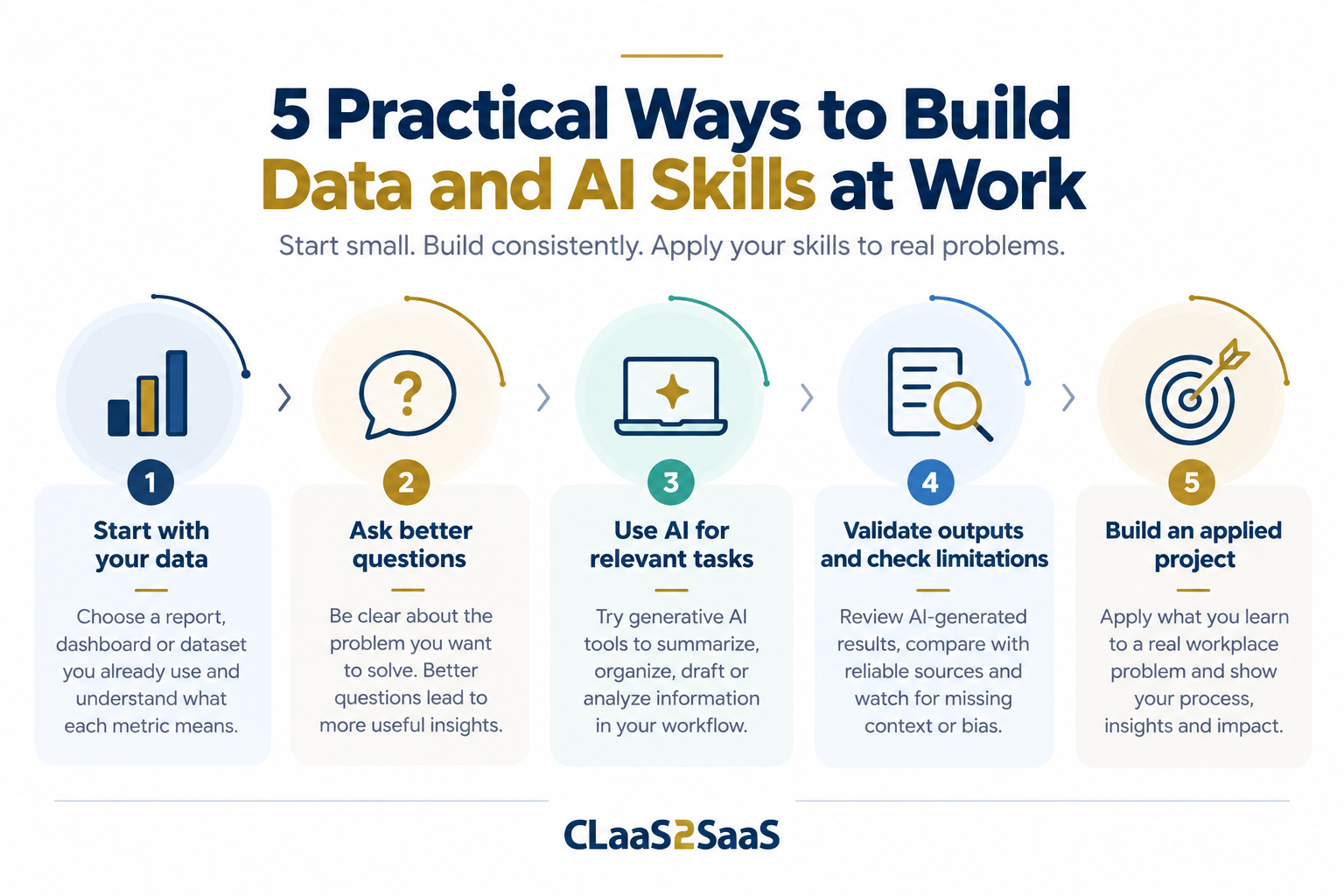
Then build one small applied project around a genuine workplace problem. A marketer could analyze campaign results and identify which channels generate qualified leads. An HR professional could examine workforce or engagement trends. An operations professional could analyze recurring delays and identify patterns for improvement.
As your capability develops, these projects can progress from basic analysis and dashboards to predictive models, machine learning, and AI-supported solutions.
Structured learning can help professionals turn foundational data and AI literacy into practical, applied capability. The CLaaS2SaaS Data Science & AI pathway develops skills in data analytics, AI model development, machine learning, deep learning, and low-code application development through hands-on projects.
Learners apply these capabilities to real-world problems, helping them build the technical and analytical skills needed to work more confidently with data and AI.
The goal is not to chase every new platform. Start by learning to understand data, use AI responsibly, question outputs, and turn evidence into action. From there, professionals who want to deepen their capabilities can progress into areas such as data analytics, machine learning, AI model development, and intelligent application development as their roles and career goals evolve.
Share


Want to check if this career is for you?