How Digital Innovation Consultants Help Businesses Turn Technology Into Business Value
How Digital Innovation Consultants Help Businesses Turn Technology Into Business Value
Content
Content
A company can invest in AI, automation, or analytics and still see limited improvement. Often, the business selected a tool before clearly defining the problem or desired outcome.
A digital innovation consultant connects business needs with practical digital solutions. The role involves identifying the problem, evaluating technology options, building a business case, and helping teams turn technology into measurable business value.
This capability is becoming more important as organizations adopt AI and other digital tools. The World Economic Forum’s Future of Jobs Report 2025 found that 86% of surveyed employers expect AI and information-processing technologies to transform their business by 2030.
What Does a Digital Innovation Consultant Actually Do?
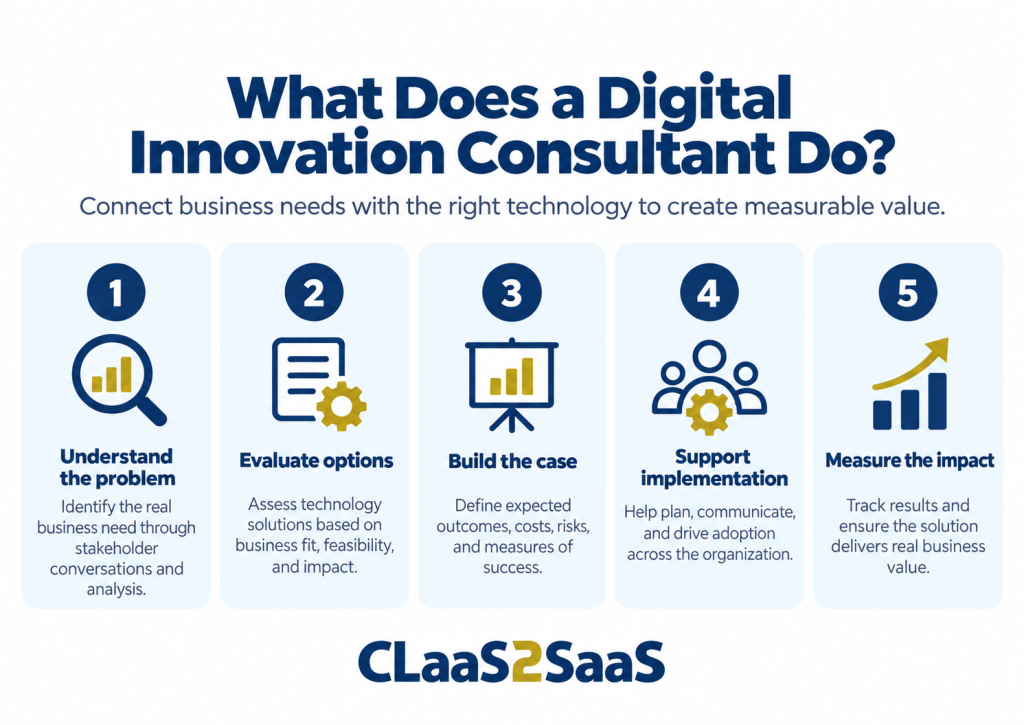
A digital innovation consultant connects business needs with digital technology. The consultant clarifies what should improve, examines the current process, identifies causes, evaluates solutions, and supports implementation.
Consider a customer service team that wants to reduce response times. Buying a new service platform may seem like the answer, but the real issue could be slow routing, disconnected customer data, repeated manual entry, or unclear ownership.
A consultant would first investigate those causes through stakeholder interviews, workflow mapping, and available data. Only then would options such as automation, AI assistants, analytics, CRM capabilities, or enterprise AI platforms be evaluated.
This is the core of technology-to-business-value translation: turning a broad goal such as “respond faster” into a clear problem, practical requirements, expected outcomes, and measurable results.
Why Does This Role Exist? The Translation Problem
Business leaders and technical teams often describe the same challenge differently. A business leader may say, “We need to improve customer response time,” while a technical team may focus on integrations, data access, security, or implementation effort.
A digital innovation consultant connects these perspectives. Instead of starting with “Which tool should we buy?” the process begins with a few practical questions:
- What problem are we trying to solve?
- Who is affected?
- What is causing the issue?
- What outcome should improve?
- How will success be measured?
Digital innovation also does not always mean buying new software. Better integration, process redesign, improved data quality, clearer responsibilities, or stronger user support may solve more of the problem. This broader approach is central to enterprise transformation.
How Do Digital Innovation Consultants Define Business Value?
Technology creates value when it improves an outcome that matters to the organization. Consultants therefore establish a baseline before recommending or measuring a change.
Useful measures can include response time, manual hours, error rates, conversion, cycle time, cost, adoption, or customer satisfaction.
For example, if customer inquiries currently take eight hours to reach the correct service team, routing time becomes a meaningful baseline. After automated routing is introduced, the organization can compare the new result with the original performance.
Automation itself is not the final outcome. The value comes from improvements such as less manual work, fewer errors, faster turnaround, or better consistency.
What Skills Does This Role Require Day to Day?
Digital innovation consulting requires a combination of business, technology, analytical, and communication skills.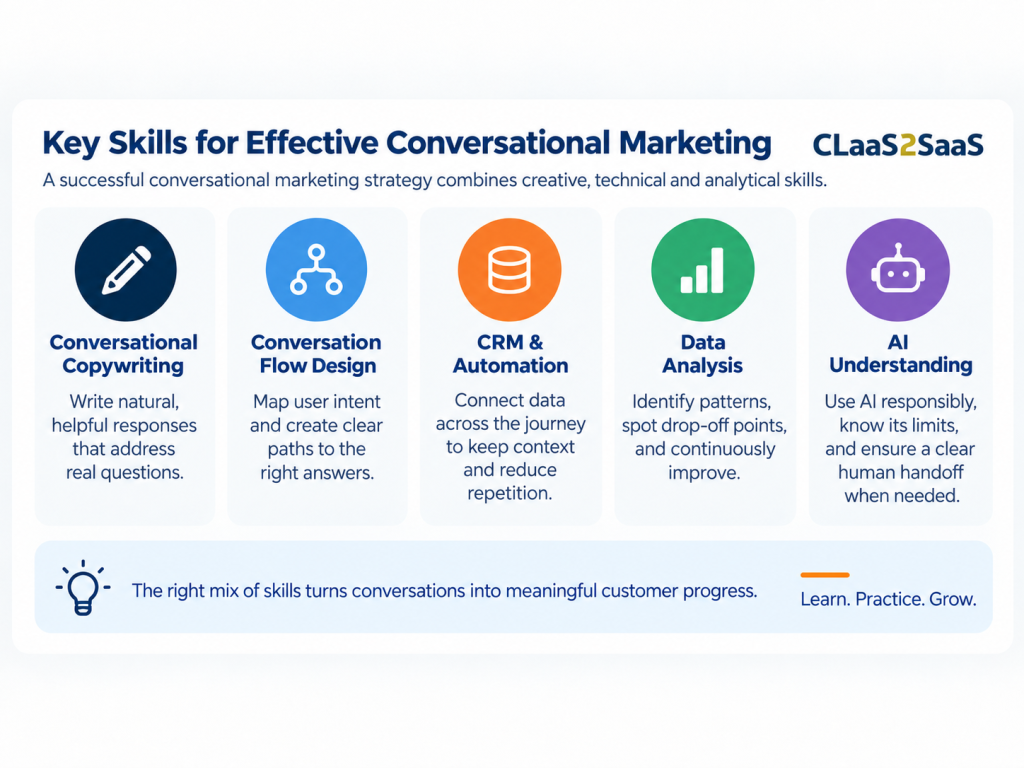
How Does Digital Innovation Consulting Differ From Adjacent Roles?
Responsibilities vary across organizations, and job titles often overlap.
Business analysts often emphasize requirements, processes, and stakeholder needs, although many also contribute to solution evaluation. IT consultants may focus on technology strategy, implementation, systems integration, architecture, or specialized technical advice while also participating in business discovery. Product managers usually guide the ongoing direction and priorities of a product, although their responsibilities may extend across several initiatives.
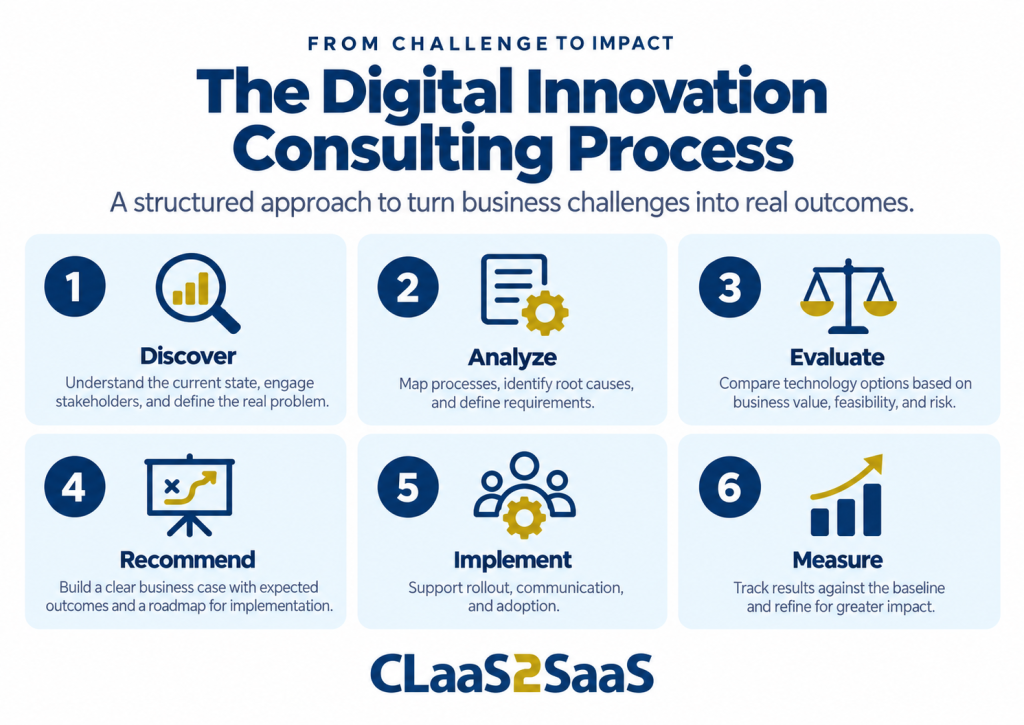
A digital innovation consultant commonly connects discovery, technology evaluation, business-case development, and adoption within individual transformation initiatives.
For someone considering a digital innovation consulting career, the job description is often more informative than the title. Look at the problems handled, stakeholder interaction, expected technical depth, implementation involvement, and how success is measured.
Build Digital Innovation Consulting Capabilities
Preparing for this career takes more than knowing digital tools. You need to analyze business problems, evaluate solutions, communicate with stakeholders, and connect technology decisions to measurable outcomes.
A practical way to build these capabilities is to start with a real business process. Identify the problem, map the workflow, explore how AI, automation, analytics, or low-code tools could improve it, and define how you would measure the result.
CLaaS2SaaS’s Digital Innovation Consultant pathway is designed around practical, work-integrated capability building, where learners build technical and leadership capabilities. Eligible learners can then progress to an International Master of Business Administration (MBA) top-up, which extends the pathway into advanced strategy and leadership.
Together, these stages help learners move from building and implementing digital solutions to leading broader transformation initiatives, aligning technology with business strategy, and scaling innovation across an organization.
Turn Digital Skills Into Business Solutions
Businesses do not need technology for its own sake. They need people who can understand a business problem, evaluate the right digital approach, and connect implementation to outcomes that matter.
Building practical capabilities in automation, analytics, AI, low-code applications, and digital transformation can provide part of that foundation. The next step is applying those capabilities to real business problems with clear objectives and measurable outcomes.
Explore the CLaaS2SaaS’s Digital Innovation pathway
Share


Want to check if this career is for you?