Future-Proof Your Career on a Digital Marketing Degree with AI Tools
SHARE THIS:


Digital marketing is no longer just about creativity, channels, or campaign ideas. It is about systems, data, automation, and intelligent decision-making at a scale. AI has moved from being an optional add-on to becoming the backbone of modern marketing operations. As noted by Melissa Russell of Harvard Professional, AI allows marketers to refine audience segmentation, predict trends, and make data-driven decisions in real time, shaping the future of marketing.
Yet many graduates still enter the workforce with outdated knowledge, fragmented skills, and little exposure to real marketing technology stacks. This gap between education and industry expectations is growing fast. With automation and AI reshaping roles globally, the World Economic Forum estimates that by 2030, 170 million new jobs will emerge even as 92 million roles are displaced, highlighting the need for adaptable, tech-savvy marketers.
For students choosing their first degree, the challenge is no longer just studying marketing, but choosing a digital marketing degree that stays relevant as technology reshapes the industry
A digital marketing degree with AI tools directly addresses this problem. It prepares learners not just to enter the workforce, but to stay relevant, adaptable, and competitive as marketing continues to evolve.
Why Digital Marketing Careers Need to Be Future-Proofed
Marketing roles are changing faster than job titles can keep up. Businesses now expect marketers to operate across platforms, channels, and customer touchpoints while making data-driven decisions in real time. Several shifts are driving this change:
- AI-powered automation is handling repetitive tasks
- Customer journeys are becoming non-linear and conversational
- Marketing performance is measured continuously, not campaign by campaign
- Teams are expected to do more with fewer resources
The result is a demand for marketers who can think holistically and execute efficiently. Employers are no longer hiring single-skill specialists. They are hiring adaptable professionals who understand systems, tools, and outcomes. This shift means that undergraduate education must now prepare students not just for their first job, but for how marketing roles will evolve over the next decade.
What Is a Digital Marketing Degree with AI Tools?
A digital marketing degree with AI tools is designed around how modern marketing actually works inside organizations today. Instead of focusing only on theory, this degree integrates artificial intelligence, automation, and real-world platforms into the learning process from the beginning. It is designed for undergraduate learners, combining academic foundations with applied AI-enabled marketing practice rather than taught as standalone electives or short courses. Students build capability progressively over the duration of the degree, moving from fundamentals to applied, real-world marketing systems.
The goal is not to turn students into data scientists. The goal is to train marketers who can confidently use AI to plan, execute, optimize, and scale marketing strategies.
Core characteristics include:
This approach ensures that graduates do not just understand marketing concepts. They know how to apply them in real environments. - Hands-on use of AI-powered marketing platforms
- Full-funnel and omni-channel marketing execution
- Real business scenarios and applied projects
- Continuous assessment based on outcomes, not memorization
- Alignment with real digital marketing roles
How AI Is Reshaping the Digital Marketing Career Path Degree
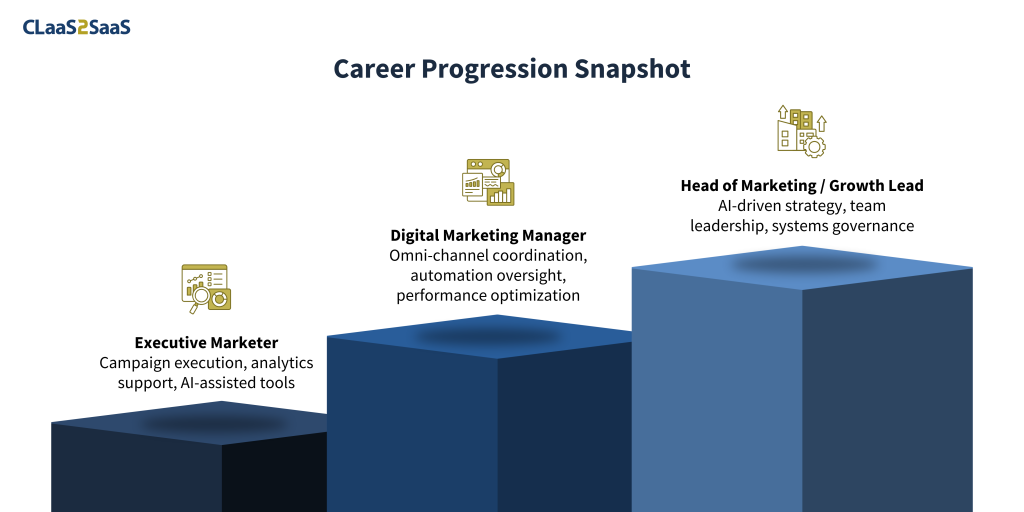
AI has changed the expectations placed on marketers at every level. Entry-level roles now require tool proficiency. Mid-level roles demand automation and analytics skills. Leadership roles require strategic oversight of AI-driven systems.
A modern digital marketing career path degree reflects this progression. As students progress through the degree, learning shifts from execution-level tasks to understanding how AI-enabled marketing systems support strategic decision-making. With AI and analytics among the fastest-growing skill areas globally, students trained in these tools are better positioned to meet the demands of an evolving job market.
From Execution to Strategy
AI handles tasks like scheduling, testing, and data processing. This frees marketers to focus on:
- Strategy and decision-making
- Customer experience design
- Creative direction and messaging
- Performance optimization
From Channels to Systems
Marketing is no longer siloed. SEO, paid ads, email, social media, CRM, and automation platforms now work together.
Students learn how to:
- Connect multiple channels into a single customer journey
- Use AI to personalize messaging at scale
- Analyze performance across platforms
- Optimize continuously based on data
Traditional Digital Marketing Degrees vs AI-Integrated Programs
Both pathways award recognised academic degrees, but AI-integrated programs differ in how deeply real tools, platforms, and applied work are embedded into the learning experience. In AI-driven marketing roles, especially leadership and regional roles, employers increasingly value degree-qualified professionals who also possess applied AI capability.
Traditional Digital Marketing Degrees
Many traditional programs still emphasize:
- Static frameworks and textbook models
- Limited exposure to live tools
- Separate treatment of channels
- Heavy reliance on exams and theory
Digital Marketing Degrees with AI Integration
AI-integrated programs are designed around employability and real-world relevance. Through a work-study approach, students don’t just learn theory and get an undergraduate degree—they gain hands-on experience while applying skills in practical, professional settings.
Students develop a structured applied experience with:
- Marketing automation and conversational tools
- AI-assisted content and performance optimization
- CRM-driven personalization
- Data-informed campaign planning
Learning to Become a Full-Stack, Omni-Channel Marketer
One of the defining strengths of an AI-driven marketing degree is its full-stack focus.
Rather than preparing students for just one narrow role, it equips them with a broad, connected skill set that mirrors how marketing works in the real world. Students don’t just learn concepts. They get hands-on experience across multiple channels, tools, and strategies, seeing how each part of the marketing ecosystem interacts.
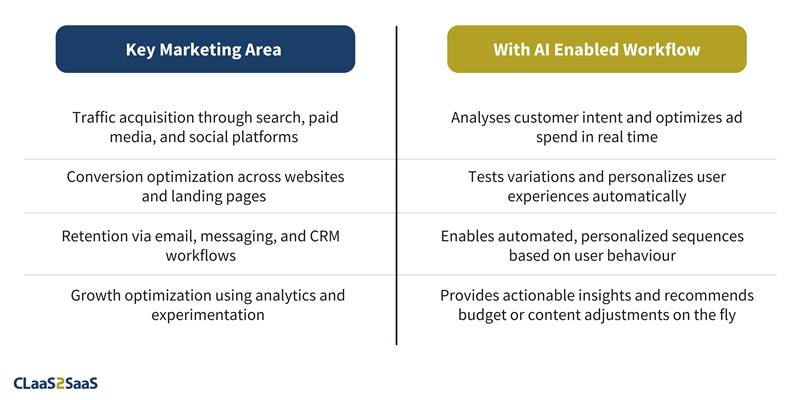
AI tools act as accelerators across all these areas, helping marketers work smarter rather than harder. This applied, AI-enabled approach forms the foundation of omni-channel conversational marketing, where every interaction feels connected and personalized.
Career Outcomes: From Graduate to Leadership Role
A major advantage of this pathway is how it supports long-term career progression.
Graduates are not limited to execution roles. They are trained to understand the entire marketing ecosystem, which positions them to become digital marketing manager candidates earlier in their careers.
Employers value professionals who can:
This digital marketing career path degree structure builds those capabilities step by step. - Coordinate campaigns across teams and platforms
- Interpret data and translate it into action
- Oversee automation and AI-driven workflows
- Align marketing efforts with business goal
Why Employers Prefer AI-Ready Marketing Graduates
Hiring managers are increasingly cautious about credentials that do not translate into real performance.
Employers prioritize candidates who:
- Can contribute quickly with minimal onboarding
- Understand modern marketing tools and workflows
- Adapt easily as platforms evolve
- Think strategically, not just tactically
Addressing Common Concerns About AI-Based Marketing Degrees
Will AI replace marketing jobs?
AI replaces repetitive tasks, not human judgment. Strategy, creativity, and ethical decision-making remain human-led. Education should focus on collaboration with AI, not competition.
Is this degree too technical?
The focus is on application, not engineering. Students learn how to use and interpret tools, not how to build algorithms.
Is it suitable for beginners?
Yes. Strong programs include structured learning paths that build confidence gradually, starting from fundamentals and progressing to advanced applications.
Who Should Choose This Degree Path?
This pathway is especially well-suited for:
Students Seeking Career Security
AI skills reduce the risk of role obsolescence and increase adaptability across industries.
Career Switchers Entering Digital Marketing
A structured degree with applied learning provides clarity, credibility, and faster entry into professional roles.
Aspiring Marketing Leaders
Understanding automation, analytics, and systems is essential for managing modern marketing teams.
Why This Degree Is a Smarter Long-Term Investment
Instead of stacking certifications after graduation, students graduate with an integrated skill set that reflects real-world expectations. Nearly 39% of workers’ skills are expected to become outdated by 2030, which makes continuous learning and AI-focused education essential for long-term career growth.
Benefits include:
- Faster employability
- Broader career options
- Stronger portfolios
- Higher confidence in professional environments
Building a Career That Grows with Technology
If you’re planning a career in digital marketing, the real question is no longer whether AI will shape your role, but whether your education prepares you to work with it. A digital marketing degree with AI tools gives you more than theoretical knowledge; it builds the practical, data-driven, and system-level skills employers now expect.
You don’t have to choose between creativity and technology, or between a recognised degree and real-world skills. With the right AI-integrated pathway, you can develop both at the same time and stay relevant as marketing continues to evolve.
Course

Ready to Take the First Step?
If you’re ready to move beyond theory-heavy education, explore how the CLaaS2SaaS Work-Study pathway can help you gain practical digital marketing skills, hands-on experience with AI tools, recognised certifications, and a bachelor’s degree, all in one structured journey.
Explore how this AI-integrated digital marketing degree prepares you for real-world roles and long-term career growth.
From Doubt to Determination
From Doubt to Determination – Percival’s Journey from Beginner to Tech Professional with CLaaS2SaaS

SHARE THIS:
From Curiosity to Uncertainty
Growing up, Percival always had a natural curiosity about how things worked. He wasn’t the type of student chasing top grades or recognition, but he loved exploring ideas, researching online, and learning alongside his friends. For him, discovery often happened outside the classroom, through questions, experimentation, and late-night searches on the internet. That quiet curiosity slowly shaped his interest in technology, even before he realized it could turn into a career.Questioning the Traditional Path
After taking a two-year break from school, Percival faced a difficult decision about his future. Returning to a traditional four-year university felt intimidating, both financially and emotionally. The idea of spending years studying without real-world exposure didn’t sit well with him, especially since he still wasn’t confident about what he wanted to pursue. On top of that, he had no technical background, which made entering the tech field feel even more overwhelming.
“I thought spending another four years of my time and tons of money for a traditional degree felt overwhelming for me at first, so I wasn’t even sure what I wanted to do yet in my life and I honestly, I didn’t feel prepared.”
Discovering a Different Path
That’s when Percival discovered the CLaaS2SaaS pathway, an alternative route that combined structured learning with real-world industry exposure. Instead of delaying experience until after graduation, the program allowed him to work and study at the same time while pursuing a Bachelor’s Degree in Software Engineering. It was a model that felt more practical and aligned with how he learned best: by doing.
Still, he wasn’t immediately convinced. There were mixed reviews online, and stepping into tech as a complete beginner felt risky. But rather than waiting until he felt “ready,” he chose to take the leap.
“I was skeptical at first… I also asked my parents about it. I took this opportunity to make myself better because I actually have no knowledge in programming and I’m a beginner, right? So, it’s a challenge for me. But I did it anyway. I joined CLaas2SaaS and I can confidently say that I learned things that I can use in the real world.”
That decision became the turning point of his journey.
Learning the Hard Way and Growing Because of It
The start of the bootcamp wasn’t easy. The pace was fast, the lessons were technical, and many of the concepts were completely new to him. As someone with no prior coding experience, he often struggled to keep up and questioned whether he belonged in Software Engineering at all. But instead of isolating himself, he reached out to classmates, asked questions, and committed to learning outside of class.
“It was more than hard because it’s fast paced and given that I’m a beginner, it is hard for me because I can’t even follow up at first. I can’t use the computer much because my knowledge is limited. So, what I did, I tried to connect to my classmates as much as possible and I made friends.”
Over time, those small efforts built both his skills and his confidence.
From Classroom to Real-World Experience
As he progressed into the apprenticeship stage, Percival began applying what he learned to real industry projects. He worked with tools like Power Apps and Azure, built agents, and contributed to mobile applications that mirrored actual workplace responsibilities. The experience helped him understand not only how to code, but how to collaborate, communicate, and solve problems within a team. It felt less like schoolwork and more like preparing for a real career.
Balancing weekday work with weekend classes required discipline, but it also strengthened his time management and independence. Each week, he could see himself improving—not just technically, but personally. Slowly, the beginner who once doubted himself was becoming someone capable and reliable.
The Transformative Outcome
Percival’s path shows that there’s more than one way to build a career in tech. Through CLaaS2SaaS, he was able to pursue a Bachelor’s Degree while gaining real Software Engineering experience at the same time, something a traditional route might not have offered as quickly. Instead of waiting years to become job-ready, he grew through hands-on practice from day one.
For students who feel unsure or underqualified, his story is proof that you don’t need to be an expert to begin. Sometimes, all it takes is the courage to say yes and the determination to keep going.
Course
Take the First Step Toward Your Own Success
If you relate to Percival’s story and want to become one of our learners to explore a learning path that aligns with your goals, now is the time to take action.
Book a consultation or get a personalized career proposal today to see how CLaaS2SaaS can help you build the skills you need for a successful
Low Code App Development Training and RPA Certification
Low Code App Development Training & RPA Certification for Enterprise Automation
SHARE THIS:
Digital transformation is no longer a future initiative, but an everyday expectation. Across enterprises, teams are being asked to digitize processes, automate workflows, and deliver results faster, often without expanding technical headcounts.
At CLaaS2SaaS, we speak daily with working professionals who are navigating this shift. Many are not looking to become software engineers, yet they’re expected to understand how applications work, how processes can be automated, and how digital tools can be used to solve real business problems. This is exactly why low code app development training has moved from a “nice-to-have” skill to a core capability in modern enterprises.
Let’s go through what low code app development training really means, how it connects with automation and RPA (Robotic Process Automation), and why these skills are becoming foundational for professionals involved in digital innovation and transformation towards faster execution and reduced dependency on IT.
Why Low Code App Development Training Is Essential for Modern Enterprises
Enterprises today operate in an environment that demands speed and adaptability. Business units cannot always afford long development cycles or heavy reliance on specialized technical teams for every digital initiative.
In most enterprises, digital transformation stalls not because of strategy, but because execution is bottlenecked by manual processes, disconnected systems, and limited technical capacity. Low code app development training directly addresses this gap by enabling professionals closest to the business problem to design, automate, and improve workflows without waiting on long development cycles.
Low code app development training helps close this gap by enabling faster solution development and closer collaboration between business and technology teams. It allows professionals who understand the business context to actively contribute to building applications and improving workflows. Low code is not about bypassing IT. It is about creating digitally capable professionals who can translate business needs into workable solutions without compromising governance and support enterprise-wide transformation efforts.
What Is Low Code App Development Training?
Low code app development training equips learners with the skills to design, build, and deploy applications using minimal hand coding. Instead of writing thousands of lines of code, learners work with visual builders, logic flows, and reusable components.
Low code platforms typically provide:
- Drag-and-drop application builders
- Pre-configured logic and workflow components
- Built-in data connectors
- Visual process modelling tools
Low code app development training is particularly relevant for:
In enterprise contexts, this often includes platforms such as Microsoft Power Apps, where applications are built on governed data models, integrated with existing systems, and deployed within IT-approved environments. In short, it’s designed for people who need to build solutions, not just understand them conceptually. - Business and operations professionals
- Managers leading digital initiatives
- Non-technical roles working closely with IT teams
- Career professionals transitioning into digital or transformation roles
Where Automation Fits into Low Code App Development Training
As professionals become more comfortable in building applications and improving workflows with low code, a natural next question arises: how can repetitive tasks within these processes be automated?
This is where automation enters the picture.
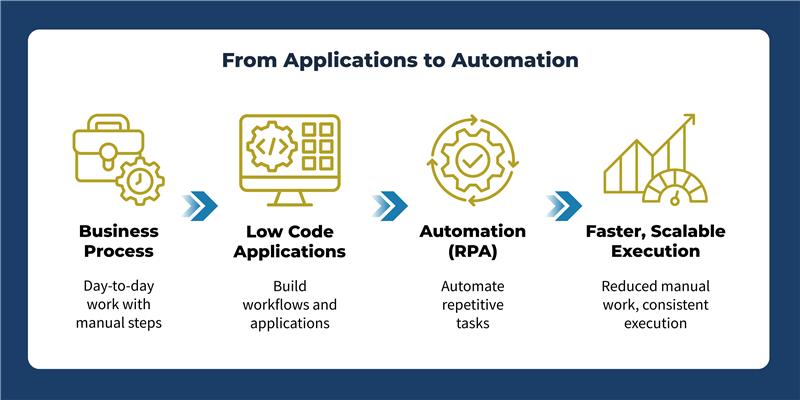
Low code app development training does not exist in isolation. In enterprise environments, applications are often only one part of a larger operational workflow. Many processes still rely on manual steps such as data entry, report generation, or system-to-system updates. These repetitive activities create inefficiencies that applications alone cannot fully eliminate.
Automation technologies are designed to address this gap.
They allow organizations to streamline execution once workflows and applications are in place. For career professionals involved in digital initiatives, understanding how automation complements low code development becomes increasingly important.
One of the most widely adopted automation approaches in enterprises today is Robotic Process Automation (RPA). Before exploring how low code and RPA work together, it’s important to first understand what RPA is and why organizations rely on it.
What Is Robotic Process Automation (RPA) and Why Does an RPA Certification Matter?
Robotic Process Automation, commonly referred to as RPA, is a technology that uses software “bots” to automate repetitive, rule-based tasks across digital systems.
In simple terms, RPA allows organizations to automate tasks that are usually performed by people clicking through applications, copying data, generating reports, or triggering routine actions. These bots interact with systems in the same way a human user would, but they do so faster, more consistently, and without fatigue.
As automation becomes more widely adopted, organizations increasingly focus on whether automation initiatives can be designed, governed, and sustained over time. This is where formal learning and structured capability development become relevant.
An RPA certification does not serve as a guarantee of role or career progression. Instead, it helps signal that a professional has developed a practical understanding of how automation works in real business environments. More importantly, it reflects readiness to apply automation responsibly within organizational constraints.
For many professionals, RPA certification complements low code app development training by strengthening their automation and execution skill set. - Practical understanding of automation tools
- Ability to design and manage automated workflows
- Readiness to contribute to transformation initiatives
Why Enterprises Are Adopting Low Code and Robotic Process Automation at Scale
Industry research has consistently shown that low code and automation are becoming core components of enterprise digital transformation strategies, particularly as organizations look to accelerate delivery while managing technical constraints. According to Gartner, low-code platforms play a growing role in enabling business-led application development and process automation.
The adoption of low code is closely tied to a broader shift toward automation and digital efficiency. Many organizations struggle with:
- Manual, repetitive workflows
- Fragmented systems and data
- Long development backlogs
- Limited technical resources
Low code platforms enable teams to respond to these challenges quickly by building targeted applications and automations without waiting months for development cycles.
In practice, low code and automation serve different but complementary purposes:
- Low code apps manage user interaction, forms, approvals, and workflows
- Automation flows orchestrate system-to-system actions
- RPA bots handle legacy or manual interface tasks where APIs are unavailable
When combined with Robotic Process Automation (RPA), low code becomes a powerful enabler of digital transformation. Rather than treating digital initiatives as isolated IT projects, enterprises increasingly use low code to support continuous improvement across departments. This shift explains why low code app development training is now viewed as a strategic capability rather than a technical niche.
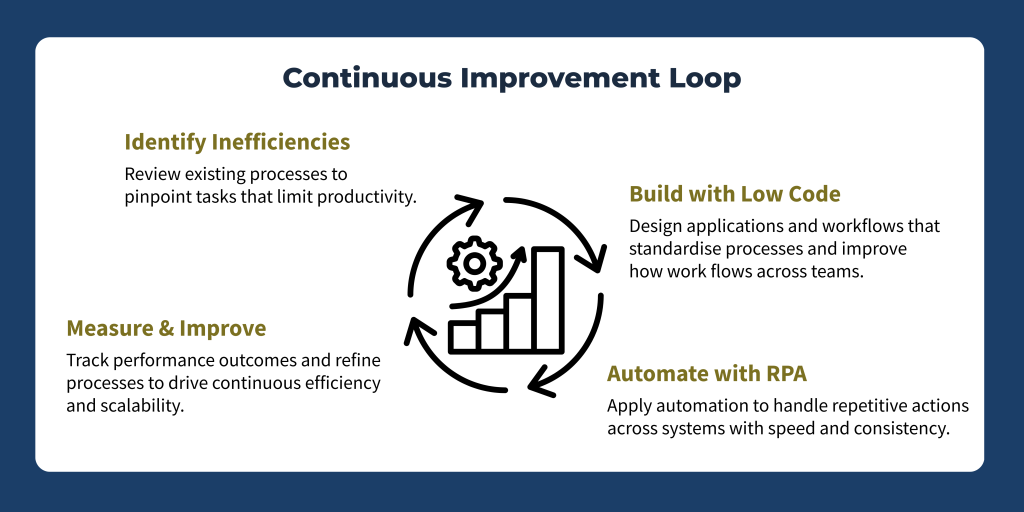
Core Skills You Gain from Low Code App Development Training
Low code app development training goes beyond learning a tool. It builds a set of transferable, enterprise-relevant capabilities.
- Building Business and Workflow Applications: Learners gain hands-on experience creating applications such as approval workflows, internal dashboards, and operational tools that directly deliver operational solutions.
- Understanding Systems, Data, and Process Logic: Even without deep coding, low code training develops systems thinking. Learners begin to understand how data flows, how systems interact, and how logic drives outcomes to bridge business and technology.
- Applying Low Code to Real Business Problems: Most importantly, low code app development training focuses on application. The goal is not theoretical knowledge, but the ability to design solutions that solve real organizational challenges.
These capabilities are especially valuable for roles such as operations analysts, digital transformation managers, automation leads, and business process owners who need to bridge strategy and execution.
Power Automate Certification Course as a Low Code Automation Path
Microsoft Power Automate is one of the most widely used low code automation tools in enterprise environments.
It allows users to build workflows that connect Microsoft and third-party applications, making it particularly effective for organizations already using Microsoft 365 or Dynamics. Power Automate supports both simple task automation and more complex business processes.
A Power Automate certification course helps learners develop hands-on experience with workflow design, logic configuration, and system integration. For many professionals, it serves as a practical entry point into low code and enterprise automation.
Low Code App Development Training for Digital Transformation Leaders
Digital innovation leaders are expected to connect strategy with execution, and it requires more than conceptual knowledge of technology. This shift is also reflected in broader leadership research. Recent insights from McKinsey highlight that organizations increasingly expect leaders and professionals to possess a baseline level of digital and AI literacy, even if they are not building technology themselves.
Low code app development training provides leaders with a practical understanding of how digital solutions are built and deployed. This enables better decision-making, more effective collaboration with technical teams, and stronger oversight of transformation initiatives.
As a result, low code skills are becoming a foundational capability for professionals moving into digital leadership roles.
Advancing from Low Code Skills to Digital Transformation Leadership with CLaaS2SaaS
For professionals who want to go beyond individual skills, structured learning pathways matter.
CLaaS2SaaS’ Digital Innovation Lead (MBA) pathway is designed to progressively build capability—from execution to leadership. Skill → capability → leadership. The pathway begins with a Professional Certificate focused on applied digital skills such as low code application development, AI model development, and data analytics. Learners can then progress to a Professional or Postgraduate Diploma, and ultimately an Applied Master or MBA-equivalent top-up.
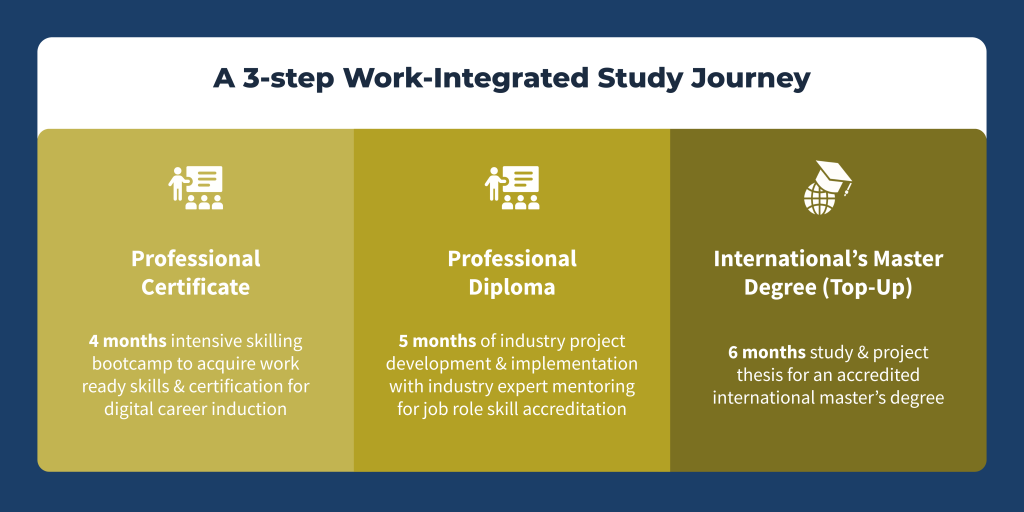
A defining feature of the pathway is its emphasis on applied projects. Learners are expected to work on real digital transformation initiatives, ensuring that skills gained through training translate directly into business impact.
Since low code application development is a foundational module within the pathway, this will support later learning in digital transformation leadership, strategy, and innovation by grounding learners in execution-oriented digital skills.
As digital transformation continues to evolve, choosing the right program requires clarity on both career goals and practical outcomes. This is why many professionals take time to understand how to choose a digital transformation course as a working professional, especially when balancing work commitments with long-term leadership aspirations.
1. Is low code app development training suitable for non-technical learners?
Yes. Low code platforms are designed to be accessible to professionals without a technical background.
2. Is low code a replacement for software engineering?
No. Low code is not intended to replace software engineering. Software engineering remains essential for complex, large scale systems, while low code helps organizations address everyday operational needs more efficiently.
3. How long does it take to gain practical low code skills?
With applied, part-time learning models, learners can begin building usable applications within a few months.
4. What is the difference between low code and RPA?
Low code focuses on building applications and managing workflows, while RPA automates repetitive tasks across systems.
5. Is a Power Automate certification course suitable for enterprise use?
Yes. Power Automate is widely adopted in enterprise environments, particularly within the Microsoft ecosystem.
Course
Building Future-Ready Capabilities with Low Code App Development Training
Low code app development training reflects a shift in how digital skills are developed and applied. It empowers professionals to move faster, collaborate more effectively, and deliver measurable value within their organizations.
At CLaaS2SaaS, we see low code and automation not as shortcuts, but as enablers of smarter and more sustainable transformation. For career professionals navigating digital change, these capabilities form a strong foundation for long-term growth.
International Bachelor in Software Engineering
International Bachelor in Software Engineering: Your Path to Global Tech Careers
SHARE THIS:
This International Bachelor in Software Engineering combines a UK-awarded degree from the University of Roehampton with a structured work-study model in Asia. Students graduate with both global academic recognition and real industry experience, designed to support faster employability and long-term career growth in the global tech economy.
We live in a world powered by technology. Every time you use a mobile app, stream a movie, make an online payment, book a ride, or access cloud storage, you are interacting with software built by engineers. Behind these everyday digital experiences are professionals who design, develop, test, and maintain complex systems that keep businesses and societies running.
Software engineering is a specialized branch of computer science focused on creating reliable, secure, and scalable software systems. It is not just about writing code. It involves structured planning, system design, testing, collaboration, and continuous improvement. Engineers follow modern development approaches such as Agile and DevOps to ensure software is efficient, high-quality, and adaptable to change.
As industries continue to digitize, software engineering has become one of the most important and strategic fields globally.
Why Software Engineering Is So Important Today
Technology investment is no longer optional for companies, it is essential. Organizations across sectors such as finance, healthcare, logistics, retail, education, and entertainment rely heavily on software systems to operate and grow.
Here’s why software engineering matters: 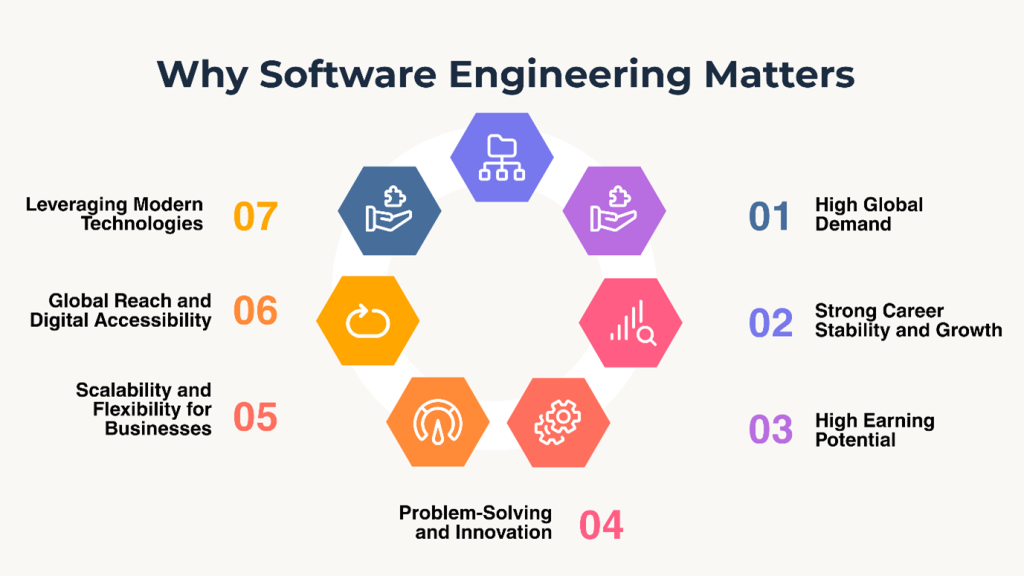
1. High Global Demand
Businesses worldwide are actively hiring software engineers to support digital transformation. As companies expand their online services and automate processes, the need for skilled developers continues to rise. Software engineering consistently ranks among the most in-demand career paths internationally.
2. Strong Career Stability and Growth
Because software skills are transferable across industries, graduates enjoy diverse career opportunities. Whether working in fintech, AI, cybersecurity, gaming, cloud computing, or enterprise systems, software engineers can specialise and grow into senior or expert roles over time.
3. High Earning Potential
Technical expertise in programming, system architecture, and scalable development commands competitive salaries globally. As digital systems become more complex, professionals with strong engineering foundations become even more valuable.
4. Problem-Solving and Innovation
Software engineering is ideal for those who enjoy solving complex challenges. Engineers design creative solutions to real-world problems, whether improving healthcare systems, developing secure payment platforms, or building intelligent applications powered by data and AI.
5. Scalability and Flexibility for Businesses
As companies grow, their software systems must handle more users, more data, and new features. Skilled software engineers design systems that can scale efficiently without losing performance. This ability to plan for growth makes software engineering crucial for long-term business success.
6. Global Reach and Digital Accessibility
Software connects people across countries and cultures. Engineers play a role in building inclusive, accessible digital systems, ensuring applications work across devices, languages, and user needs. With billions of people using digital platforms daily, software engineering has a truly global impact.
7. Leveraging Modern Technologies
Software engineers work with powerful tools such as:
- Programming languages like Python, Java, and C++
- Web and application frameworks
- Cloud platforms and DevOps tools
- Data libraries and AI technologies
- Agile and Scrum development methodologies
Because these skills are foundational to digital systems across industries, software engineering remains one of the few disciplines that consistently delivers global mobility, long-term relevance, and strong earning potential.
Want an International Bachelor’s Degree, But Not Sure About Studying Abroad?
Students are often forced to choose between international recognition and practical affordability, or between studying abroad and gaining real work experience.
However, the idea of relocating overseas for three to four years can feel overwhelming. There are concerns about high living costs, adjusting to a new country, being away from family, and the uncertainty of whether the degree will actually lead to employment.
At the same time, students are becoming more career-focused. They don’t just want a certificate, they want assurance that their time and investment will lead to a stable, high-income career in technology.
This is exactly why our Work-Study Bachelor’s Degree in Software Engineering offers a different path. It combines international academic recognition with structured, real-world industry exposure, without requiring the traditional full overseas university experience.
A UK-Awarded Degree with International Recognition
This International Bachelor’s in Software Engineering is awarded by the University of Roehampton (UK), a respected British university with established academic standards.
What does this mean for you?
- Your degree is issued by a recognised UK university
- It follows the academic framework and quality standards of the UK higher education system
- Your qualification holds international credibility
- Employers see a globally recognised university on your certificate
This is not a short course or a private certification. It is a fully accredited bachelor’s degree aligned with UK academic benchmarks. You gain the credibility of a British university qualification, while studying within a more accessible and industry-integrated pathway in Asia.
This matters because it enables not only recognition by multinational employers, but also eligibility for further postgraduate studies internationally and stronger positioning for global and regional technology roles.
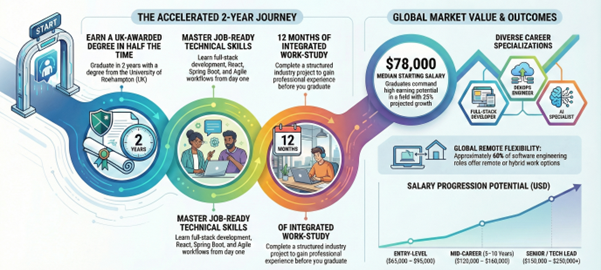
Graduate in Just 2 Years, Without Compromising Depth
Traditional bachelor’s degrees often take three to four years. The Work-Study Bachelor’s Degree pathway is structured to allow students to graduate in just two years, without sacrificing technical depth or academic quality.
The programme follows a carefully designed progression. Students build strong technical foundations during the Higher Diploma which is accredited by Lithan Singapore, before advancing to the University of Roehampton Top-Up Bachelor’s Degree. Each stage builds on the previous one, ensuring students develop both conceptual understanding and applied competence.
This optimised structure allows students to enter the workforce earlier, giving them a competitive advantage in a fast-moving digital economy where skills and experience matter.
Built Around Job-Ready Skills from Day One
One of the biggest frustrations among graduates is discovering that employers expect experience, even for entry-level roles. Many traditional programmes focus heavily on lectures and theory, leaving students underprepared for real development environments.
The CLaaS2SaaS Work-Study Bachelor’s Degree in Software Engineering is designed differently. From the beginning, students develop applied technical skills in full-stack software development.
This includes building web applications using industry-relevant technologies such as React, Spring Boot, and API-based systems. Students learn not just how to code, but how to structure scalable systems, implement secure architecture, manage databases, and collaborate within Agile workflows. These technologies are commonly used in enterprise, startup, and global development teams, ensuring students train within environments similar to those used by employers.
Beyond implementation skills, the programme emphasises core software engineering foundations that distinguish professional engineers from short-term coding trainees. Students are introduced to:
- Software architecture concepts and layered system design
- System design thinking for real-world problem solving
- Scalability and maintainability principles for long-term system growth
- Code quality standards, documentation practices, and structured testing discipline
- Version control, automated testing, debugging methodologies, DevOps workflows, and AI-assisted development environments.
This deeper engineering focus ensures graduates understand why systems are designed in certain ways, not just how to write functional code.
By focusing on applied learning combined with engineering theory, the programme ensures students are not memorising syntax or following tutorials. They are learning to think like software engineers, capable of building reliable, scalable systems in professional environments.
The Work-Study Advantage: Real Industry Experience Before Graduation
The defining feature of this pathway is its integrated work-study structure. During the Top-Up Bachelor’s phase, students complete an industry project that functions as a structured apprenticeship experience.
This is not a short internship added at the end of a degree. It is embedded into the academic pathway, ensuring students apply their technical learning in real or simulated production environments under professional guidance, aligned with international development standards and global best practices.
Through this experience, students develop:
- Confidence working on real technical problems
- Exposure to collaborative, cross-functional, and cross-border development practices
- Professional communication skills suited for global and remote teams
- A portfolio of tangible, industry-relevant projects
By the time they graduate, students can have up to 12 months of practical experience alongside their UK-awarded bachelor’s degree. This combination of international academic recognition, global-ready collaboration skills, and real-world industry exposure significantly strengthens their employability in both local and international tech markets. For employers, this significantly reduces hiring risk, as graduates demonstrate both capability and adaptability before full-time employment.

More Than a Degree, A Career Launchpad
The Work-Study Bachelor’s Degree pathway was created for students who want clarity, structure, and results. It addresses the common fears surrounding higher education, wasted time, uncertain career outcomes, and lack of job readiness.
Instead of choosing between academic recognition and practical experience, students receive both. They graduate in just two years with:
- A University of Roehampton (UK) awarded bachelor’s degree
- Full-stack software engineering capabilities
- Real project and apprenticeship exposure
- Industry mentorship and professional readiness
In a competitive global tech landscape, this combination creates a strong foundation for roles such as software engineer, full-stack developer, or junior DevOps engineer.
The Work-study model ensures that when you step into the workforce, you do so with both credibility and capability.
Career Outcomes: What You Can Do With an International Software Engineering Degree
An International Bachelor’s Degree in Software Engineering opens doors to a wide range of high-growth and high-impact career paths. As digital transformation accelerates across industries, from fintech and healthcare to AI, cybersecurity, and cloud computing, software engineers remain among the most in-demand professionals globally.
The programme is designed to support both immediate employability and long-term progression. Graduates typically begin in execution roles and grow into specialised or leadership positions as experience increases.
This structured progression ensures that students not only secure their first job, but also have a clear roadmap for advancing to high-impact, high-responsibility roles in the global tech industry. - Software Engineer / Software Developer, designing, developing, and maintaining applications and systems across platforms. This role provides foundational experience in software design and development.
- Full-Stack Developer, building both front-end user interfaces and back-end systems, APIs, and databases. This position allows early-career professionals to gain broad exposure across multiple layers of software systems.
- DevOps Engineer, bridging development and operations by managing deployment pipelines, automation, and cloud infrastructure. This is a natural next step for those interested in infrastructure, automation, and system scalability.
- AI / Machine Learning Engineer (Entry-Level Pathway), supporting the development of intelligent applications and data-driven systems. Early-career engineers can specialise in AI and gradually advance to more complex machine learning and data engineering projects.
- Cybersecurity Analyst, protecting digital systems and ensuring secure software environments. Starting in analyst roles can lead to senior security engineering or architecture positions.
- Software Tester / QA Engineer, ensuring quality, performance, and reliability of applications before release. QA experience often serves as a springboard to full-stack or DevOps roles.
- Technical Lead (Long-Term Progression), guiding development teams and making architectural decisions as experience grows. Graduates can move into leadership, project management, or specialised architecture roles.
Salary Potential and Career Growth
Disclaimer: Salary figures referenced above are based on aggregated global industry data and publicly available labor statistics. Actual compensation varies significantly depending on country, region, company size, industry sector, economic conditions, individual performance, and years of experience. These figures are intended for general informational purposes only and do not guarantee specific salary outcomes.
Recent industry data as per an analysis done by Hakia shows:
- Median starting salaries for software engineering graduates are approximately USD $78,000 annually, with typical entry-level ranges between $65,000–$95,000, depending on location and employer.
- Mid-career professionals (5–10 years of experience) often earn between $120,000–$160,000 annually.
- Senior engineers and technical leads can command $150,000–$250,000+, particularly in large technology firms.
- Specialisations in AI, machine learning, cloud computing, and DevOps often attract additional salary premiums.
- The field shows approximately 25% projected job growth through 2032, significantly higher than the average across industries.
- Around 60% of roles now offer remote or hybrid flexibility, expanding global career access.
In major technology companies, total compensation packages, including bonuses and stock options, can be substantially higher.
Beyond salary, software engineering also reports strong job stability. With low unemployment rates and high demand across industries, graduates benefit from strong long-term career security.
A Degree That Strengthens Your Market Position
Research also indicates that graduates with formal degrees in software engineering or computer science often earn a salary advantage compared to self-taught developers, particularly in their early career years. Employers frequently prioritise candidates with structured academic foundations combined with real-world experience.
This is where an international, work-integrated bachelor’s degree creates additional value. By combining UK academic recognition with applied development experience, graduates can enter the workforce with both theoretical grounding and practical exposure, a combination that strengthens employability.
How CLaaS2SaaS Supports International Students

CLaaS2SaaS is committed to student success. From academic guidance to career support, the program ensures students are prepared for the challenges of studying abroad and entering the workforce.
What CLaaS2SaaS Offers Students
- Structured academic guidance
- Industry mentoring and coaching
- Career support and employability pathways
- Guidance on navigating international study and work environments
Start Your Journey Towards a Global Software Engineering Career
A Bachelor in Software Engineering is not just about earning a degree. It’s about building a sustainable, global career in technology. With the International Bachelor in Software Engineering, powered by the University of Roehampton curriculum, you’ll gain:
If you’re ready to launch your career in software engineering, this program is designed for you. - A globally recognized qualification
- Real-world experience in Asia’s tech ecosystem
- A competitive edge in the global job market
Course
Ready to Take the Next Step?
Embark on your journey toward a successful career in software engineering today. With a degree that offers both academic rigor and real-world experience, you’ll be prepared to thrive in the global tech industry.
Ready to launch your global tech career? Explore the International Bachelor in Software Engineering and start building real-world job-ready skills today.
Software Engineering Degree vs Bootcamp
Software Engineering Degree vs Bootcamp: Which Is Better for Long-Term Career Growth?
SHARE THIS:
Choosing how to enter the tech industry is no longer just an education decision. It is a career strategy decision that can shape professional mobility, earning potential, and long-term relevance in a rapidly evolving field. The debate around software engineering degree vs bootcamp continues to grow as more learners search for faster and more affordable ways to access technology roles, especially working adults and career switchers who cannot pause their income for years. The pathway someone chooses today can influence not only how quickly they get hired, but also how far they can progress later.
At first glance, the decision seems straightforward. Bootcamps promise speed, hands-on projects, and job-ready skills. Degree programs promise structured learning, deeper technical foundations, and globally recognized credentials. Both pathways appear to offer a solution, but they are built around different assumptions about how careers develop. One prioritizes immediate execution, while the other emphasizes long-term knowledge frameworks and formal recognition.
The technology job market has also evolved. Employers are no longer hiring solely for familiarity with tools or programming languages. They are looking for professionals who understand systems, can collaborate across teams, adapt to new technologies, and grow into more complex responsibilities over time. This shift means the real question is not just how fast you can secure your first role, but how well your learning pathway prepares you for sustained growth and changing demands.
When the goal is long-term career growth, the choice becomes more complex. A pathway focused only on short-term skills may help with entry but can limit progression into senior engineering, architecture, or leadership roles. A pathway focused mainly on theory may provide depth but delay the practical exposure employers expect early on. Learners often feel forced to choose between speed and credibility, practice and recognition, or income and education.
This is why hybrid, work-integrated learning models are gaining attention. Instead of treating education and employment as separate phases, they combine skill development, industry experience, and academic progression in parallel. A model like CLaaS2SaaS is designed around how modern careers actually unfold, not in isolated stages but as continuous cycles of learning, application, and advancement. This article explores what each pathway offers, where each one falls short, and why an integrated approach can support both immediate employability and sustainable career progression.
What Is a Bootcamp and What Does It Offer?
Coding bootcamps are short, intensive programs built to help learners gain technical skills quickly. Most run from a few weeks to several months and focus heavily on applied development skills.
Common bootcamp features include:
- Project-based coding Learners build functional applications and systems, allowing them to apply concepts in practical scenarios similar to real development work.
- Real-world simulations Training activities mirror workplace environments, helping learners practice problem-solving, collaboration, and technical decision-making under realistic conditions.
- Portfolio building Students graduate with tangible projects that demonstrate their technical ability and approach to solving problems, which employers can directly evaluate.
- Interview preparation Programs provide structured guidance on technical interviews, coding challenges, and communication skills needed to perform confidently during hiring processes.
- Career coaching Learners receive support in career planning, job search strategy, and professional development to help them transition into and grow within the tech industry.
Bootcamps excel at helping learners enter the job market fast. They are often structured around current industry tools and stacks, such as web development frameworks, JavaScript ecosystems, or Python environments.
However, bootcamps usually concentrate on how to build, not always why systems work the way they do. According to CourseCompare, bootcamps are skills-focused, while degrees provide deeper theoretical grounding that supports adaptability over time.
Bootcamps are a strong starting point, but they may not provide the academic recognition or conceptual depth required for long-term progression into architecture, leadership, or specialized technical fields.
What Is a Software Engineering Degree and Why It Matters
A software engineering or computer science degree provides structured learning across both practical and theoretical areas. Beyond coding, students learn:
This deeper foundation helps graduates adapt as technologies evolve. Frameworks change, but core computing principles remain relevant. - Algorithms and data structuresLearners understand how to organize data efficiently and design logical processes that improve performance, scalability, and problem-solving effectiveness.
- System design and architectureStudents learn how complex software systems are structured, enabling them to design reliable, maintainable, and scalable applications.
- Databases and operating systems This area builds knowledge of how data is stored, managed, and retrieved, as well as how software interacts with the core systems that run applications.
- Security principlesLearners gain awareness of how to protect systems, data, and users by understanding vulnerabilities, risk management, and secure development practices.
- Computational problem solvingStudents develop structured thinking skills to break down complex challenges into logical steps that can be solved efficiently using technology.
According to BestColleges, degree programs often prepare learners for a broader range of long-term career options, including advanced technical roles and management pathways.
Degrees also carry formal academic recognition, which many employers consider when evaluating candidates for promotions or specialized roles.
Software Engineering Degree vs Bootcamp: Comparing Career Outcomes
Understanding fast track vs bootcamp outcomes requires looking beyond the first job.
Time to Employment
- Bootcamps: Faster entry into junior roles
- Degrees: Longer study period before first job
Depth of Knowledge
- Bootcamps: Focus on tools and frameworks
- Degrees: Cover tools plus foundational theory
Recognition and Credibility
- Bootcamps: Certificate credentials
- Degrees: Academic qualification
Long-Term Career Growth
- Bootcamps: Strong early career entry
- Degrees: Greater mobility into senior, specialized, or leadership roles
Years 0–2: Entry and Execution
Bootcamp graduates often enter junior developer roles faster, focusing on feature implementation using tools like React, Node.js, REST APIs, Git, and basic cloud services. Degree-based learners may take slightly longer to enter the workforce but begin with broader exposure to system design, databases, algorithms, and software development lifecycles, helping them understand how individual components fit into larger systems.
Years 3–5: System Ownership and Depth
As expectations increase, many bootcamp graduates need additional upskilling to move beyond execution-focused roles. Engineers at this stage are expected to work with scalable architectures, backend services, cloud platforms (AWS, Azure, GCP), CI/CD pipelines, and automated testing. Degree holders more commonly progress into mid-level roles with responsibility for system design, performance optimization, security considerations, and DevOps practices.
Years 6–10: Architecture and Leadership
Senior roles increasingly involve architecting distributed systems, leading teams, and making complex technical decisions across cloud-native platforms, microservices, security, and enterprise systems. These positions often favor candidates with strong foundations and recognized academic qualifications, particularly in enterprise, regulated, or international environments, where long-term technical credibility matters.
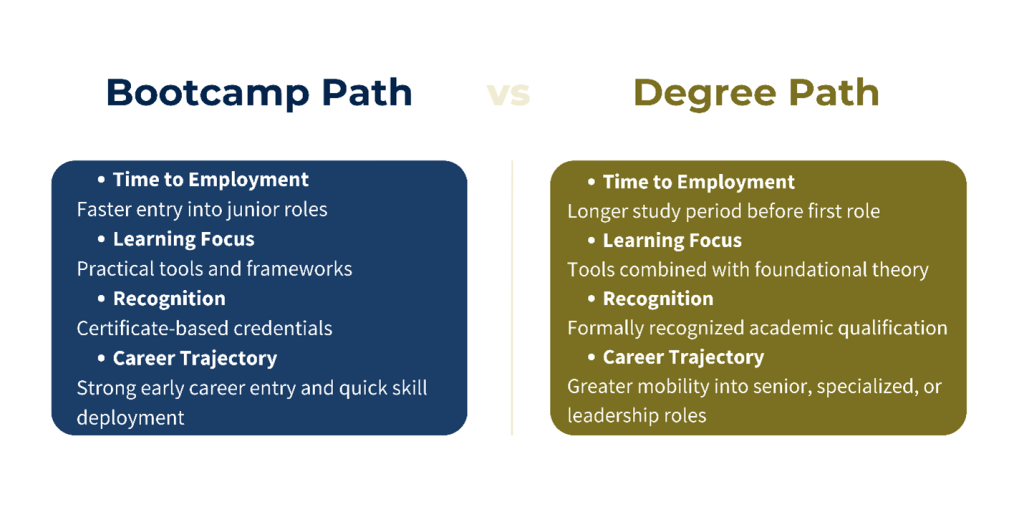
If speed to employment is the priority, then bootcamps clearly win because they help learners gain practical skills quickly. If broader knowledge that transfers across technologies and deeper recognition in corporate, government, or international roles is the goal, then formal degrees typically provide stronger long-term value. According to CourseCompare, degree graduates often enjoy greater flexibility as their careers progress, especially when moving into complex or cross-functional roles.
Limitations Facing Each Pathway
Bootcamp Limitations
- Limited academic recognition
Bootcamp credentials may not carry the same weight as formal degrees in some organizations, particularly for senior roles or international opportunities. - Narrow focus on specific tools
Training often centers on current technologies, which can limit exposure to broader computing principles needed for long-term adaptability. - May require further formal study later
Some learners pursue additional academic qualifications later in their careers to meet advancement or employer requirements.
Traditional Degree Limitations
- Longer time to complete
Traditional degree programs typically require several years of study before learners can fully enter the workforce, which can delay income and practical exposure. - Higher upfront cost
Degree pathways often involve significant tuition and related expenses that must be paid before career returns are realized. - Often limited integration with real work experience
Many traditional programs separate classroom learning from industry practice, leaving students with less hands-on exposure before graduation.
This creates a trade-off between speed and depth, which is especially challenging for working adults.
CLaaS2SaaS: A Hybrid Pathway That Combines Both
Instead of choosing one side in the software engineering degree vs bootcamp debate, CLaaS2SaaS is built to integrate the strengths of both pathways while minimizing their limitations.
CLaaS2SaaS stands for Competency Learning as a Service to Software as a Service, a model designed around how modern tech careers actually develop. Rather than separating education and employment into different stages, this approach allows learners to build skills, gain experience, and progress academically in parallel., this approach allows learners to build skills, gain experience, and progress academically in parallel.
Their work-study programs reduce risk by allowing learners to enter the workforce quickly without closing the door on academic recognition, senior roles, or international mobility. Instead of revisiting education later at higher cost, learners build credentials progressively as their career expands.
It combines:
- Applied, project-based learning
Learners develop technical capability by working on structured projects that reflect real development tasks, strengthening both confidence and job readiness. - Industry experience during study
Work exposure is integrated into the learning journey, allowing students to understand professional workflows, collaboration, and delivery standards while still studying. - Pathways toward a recognized Bachelor of Science degree
Learners are not limited to short-term certifications and can progress toward a formal academic qualification that supports long-term career mobility. - Flexible scheduling for working learners
The structure is designed to accommodate professionals balancing work, family, and education, reducing the need for career interruption - Personalized mentoring
Guidance is aligned with individual career goals, helping learners make informed decisions about specialization, progression, and professional development.
How CLaaS2SaaS Works in Practice
A typical CLaaS2SaaS pathway includes:
This approach improves fast track vs bootcamp outcomes because learners graduate with both experience and academic credentials. Fast-track outcomes are strongest when speed does not replace foundation, but compresses timelines without removing progression. - Applied Technical Training
Learners develop job-ready skills through guided project work. - Industry Integration
Students gain real experience while learning, building portfolios grounded in real use cases. - Academic Progression
Learners can progress toward a Bachelor’s degree, adding formal recognition. - Career Mentorship
Support focuses on long-term career direction, not just first-job placement.
Why Employers Prefer Lower-Risk, Work-Integrated Learning Models
In markets like Singapore, Philippines, Malaysia, Indonesia, where employers often balance skills-first hiring with formal qualification screening (especially in enterprise, finance, and government-linked sectors) academic recognition continues to influence promotion and mobility decisions. This makes long-term credential strategy particularly important for learners planning regional or global careers.
Employers increasingly look for professionals who combine:
- Practical experience
The ability to apply knowledge in real scenarios shows that a candidate can deliver outcomes, work within deadlines, and handle the complexities of real development environments. - Theoretical understanding
A strong foundation helps professionals make informed technical decisions, troubleshoot unfamiliar problems, and design solutions that scale beyond immediate tasks. - Adaptability
Technology evolves quickly, so employers value individuals who can learn new tools, shift between projects, and adjust to changing business or technical requirements. - Professional collaboration skills
Modern software development is team-based, requiring clear communication, cross-functional coordination, and the ability to contribute effectively within structured workflows.
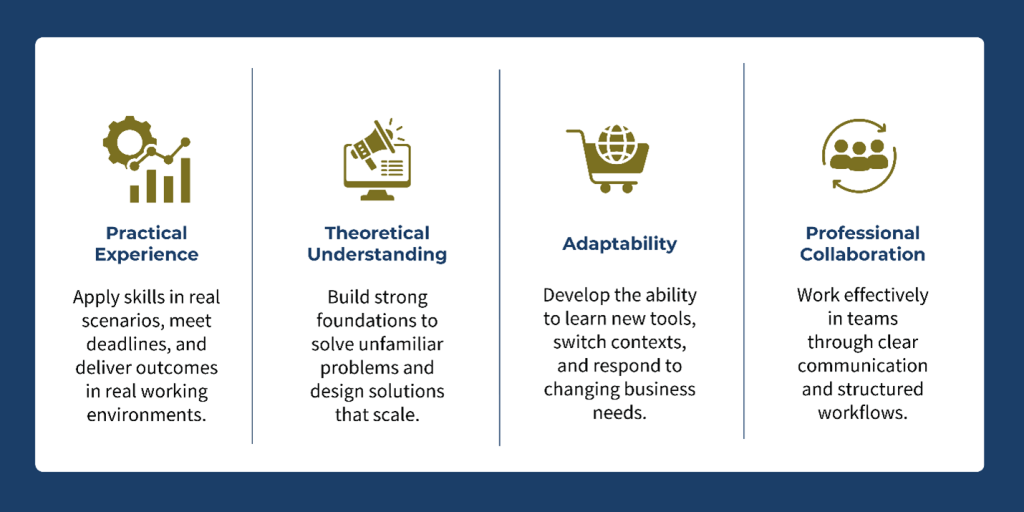
Graduates of integrated models can demonstrate both real-world application and structured learning. That balance supports stronger long-term career growth compared to single-track pathways.
Who Should Choose Which Path?
Bootcamp may be right if:
- You need immediate entry into the workforce
- You already hold a degree
- You plan to self-direct further learning
A work-integrated degree pathway is better if:
- You want recognized credentials
- You aim for senior or specialized roles
- You want balanced skill depth and practical experience
- You are planning for long-term mobility
Addressing Common Misconceptions
“Bootcamps are always cheaper”
They may appear more affordable at the start, but future education needs, credential upgrades, or specialized training can increase the total long-term investment.
“Degrees are too slow”
Modern work-integrated learning models allow learners to gain industry experience while studying, reducing the gap between education and employment.
“Employers only care about skills”
Skills matter for entry-level hiring, but long-term progression often depends on foundational knowledge, credibility, and recognized qualifications.
“You can learn everything online for free”
While free resources are valuable, structured programs provide guided progression, feedback, accountability, and recognized outcomes that self-study often lacks.
“Bootcamps guarantee jobs”
No learning pathway can guarantee employment, as career success depends on performance, adaptability, and market conditions.
Course
Conclusion
The software engineering degree vs bootcamp choice is not about which is easier. It is about which supports your career across decades.
Bootcamps help you enter. Degrees help you grow. A hybrid pathway like CLaaS2SaaS helps you do both at the same time.
Compare Learning Pathways
Explore how different learning routes compare in recognition, employability, and career progression and see how CLaaS2SaaS blends practical training with academic advancement for sustainable success.
Project Based Digital Marketing Course
Project Based Digital Marketing Course: Real-World Training That Builds Job-Ready Skills
SHARE THIS:
Digital marketing skills are in high demand, but many learners face the same challenge. They complete courses, earn certificates, and still feel unprepared to manage real campaigns. Knowing the theory is not the same as running live ads, optimizing funnels, or presenting performance results to stakeholders.
This gap exists because digital marketing is a practical discipline. Platforms change constantly. Tools evolve. Employers expect marketers who can execute, analyze, and adapt quickly.
That is why a project based digital marketing course has become the preferred learning model for career-ready professionals.
Instead of focusing on lectures alone, learners gain real experience through hands-on projects, live tools, and industry-style workflows. This article explains why project-based learning matters, how it works, and why CLaaS2SaaS offers a more effective pathway to digital marketing careers.
This Article Is For
This guide is designed for learners who want real outcomes, including:
If your goal is to move beyond theory and gain confidence working on real campaigns, this article will show you how project-based learning delivers measurable value. - Students and fresh graduates seeking practical experience
- Career switchers entering digital marketing from non-marketing roles
- Working professionals who want to upskill without leaving their job
- Entrepreneurs managing their own marketing channels
Why Traditional Digital Marketing Courses Often Fall Short
Many digital marketing programs still rely heavily on lectures, slides, and exams. While foundational knowledge is important, it rarely prepares learners for real-world execution.
Common limitations include:
- Minimal exposure to live tools and platforms
- Simulated case studies with predictable outcomes
- Limited understanding of analytics-driven decision making
Employers increasingly expect marketers to contribute from day one. According to LinkedIn’s marketing skills insights, modern marketers are expected to combine data literacy, automation, and multi-channel execution skills, not just content knowledge.
Without practical exposure, many graduates struggle to meet these expectations.
What Is a Project Based Digital Marketing Course?
A project based digital marketing course is designed around execution first. Learners build skills by working on real tasks that reflect industry demands.
Instead of passively consuming information, learners:
- Plan and execute live or simulated campaigns
- Work with real marketing tools and dashboards
- Solve realistic business problems under practical constraints
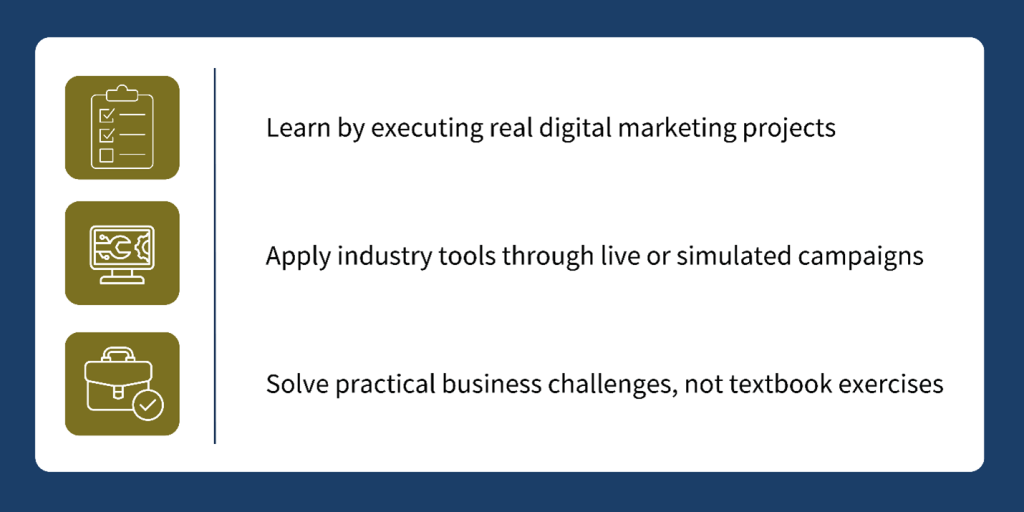
At CLaaS2SaaS, this model is strengthened through work-integrated learning. Projects are structured to reflect how marketing teams operate in real organizations, helping learners develop both technical and professional skills.
For example, learners may be tasked with launching a lead generation campaign for a simulated business, defining target audiences, setting budgets, running ads, and presenting performance insights based on real campaign data.
How Hands-On Digital Marketing Training Builds Real Capability
Hands-on digital marketing training ensures learners do not just understand concepts but can apply them confidently.
Learners actively practice:
- Campaign creation and optimization across digital channels
- Performance tracking using analytics and reporting tools
- Customer journey mapping through CRM and automation systems
This shift is reflected in industry hiring trends. LinkedIn reports that marketing roles increasingly require practical, cross-channel execution skills and continuous upskilling as platforms, data tools, and AI reshape the profession.
By learning through action, learners retain skills longer and adapt faster to new tools.
Real World Digital Marketing Bootcamp vs Traditional Learning
Traditional Digital Marketing Education
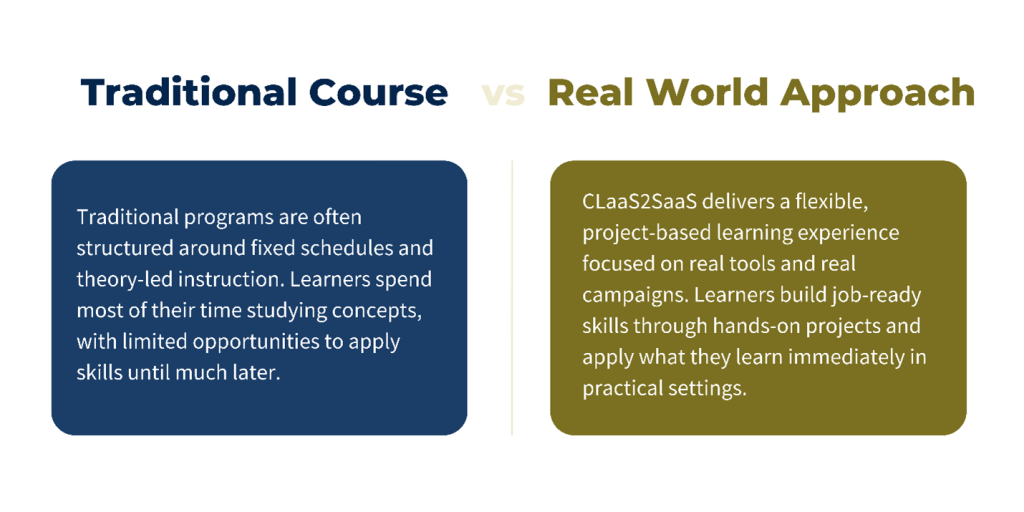
Traditional programs often involve long learning timelines and delayed application. Graduates may understand concepts but lack confidence using real platforms.
Typical challenges include:
- Heavy focus on theory over execution
- Limited portfolio development
- Additional training required after graduation
Real World Digital Marketing Bootcamp Approach
A real world digital marketing bootcamp prioritizes relevance, speed, and hands-on execution.
Learners benefit from:
- Project-based assessments instead of exams
- Direct exposure to real tools and workflows
- Portfolio-ready outputs that demonstrate competence
Unlike short bootcamps that focus on isolated tasks such as running ads or writing content, project-based learning emphasizes end-to-end responsibility, from campaign planning and execution to reporting and optimization. CLaaS2SaaS combines this bootcamp intensity with structured credentials, giving learners both practical experience and long-term career value.
How the CLaaS2SaaS Project-Based Learning Model Works
CLaaS2SaaS follows a skills-first, work-integrated approach designed for real employability.
Foundation Through Applied Learning
Learners start with core digital marketing concepts and immediately apply them through guided projects. This ensures understanding is reinforced through action.
Learners start with core digital marketing concepts and immediately apply them through guided projects. This ensures understanding is reinforced through action.
Industry-Aligned Projects
Projects increase in complexity and cover areas such as:
Projects increase in complexity and cover areas such as:
- SEO and paid advertising execution
- CRM setup and lead management
- Omni-channel campaign planning
- Marketing automation and analytics
Capstone and Portfolio Development
Learners complete a comprehensive capstone project that integrates multiple skills into a single campaign. This project forms part of a professional portfolio used for job applications and interviews.
Learners complete a comprehensive capstone project that integrates multiple skills into a single campaign. This project forms part of a professional portfolio used for job applications and interviews.
What You Actually Learn Through Project-Based Training
Project-based learning focuses on skills employers actively hire for.
Campaign Execution
Learners plan, launch, and optimize campaigns with real constraints such as budgets, timelines, and performance targets.
Data and Analytics
Projects require learners to interpret campaign data, identify insights, and make optimization decisions. This builds confidence in analytics-driven marketing.
CRM and Automation
Learners gain experience managing customer data, automating workflows, and supporting sales pipelines through CRM platforms.
Professional Workflow Skills
Beyond technical ability, learners develop collaboration, communication, and project management skills that reflect real marketing environments.
Who Benefits Most from a Project-Based Digital Marketing Course
Career Switchers
Hands-on projects help career switchers demonstrate capability even without prior marketing experience.
Working Professionals
Professionals can immediately apply what they learn at work, accelerating career growth without career disruption.
Entrepreneurs
Entrepreneurs gain direct control over marketing execution, allowing them to optimize performance and spending through data-informed decisions.
Why Employers Prefer Project-Based Graduates
Employers increasingly value demonstrable skills over theoretical credentials alone.
Project-based graduates stand out because they:
- Have experience using industry tools
- Understand end-to-end campaign workflows
- Require less onboarding and supervision
This shift reflects a broader skills-first hiring trend observed across global job markets. According to Statista, global digital advertising continues to grow rapidly, reinforcing the demand for marketers who can execute and optimize real campaigns across multiple channels.
For fresh graduates and career switchers, this practical exposure makes a critical difference at the hiring stage. Instead of relying on academic credentials alone, learners can point to completed projects, campaign results, and real tools they have already used. This helps entry-level candidates stand out in interviews and reduces the experience gap that often holds new graduates back.
How CLaaS2SaaS Supports Career Outcomes Beyond Training
CLaaS2SaaS goes beyond education by integrating career support into the learning journey.
Learners benefit from:
- Portfolio and career coaching
- Industry-aligned project experience
- Stackable credentials for long-term growth
- Access to employer and career networks
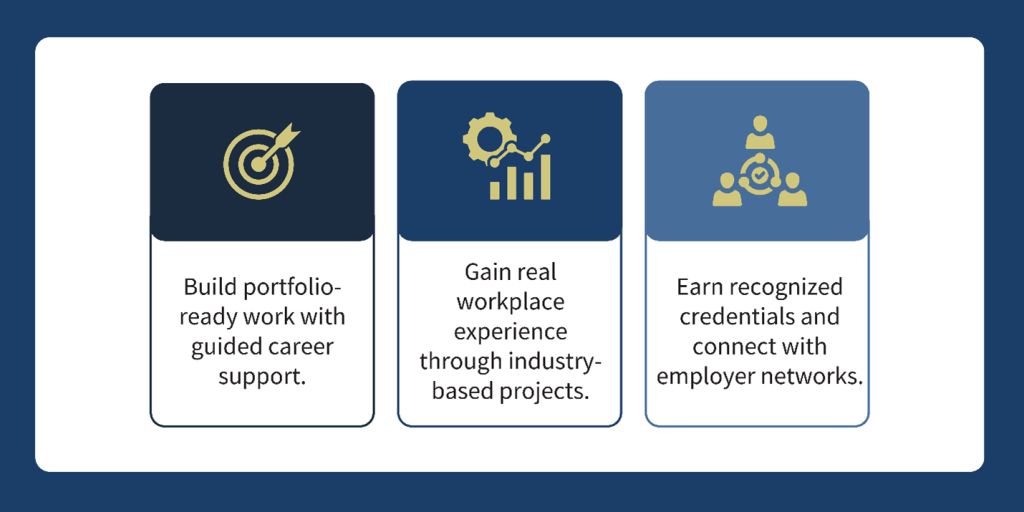
These portfolios allow learners to demonstrate real decision-making, not just outcomes, helping employers assess readiness beyond resumes and certificates. This ensures learners are prepared not just to finish a course, but to transition confidently into real roles.
Frequently Asked Questions
How long does a project-based digital marketing course take?
Program duration varies by pathway, with foundational programs typically completed within a few months and options to progress further.
Can I study while working full-time?
Yes. Programs are designed for flexibility, allowing working professionals to balance learning with existing commitments.
Is project-based learning suitable for beginners?
Yes. Projects are structured progressively, starting with fundamentals and advancing toward full campaign execution.
Does project-based learning remove theory entirely?
No. Theory supports execution and is taught in context, ensuring learners understand both the why and the how.
Course
Start Building Real Digital Marketing Skills Today
Digital marketing rewards professionals who can execute, adapt, and deliver measurable results. Theory alone is no longer enough.
A project based digital marketing course offers a faster, more practical path to industry readiness. By combining hands-on digital marketing training with a real world digital marketing bootcamp approach, CLaaS2SaaS helps learners build confidence through real execution.
If you are ready to move beyond certificates and develop real capability, now is the time to take action.
Guide to Global Economy
International Bachelor's Digital Business: Guide to Global Economy
SHARE THIS:
Choosing a degree today feels risky.
Students worry about graduating without getting a job. Parents worry about spending years and money on programs that do not deliver real-world value. Working learners struggle to balance education with employment while still trying to move their careers forward
This anxiety is not imagined. The global education landscape has evolved significantly, but it still faces many challenges. Degrees alone no longer ensure employability. Skills, experience, and the ability to contribute immediately now matter just as much as academic credentials.
That’s why international digital business bachelor options are becoming an increasingly popular choice for students around the world
This article explores how international digital business degrees are evolving, how global models differ, and why applied, work-integrated pathways are becoming increasingly relevant, especially in Asia and Singapore.
The International Degree Landscape
Around the globe, digital business education is growing rapidly. Traditional university programs have long been the standard for acquiring higher education, but as the digital economy expands, students are increasingly seeking international digital business bachelor options that offer more than just academic theory alone.
From Singapore to Europe, the demand for digital business degrees is at an all-time high, driven by rapid technological advancements, e-commerce, and digital transformation. Whether you’re looking to study in Singapore or pursue an international bachelor digital business degree in Europe or Asia, the flexibility and global applicability of these programs are key drivers of their popularity.
These programs typically focus on:
- Global digital marketing strategies
- E-commerce solutions
- Digital transformation tools
- Tech-driven business management
As businesses continue to evolve, an international bachelor digital business degree can open doors to global opportunities. However, international reach alone does not guarantee relevance. Increasingly, students and employers are evaluating degrees based on how well they translate into real-world capability.
This is where many traditional international degree models begin to show their limits.
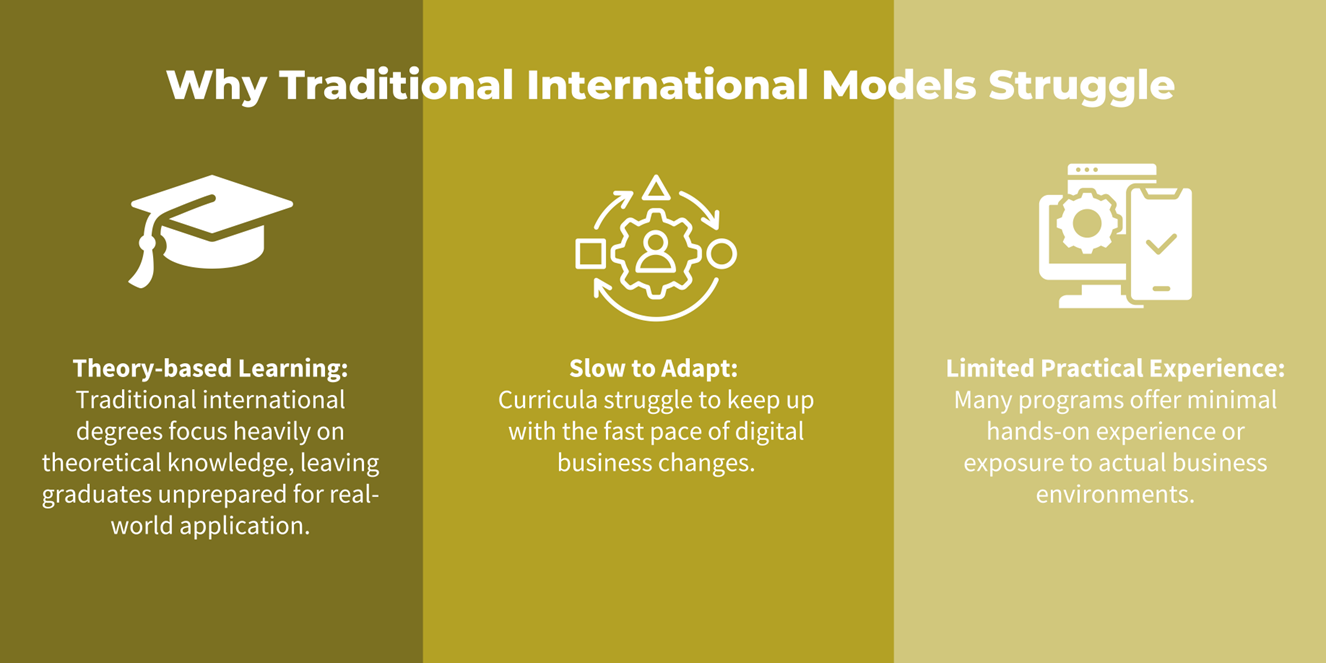
Why Traditional International Models Struggle
While many programs share similar titles, the learning experience and outcomes differ significantly. Traditional international bachelor’s degree programs often focus heavily on theory, providing students with strong academic foundations but leaving them unprepared for the real-world application of their knowledge.
As the digital business landscape evolves, these models struggle to keep up with the rapid pace of technological change and the need for practical experience.
Many international business programs:
- Rely on static or slow-to-update curricula
- Offer limited real-world exposure
- Provide minimal practical experience in actual business environments
For students aiming for international digital business bachelor programs, these gaps create a challenge. As the global digital economy matures, students are evaluating international degrees not just by geography or prestige, but by how effectively they prepare graduates for real digital business roles.
Graduates often find themselves needing to catch up in the workforce. Despite having a prestigious international degree, many employers must still invest time and resources to close skills gaps. This mismatch creates frustration for learners and inefficiency for employers.
These limitations are not execution issues alone, they reflect structural constraints in traditional degree design. This gap has driven interest in more applied and work-integrated degree structures.
Work-Study: The Evolved Global Pathway
Work-study programs, which integrate applied learning with formal education, have evolved as a response to the challenges posed by traditional international models. By combining digital business education with real-world work experience, work-study degrees prepare students for immediate success in the global workforce.
In digital business education, this approach allows students to:
- Apply concepts while learning them
- Work with real tools used by modern organisations
- Develop professional habits alongside academic knowledge
Rather than treating work as something that happens after graduation, applied pathways integrate learning and execution throughout the degree journey. This evolution reflects changing employer expectations and the realities of digital-first industries.
What Is an International Digital Business Bachelor Degree?
An international work-study digital business bachelor’s degree blends academic study with structured, real-world experience, preparing graduates to operate confidently in the global digital economy.
The work-study model works especially well in the digital business field, where practical skills in digital marketing, e-commerce, and business analytics are in high demand. Students engage with the latest digital tools, like Google Ads, CRM software, and AI-driven analytics, during their studies, applying them to live business projects.
In a work-study model:
- You study part-time
- You work full-time or complete a structured apprenticeship
- Your work experience directly supports your academic outcomes
This approach ensures that what you learn in class is immediately applied in a real business environment. Concepts are not memorized for exams and forgotten later. They are practiced, tested, and refined on the job. This means graduating with both a recognized qualification and a year of relevant experience. And since it’s international, this also means that degree provides worldwide recognition and global employability.
Why Work-Study Is Replacing Traditional Degrees
The shift toward work-study education is driven by employer demand.
Hiring priorities have shifted away from academic results alone toward practical, job-ready skills. Employers increasingly look for graduates who can contribute from day one, adapt quickly to new tools, and operate confidently in real workplace environments. According to the World Economic Forum, hands-on experience and applied digital skills are now among the most critical factors influencing graduate employability in the modern labour market.
Traditional degrees often fall short because:
- Students graduate with little to no practical experience
- Skills taught may not align with current digital job requirements
- Employers must invest time and resources retraining new hires
This gap creates frustration for graduates and employers alike. Applied and work-integrated degrees respond directly to this demand. By graduation, learners are not starting from zero, they have context, experience, and confidence.
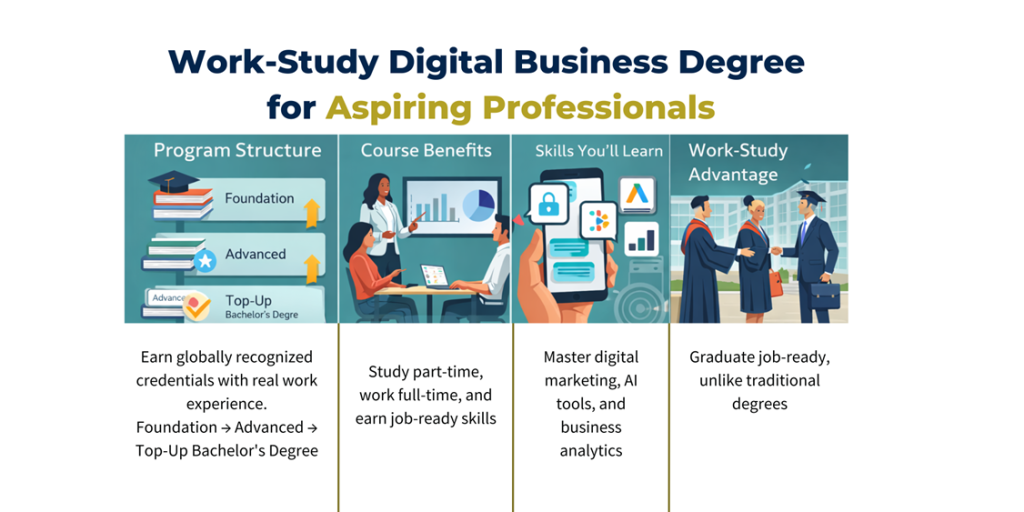
Digital Business Degree Singapore and Asia
A digital business bachelor from a reputable institution can open doors to a multitude of opportunities in Asia. As businesses in Singapore and across the continent adopt more digital tools and strategies, demand is rising for graduates who combine business understanding with digital execution.
For students aiming to build careers in Asia’s digital economy, the CLaaS2SaaS international bachelor digital business program is the ideal foundation for long-term success. The program offers a pathway designed to match regional growth velocity with global employability standards.
The digital economy in Asia is booming, and businesses across industries are increasingly investing in technology, digital marketing, and e-commerce. With this degree, you’ll be prepared to work in the most exciting, fast-paced industries around the globe.
What You Learn While You Work
The CLaaS2SaaS bachelor’s degree in digital business earned through work-study focuses on execution rather than rote learning.
While completing a work study digital business degree, students develop capability in:
- Digital marketing strategy and execution
- Customer journey and funnel optimisation
- CRM and workflow automation using tools like HubSpot
- Paid advertising across Google and social platforms
- Business analytics and performance reporting
- AI-enabled productivity using tools such as ChatGPT and Copilot
Because learning happens alongside employment, concepts are reinforced daily. Mistakes become learning opportunities. Confidence grows through real responsibility.
This applied learning model explains why employers increasingly prefer work-study graduates over those with purely academic backgrounds.
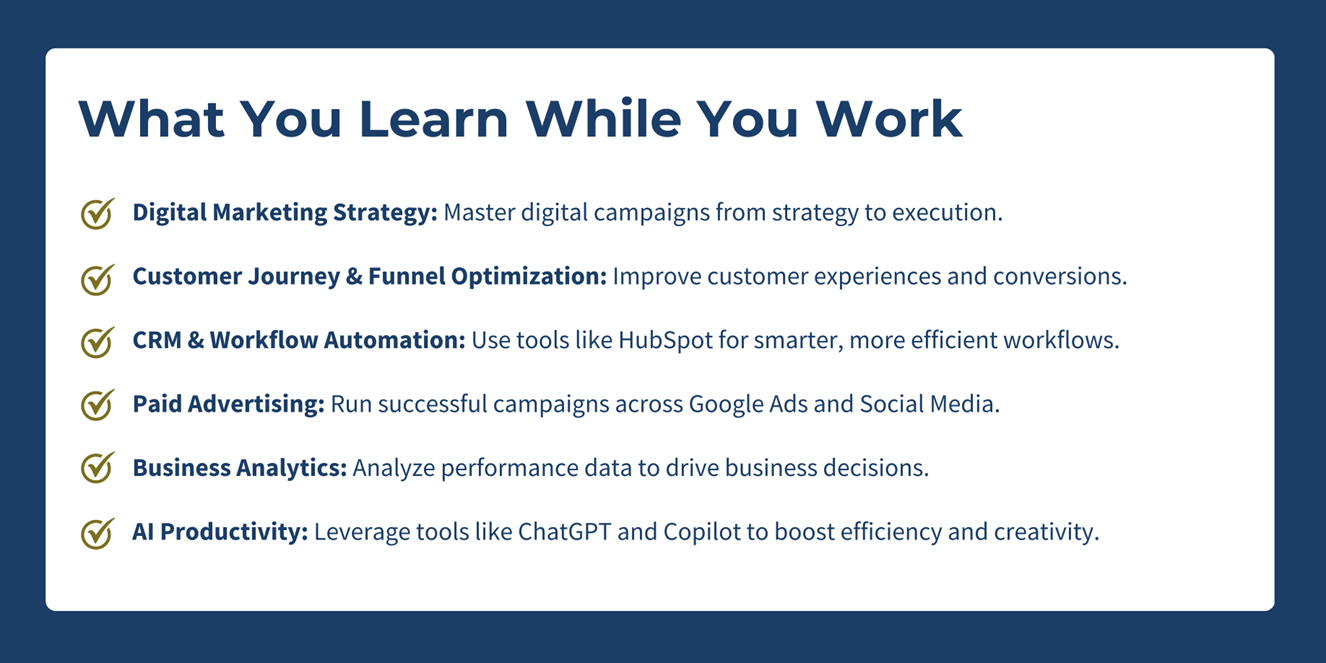
Why Employers Value Work-Study Graduates
From an employer’s perspective, hiring a work-study graduate reduces uncertainty.
These graduates already understand:
They do not require months of onboarding before becoming productive. A work study digital business degree functions not just as a credential, but as a signal of real-world readiness, that a candidate can balance responsibility, learn quickly, and perform under real conditions. - Professional communication standards
- Accountability, deadlines, and teamwork
- Industry-standard digital tools and workflows
Key Benefits of a Work Study Digital Business Degree
Career Advantages
Graduates benefit immediately from:
Instead of explaining hypothetical knowledge, students can discuss real projects, campaigns, and outcomes. Graduates benefit immediately from:
- One year or more of real work experience
- Stronger resumes and professional portfolios
- Greater confidence during interviews
Financial Advantages
Work-study programs reduce financial pressure because:
Work-study programs reduce financial pressure because:
- Students earn income while studying
- Reliance on student loans is reduced
- Return on investment is achieved faster
Long-Term Value
Beyond graduation, work-study graduates gain:
Beyond graduation, work-study graduates gain:
- Industry-aligned, future-ready digital skills
- Professional networks built during study
- Better career mobility across sectors
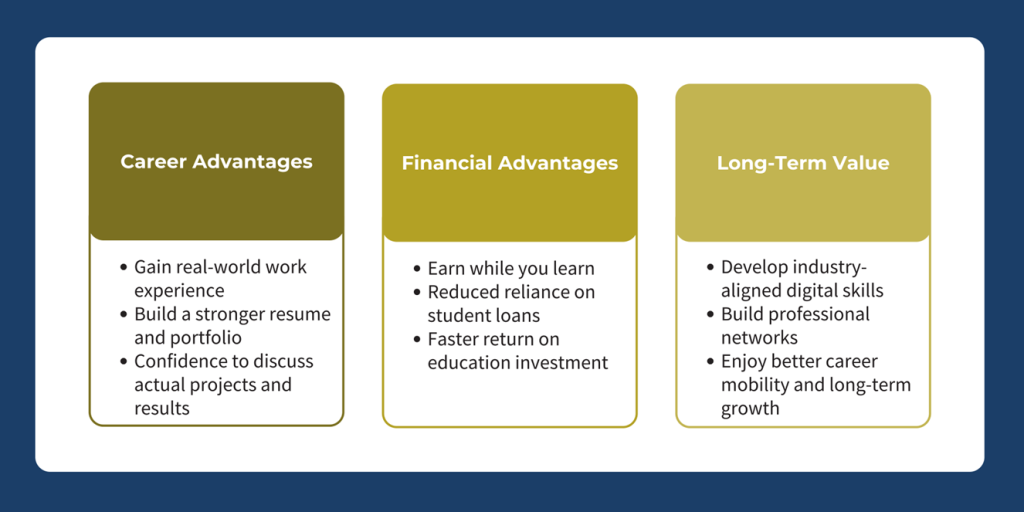
Understanding the 2-Year Bachelor Pathway in Digital Business
Fast-track digital business programs differ from traditional universities.
Rather than fixed semesters and extended timelines, these programs are modular and stackable. Students progress through recognized credentials while remaining career-focused.
Overview of the Program Structure
Foundation Diploma (Optional)
Build confidence in business fundamentals, communication, and digital literacy.
Build confidence in business fundamentals, communication, and digital literacy.
Advanced or Higher Diploma
Move from theory into execution using real tools and applied projects.
Move from theory into execution using real tools and applied projects.
Top-Up Bachelor’s Degree (Work-Study Year)
Graduate with a bachelor’s degree and significant work experience.
Graduate with a bachelor’s degree and significant work experience.
This structure allows students to advance efficiently while reducing academic and financial risk.
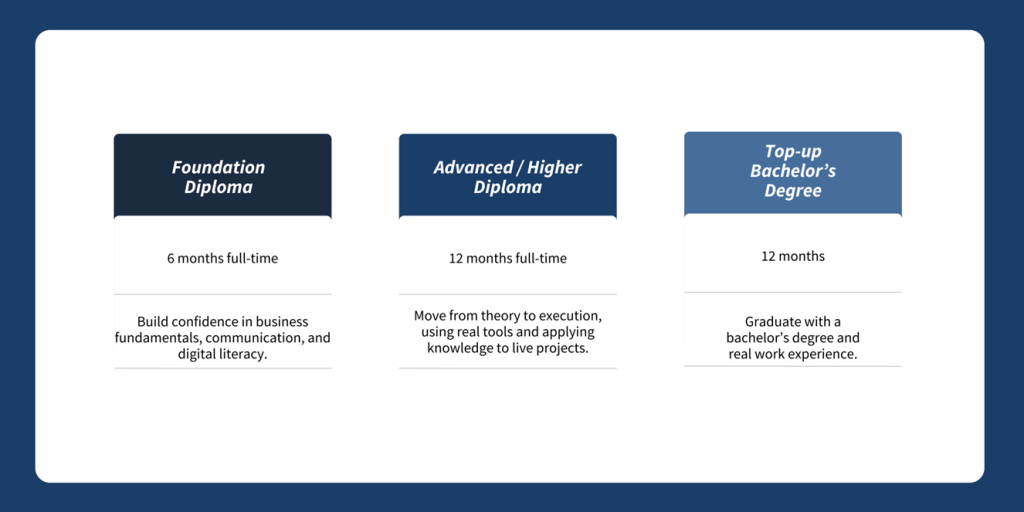
Who Should Choose This Path?
A work study digital business degree is ideal for learners who want certainty and momentum.
– Students Who Want Clarity
They see the connection between education and employment in real time.
They see the connection between education and employment in real time.
– Parents Seeking ROI-Driven Decisions
Work-study reduces financial risk while improving employability.
Work-study reduces financial risk while improving employability.
– Learners Who Thrive in Hands-On Environments
Applied learning builds competence faster than exams alone.
Applied learning builds competence faster than exams alone.
If relevance, employability, and global mobility matter, this pathway is worth serious consideration.
Realistic Use Case: Student vs Traditional Graduate
Traditional Path:
4 years of study → limited experience → entry-level job hunt
Traditional graduates often face delayed employability and additional retraining.
Work-Study Path:
2 to 2.5 years of study → 1 year of work experience → job-ready graduate
Work-study graduates finish with real outcomes, stronger resumes, and faster career momentum.
FAQs: Work Study Digital Business Degree
Is the degree internationally recognised?
Yes. The bachelor’s qualification carries global credibility.
Can I work full-time while studying?
Yes. Many students begin with a Foundation Diploma.
Do employers really value a work-study degree?
Yes. Work-study graduates arrive with practical tool knowledge, real project outcomes, and workplace readiness.
Course
Ready to Take the Work-Study Route?
If you are ready to earn an internationally recognised qualification while building real-world experience, now is the time to act. Your next step is to understand entry requirements and pathway options.
Discover how CLaa2SaaS upports students in meeting digital business degree requirements, gaining structured work experience, and graduating with skills employers actively seek.
Your Guide to Career Success
Blog
Digital Business Apprenticeship Bachelor Degree – Your Guide to Career Success
SHARE THIS:
An apprenticeship digital business bachelor is quickly becoming the smartest alternative to traditional university pathways for students who want real skills, real experience, and faster career outcomes.
In today’s competitive digital economy, employers are looking for practical, job-ready candidates who can start contributing from day one, not graduates who need years of additional training after finishing school.
Traditional degrees often leave students unprepared for the fast-paced, ever-changing digital business landscape. That’s why programs like CLaaS2SaaS’ Work-Study Digital Business Degree are designed to combine academic learning with real industry execution.
This article will provide everything you need to know about this exciting program — from how it works to why it’s gaining popularity as one of the best digital business bachelor programs available today.
Why Choose a Digital Business Apprenticeship Bachelor Degree?
The demand for digital business professionals is rising at an exponential rate, but a common bachelor’s degree programs aren’t evolving quickly enough to meet the needs of employers.
By the time a student completes a four-year degree, the skills they’ve learned may already be outdated. This is especially true in industries that depend on technology, marketing platforms, and data analytics, where things evolve rapidly.
That’s where a Digital Business Apprenticeship bachelor’s degree comes in. This program is designed to give you the skills and real-world experience you need to succeed in a digital business career, while allowing you to graduate in just a few years, fully prepared for the job market.
If you’re someone who values efficiency, hands-on learning, and career-driven outcomes, this apprenticeship bachelor’s degree could be the perfect fit for you.
This mismatch isn’t limited to tech companies; every industry now relies on digital channels to communicate, sell, and grow. Employers aren’t looking for graduates who can write essays about digital strategy.
They’re looking for people who can launch campaigns, analyze performance, automate workflows, and adapt quickly, skills that many traditional degrees do not sufficiently provide. Research on workforce digital needs shows that workforces often do not have the skills needed to manage digital transformation, leaving businesses struggling to find qualified talent.
What Is an Apprenticeship Digital Business Bachelor Pathway?
An apprenticeship digital business bachelor pathway is a modern approach to earning a recognised degree while gaining real industry experience at the same time.
Instead of spending years learning business concepts only through lectures and exams, students build practical digital skills through hands-on training, applied projects, and workplace exposure.
This is exactly the model behind CLaaS2SaaS’ Work-Study Degree in Digital Business, a structured program designed to help students graduate faster while becoming job-ready in today’s digital economy.
Through this work-study format, learners don’t just study digital business in theory. They actively develop capabilities in areas like:
- Digital marketing execution
- E-commerce operations
- Business automation workflows
- Data-driven decision-making
- Digital transformation strategy
The result is a degree pathway that prioritises employability, relevance, and real outcomes, not just classroom learning.
Traditional Degree vs Digital Business Apprenticeship Degree
Digital roles are growing faster than universities can redesign their curriculum. In fact, the majority of jobs today require digital skills, yet many workers don’t have them — creating a persistent digital skills gap employers struggle to fill. According to a report by the National Skills Coalition, 92% of jobs now require digital skills, but a significant share of workers lack foundational competencies necessary for modern work.
Traditional Business Degree
A traditional business degree generally takes 4 years to complete and focuses heavily on academic theory. Students typically spend most of their time in classrooms, learning about management, economics, and business practices.
While this degree provides foundational knowledge, it often lacks the practical, hands-on experience needed for the modern digital business world.
Graduates may find themselves needing additional training or experience to qualify for roles in digital marketing, data analytics, or e-commerce.
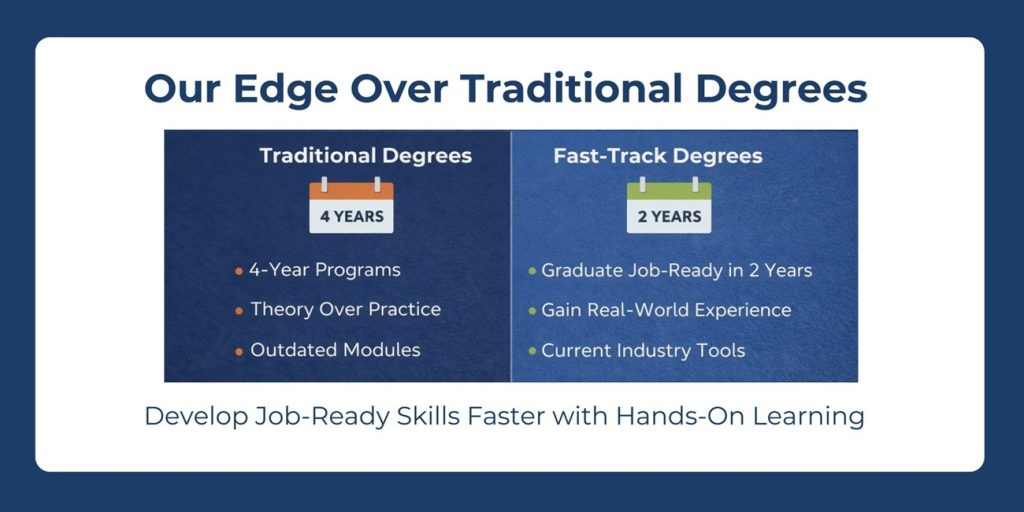
Digital Business Apprenticeship Pathway
A digital business apprenticeship is more than a study format, it is a strategic model for career acceleration.
Instead of separating education and employment into two disconnected stages (study first, work later), the apprenticeship model integrates them from the start. Students build digital business capability while actively operating in real workplace environments.
This matters because digital careers are not built through theory alone. They are built through execution, repetition, and exposure to the tools and workflows businesses actually use. That is why CLaaS2SaaS’ Work-Study Degree in Digital Business is designed around a simple principle:
You don’t become job-ready after graduation; you become job-ready during the degree.
Rather than treating work experience as an optional internship, this pathway embeds employability into the learning journey itself.
Graduates leave with:
- Applied digital skills, not just academic knowledge
- Portfolio-level experience employers can evaluate
- Industry familiarity that reduces the “first job” gap
How the Work-Study Digital Business Degree Works
The work-study structure is intentionally built to move students from foundational learning into real digital execution, step by step.
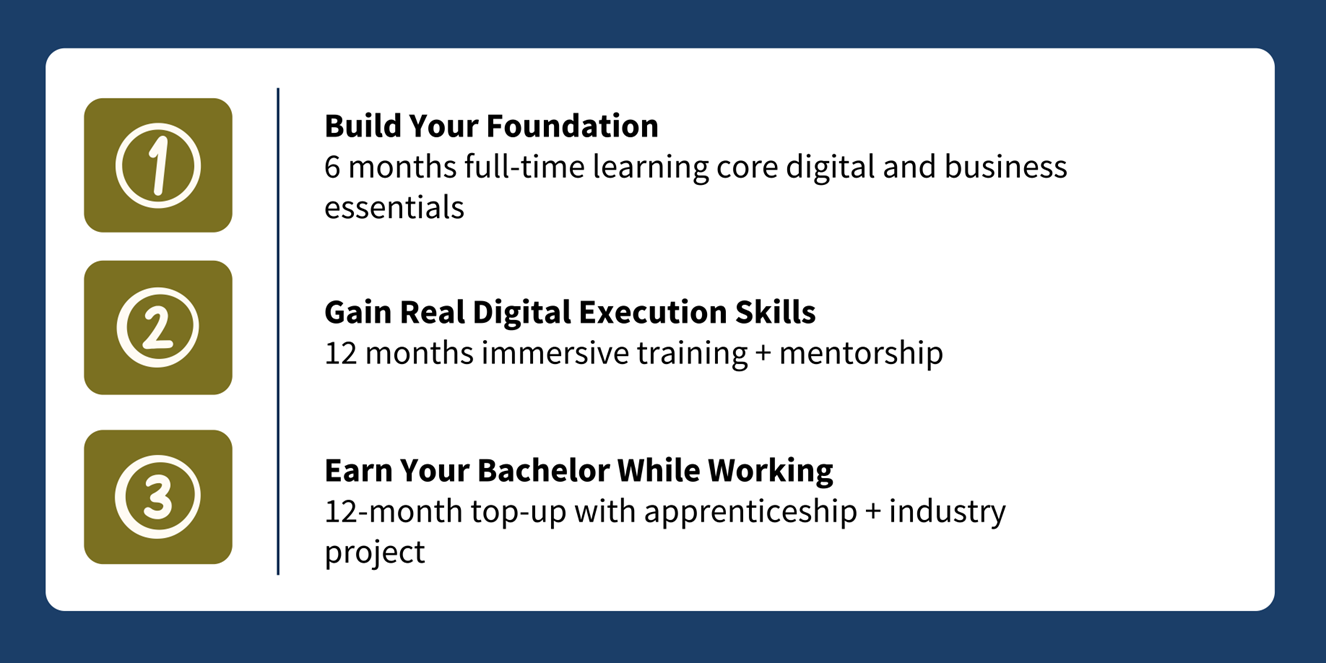
This is not about rushing content; it is about sequencing learning in a way that mirrors how digital professionals grow in the workplace.
Typical Program Structure
Foundation Phase (Optional)
For students who need preparation, this stage builds core business confidence, communication ability, and digital literacy before moving into applied work.
Advanced Phase
Students transition into execution. They begin applying digital business concepts through real tools, platforms, and business challenges developing competence in areas such as:
- HubSpot and CRM workflows
- Google Ads and campaign fundamentals
- WordPress and digital content operations
This is where students start building the skills employers actually hire for.
Top-Up Bachelor Phase
The final stage bridges qualification and employability. Students complete their bachelor-level learning while continuing to gain meaningful industry exposure.
By graduation, learners do not just hold a degree, they hold experience, evidence, and workplace readiness.
This is what makes the apprenticeship pathway not just faster, but strategically stronger than common routes.
What You Actually Learn in the Digital Business Apprenticeship Degree
A major advantage of the Digital Business Apprenticeship Bachelor Degree is that students are taught not just theory, but practical skills that are immediately applicable to their careers. The program covers:
These skills are not just nice-to-have; they are essential for many modern digital roles, making graduates of this program highly competitive in the job market. - Digital Business Strategy: Learn how to create, implement, and evaluate digital strategies for business growth.
- Data Analytics: Understand how to analyze and use data to make business decisions.
- E-commerce Management: Gain hands-on experience in managing online business operations and sales strategies.
- Technology Integration: Learn how to use tools like CRM systems and automation platforms to streamline business operations.
Career Outcomes That Make This Program Worth It
Employers are no longer hiring based on how long you studied; they’re hiring based on what you can actually do. Graduates of the Digital Business Apprenticeship Bachelor Degree are well-prepared for roles such as:
- Digital Business Consultant
- E-commerce Manager
- Data Analyst
- Digital Marketing Strategist
These roles are in high demand, and having real-world experience combined with a Bachelor’s degree makes these graduates highly attractive to employers.
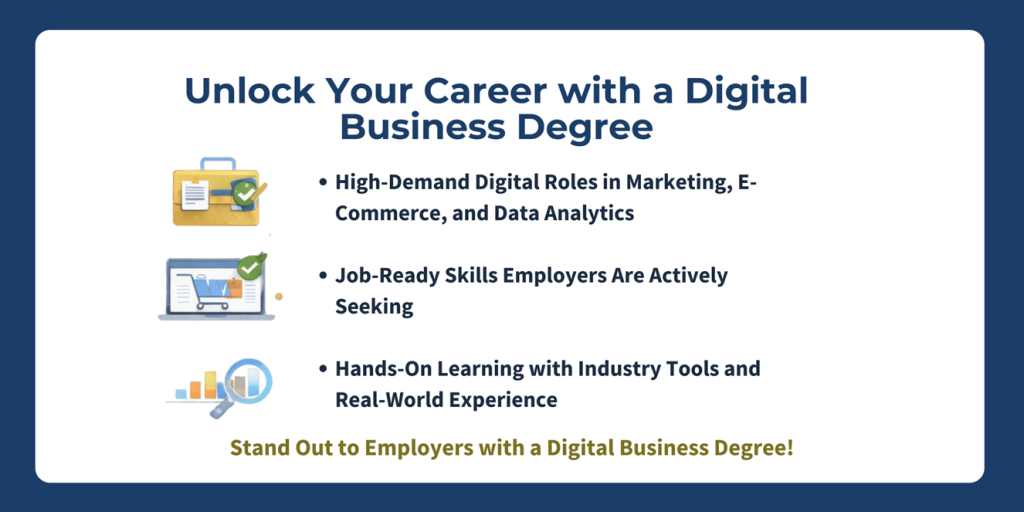
Why Employers Prefer Work-Study Digital Business Graduates
Employers don’t hire based on degree titles alone anymore, they hire based on skills, readiness, and real experience.
Digital business roles evolve too quickly for companies to spend months retraining graduates after they enter the workforce. Hiring managers increasingly prioritise candidates who can contribute immediately with applied platform knowledge and workplace confidence.
According to the LinkedIn Workplace Learning Report, businesses are shifting toward skills-based hiring, with adaptability and practical digital capability ranked among the most valuable traits in new graduates.
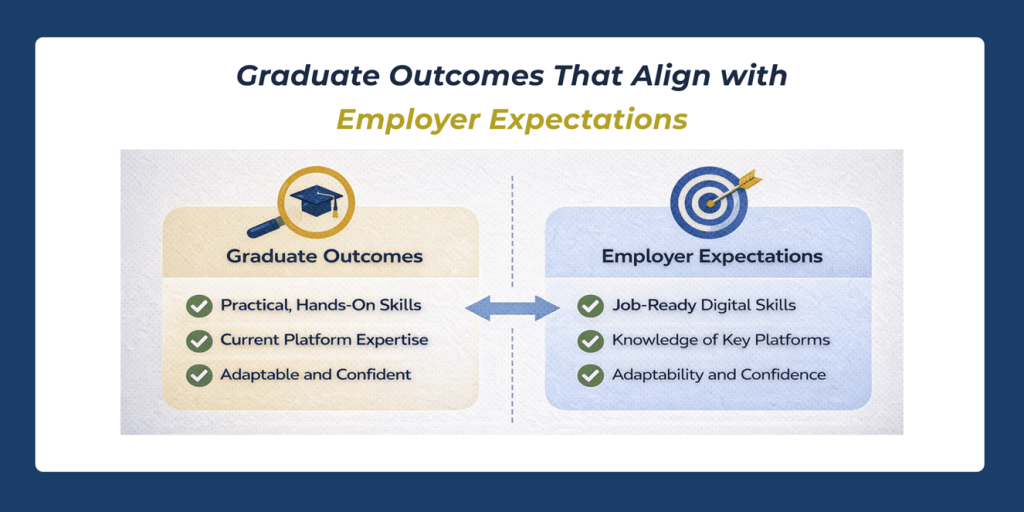
That’s why work-study pathways like CLaaS2SaaS’ Work-Study Degree in Digital Business stand out.
Instead of graduating with only theoretical knowledge, students graduate having already gained experience through:
- Real industry projects
- Exposure to digital tools and business workflows
- Applied learning that mirrors employer expectations
For employers, this means less onboarding time, faster productivity, and graduates who are prepared to operate in real digital business environments from day one.
In a market where digital skills change rapidly, work-study graduates offer something traditional degrees often cannot: immediate relevance and proven capability.
Addressing Common Misconceptions
“Is a fast-track degree less credible?”
No. The credibility of the degree comes from accreditation and academic standards, not the length of the program. The Digital Business Apprenticeship Bachelor Degree is awarded by recognized institutions and meets rigorous academic requirements.
No. The credibility of the degree comes from accreditation and academic standards, not the length of the program. The Digital Business Apprenticeship Bachelor Degree is awarded by recognized institutions and meets rigorous academic requirements.
“Does finishing faster mean learning less?”
Not at all. Fast-track programs remove inefficiencies and focus learning on what’s relevant and practical, ensuring that students gain the skills needed for the modern digital job market.
Not at all. Fast-track programs remove inefficiencies and focus learning on what’s relevant and practical, ensuring that students gain the skills needed for the modern digital job market.
Who Should Consider a Digital Business Apprenticeship Degree?
This program is ideal for individuals who want a focused, career-driven education in digital business. If you value efficiency, skills over theory, and outcomes over tradition, then this is the right path for you.
Is This Path Right for You?
If you’re ready to fast-track your career in digital business and gain the skills employers want, the Digital Business Apprenticeship Bachelor Degree is an excellent choice. With a blend of academic learning and hands-on experience, this program is designed to get you ready for the job market faster than traditional degrees.Course
Start Your Digital Business Career Now!
The digital economy moves quickly, and the sooner you start building your career, the better. The Digital Business Apprenticeship Bachelor Degree provides an efficient and practical path to career success. Apply today and take the first step toward building your future in digital business!
How to Fast Track Digital Marketing Certification Online
Blog
How to Fast Track Digital Marketing Certification Online - Full Course

SHARE THIS:
Let’s be real. Digital marketing is changing fast. By the time many professionals finish a traditional degree, the tools and strategies they learned early on are already outdated. Platforms evolve quickly. AI tools update weekly. Consumer behavior shifts constantly. Businesses are not waiting for education to catch up. They need marketers who can adapt quickly and deliver results now.
According to ResearchAndMarkets, the digital advertising market in Asia-Pacific is projected to reach $2.8 trillion by 2031, growing at 13.25% annually. Demand for skilled digital marketers is rising fast, and companies need job-ready talent immediately.
This increase isn’t simply happening in huge IT companies. Digital channels are being used by every business to sell, talk to customers, and develop trust. In hospitals, banks, schools, stores, and many other areas, it’s important to know how to use digital marketing.
If you want to jumpstart your career without spending years in school, a fast track digital marketing certification is one of the fastest ways forward. In just 4 months, you can build real skills that employers value today.
This article is for:
This guide is designed for lifelong learners who want career growth without delay, including:
- Aspiring marketers looking for a career change
- Professionals who want to upskill through an accelerated digital marketing program
- Working adults who want practical training without stepping away from their job
Fast-track certifications are especially useful for people who feel stuck in their current role or want to move into a future-proof industry. Instead of waiting years for a traditional qualification, you can gain job-ready expertise in months.
Why a Fast Track Digital Marketing Certification Matters Now
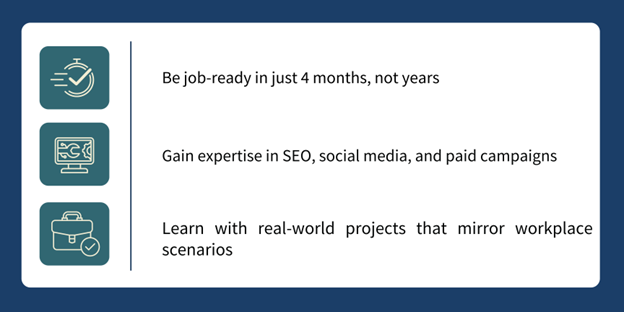
Digital marketing is no longer optional.
Every industry relies on SEO, social media, email marketing, content strategy, and AI-powered tools to reach customers. Marketing teams need professionals who can execute quickly and work across multiple channels.
Marketers these days have to do more than just make content. They need to know about data, automation, customer journeys, and how to measure performance. Employers want people who can start campaigns, keep track of results, and change their plan on the go.
LinkedIn’s Fall Marketing Jobs Outlook highlights that marketing is changing faster than ever. Professionals must stay agile, build diverse skill sets, and continuously upskill as AI reshapes the industry (LinkedIn, 2025).
Traditional degrees often struggle to keep pace. They move slowly while the industry moves daily.
A fast track digital marketing certification solves this gap by focusing on practical, job-ready skills that match what employers need right now.
That is why an accelerated digital marketing program helps professionals become employable in months, not years.
What is a Fast Track Digital Marketing Certification?
A fast track digital marketing certification is a focused and intensive digital marketing training program designed to teach real-world skills in a short timeframe.
Instead of waiting years for a degree, you learn the tools and strategies that matter most today.
In just 4 months, you’ll:
- Learn tools like Google Ads, Google Analytics, HubSpot CRM, and AI content platforms
- Work on real-world projects that simulate industry campaigns
- Build hands-on experience in SEO, email marketing, social media, and automation
This is not theory-based learning. It is practical training built for immediate career impact. Fast-track programs are built around execution. You do not just learn what digital marketing is. You learn how to apply it in real business environments.
Traditional Degree vs. Full-Stack Conversational Marketing Certification
The gap between traditional marketing degrees and fast track certifications is obvious:
Traditional Programs:
- Often take several months or years to complete, delaying your career progress
- Focus heavily on academic theory and may lack practical, hands-on experience with real tools
- Many graduates find they need additional upskilling or training to meet the fast-evolving demands of the marketing industry
- Traditional courses can be rigid, with limited flexibility for working professionals or career changers
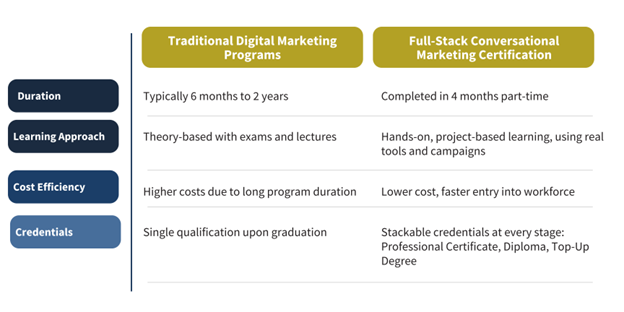
Full-Stack Conversational Marketing Certification (CLaaS2SaaS):
- Completed in as little as 4 months, allowing you to enter the workforce faster
- Offers intensive, hands-on digital marketing training, with real-world projects using tools like Google Ads, HubSpot CRM, SEO, and social media marketing
- Prepares you with job-ready skills that can be immediately applied to real campaigns
- Focuses on speed, relevance, and employability, helping you stay competitive in today’s fast-paced marketing environment
How the Full-Stack Conversational Marketing Certification Works
The Full-Stack Conversational Marketing certification is designed to serve as a Fast Employability Engine, equipping you with the skills and experience needed to accelerate your digital marketing career. Here’s how it works:
1. Professional Certificate – Gain job-ready digital marketing skills fast by covering key fundamentals like campaign management, automation tools, and hands-on execution. This certificate helps you enter the workforce quickly, ready to handle SEO, Google Ads, content marketing, and more.
2. Professional Diploma – Strengthen your expertise through real industry projects and expert mentoring in content creation, CRM, omni-channel strategies, and AI-driven marketing. By the end of this stage, you’ll be prepared to apply your knowledge immediately in a workplace setting.
3. Top Up Degree – The final stage provides an accredited international master’s qualification, enhancing your leadership abilities in advanced digital marketing strategies, branding, and applied research. You’ll gain a competitive edge in senior roles with a globally recognized qualification.
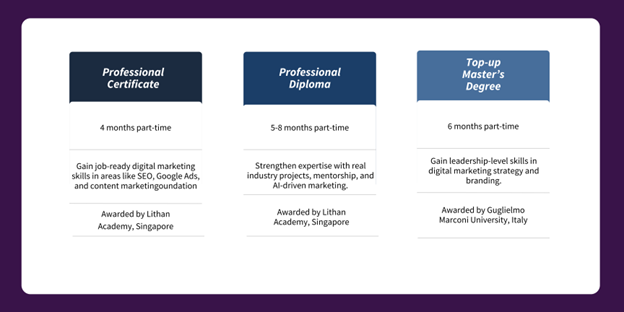
Stackable Pathway for Lifelong Learners
The Full-Stack Conversational Marketing program ensures you’re not just learning about digital marketing but learning how to do it with practical experience, real projects, and industry-recognized certifications that make you job-ready.
This stackable pathway offers lifelong learners flexibility. You can start with the Professional Certificate, enter the workforce, and continue earning credentials through the Professional Diploma and Top-Up Degree as you advance in your career.
With the Fast Employability Engine approach, you can upskill at your own pace while building the credentials needed to progress without the long timelines of traditional programs
What You Actually Learn (Not Just Theory)
This certification program is focused on real-world skills. Here’s what you’ll actually learn:
These are the skills employers are hiring for today, not years down the road. - Google Ads and social media campaigns: Learn how to create and optimize campaigns.
- CRM systems like HubSpot: Gain experience managing customer relationships and optimizing sales funnels.
- SEO and Analytics: Learn to track and optimize marketing campaigns.
- AI tools: Learn how to automate marketing processes using the latest technology.
Career Outcomes That Justify the Fast Track
The goal of this certification is simple: get you hired. Upon completion, you’ll be ready for roles such as:
These are real roles that employers are hiring for right now, and you’ll have the skills and hands-on experience to do them. - Digital Marketing Executive
- SEO Specialist
- Content Strategist
- Social Media Manager
- E-commerce Campaign Manager
Why Employers Prefer Fast-Track Graduates
Employers want someone who can get things done quickly. Fast-track graduates have the skills they need since they have already used the tools and methods that businesses use today. Fast track graduates:
In a job market where skills and experience are everything, fast-track graduates are ahead of the curve. Employers increasingly value capability over credentials alone. They want proof that you can execute. - Have hands-on experience with real tools like Google Ads and HubSpot CRM.
- Are prepared to hit the ground running with minimal training.
- Have worked on real-world projects, showcasing their ability to deliver results.
Start Your Journey Now!
Are you ready to take your career into your own hands? A fast track digital marketing certification gives you the skills and experience you need to land a job in 4 months.
Stop waiting for traditional degrees to catch up with the digital world. Take charge of your future and become a job-ready digital marketer today.
Course
Frequently Asked Questions
How long does a fast-track digital marketing certification take?
Most learners complete the professional certificate in 4 months, with options to progress toward diploma or master’s pathways.
Can I study while working full-time?
Yes. The program is designed for working adults with flexible and skills-first learning models.
Is a fast-track certification recognized by employers?
Employers value practical skills, tool experience, and real project outcomes, which fast-track programs deliver.
Does fast-track mean lower quality?
No. Fast-track programs remove inefficiencies and focus on job-relevant skills instead of outdated content.
Professional Certificate on Digital Marketing While Working
Blog
Get Professional Certificate on Digital Marketing Course While Working

SHARE THIS:
Let’s be real. Digital marketing changes fast. By the time many professionals finish a traditional degree, the tools and strategies they learned early on are already outdated. Platforms evolve quickly. AI tools update weekly. Consumer behavior shifts constantly.
Businesses are not waiting for education to catch up. They need marketers who can adapt quickly and deliver measurable results.
In 2025, global digital advertising spending is still climbing, with revenues reaching approximately $734.6 billion, and businesses on average earning $5 for every $1 spent on digital marketing. This trend shows that digital skills deliver real business value.
At the same time, digital channels continue to dominate how consumers discover, evaluate, and buy products. Around 58% of small businesses worldwide use digital marketing as a core customer engagement strategy.
This Article Is For
This guide is designed for lifelong learners who want to grow their careers without delay, including:
- Aspiring marketers seeking a structured path into digital marketing
- Professionals who want to build real skills through an online digital marketing bootcamp for working adults
- Working adults who need flexibility but still want industry-relevant training
Many professionals today are not looking for another long academic program. They want skills they can apply immediately in their jobs, businesses, or career transitions. This is why CLaaS2SaaS’ Professional Certificate in Digital Marketing is ideal for working adults looking to upgrade their career.
Why a Digital Marketing Course While Working Matters Now
Today’s digital landscape is complex and constantly evolving. Every industry now relies on online visibility, customer data, and measurable campaign performance.
- Here’s what the latest data shows:
- Global digital advertising spend continues to grow, topping $734.6 billion in 2025 as companies shift budgets to digital channels.
- Around 58% of small businesses use digital marketing to connect with customers and grow revenue.
- SEO and web presence remain critical, as organic strategies continue to drive meaningful traffic and ROI for brands.
Working professionals who upgrade their digital skills now are better positioned to meet this demand. CLaaS2SaaS’s Full-Stack Conversational Marketer program, which includes this Professional Certificate, uniquely prepares you to work in AI-driven, conversational marketing, a key growth area in today’s digital landscape. Conversational marketing tools like chatbots, AI, and automation are revolutionizing how businesses engage with customers. Learning these skills can set you apart from other candidates with traditional digital marketing knowledge.
What Makes a Digital Marketing Course While Working Different?
A digital marketing course designed for working adults should focus on practical skills, flexible learning, and real outcomes, not just theory.
When you compare traditional programs and part-time certifications designed for professionals, the differences are clear:
Traditional Courses
Traditional education can still be valuable, but it often moves too slowly for an industry that changes monthly. - Often require full-time schedules
- Focus heavily on academic theory
- May take years before you can apply skills in a real work context
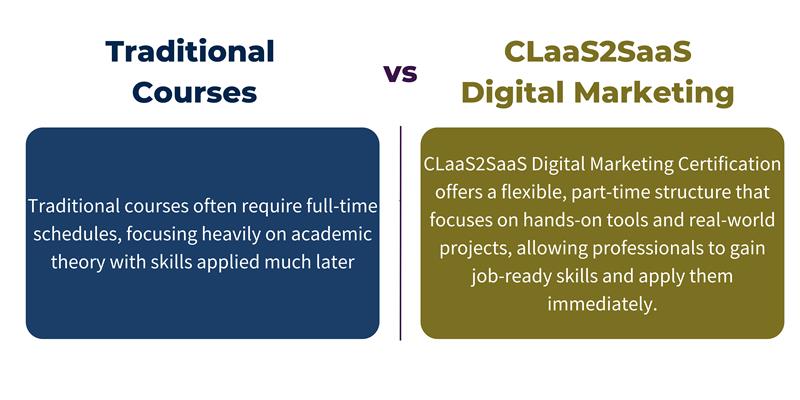
Digital Marketing Course While Working (With CLaaS2SaaS)
- Part-time and flexible schedule
- Focus on hands-on tools like SEO, Google Ads, CRM, and analytics
- Projects simulate real workplace scenarios
- Designed to fit around your current job and life
Professional Certificate in Digital Marketing (4 Months Part-Time)
The Professional Certificate in Digital Marketing from CLaaS2SaaS is a 4-month part-time program that equips you with the essential skills needed to succeed as a modern digital marketer. The focus is on practical, real-world training that helps you apply what you learn immediately.
Key features include:
- Part-time structure suited to working adults
- Competency-based, outcome-driven learning
- Hands-on projects that mirror real marketing challenges
- Training in widely used tools (Google Ads, HubSpot CRM, SEO platforms)
The certificate is awarded by Lithan CLaaS2SaaS, a trusted provider of flexible learning pathways, helping you stand out in the job market without putting your career on hold. This type of credential is especially valuable for professionals who want a fast, credible entry point into marketing roles without committing to a multi-year study.
What You Will Learn in an Online Digital Marketing Bootcamp for Working Adults
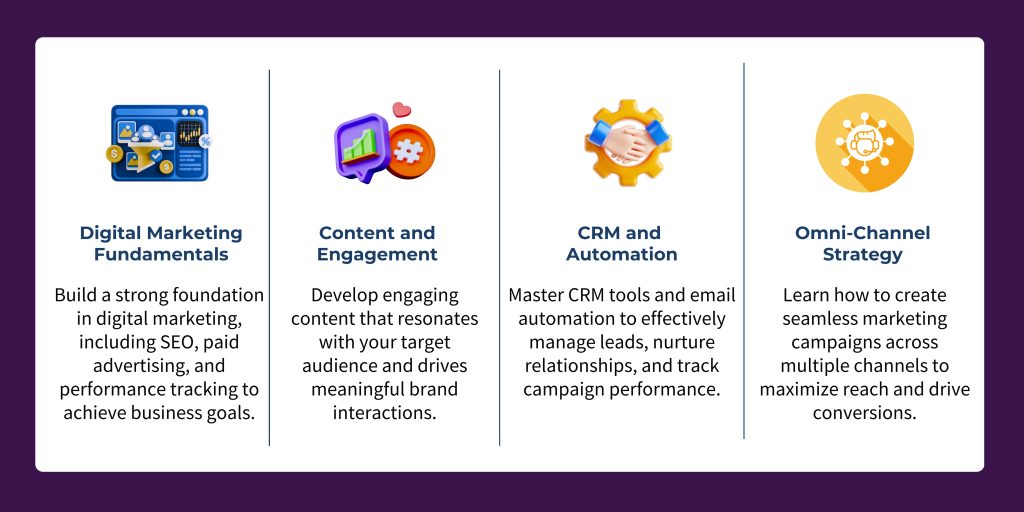
The curriculum is designed to build practical skills that employers are actively looking for. Here’s what you’ll master:
Digital Marketing Fundamentals
You learn how to plan and execute online campaigns that align with business goals. This includes building paid advertising strategies, improving online visibility, and understanding the full marketing funnel.
You will also learn how marketers measure success through reach, engagement, conversions, and ROI.
Content and Engagement
Content drives brand trust and customer attention. This module helps you create marketing content that connects with audiences across platforms.
You will build skills in storytelling, multimedia content, and campaign communication, which are critical for modern marketing roles.
CRM and Automation
Automation is now a standard requirement in marketing teams. You gain experience managing customer journeys, organizing leads, and improving workflows through CRM tools like HubSpot.
These skills are essential for roles that involve lead nurturing, lifecycle marketing, and customer retention.
Omni-Channel Strategy
Customers interact with brands across multiple touchpoints, from social media to email to websites and e-commerce platforms.
This module teaches you how to coordinate campaigns across channels while using data to optimize performance and improve results.
All of these skills help learners apply digital marketing in real business contexts, not just learn concepts.
How the Learning Format Fits Around Your Job
One of the biggest concerns for working professionals is time.
This program uses a work-integrated approach that helps you balance work, life, and study. The learning structure includes:
This means you get meaningful training without dropping your career or commitments. For many lifelong learners, this flexibility is what makes certification possible in the first place. - E-learning modules allow you to learn at your own pace
- Mentored sessions provide expert support without rigid scheduling
- Hands-on projects reinforce learning through practice
- Outcome-based assessments focus on skills, not exams
Certifications You Can Earn Along the Way
Beyond the core certificate, learners also gain industry-recognized credentials from leading platforms, including:
These credentials enhance your resume and demonstrate real tool competency, a big advantage when hiring managers evaluate candidates. - Google Ads certification
- Google Analytics certification
- HubSpot Digital Marketing certification
- HubSpot Email Marketing certification
- CRM and sales software certifications
Career Outcomes After Completing the Certificate
The goal of the Professional Certificate is simple: help you become job-ready fast.
After finishing the program, you can pursue roles such as:
These roles are in demand globally as companies invest more in online sales, customer experience, and data-driven marketing. Because the program focuses on execution, learners graduate with practical confidence, not just theoretical understanding. - Digital Marketing Executive
- SEO Specialist
- Social Media Marketer
- Content Marketing Associate
- CRM and Automation Specialist
- E-commerce Campaign Coordinator
FAQ: Digital Marketing Course While Working
Can I study this course part-time while working full-time?
Yes. The program is designed with flexible pacing to fit around your schedule.
How long does the certificate take?
The Professional Certificate can typically be completed in 4 months of part-time study.
Does this course require prior marketing experience?
No. It starts from core concepts and builds towards practical execution.
Is this certification recognized by employers?
Yes. The certificate and accompanying industry credentials demonstrate real skills with modern tools.
Will this help me get a new job?
The focus is on job readiness and practical skills employers want, increasing your competitiveness in the job market.
Course
Start Your Professional Certificate in Digital Marketing Today
Digital marketing is one of the fastest-growing and most dynamic career fields today. Companies are investing heavily in digital channels, and marketers who can execute campaigns, analyze data, and adapt quickly are in high demand.
You do not have to choose between working and learning. A digital marketing course while working helps you gain real, job-ready skills in just 4 months.