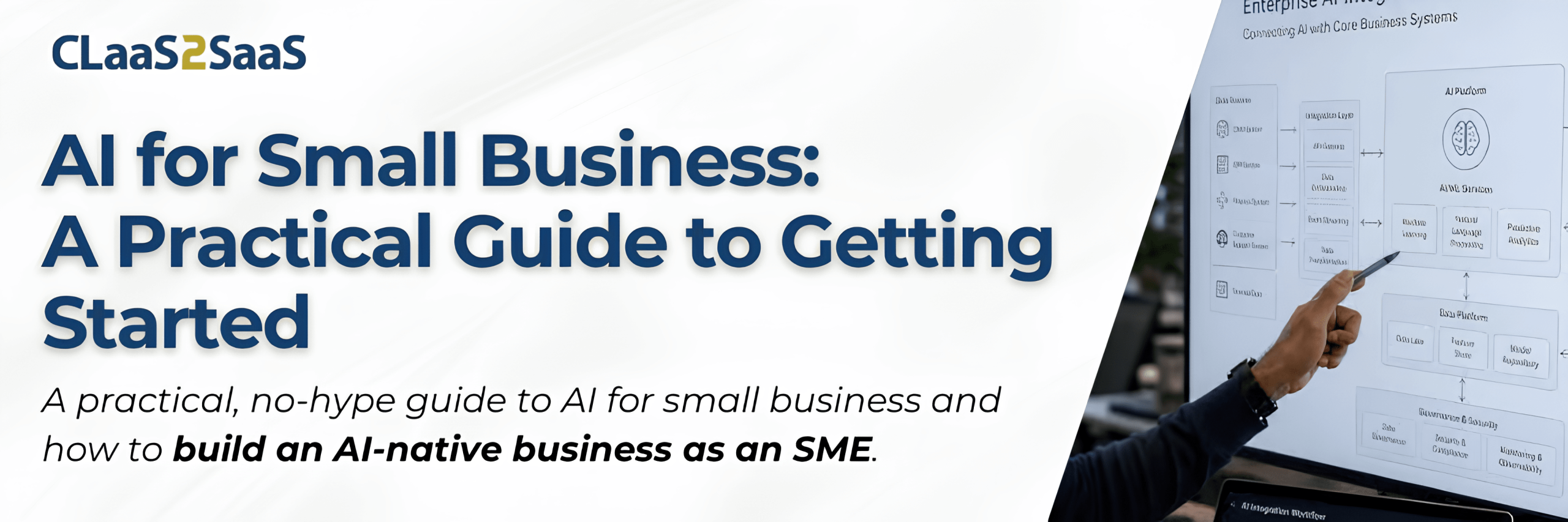
AI for Small Business: A Practical Guide to Getting Started
AI for Small Business: A Practical Guide to Getting Started
Content
Content
Search ‘AI for small business’ and you’ll usually find one of two extremes: dictionary-style explainers for complete beginners, or enterprise advice written for companies with data teams, established infrastructure, and experimentation budgets. Neither helps a three-person operations team in which everyone already covers several roles. This guide gives SME owners a practical, sequenced starting point instead of a listicle.
Why Most SMEs Get Stuck Before They Start With AI
The real blockers for most SMEs aren’t about understanding what AI is; they’re about knowing where to start without a dedicated data or IT person to lean on. There’s also a real fear of wasted spend: picking the wrong tool, signing up for a subscription nobody ends up using, or investing time into a rollout that stalls after the first month. And a lot of the advice out there doesn’t map to what a small team’s day actually looks like — ‘implement an enterprise AI strategy’ means very little when there’s no one whose job is exclusively AI strategy.
This is also why generic ‘top 10 AI tools’ listicles tend to fall flat: they’re organised by brand, not by the problem you’re actually trying to solve, and they rarely tell you what to do after you’ve picked a tool. What’s missing from most lists isn’t more tool options — it’s a sequenced, practical starting point that fits a small team’s reality. That’s what the rest of this guide covers.
A Practical First Step: Where to Start Automating
The single biggest mistake SMEs make when adopting AI is trying to roll it out everywhere at once. A far more practical approach is to pick one repetitive, low-risk process and start there: prove it works, learn what adoption actually looks like for your team, and only then expand.
A few common starting points work well because they’re contained, low-stakes, and easy to measure. Customer FAQs are a natural fit: if your team answers the same handful of questions over and over — opening hours, shipping timelines, return policies — an AI-assisted FAQ or chat response can absorb that repetitive load without touching anything customer-sensitive or high-stakes. Scheduling is another good candidate, since booking, rescheduling, and reminder follow-ups are exactly the kind of repetitive, rules-based task that’s low-risk to automate first, and mistakes are easy to catch and correct. Invoicing and basic admin round out the list; generating, sending, and following up on routine invoices is a contained process where automation saves real hours without requiring judgment calls.
What makes these good first steps isn’t that they’re the most impactful thing AI could do for your business; it’s that they’re safe to get wrong while you’re learning. You’ll build internal confidence, understand what ‘owning’ an AI-assisted workflow actually involves day to day, and have a concrete result to point to before you consider anything bigger.
A simple way to choose: ask which process is repeated most often, causes the least damage if something goes wrong early on, and is easiest to measure before and after. The process that scores well on all three is usually your best starting point, not necessarily the one that feels most exciting.
Once that first process is running smoothly, the natural next step is looking at your broader operations for where else the same pattern applies — but that’s a conversation for after you’ve proven the model on one process, not before. If you’re ready to look at specific categories of tool for that process, see the AI tool hub for a function-by-function breakdown.
What Becoming an ‘AI-Native Business’ Actually Means for an SME
‘AI-native business’ gets used loosely, so it’s worth being precise about what it actually means for an SME, rather than treating it as a buzzword. It’s not about installing one AI tool and calling the job done. Buying a single subscription doesn’t make a business AI-native any more than buying a spreadsheet program makes a business ‘data-driven’ — the tool is only useful once it’s built into how the team actually works.
Becoming AI-native is closer to an ongoing operating shift than a one-off purchase. It means the processes you automate stay owned and maintained rather than quietly abandoned a few months after launch. It means new hires get onboarded into the AI-assisted way of doing things as a normal part of the job, not as an optional extra. And it means revisiting and expanding what’s automated over time, rather than treating the first rollout as the finish line.
For a small business, this shift doesn’t need to happen all at once, and it doesn’t require a dedicated AI team to sustain. It starts with the single process from the previous section, stays owned by someone on your team, and expands deliberately as you get more comfortable with what works. That’s the difference between a business that happens to use an AI tool and a business that’s actually AI-native.
This is also the kind of gap CLaaS2SaaS’s SME AI Enablement work is positioned to help with — not as a one-off tool sale, but as advisory support intended to help you sequence that shift for your specific team and operations (confirm this description against approved landing-page copy). If you’d like a second set of eyes on where to start, you can become an AI-native business on your own timeline.
Common Mistakes SMEs Make When Adopting AI
A few patterns show up again and again when SMEs adopt AI, and knowing them in advance makes them easy to avoid. Buying the tool before mapping the process is the most common: it’s tempting to pick a well-reviewed tool first and figure out how to use it later, but this usually leads to a tool that doesn’t quite fit and gets abandoned. Map the process first, then choose a tool that fits it.
A close second is no one owning the workflow after launch. AI-assisted processes need someone responsible for checking they’re still working, correcting mistakes, and updating them as the business changes; without an owner, even a well-chosen tool tends to quietly stop being used.
The third is ignoring data-privacy basics. Even simple automations often touch customer data, so it’s worth knowing what data a tool stores, where, and for how long before rolling it out, not as an afterthought once something’s already gone wrong.
None of these mistakes are complicated to avoid once you know to look for them; they’re mostly a matter of sequencing: map first, assign ownership, and check data handling before you scale up.
Frequently Asked Questions
Is AI actually affordable for a small business?
Yes — most SMEs start with one low-cost, narrow use case (like automating a repetitive admin task) rather than a full platform rollout, which keeps initial cost and risk low. Exact program pricing is not published; a 1:1 consultation can help scope a starting point for your business.
What should a small business automate with AI first?
Start with one repetitive, low-risk process — customer FAQs, scheduling, or invoicing are common starting points — rather than an org-wide rollout. Prove it works before expanding to anything bigger.
Do I need a technical team to adopt AI as an SME?
Not necessarily. Advisory support can reduce the technical burden of getting started, though implementation needs still depend on the specific use case and how it’s built. An enablement/advisory approach is designed to lower that barrier rather than assume you need in-house AI expertise from day one.
What does ‘AI-native business’ mean?
It means AI-assisted processes are owned, maintained, and expanded over time as part of how your business operates — not a single tool purchase you set and forget. It’s an ongoing shift, not a one-off project.
How is this different from just using free AI tools like ChatGPT?
Free tools can help with individual tasks, but becoming AI-native is about process- and team-wide adoption — making sure automations are owned, maintained, and built into how your business runs, not just used ad hoc by one person.
Closing the gap between ‘heard of AI’ and ‘actually using it’ doesn’t take a big-bang rollout. It starts with one process, one owner, and a plan — and the right starting point depends on your team and the specific process you choose, not a generic checklist.
See how to become an AI-native business to explore a structured starting point first.
Share


Want to check if this career is for you?