How AI Can Reduce Learning Administration Workload in Higher Education
How AI Can Reduce Learning Administration Workload in Higher Education
Content
Content
AI learning management for higher education can cut workload by automating repeatable steps in four areas: enrollment and scheduling, progress and compliance reporting, grading and moderation logistics, and routine learner queries. That gives your registrars and academic coordinators more time for exceptions, academic judgment, and student-facing work.
This guide shows where that workload builds up and how AI reduces it. It then covers what changes day to day for your team and which governance risks to plan for first.
Where Does Learning Administration Workload Actually Pile Up?
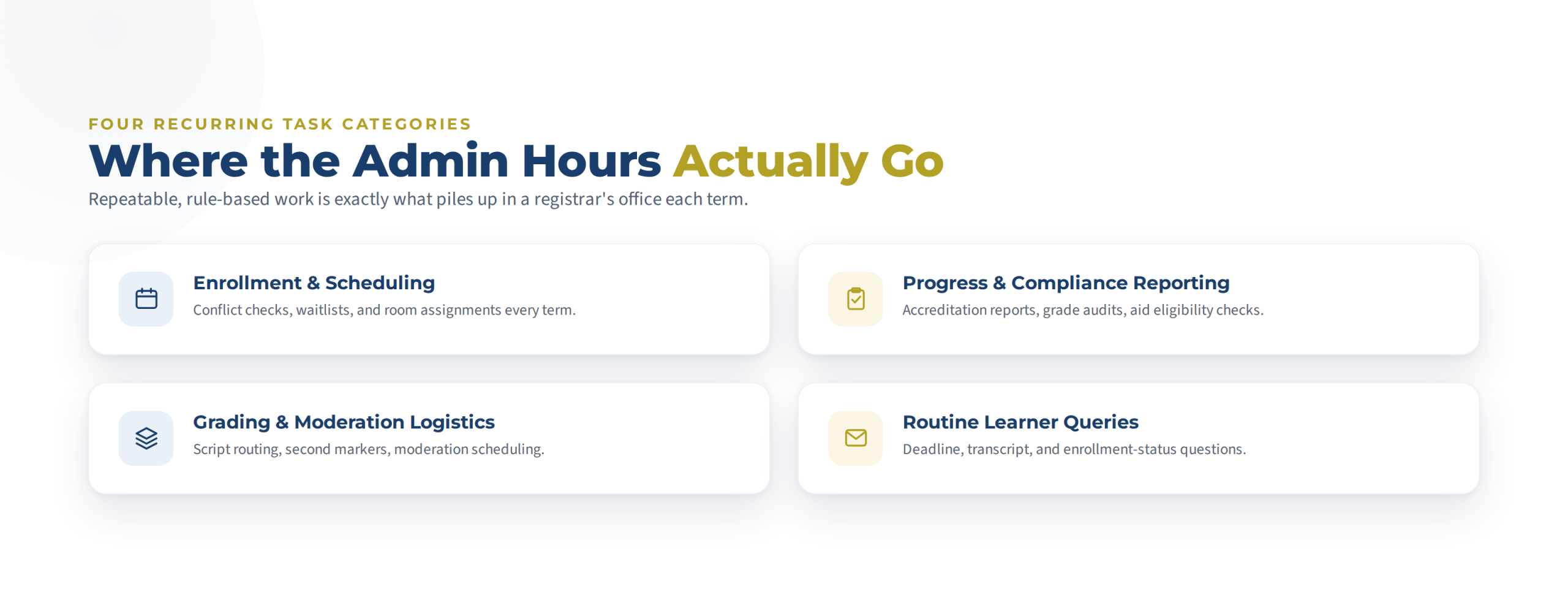
Reducing administrative burden in higher education starts with finding where the hours go. In a typical registrar or academic-operations office, the workload builds up in four places:
- Enrollment and scheduling: course-conflict checks, waitlist management, and room-assignment changes each term.
- Progress and compliance reporting: manually assembled accreditation reports, grade-distribution audits, and financial-aid eligibility checks.
- Grading and moderation logistics: exam-script routing, second-marker assignment, and moderation-meeting scheduling.
- Routine learner queries: repeated questions about deadlines, transcripts, and enrollment status that arrive by email or phone because no self-service channel exists.
Research points the same way. A systematic literature review published through IEEE screened 306 papers on AI in learning management systems and analyzed 33 of them. It found Moodle was the most common test environment, and student performance assessment was the most studied application.
How Does AI Reduce Workload in Each of These Areas?
AI in academic administration works best when each capability matches a specific task:- Scheduling: AI tools check course and room conflicts overnight and flag only the exceptions.
- Reporting: automated reporting pulls grade and attendance data from your student information system (SIS) and assembles compliance reports without manual entry.
- Grading logistics: AI triage sorts submissions by confidence, auto-scoring rule-based questions and routing borderline cases to a human marker.
- Learner queries: a chatbot answers routine questions about deadlines and transcript status.
From Administration Automation to Learner Intelligence
Automating administrative steps makes learner information timelier and easier to use. When your LMS, SIS, assessment systems, and support workflows share consistent data definitions and governance, that information adds up to a connected view of each learner. That’s intelligent learning operations, and it gives a personalized pathway the evidence it needs to adjust to a learner’s pace.
Assessment data is a natural starting point, given the IEEE review’s finding above. Learner intelligence should surface patterns and flag risks for a person to act on. Academic decisions, especially assessment outcomes and anything affecting academic standing, stay with your staff.
What Does AI Learning Management Look Like Day to Day for Staff?
A registrar’s week changes measurably after adoption. Here’s how three common roles shift:- Registrar: You stop cross-referencing enrollment spreadsheets against room capacity by hand each Monday. Scheduling tools run the check overnight, and you review only the conflicts that need a decision.
- Academic coordinator: A chatbot answers routine transcript-status questions and escalates unusual cases, such as a transcript held for an unpaid balance, to you.
- Compliance officer: Automated reporting builds the grade-distribution audit from SIS and LMS data overnight, so you only validate the result.
Across these roles, attention moves from repetitive execution to exception handling and judgment calls. That shifts the skills your office needs toward interpreting an AI-flagged exception correctly.
What Risks and Guardrails Should Institutions Plan For?
Plan for three risk categories before you automate anything:- Data governance: who can access learner records and how long that data persists.
- Grading and personalization accuracy: human review of any AI-assisted grading decision or pathway recommendation above a defined stakes threshold.
- Change management: staff trust in AI-generated recommendations, and the training that builds it.
An unreviewed grading error compounds quickly across a cohort, so any decision affecting academic standing or learning path needs a human-in-the-loop checkpoint. If your staff distrust an AI-generated flag, they’ll recheck every case by hand, and the time savings disappear.
How Should Institutions Get Started Without Overhauling Everything at Once?
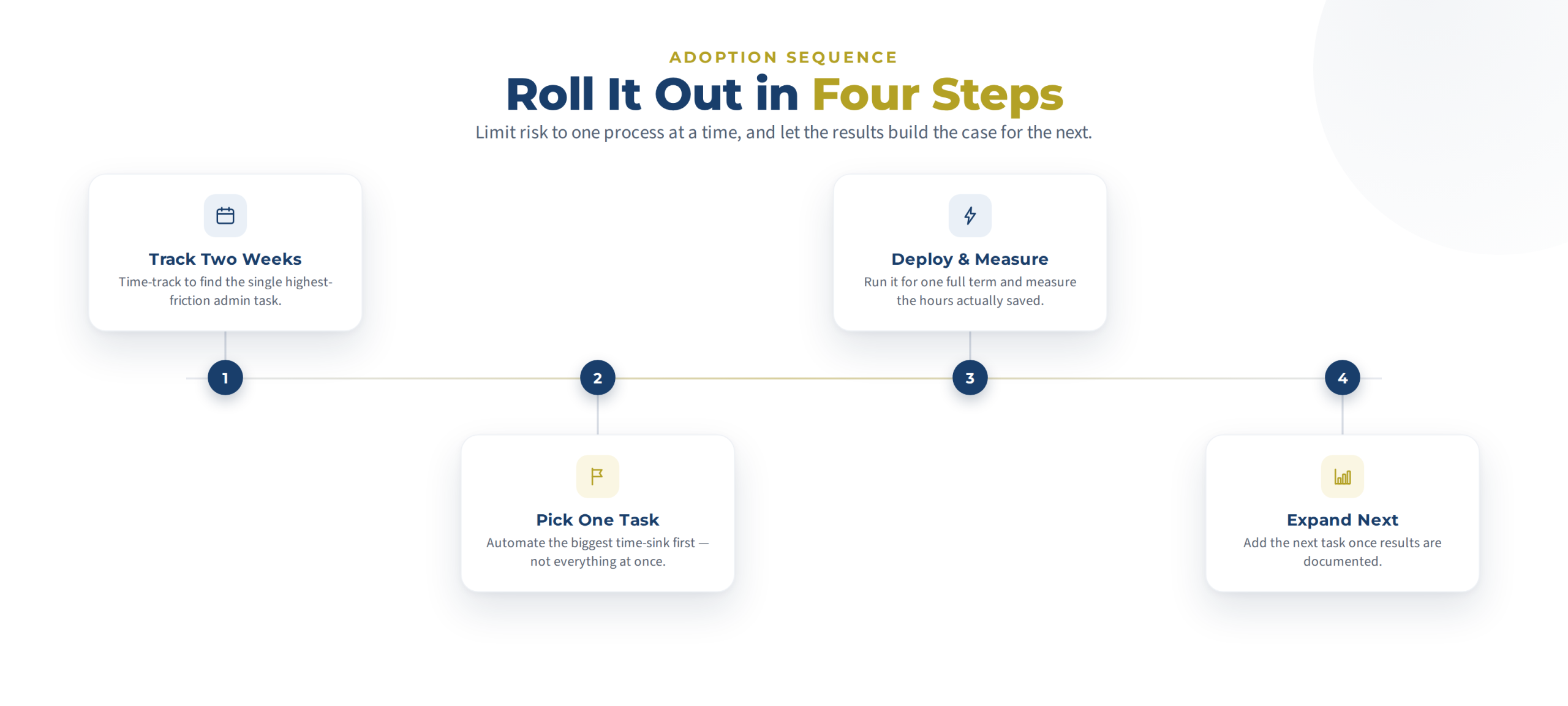
Start with one high-friction process. Track it for a defined period, automate selected repeatable steps, and compare the results. Measure:
- Time saved
- Accuracy and escalation rates
- Staff and learner experience
- Fairness, privacy, and security issues
Reducing learning administration workload is your first step. With the right integration and governance, the same operational data can also support timely learner assistance and adaptive pathways. Adaptive CLaaS® uses learner intelligence to support personalized, adaptive learning journeys at scale.
Share


Want to check if this career is for you?