Home Blog Enterprise Transformation Self-Service Intelligent Innovation for AI-First Enterprises
Enterprise Transformation

Self-Service Intelligent Innovation for AI-First Enterprises

Self-Service Intelligent Innovation for AI-First Enterprises

Banner with headline “Powering the Shift to Intelligent Enterprise Operations,” showing a rising chart and arrow symbolizing AI-driven enterprise growth.

Enterprise transformation is entering a new phase. The conversation is no longer about digitization or even automation. It is about how organizations embed intelligence into their core operations, empower their workforce to innovate independently, and scale capabilities through software-driven models.

This shift is best understood through the rise of self-service intelligent innovation, a model that enables enterprises to transition into AI-first organizations supported by a unified intelligence layer known as the Enterprise Intelligence Fabric (EIF).

Across industries, leaders are recognizing that traditional transformation approaches are reaching their limits. According to HFS Research, over 60 percent of enterprises expect to replace people-led services with software-driven models by 2028. At the same time, McKinsey estimates that AI could generate up to $4.4 trillion in annual economic value, highlighting both the scale of opportunity and the urgency of transformation.

Yet despite these investments, many organizations remain constrained by fragmented systems, siloed data, and workforce capability gaps. The next generation of transformation requires a fundamentally different approach. It requires a shift from isolated digital systems to integrated, intelligence-driven enterprise ecosystems.

Download the AI-First Adaptive Enterprise Transformation Brochure to explore how Enterprise Intelligence Fabric enables scalable, self-service innovation across your organization.

The Industry Shift Toward AI-First Enterprise Models

The AI-first enterprise represents more than the adoption of artificial intelligence technologies. It represents a structural redesign of how organizations operate, make decisions, and create value.

In traditional enterprises, intelligence is often retrospective. Systems record transactions, generate reports, and provide historical insights. Decision-making remains reactive, dependent on human interpretation and coordination.

In contrast, AI-first enterprises operate on a fundamentally different principle. Intelligence is embedded into workflows, decisions are informed by real-time data, and systems are capable of predicting and adapting to change.

Several global trends are accelerating this shift.

  • Gartner predicts that over 80 percent of enterprises will deploy generative AI applications in production environments by 2026
  • The World Economic Forum reports that 44 percent of core workforce skills will change within five years
  • Deloitte highlights that intelligent automation can reduce operational costs by up to 30 percent
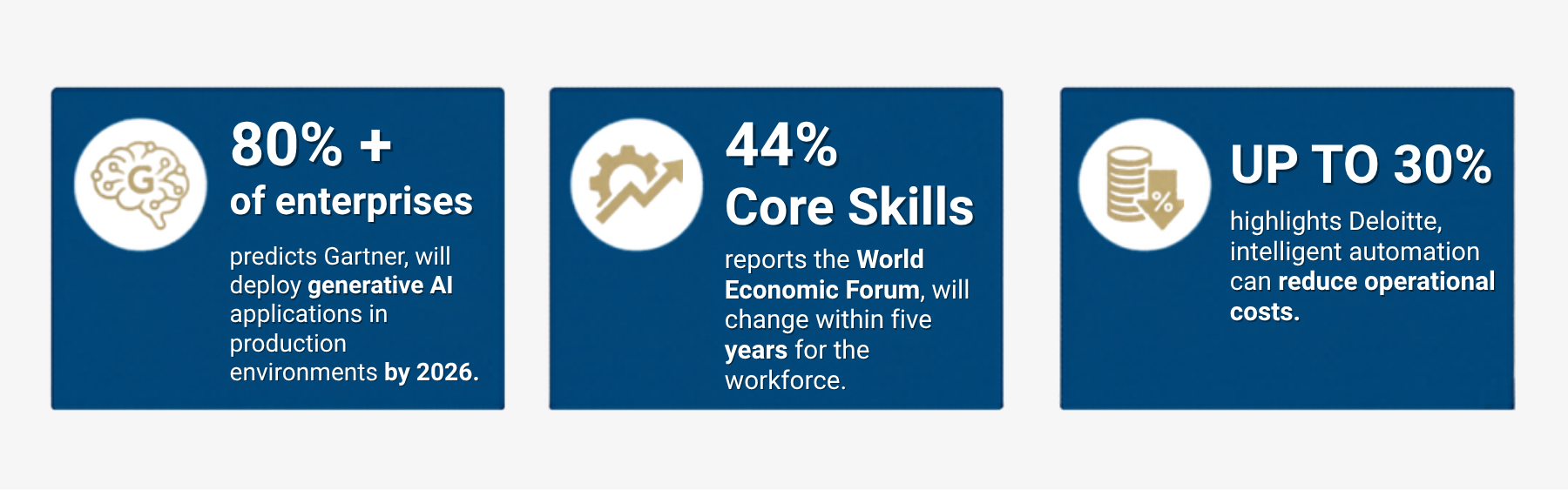
Three stats panels showing AI adoption, workforce skill change, and cost reduction from automation.

These trends are converging to create a new enterprise paradigm where:

  • Intelligence is continuous rather than episodic
  • Automation is adaptive rather than static
  • Innovation is distributed rather than centralized

The AI-first enterprise is therefore not simply a technological evolution. It is a strategic and operational transformation.

Why Traditional Digital Transformation Is No Longer Enough

Over the past decade, enterprises have invested heavily in digital transformation initiatives. These efforts have focused on implementing enterprise systems such as ERP, CRM, HRMS, and workflow automation tools.

While these investments have delivered incremental improvements, they have not addressed a fundamental structural issue: the lack of integration across systems, data, and decision-making processes.

Most organizations today operate within fragmented digital environments. ERP systems manage financial transactions. CRM platforms handle customer interactions. HR systems manage workforce data. Each system functions effectively within its domain, but they do not share intelligence in a meaningful way.

As described in the Enterprise Intelligence Fabric framework, these systems can explain what has happened, but they rarely explain why it happened or what should happen next.
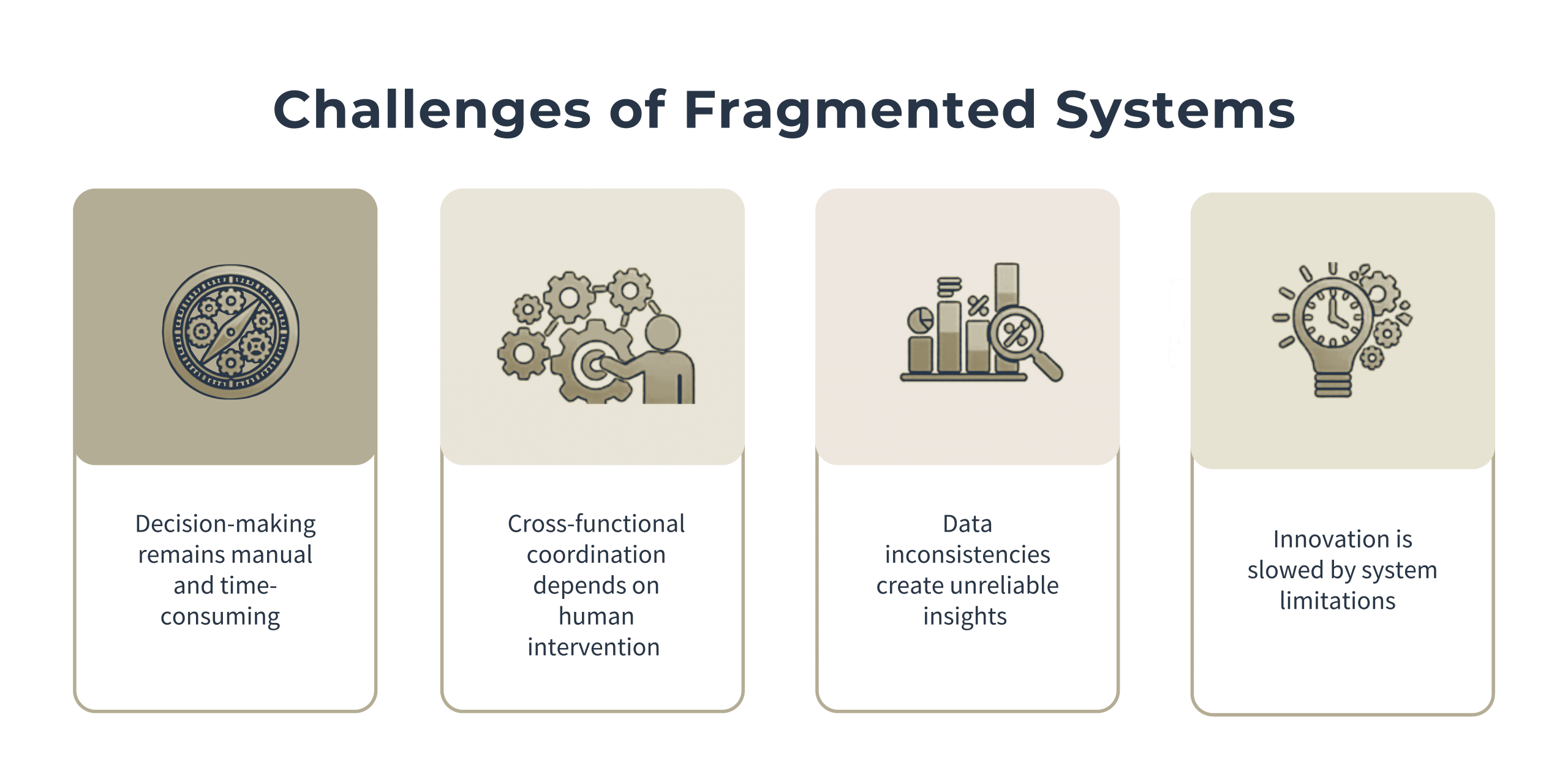
Infographic showing four challenges of fragmented systems: manual decisions, poor coordination, unreliable data, and slowed innovation.

In many cases, employees spend more time navigating systems than creating value. Transformation initiatives become technology projects rather than business transformations.

The limitation of traditional transformation is clear. It focuses on digitizing processes, rather than integrating intelligence.

Understanding Self-Service Intelligent Innovation

Self-service intelligent innovation represents a shift from centralized, technology-driven transformation to distributed, workforce-enabled innovation.

In this model, innovation is no longer confined to IT teams or centralized functions. It is embedded within the workforce itself. Employees are empowered to design, build, and deploy solutions within their roles.

This is made possible by the convergence of:

  • AI-powered tools and platforms
  • Low-code and no-code development environments
  • Real-time data access and analytics
  • Continuous learning and upskilling models

The evolution toward this model can be understood in three stages.

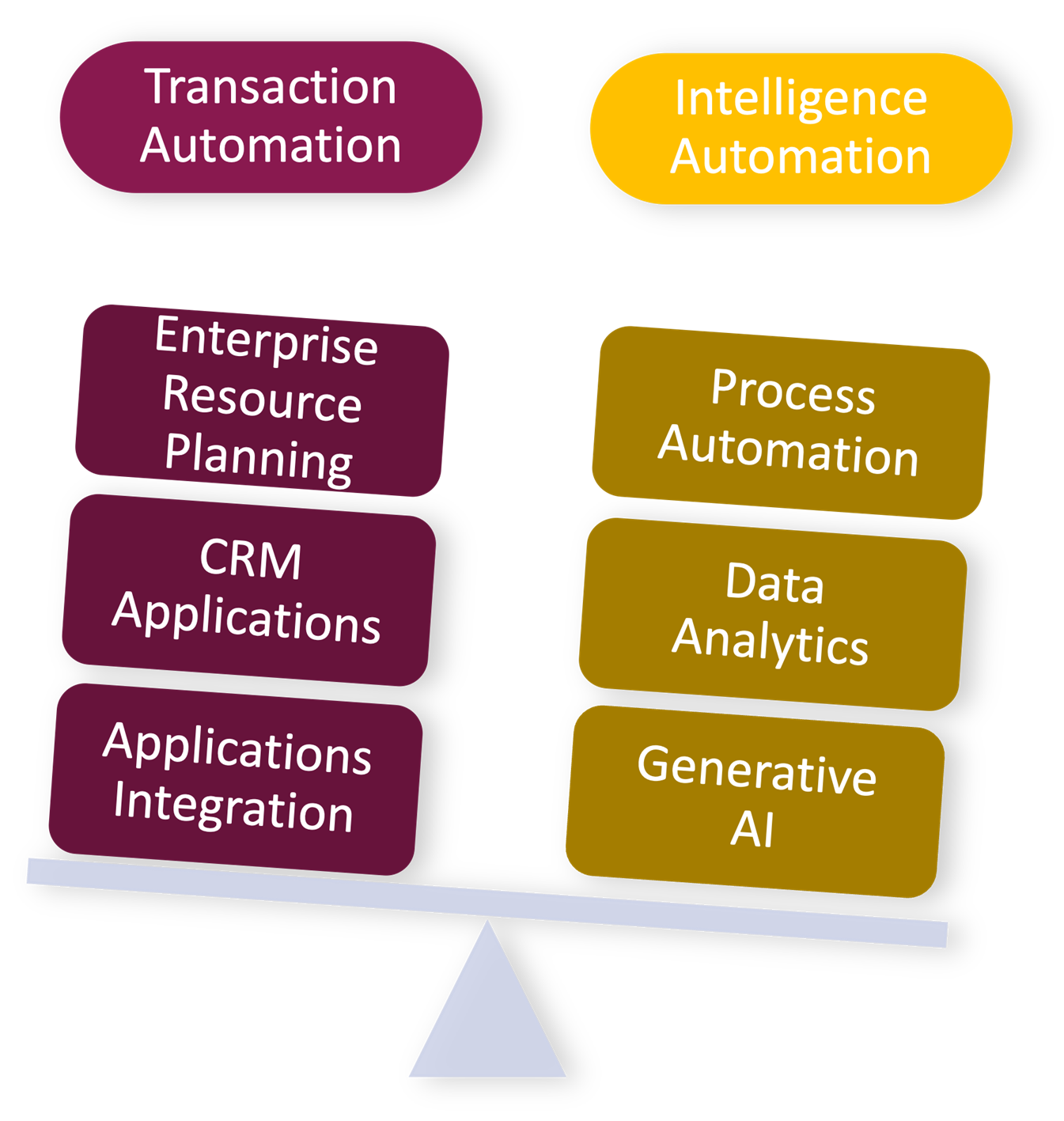
Transaction Automation focuses on digitizing repetitive tasks. This is the foundation of most digital transformation initiatives.

Intelligence Automation builds on this foundation by incorporating data analytics and AI to improve decision-making.

Self-Service Innovation represents the next stage, where employees actively create and optimize solutions, supported by intelligent systems.

This shift fundamentally changes the role of the workforce. Employees are no longer just users of systems. They become creators of value, capable of driving continuous innovation within the enterprise.

Transaction Automation to Intelligence Automation V.S. Self-Service Intelligent Innovation Diagram comparing transaction automation, intelligence automation, and self-service innovation.
A comprehensive curriculum should cover the major areas of digital marketing, including strategy development, audience targeting, content marketing, paid media, automation tools, and analytics.
Programs that integrate these areas help learners understand how different marketing channels work together.
Many certification programs rely primarily on lectures and theoretical assignments. However, modern marketing roles require practical experience working with marketing tools and data.
Programs that include real campaign simulations, hands on projects, and marketing technology training are often more valuable because they allow learners to practice executing marketing strategies.
Digital marketing evolves quickly, so programs should reflect current tools, platforms, and AI-driven practices.
Training environments such as CLaaS2SaaS integrate real industry workflows into the learning experience.
Employers often prefer candidates who can demonstrate both knowledge and practical experience. Certification programs that include portfolio projects allow learners to showcase real campaign work when applying for marketing roles.
This combination of certification and practical work can significantly strengthen a candidate’s professional profile.

The Rise of the Service-as-Software Enterprise Model

As enterprises evolve toward AI-first models, a new paradigm is emerging: the Service-as-Software model.

Traditionally, services are delivered by people. Scaling services requires increasing headcount, which in turn increases costs and complexity.

In contrast, the Service-as-Software model enables organizations to deliver services through software and AI systems. This allows for:

  • Scalable service delivery without proportional increases in cost
  • Consistent and reliable execution
  • Faster response times and improved customer experiences

AI agents play a central role in this model. These agents can perform tasks across functions, including:

  • Customer support and engagement
  • Financial operations and reporting
  • Sales and marketing automation
  • HR and talent management

As these capabilities mature, enterprises are transitioning from human-led service models to software-defined operations.

This shift is not about replacing people. It is about augmenting human capabilities and enabling the workforce to focus on higher-value activities.

Enabling Self-Service Intelligent Innovation with CLaaS2SaaS

CLaaS2SaaS is an AI-first digital acceleration platform and transformation model that connects workforce capability, enterprise systems, and intelligent automation into a unified ecosystem.

At its core, CLaaS2SaaS is not just a technology framework. It is a Learn2Work ecosystem that integrates education, enterprise transformation, and AI-driven operations to enable continuous innovation at scale.

It brings together four critical elements:

  • Competency Learning as a Service (CLaaS®) to develop a future-ready, AI-enabled workforce
  • Enterprise Systems (ERP and CRM) to operationalize business processes and customer engagement
  • AI-Driven Automation and Intelligence to enhance productivity, decision-making, and scalability
  • Enterprise Intelligence Fabric (EIF) to unify data, workflows, knowledge, and AI reasoning across the enterprise

By integrating these components, CLaaS2SaaS bridges the long-standing gap between skills development and real-world enterprise application, enabling organizations to move from learning to execution to scalable innovation.

It also connects a broader ecosystem of stakeholders including:

  • Enterprises
  • Learners and workforce talent
  • Education institutions
  • Service and technology providers

This creates a closed-loop digital acceleration model, where skills are continuously developed, applied, and scaled within enterprise environments.

Core Components of Self-Service Intelligent Innovation

The CLaaS2SaaS model is structured across three integrated transformation layers, supported by the Enterprise Intelligence Fabric as the underlying intelligence core.

This layer focuses on building a future-ready, AI-enabled workforce through a Learn2Work approach.

It enables:

  • Personalized, skills-based learning pathways
  • Work-integrated training aligned to real enterprise use cases
  • Continuous upskilling and reskilling across career stages
  • AI literacy and digital capability development

Unlike traditional training models, Adaptive CLaaS® ensures that learning is directly tied to enterprise outcomes and innovation use cases, creating immediate business value.

This layer transforms enterprise operations by embedding intelligence into core systems.

It enables:

  • Automation of business processes across finance, HR, and operations
  • Intelligent workflows that adapt to changing conditions
  • Real-time decision support and performance optimization
  • Integration of AI agents into operational environments

ERP evolves from a transactional system into an intelligent execution engine, capable of driving efficiency and scalability.

This layer enhances customer engagement through AI-driven intelligence.

It enables:

  • Personalized customer journeys and interactions
  • Predictive insights for sales and marketing
  • Automated engagement and service workflows
  • Real-time customer intelligence

CRM evolves into a proactive, data-driven engagement platform, enabling enterprises to scale customer experience effectively.

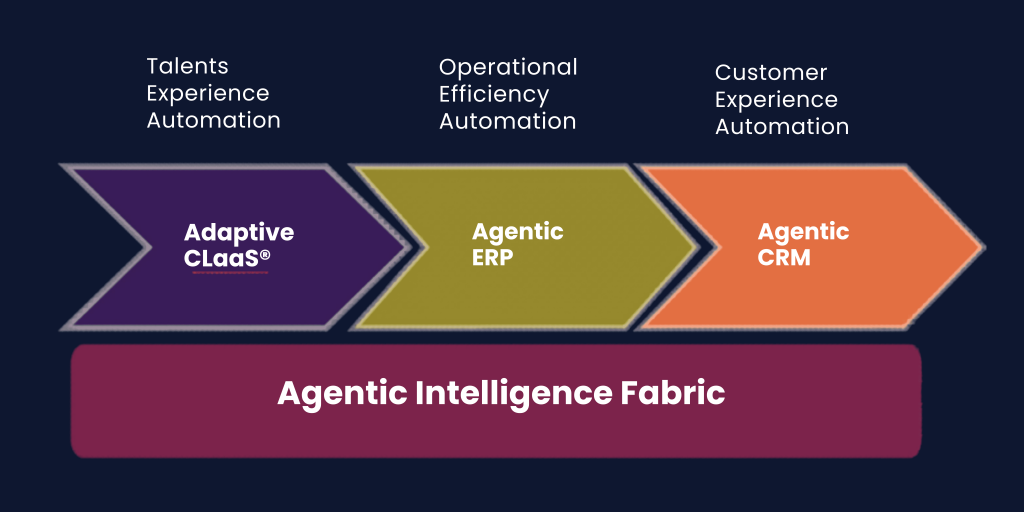
Layered diagram showing Adaptive CLaaS, Agentic ERP, and Agentic CRM supported by an intelligence fabric.

Enterprise Intelligence Fabric: The Intelligent Core of the Enterprise

At the center of this transformation is the Enterprise Intelligence Fabric (EIF).

The EIF addresses one of the most critical challenges in modern enterprises: the fragmentation of systems, data, workflows, and decision-making processes.

It provides a unified intelligence layer that connects these elements into a cohesive, governed environment.

As defined in the framework, the EIF unifies an organization’s data, workflows, knowledge, and AI reasoning into a single execution layer that enables coordinated, intelligent action across the enterprise.

This represents a significant shift.

Instead of relying on humans to bridge gaps between systems, the EIF enables AI-driven coordination and decision-making. It transforms the enterprise from a collection of isolated systems into an integrated intelligence engine.

The Four Hubs of the Enterprise Intelligence Fabric

The EIF is structured around four interconnected hubs, each serving a distinct role in enabling intelligent operations.
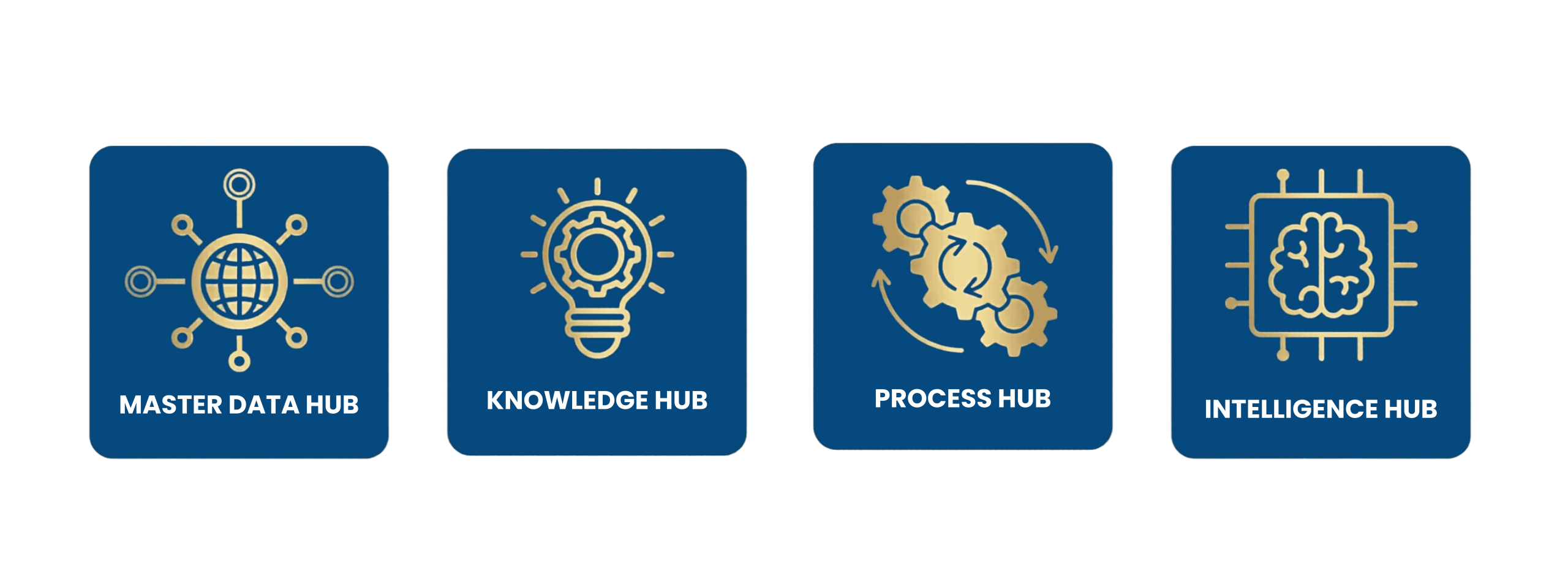
Infographic showing four hubs of the Enterprise Intelligence Fabric: data, knowledge, process, and intelligence.

The Master Data Hub ensures that all enterprise systems operate on a consistent and reliable data foundation.

It standardizes data definitions, eliminates duplication, and enforces governance rules. This creates a single source of truth that is essential for accurate analytics and AI-driven decision-making.

Without this foundation, intelligence becomes unreliable. With it, intelligence becomes scalable.

The Knowledge Hub consolidates structured and unstructured information into a unified, accessible layer.

This includes documents, policies, operational records, and communication data. By enabling semantic search and contextual retrieval, the Knowledge Hub ensures that both humans and AI systems have access to accurate, relevant information.

This reduces fragmentation, improves decision-making, and accelerates onboarding.

The Process Hub transforms manual workflows into automated, traceable processes.

It integrates with enterprise systems to enable end-to-end execution of business operations. Every action is logged, monitored, and governed, ensuring compliance and transparency.

Over time, the Process Hub generates valuable operational data that can be used to optimize performance and identify inefficiencies.

The Intelligence Hub is the core of the EIF’s analytical and decision-making capabilities.

It brings together data, workflows, and knowledge to provide real-time insights, predictive analytics, and scenario simulations.

It also enables AI agents to reason, coordinate, and act within defined governance boundaries. This ensures that decisions are not only intelligent but also aligned with organizational policies and objectives.

Together, these four hubs create a system where intelligence flows seamlessly from data to action and back again, enabling continuous learning and improvement.

Key Components of Self-Service Intelligent Innovation

To operationalize this model, enterprises must align several strategic components.

AI-First Architecture ensures that intelligence is embedded across all enterprise functions.

Agentic Automation enables systems to perform tasks, make decisions, and adapt to changing conditions.

Workforce Upskilling ensures that employees have the skills and capabilities to leverage AI tools effectively.

Unified Platforms, powered by EIF, provide the infrastructure needed to integrate data, systems, and workflows.

These components must work together to create a cohesive transformation strategy.

Industry Impact and Opportunities

The adoption of self-service intelligent innovation, enabled by EIF, is reshaping industries in profound ways.

Operational efficiency improves as automation reduces manual effort and increases consistency.

Talent transformation occurs as employees shift from task execution to innovation and system design.

Customer experience is enhanced through personalized, data-driven interactions.

Business agility increases as organizations become more responsive to market changes.

This transformation represents a shift from efficiency-driven operations to intelligence-driven enterprises.

Strategic Implications for Digital Leaders

For enterprise leaders, the transition to self-service intelligent innovation requires a new approach.

Leaders must move beyond technology-centric strategies and focus on how intelligence is integrated across the organization.

They must empower the workforce to innovate independently, redefine service delivery models, and invest in continuous learning.

Most importantly, they must align transformation initiatives with measurable business outcomes.

Explore how the CLaaS2SaaS model, powered by Enterprise Intelligence Fabric, enables enterprises to scale innovation and achieve AI-first transformation.

From Framework to Execution: CLaaS2SaaS with EIF

The CLaaS2SaaS model provides a practical pathway for implementing self-service intelligent innovation.

It integrates workforce capability development, operational automation, and customer experience into a unified system.

At its core, the Enterprise Intelligence Fabric acts as the integration layer that connects all components.

This enables enterprises to move from capability development to scalable, software-driven innovation.

Conclusion: Building the Intelligent Enterprise

The future of enterprise transformation lies in the ability to integrate intelligence across systems, workflows, and people.

The Enterprise Intelligence Fabric provides the foundation for this transformation. It enables organizations to move beyond fragmented systems and create a unified, adaptive intelligence environment.

Self-service intelligent innovation builds on this foundation, empowering the workforce to drive continuous improvement and innovation.

Together, these models redefine what it means to be a modern enterprise.

The organizations that succeed will not be those that adopt the most technology, but those that integrate intelligence most effectively.

Download the AI-First Adaptive Enterprise Transformation Brochure to explore implementation strategies, architecture design, and enterprise use cases.
Want to check if this career is for you?