Python Course SG - Data Science, Web Dev & Automation
Python Course SG - Data Science, Web Dev & Automation
Content
Content
Why Python skills Matter in an AI – Driven Economy?
Software development is changing rapidly as businesses adopt artificial intelligence, automation, analytics, and intelligent digital workflows.
This shift is also changing what employers expect from technical professionals.
In the past, learning programming syntax alone could help learners enter the industry. Today, many repetitive coding tasks can already be assisted by AI tools. What remains valuable is the ability to design practical solutions, connect systems, automate business processes, and build applications that solve operational problems.
Python continues to stand out because it supports a wide range of high-demand areas, including web development, machine learning and data science, workflow automation, application development, and artificial intelligence. Enrolling in a dedicated python programming course singapore enables learners to master these exact ecosystems. That flexibility is why python programming is often used as a foundation skill for software engineering and AI applications development. However, different career goals require different learning pathways.
A learner who wants to become a data analyst will need a different skill focus compared to someone building full-stack applications or automation systems.
Understanding these pathways early helps learners avoid generic learning routes that do not align with their long-term goals.
Which Python Track Is Right for You?
The right Python pathway depends on the type of work you want to build in the future.
Some learners enjoy analytical work and AI-driven insights. Others prefer building applications and software platforms. Some professionals want practical automation skills they can immediately apply in operations and business environments.
Understanding these differences makes it easier to choose a pathway aligned with your strengths, interests, and career direction.
Track A - Python for Data Science & Machine Learning
This pathway is designed for learners interested in data analytics, artificial intelligence, and machine learning applications.
Instead of focusing mainly on application development, learners work with data-driven systems, predictive insights, and intelligent reporting workflows. The goal is to help learners understand how businesses use data to improve decision-making and operational performance.
Learners also explore how AI-enhanced analytics supports business forecasting, operational optimization, intelligent reporting, and data-driven decision-making across modern enterprises.
Projects in this pathway may include analytics dashboards, forecasting systems, customer insight platforms, and AI-assisted reporting tools.
Career pathways may include roles such as Data Analyst, Junior Data Scientist, AI Analyst, or Business Intelligence Associate.
This track is particularly suitable for learners who enjoy analytical thinking, problem-solving, and working with data-driven environments.
Track B - Python for Web Development
For many learners, web development is one of the most practical entry points into software engineering.
This pathway focuses on building backend systems, APIs, intelligent web applications, and full-stack digital platforms. Rather than learning programming in isolation, learners apply Python in real software engineering workflows that reflect how modern applications are built.
Learners are also exposed to AI-assisted software development workflows that reflect how modern engineering teams accelerate development, testing, debugging, and application deployment.
Learners may work on projects such as booking platforms, SaaS-style systems, e-commerce backend applications, or AI-enabled customer portals.
Career outcomes may include roles such as Web Developer, Backend Developer, Full-Stack Developer, or Software Engineer.
This pathway is especially valuable for career changers and beginner developers because it produces visible project outcomes relatively quickly. Learners can build deployable applications while strengthening their software engineering capability.
Track C - Python for Automation & Scripting
Many businesses still rely on repetitive manual workflows that consume time and reduce operational efficiency.
This pathway helps learners build intelligent workflow automation capability using Python to streamline operations, integrate systems, reduce manual processes, and support AI-enabled business transformation initiatives.
Projects may include reporting automation tools, workflow bots, internal productivity dashboards, and data extraction systems.
Career outcomes may include Automation Specialist, Workflow Automation Associate, Operations Technologist, or Junior Developer roles.
This pathway is particularly useful for professionals who want immediately applicable digital skills that improve operational execution and workflow efficiency.
Python Track Comparison Table – Use Cases, Career Paths, Tools, Salary Track Best For Real-World Projects Career Path
Unlike many digital marketing programs that provide only theoretical overviews, this course integrates GenAI tools, analytics systems, and automation platforms directly into practical learning activities.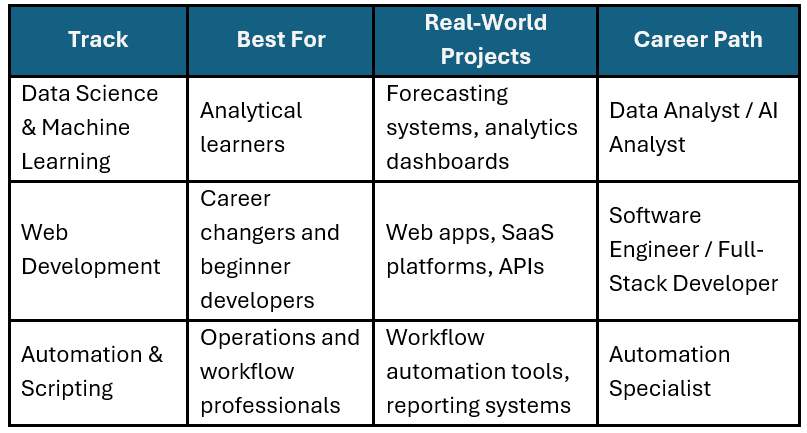
Completing a course does not automatically lead to a salary increase. Salary growth depends on the role you move into, your experience, the market demand for your skills, and how consistently you apply those skills at work.
Rather than learning Python in a generic way, this structure helps learners focus on capabilities connected to specific industries, career outcomes, and digital transformation demands.
SG Salary Benchmarks for Python Developers by Track & Level
Python-related roles continue to grow across Singapore’s digital economy as businesses increase investment in software engineering, automation, analytics, and AI-powered systems.
For learners evaluating long-term career value, salary progression is often one of the clearest indicators of market demand. Completing a course does not automatically lead to a salary increase. Salary growth depends on the role you move into, your experience, the market demand for your skills, and how consistently you apply those skills at work.
Disclaimer: Salary outcomes may vary based on factors such as prior experience, educational background, job role, industry demand, employer requirements, geographic location, individual performance, and market conditions. Any salary figures mentioned are for general informational purposes only and should not be interpreted as guaranteed compensation or employment outcomes.
Entry-level Python-related roles such as Junior Developer, Automation Associate, or Data Analyst may start around SGD 4,000 to SGD 5,500 per month depending on industry and project exposure.
As professionals gain practical experience and portfolio capability, progression opportunities expand into software engineering, AI implementation, and intelligent systems development. Mid-level roles such as Full-Stack Developer, Automation Specialist, or Data Analyst may reach approximately SGD 6,000 to SGD 9,000 per month.
For learners progressing into artificial intelligence and machine learning implementation, more advanced AI-focused roles may exceed SGD 10,000 per month depending on specialization and experience.
The key difference is often not theory alone, but practical implementation capability. Demand continues to rise as organizations expand investments in AI implementation, intelligent automation, software modernization, and data-driven operational systems. Employers increasingly value professionals who can apply technical skills to real operational and business challenges.
What You Will Build – Real-World Projects
One of the biggest weaknesses of many traditional coding courses is the lack of practical implementation experience.
Some learners complete theory-heavy programmers but graduate without deployable projects or portfolio evidence that demonstrates real capability.
Applied learning focuses on solving this gap.
Instead of relying only on exercises and syntax practice, learners work on projects that reflect real software engineering and business implementation environments.
Depending on the selected pathway, learners may build AI-powered dashboards, backend web applications, workflow automation systems, analytics tools, or API-driven platforms.
Rather than only learning concepts, you will build practical projects that reflect real software and AI use cases.
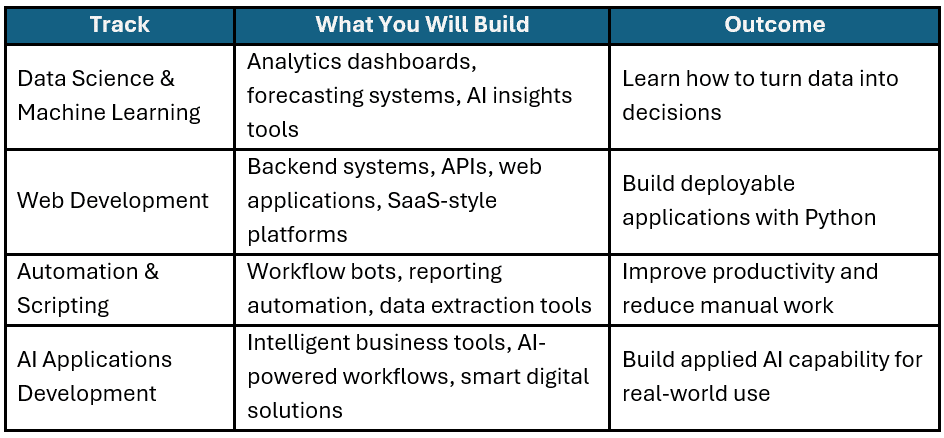
These projects help learners strengthen technical execution while also developing problem-solving capability and practical workplace readiness.
More importantly, portfolio-based learning helps learners demonstrate capability to employers beyond certificates alone.
Program Pathway, Assessment & Trainer Credentials
A strong Python learning pathway should move learners from foundational programming into applied capability, where they can design, build, and adapt real digital solutions.
CLaaS2SaaS’ Professional Certificate is a 4-month intensive skilling pathway designed to help learners gain job-ready foundations in applied AI and digital development. Learners build practical capability in low-code application development, AI model creation, and data analytics, then apply those skills through a capstone project focused on building an intelligent real-world application.
The next stage is a Professional Diploma Certification, a 5-month industry project pathway that builds additional technical depth, implementation capability, and industry relevance.
For Data Science & AI track, the pathway strengthens applied skills in data analytics, machine learning foundations, AI-assisted business intelligence, predictive analytics, visualization, and intelligent workflow implementation.
For AI Application Development track, learners progress from foundations into front-end development, UI frameworks, database design, web development basics, and low-code application development. The pathway also integrates AI model development, data analytics, agile project management, and a capstone project focused on application implementation.
The Master’s Top-Up pathway is designed for learners who want advanced computer science capability and an international master’s qualification. This stage focuses on computer networks, databases, software engineering, security, and a final thesis. It is intended for learners who want to deepen their technical competence and demonstrate professional-level problem solving.
Assessment is based on practical execution rather than memorization. To ensure a premium learning experience, learners at each stage build skills through applied projects. They also complete implementation-based assessments and gain exposure to real-world development and AI environments.
Trainers bring industry experience in software engineering, automation, and AI implementation, which helps learners connect technical concepts to real workplace applications.
Why Applied AI Learning Matters More Than Traditional Coding Courses
Many traditional coding programmers still focus heavily on isolated syntax learning.
While technical fundamentals remain important, employers increasingly value professionals who can use those skills in modern development environments where AI is part of the workflow.
This is why many learners struggle after completing theory-heavy programmers. They may understand concepts academically but still lack experience in working with AI-assisted tools, shaping solutions for real business needs, or translating ideas into deployable applications.
Applied AI learning takes a different approach.
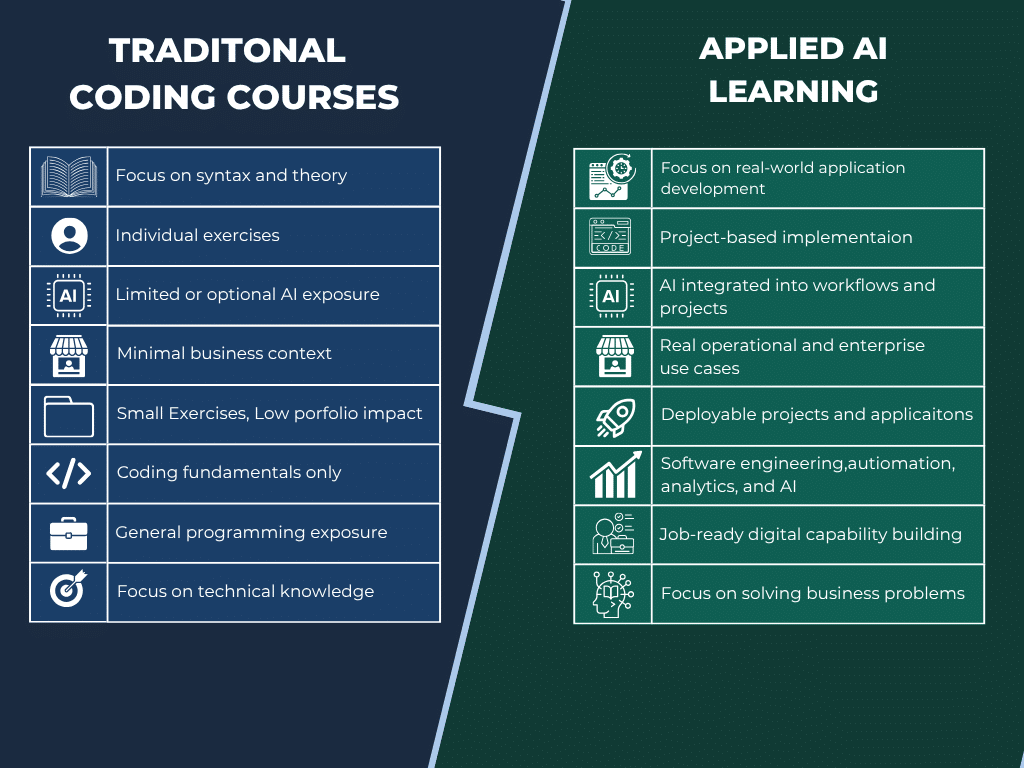
Instead of treating programming as a standalone technical subject, learners work in environments where Python supports AI-assisted software development, human-AI collaboration, and solution design. That means learning how to use AI tools to accelerate development, evaluate outputs critically, and build systems that solve practical business problems.
This approach combines software engineering, analytics, and intelligent workflow design, helping learners develop the capability to create applications that are not only functional, but also relevant to how modern teams build and deploy solutions.
As artificial intelligence continues reshaping software development, professionals who can design, guide, and implement intelligent digital solutions will become increasingly valuable across industries.
AI & ML Career Progression After Python
For many learners, Python is not the destination. It is the starting point for broader AI and software engineering pathways.
After developing foundational Python capability, learners may continue progressing into areas such as machine learning engineering, intelligent automation, AI applications development, cloud-integrated systems, and data-driven enterprise solutions.
This progression pathway aligns closely with the growing demand for professionals who can combine technical execution with applied AI capability.
At CLaaS2SaaS, the learning pathway is designed around stackable progression. Learners may begin with a Professional Certificate before progressing into Diploma, Postgraduate Diploma, or Master top-up pathways depending on their career goals and academic background.
This allows learners to progressively build capability across multiple qualification levels instead of treating education as a one-time academic event. This staged approach supports continuous upskilling in an AI-driven economy where professionals increasingly need to adapt, specialize, and strengthen digital capability over time.
Frequently Asked Questions
Which Python track should I choose?
The best track depends on your career goal. Learners interested in analytics and artificial intelligence may prefer the data science pathway, while learners interested in software engineering may prefer web development. Professionals seeking workflow efficiency and operational automation may prefer the automation pathway.
What is the salary range for Python developers in Singapore in 2026?
Entry-level Python-related roles may start around SGD 4,000 to SGD 5,500 per month, while more advanced software engineering and AI-focused roles may exceed SGD 10,000 depending on specialization and experience.
Disclaimer: These figures are indicative only and do not guarantee salary outcomes. Actual compensation may vary based on role, experience, employer, industry demand, and individual performance.
Do I need prior coding experience to join the Python course?
Many beginner-friendly pathways are designed for career changers and non-technical learners. Web development is often one of the more accessible entry points because learners can quickly build visible projects and portfolio outcomes.
What real-world projects will I build during the course?
Projects may include AI-powered dashboards, backend web applications, workflow automation systems, analytics tools, and API-driven business platforms depending on the selected track.
Can Python skills lead to AI/ML careers in Singapore?
Yes. Python is widely used across artificial intelligence, machine learning, analytics, automation, and software engineering workflows, making it a strong foundation for AI-related career pathways.
Build AI Applications, Not Just Coding Knowledge
Choosing the right Python pathway is ultimately about more than learning programming syntax.
It is about building practical capability for an AI-driven economy.
Whether your goal is software engineering, data analytics, automation, or AI applications development, the right learning environment should help you move beyond theory into real implementation.
Applied learning, portfolio-ready projects, and work-integrated capability building can help learners strengthen employability while preparing for the future of intelligent digital systems.
Share


Want to check if this career is for you?