Adaptive Learning Platforms Explained: How Universities Personalize at Scale
Adaptive Learning Platforms Explained: How Universities Personalize at Scale
Content
Content
An adaptive learning platform is software that uses learner-performance data to personalize elements such as content sequence, difficulty, pacing, or support. Depending on the platform, these adjustments may occur as new assessment and interaction data become available, rather than following one fixed path for every student.
If you’re a provost or academic-technology director weighing whether to adopt one, here’s what you need: what an adaptive learning platform actually is, the two mechanisms behind real-time personalization, what the research shows about the outcomes it produces, and what to evaluate before you commit.
What Is an Adaptive Learning Platform?
An adaptive learning platform is software that continuously analyzes a learner’s performance data and adjusts content sequence, difficulty, and pacing in response, rather than presenting a fixed syllabus to every student. Traditional fixed-path e-learning typically presents the same predefined content sequence to learners regardless of differences in prior knowledge or mastery. Adaptive platforms instead build an individual learner profile from quiz results, time-on-task, and response patterns, routing each student through a different content path, a core example of personalized learning technology at institutional scale.
The mechanism continuously differentiates learner pathways based on demonstrated mastery. A student who demonstrates mastery of a concept early moves forward without repeating material already learned. A student who struggles receives additional practice, alternate explanations, or remedial content before the platform advances them to the next concept. Neither student experiences a fixed, one-size-fits-all sequence.
Higher education institutions deploy adaptive learning platforms across two common use cases: large-enrollment general-education courses, where individualized personalization can be difficult to deliver manually at scale, and remedial or bridge programs, where students arrive with uneven prior preparation. Universities are also extending adaptive learning into skills-first programs, microcredentials, and workforce-aligned pathways as institutions seek to personalize learning across increasingly diverse learner needs.
How Do Adaptive Learning Platforms Personalize Content?
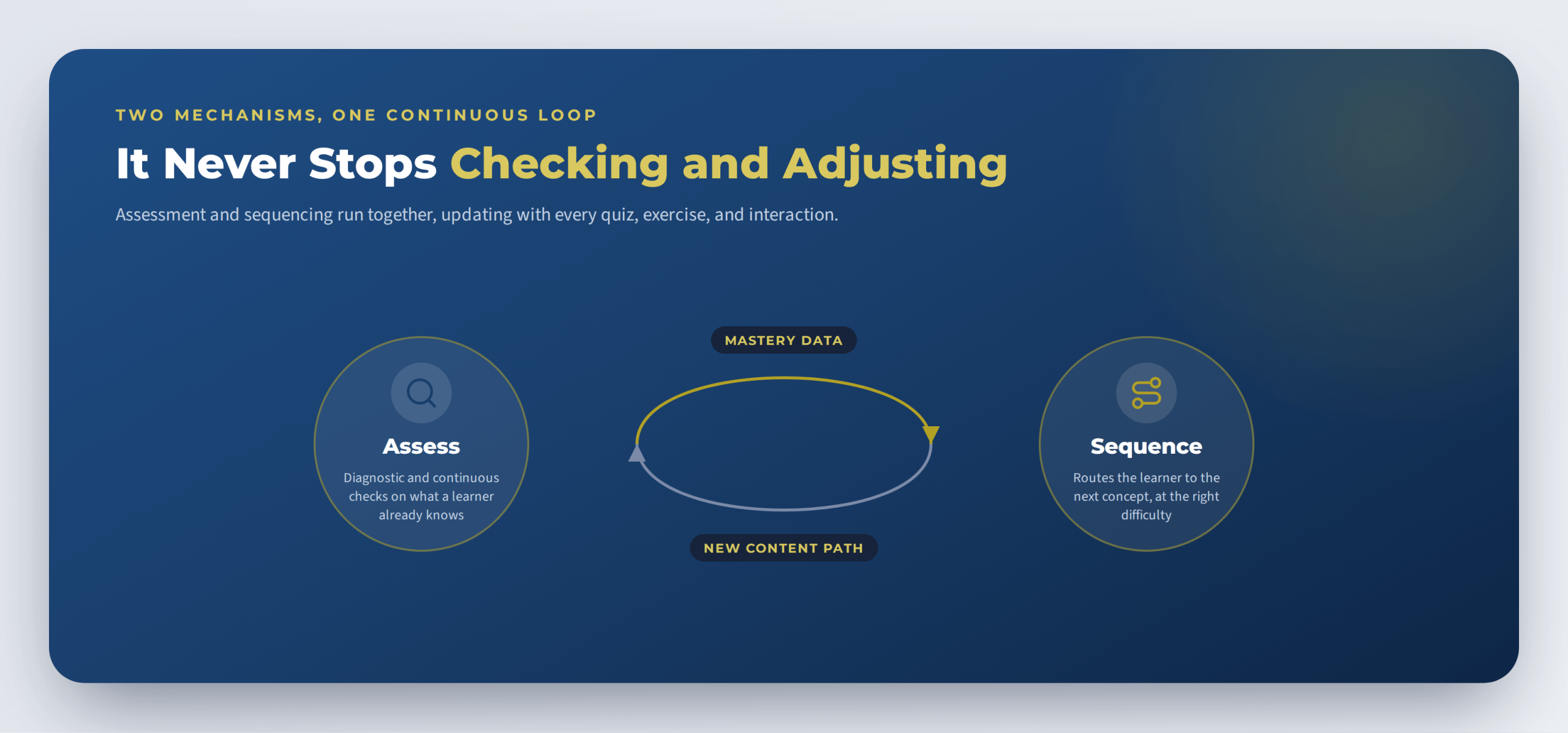
Adaptive learning platforms personalize content through two linked mechanisms working together in a continuous loop. The first mechanism assesses what a learner already knows. The second mechanism sequences new content based on that assessment. Together these mechanisms replace a fixed syllabus with a data-driven path unique to each learner, the operational core of AI-driven curriculum personalization.
What Is Diagnostic and Continuous Assessment?
Diagnostic and continuous assessment is how an adaptive platform determines what a learner already knows before and while teaching new material. A diagnostic assessment runs before a unit begins, establishing a baseline of prior knowledge. Continuous assessment then updates that baseline after every quiz question, exercise, and interaction. Depending on the platform, signals may include assessment results, response patterns, time-on-task, and other learner interactions.What Is Dynamic Content Sequencing?
Dynamic content sequencing is how an adaptive platform decides which content, at which difficulty level, a learner sees next. Strong mastery of a prerequisite triggers advancement without repetition. Weak mastery triggers remedial content, an alternate explanation, or additional practice before advancement. The engine recalculates this after every new data point, so two students with different mastery profiles experience different paths in the same week.What Evidence Shows Adaptive Learning Changes Student Outcomes?
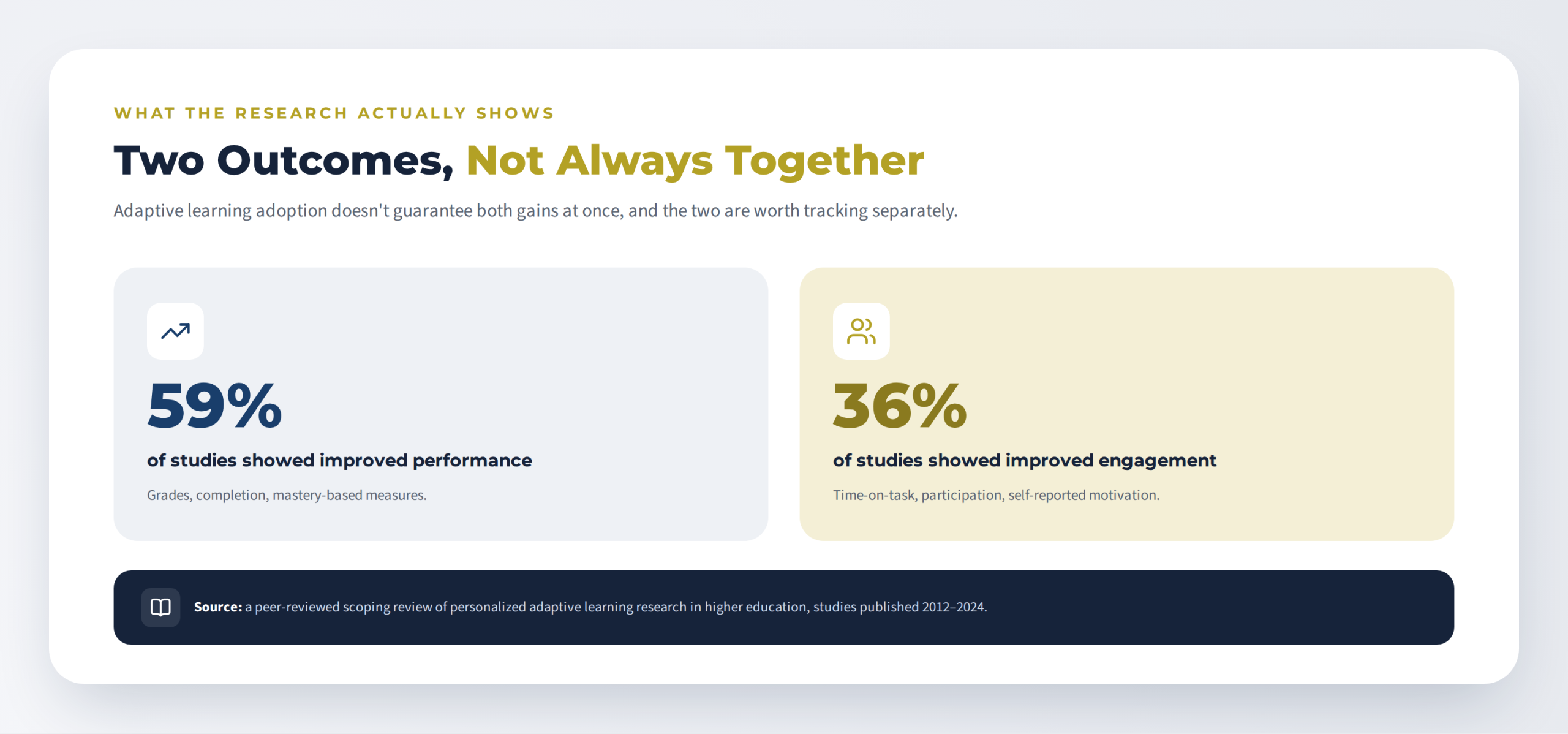
A 2024 scoping review published in Heliyon, examining 69 eligible studies on personalized adaptive learning in higher education, found improved academic performance in 41 studies (59 percent) and increased engagement in 25 studies (36 percent).
Performance and engagement are distinct outcome categories, and adoption doesn’t guarantee improvement in both at once. An implementation may improve academic performance without producing the same improvement in learner engagement, particularly early in adoption. Treat the two metrics as separate evaluation criteria, not a single combined score.
What Should Universities Evaluate Before Adopting an Adaptive Platform?
Universities should evaluate four areas before adopting an adaptive learning platform: integration compatibility, faculty change-management requirements, data governance policies, and learning and outcome alignment.- Integration compatibility with the existing student information system (SIS) and learning management system (LMS).
- Faculty change-management requirements, including training time and altered grading workflows.
- 3. Data governance policies covering who accesses learner-profile data and how long the institution retains it.
- Learning and outcome alignment: whether the platform personalizes around competencies, learner needs, and institutional outcomes, rather than simply automating content delivery.
Faculty roles can shift from single-pace delivery toward interpreting learner data and directing instruction where support is needed most. Rather than relying primarily on a common pace and sequence for the whole class, an instructor can use aggregate mastery data to focus live instruction on concepts where learners need more support. This is why adaptive learning is more than a technology deployment: it can reshape curriculum delivery, faculty practice, and learner support.
Where Is Adaptive Learning Headed in Higher Education?
Some adaptive learning platforms are beginning to incorporate generative AI tutoring, potentially extending personalization from content sequencing into conversational support. In these systems, a learner may receive explanations or follow-up questions informed by the same performance data used to personalize the learning pathway.
Instead of working through a remedial module alone, a student on a combined system gets conversational explanation and follow-up questions matched to the same mastery profile. This extends personalization beyond content sequencing into conversational instructional support.
Adaptive learning is one part of a larger shift already underway: universities and polytechnics moving from one-size-fits-all delivery toward AI-first, adaptive institutions built around skills-first learning, lifelong learning, applied learning, and workforce alignment.
CLaaS2SaaS helps universities and polytechnics transform into AI-First Adaptive institutions by connecting adaptive learning with skills-first pathways, lifelong learning, applied learning, and workforce alignment. Adaptive CLaaS® provides the personalization capability within that transformation, using learner intelligence to support more adaptive learning journeys at scale.
Share


Want to check if this career is for you?