What Is an AI-First University? The Model Replacing One-Size-Fits-All Education
What Is an AI-First University? The Model Replacing One-Size-Fits-All Education
Content
Content
One-size-fits-all curricula struggle to keep pace as job skills change. That gap is what the AI-first university model is designed to address. For university and polytechnic leaders, the question is whether AI and adaptive learning remain isolated tools or become part of how curriculum and delivery operate.
The Problem With One-Size-Fits-All Higher Education
A traditional curriculum is typically built once and taught many times, then updated on a fixed review cycle. That cadence made sense when the underlying skills didn’t move much between cycles. It doesn’t hold up as well against how quickly software tools, industry practices and in-demand skills can now shift — by the time a curriculum committee finishes revising a syllabus, the skill it was built around may already be behind what employers are hiring for.
Two warning signs are worth watching for as a result: graduate employability can plateau even as enrollment grows, and industry partners may describe a persistent gap between what graduates can do and what a role actually requires. Neither signal is necessarily about teaching quality — it can simply reflect an update cycle that’s too slow and too generic for a workforce that keeps changing.
Bolt-on digital tools don’t close this gap on their own, because they don’t touch the update cycle itself. A new LMS, a chatbot, or an AI writing assistant embedded into one course can improve the student experience without changing how often or how precisely the curriculum is revised. That’s the structural reason “adding AI tools” and “becoming an AI-first university” are different things — and for institutions looking for a genuine one-size-fits-all education alternative, the difference is exactly where the next section starts.
Defining the AI-First University
An AI-first university — sometimes called an adaptive institution — is one where AI and adaptive learning aren’t features added to an existing curriculum; they function as the operating model the curriculum runs on. Two things typically distinguish this from a traditional institution that has simply added some AI tools.
First, curriculum currency moves from periodic to more continuous. Instead of a committee revising content on a fixed academic calendar, an agentic system helps keep content and skills mapping aligned to industry demand on an ongoing basis, subject to institutional governance and academic oversight.
Second, delivery becomes adaptive at the level of the individual learner rather than the cohort. Instead of every student moving through identical content at an identical pace, the learning path can adjust based on demonstrated strengths and gaps.
CLaaS2SaaS applies this idea through HigherEd CLaaS2SaaS: an Agentic CLaaS2SaaS + Adaptive CLaaS model, delivered via CLaaS Academy’s library of 100+ Digital Skilling Modules. It’s worth being precise about what this framing is and isn’t: “AI-first university” describes a model — a way of running curriculum and delivery — rather than a fixed, industry-standard definition every vendor uses identically. What matters for a university or polytechnic evaluating this shift isn’t the label, but whether the underlying model actually changes how fast curriculum updates and how personalized delivery becomes.
Adaptive vs Traditional: A Side-by-Side Comparison
The clearest way to see the difference is side by side, factor by factor, rather than as an abstract philosophy. As with any comparison of an established model against an emerging one, treat the right-hand column as a direction of travel rather than a guaranteed outcome — the pace and extent of change will depend on institutional governance, academic oversight, and how a specific program is run.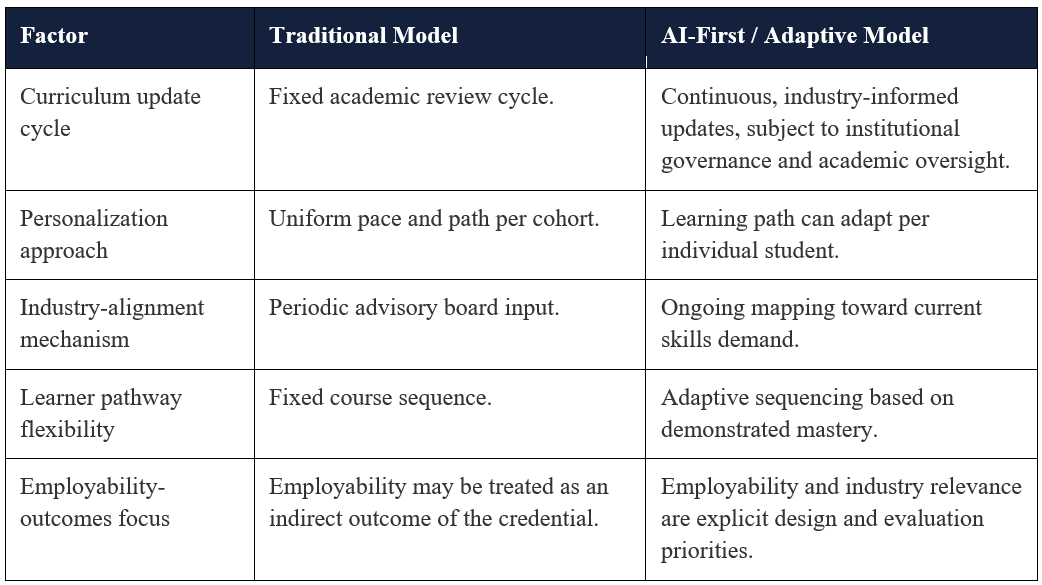
- Curriculum update cycle — How often does your institution actually revise course content in response to a documented skills gap?
- Personalization — Are students in the same course able to progress at different paces based on demonstrated mastery today?
- Industry alignment — Does employer feedback change curriculum directly, or is it collected without a clear path into course design?
- Pathway flexibility — Could a student’s sequence change based on competency, or is it fixed by academic year?
- Employability focus — Is employability measured and reported as an institutional metric, or assumed as a natural result of graduation?
What This Looks Like in Practice: CLaaS Academy
For an institution putting this model into practice, the starting point is often the skilling layer rather than a wholesale rebuild of every program. CLaaS Academy’s 100+ Digital Skilling Modules give a university or polytechnic a ready library of content built for an adaptive, agentic delivery model, rather than requiring every module to be authored from scratch before a pilot can start.
Paired with the Agentic CLaaS2SaaS + Adaptive CLaaS approach, this can let a department begin applying the AI-first model to a specific cohort or program without redesigning the institution’s entire curriculum architecture on day one. The module library is one part of how the operating-model shift — more continuous currency, more individual-level adaptivity, more work-integrated delivery — gets applied in practice; the surrounding governance, faculty roles and assessment design matter just as much.
What this looks like for a specific institution — which programs, which cohort size, what a pilot timeline realistically involves — depends on current systems and structure, and connects to CLaaS2SaaS’s broader Future-Ready Talent approach. That’s exactly the kind of detail a direct conversation can resolve faster than a guide.
Frequently Asked Questions
What is an AI-first university?
An AI-first university (or “adaptive institution”) is one where artificial intelligence and adaptive learning aren’t add-ons bolted onto an existing curriculum — they function as the operating model. Course content, delivery and personalization are shaped by AI/agentic systems so the curriculum can stay current with real industry skills demand. CLaaS2SaaS applies this idea through HigherEd CLaaS2SaaS — an Agentic CLaaS2SaaS + Adaptive CLaaS model delivered via CLaaS Academy’s 100+ digital skilling modules. Book a 1:1 consultation to see how it could map to your institution.
How is an AI-first university different from just using AI tools in the classroom?
Using AI tools in the classroom means layering AI onto an otherwise unchanged curriculum — a chatbot here, an AI grading assistant there. Becoming an AI-first university means AI and adaptive systems function as the operating model itself: how curriculum content stays current, and how delivery adapts to each learner. The first changes the experience of one course; the second changes how the institution functions.
What is an “adaptive institution”?
Within CLaaS2SaaS’s framing, “adaptive institution” is a closely related term for an AI-first university — this is the adaptive institution meaning used throughout this guide: an institution whose curriculum and learner pathways can adjust more responsively than a fixed, one-size-fits-all model. Other organizations may use the terms differently, so evaluate the underlying capabilities rather than the label.
Does becoming an AI-first university improve graduate employability?
The model is designed to help close the curriculum-to-industry gap that can contribute to weak employability outcomes — continuous currency and work-integrated delivery are both aimed at that gap. The actual impact for a given institution depends on program mix, industry sector and starting point; a 1:1 consultation is the best way to map expected outcomes to your specific context.
Is the AI-first model only for large universities?
No. HigherEd CLaaS2SaaS is intended for both larger universities and polytechnics. These institutions can begin with one department or cohort and use the pilot evidence to guide a phased expansion.
Becoming an AI-first university isn’t a single overnight rebuild — most institutions start with one cohort or department and scale from there through CLaaS Academy’s modules.
Share


Want to check if this career is for you?