Work Study Degree
Online Classes PH - CHED-Accredited Credentials & OFW Guide
Online Classes PH - CHED-Accredited Credentials & OFW Guide
Content
Content
As AI, automation, and digital transformation continue to reshape industries, many professionals are turning to online learning not just to earn credentials, but to build future-ready capabilities that support career advancement, career transition, entrepreneurship, and leadership opportunities in the digital economy.
Work schedules, family responsibilities, tuition costs, and location can make it difficult to attend traditional on-campus classes. For overseas workers, navigating an OFW online study Philippines program brings even greater challenges because studying must fit around overseas work, time zone differences, and long-term career plans. Even if it’s online, your chosen online college courses; Philippines, should build practical capabilities that prepare you for long-term career growth.
This guide explains how to compare online learning options in the Philippines, including CLaaS2SaaS. It also explains what Filipino learners and OFWs should check before enrolling in recognized online learning pathways or career-focused pathways.
Recognition disclaimer:
Program recognition, accreditation status, credential type, and awarding institution may vary by program, intake, and learner pathway. This article is for general guidance only and does not guarantee CHED recognition for every online course or pathway. Before enrolling, learners should verify the latest program-specific recognition details with the official institution, relevant government source, or PH admissions advisor.
Program recognition, accreditation status, credential type, and awarding institution may vary by program, intake, and learner pathway. This article is for general guidance only and does not guarantee CHED recognition for every online course or pathway. Before enrolling, learners should verify the latest program-specific recognition details with the official institution, relevant government source, or PH admissions advisor.
Why Online Classes Matter for Filipino Working Adults
Online learning matters because many Filipino learners cannot pause life just to continue their education.
Some are already working full-time. Some support their families. Some live far from major campuses. Some are OFWs who want to upgrade their qualifications while staying employed abroad. For these learners, traditional education can feel out of reach.
Online classes help reduce those barriers by allowing learners to study from home, follow more flexible schedules, and continue earning while studying.
However, not every program offers the same outcome. Some online courses focus on short-term skills, while others support academic progression. Others are designed for learners who want both recognized credentials and practical, career-focused learning.
Increasingly, professionals are also seeking pathways that help them develop AI, digital business, data, marketing, and transformation capabilities. For many learners, online learning is becoming a vehicle for career acceleration rather than simply academic progression. So ideally, learning should combine flexible study with opportunities to apply new knowledge through practical projects, helping learners build confidence as well as recognised credentials.
That distinction matters. A learner who wants quick technical training may benefit from a free or low-cost short course. A learner who wants a university-based distance education experience may prefer a public open university route. A learner who wants flexible HigherEd with job-ready digital skills may need a more structured pathway that supports both academic and career outcomes.
Why the Program Must Fit Working Adults
A good online program should be realistic for working adults.
Learners should check the class schedule, weekly study commitment, assessment format, access to recorded sessions or online materials, mentor support, project deadlines, and online platform access.
Flexibility does not mean the program is easy. It means the learning design respects the learner’s real life. Working adults need structured guidance, applied tasks, and support when they struggle.
What to Check Before Choosing an Online School Philippines Learners Can Trust
Choosing an online provider should not begin with price alone. It should begin with recognition, learning fit, career outcomes, and clear program details.
A strong online school Philippines learners can trust should provide clear information about credential recognition, tuition, learning format, student support, and career relevance.
Check Career Outcomes, Not Just Course Lists
Many learners compare online programs by looking only at course titles. That is not enough.
The real question is whether the program builds skills that employers value. Filipino learners should look for programs that help them develop practical digital competencies, portfolio-ready work, and confidence to apply what they learn.
This is especially important in fields such as Digital Business, Digital Marketing, Data Analytics, Generative AI, Software Engineering, AI, Cloud, Cybersecurity, and 21st-Century Competencies. Depending on their goals, learners may pursue pathways focused on career acceleration (Digital Marketing, Data Science & AI), career conversion (AI Application Development, Software Engineering), or digital leadership (Digital Innovation MBA). The right pathway depends on whether the learner wants to advance in their current role, transition into a new profession, or lead digital transformation initiatives.
A strong pathway should not only teach theory. It should help learners apply knowledge and skills through real-world projects, guided learning, and career-relevant outcomes.
Check Pricing, Payment Options, and Program Inclusions
Pricing is one of the most important parts of the decision. Filipino learners and OFWs need to know not only how much a program costs, but what the fee includes.
Some options, such as TESDA Online Program courses, may be free. Public university options may publish tuition and fee structures. Private online education providers may use different pricing models, such as per subject, per unit, per term, per module, or per full pathway.
That is why learners should check provider-specific tuition information directly before making a decision.
Pricing disclaimer:
Fees, payment options, and program inclusions may change by intake, program, and learner profile. Any amount shown by a provider should be treated as indicative unless confirmed by the official admissions team. Learners should request the latest written quotation before enrolling.
Fees, payment options, and program inclusions may change by intake, program, and learner profile. Any amount shown by a provider should be treated as indicative unless confirmed by the official admissions team. Learners should request the latest written quotation before enrolling.
Learners should ask:
- What is the total program fee in PHP?
- Are there separate application, registration, platform, assessment, or graduation fees?
- Is payment made per module, per term, or for the full program?
- Are instalment options available?
- What is included in the fee?
- Are learning materials, mentoring, projects, or assessments included?
- What refund, deferment, or transfer policies apply?
Check OFW Study Fit, Credential Type, and Recognition Before Enrolling
For OFWs and overseas Filipino learners, online study can be useful because it allows them to continue learning without returning home or pausing employment. However, the program must fit around work schedules, time zone differences, document requirements, payment arrangements, and long-term career plans.
Before enrolling, OFWs should check:
- Schedule compatibility
Confirm class times, deadlines, and whether learning materials are accessible outside live sessions. - Time zone expectations
Ask if the program has synchronous classes, project meetings, mentor sessions, or assessments that require attendance at fixed times. - Weekly study load
Understand the expected number of study hours per week before committing. - Document requirements
Prepare digital copies of school records, identification documents, employment documents, and other admissions requirements. - Credential type
Check whether the program leads to a degree, diploma, certificate, professional certification, or other completion credential. - Awarding institution
Understand which institution or organization awards the credential and what official documents learners will receive after completion. - Recognition requirements, where applicable
If the credential is needed for employment, further study, or professional requirements, learners should check whether recognition, validation, or CHED status applies to the specific program. - Payment arrangements
Ask whether payment can be made from overseas and what payment options are available. - Support access
Confirm how to contact admissions, academic support, mentors, trainers, or student services online. - Career relevance
Choose a program that supports your long-term goal, whether that is promotion, career shift, further study, or return-to-Philippines employment.
CLaaS2SaaS , TESDA and UPOU: Which Online Learning Option Fits Your Goal?
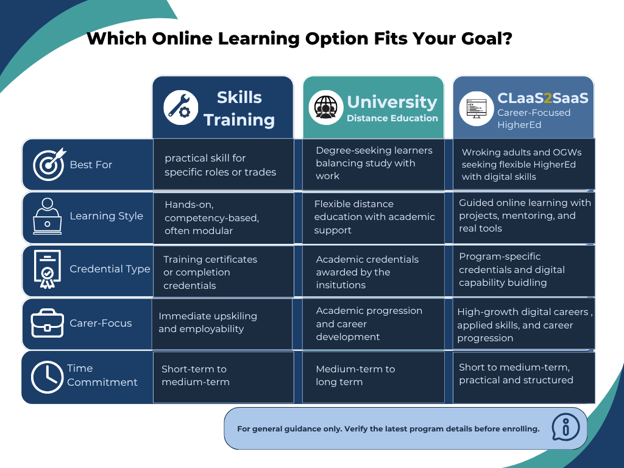
Online learning options in the Philippines serve different learner needs. TESDA, UPOU, and CLaaS2SaaS each support different goals, so the right choice depends on what the learner wants to achieve.
Some learners may need accessible technical-vocational training. Others may prefer open university distance education. Some working adults, SHS graduates, career shifters, and OFWs may need a more structured online learning option that combines flexible study, applied digital skills, guided support, and career-focused outcomes.
This comparison is not about saying one option is better than the others. It is about helping learners understand which pathway may fit their situation, budget, learning style, and long-term career plan.
Comparison note:
This comparison is for general learner guidance only. Program availability, fees, credential type, recognition status, and learning format may change over time. Learners should verify the latest details directly with each institution, provider, or official source before enrolling.
This comparison is for general learner guidance only. Program availability, fees, credential type, recognition status, and learning format may change over time. Learners should verify the latest details directly with each institution, provider, or official source before enrolling.
| Criteria | TESDA Online / Skills Training | UPOU / Open Distance Education | CLaaS2SaaS Career-Focused Online Learning |
|---|---|---|---|
| Best for | Learners who want accessible technical or vocational upskilling | Learners who want public open university or distance education | Working adults, SHS graduates, career shifters, and OFWs who want flexible online learning with practical digital skills for career acceleration, career conversion, digital leadership, and business transformation capabilities |
| Cost model | Often free or low-cost depending on the course | Public university tuition and fees | Paid program with admissions and payment guidance |
| Credential type | Training certificates or completion credentials, depending on the course | Academic credentials awarded by the institution | Program-specific credentials. Learners should confirm the awarding institution, credential type, and recognition status before enrolling |
| Learning style | Modular, skills-based, or self-paced learning | Open learning or distance education | Guided work-integrated learning with projects, mentoring, digital tools, and practical workplace application |
| Career focus | Technical-vocational upskilling and employability skills | Academic progression and flexible university learning | Job-ready digital skills (AI-enabled business, technology, and transformation capabilities), applied projects, and career progression |
| Best learner fit | Learners seeking short-term skills training | Learners seeking a public university-based distance learning option | Learners who want structured online learning with practical digital capability building |
TESDA is a strong option for learners who want accessible technical-vocational training. UPOU is a strong option for learners who want open and distance university education through a public university model.
CLaaS2SaaS may be a better fit for learners who want a more career-focused online learning experience. This includes learners who want guided support, applied projects, digital skills, and a structured pathway that can help them prepare for career progression or career conversion.
For Filipino working adults, SHS graduates, career shifters, and OFWs, the best option is not always the cheapest or the most academic. It is the option that fits their schedule, learning needs, budget, and career direction.
Career-Focused Pathway: What CLaaS2SaaS Offers Filipino Learners
CLaaS2SaaS should be positioned as a career-focused online learning option for Filipino learners who want practical digital skills, structured support, and flexible study.
That means the offer is not simply “online classes.” It is designed to help learners build practical AI-enabled business, technology, and transformation capabilities that support career progression, career conversion, and digital leadership.
CLaaS2SaaS supports learners at different stages of their professional journey—from professionals seeking career advancement, to career switchers entering high-growth digital fields, to aspiring digital leaders looking to drive business transformation initiatives.
- Stackable learning routes that allow learners to progressively stack industry certifications, digital capabilities, and higher education credentials into larger career pathways.
- Skills-first learning focused on practical workplace application
- Work-integrated learning where learners apply skills through real-world tasks
- AI-powered learning exposure across digital business, automation, analytics, and software-related areas
- Career conversion support for learners who want to shift into digital roles
- Applied projects that help learners demonstrate capability beyond theory
- Data Science & AI – pathway for professionals seeking AI and data capabilities to support digital transformation initiatives.
- AI Application Development – pathway for career changers entering software and AI development roles.
- Digital Innovation MBA – pathway for professionals seeking AI-enabled leadership capabilities, digital transformation expertise, and the ability to lead technology-driven business transformation initiatives.
A career-focused learning option should help learners answer questions such as:
- Can I apply what I learned at work?
- Can I build projects that show my skills?
- Can I explain my capabilities to employers?
- Can I keep learning as digital tools change?
- Can this program support my next career step?
Career Outcomes and Learner Proof: What to Look For
Many learners still wonder whether online learning can produce career value. The answer depends on the quality of the program, the learner’s effort, and how well the program connects learning with practical workplace skills.
Online learning can be effective when it includes structure, support, feedback, applied projects, and clear outcomes. It is weaker when it only provides passive videos without guidance or practical application.
For working adults and OFWs, a strong pathway has opened doors to major corporate benefits:
- Learners can continue working while building new digital capabilities.
- They can apply lessons to workplace tasks, projects, or career goals.
- They can build confidence in digital tools, communication, and online collaboration.
- They can strengthen their readiness for career mobility, career conversion, or further study.
- They can gain support from mentors or trainers while completing assignments and projects.
For example, Linus Lee, an Advanced Certificate in Infocomm Technology learner, shared:
“The week my training ended, I was immediately referred to an IT Consultancy firm for an opportunity for a role that I was really interested in. Within a month, this opportunity became my current newfound job.”
This testimonial reflects a goal shared by many Filipino working adults and OFWs: gaining practical skills that can open new career opportunities. It also highlights the value of programs that combine online learning with applied projects, guidance, and career-focused support. However, individual results vary, and testimonials should not be viewed as a guarantee of employment or specific career outcomes.
Frequently Asked Questions
Are CLaaS2SaaS online courses CHED-recognized?
Learners should verify the latest CHED recognition details for the specific program or pathway before enrolling. Recognition may vary depending on the credential, awarding institution, and program structure. Ask the PH admissions team for current written confirmation.
How does online learning at CLaaS2SaaS compare to TESDA free courses?
TESDA is a strong option for free or low-cost technical-vocational upskilling. CLaaS2SaaS is positioned as a career-focused HigherEd pathway for learners who want recognized credentials, applied projects, and job-ready digital skills.
What is the difference between TESDA, UPOU, and CLaaS2SaaS?
TESDA focuses on technical-vocational education and skills development. UPOU focuses on open learning and distance education through a public university model. CLaaS2SaaS is for learners looking for flexible HigherEd pathways supported by skills-first digital learning and career-focused outcomes.
Can OFWs study online while working abroad?
Yes, many OFWs can study online while working abroad if the program schedule, workload, and assessment format fit their situation. OFWs should confirm class timing, online access, document requirements, and payment arrangements before enrolling.
How much do online courses cost in Philippine pesos?
Costs vary by provider, program, credential type, and duration. TESDA Online Program courses may be free, while public university and private HigherEd pathways may have tuition and other fees. Learners should request the latest official quotation before enrolling.
Conclusion: Choose Online Learning Based on Recognition, Flexibility, and Career Value
Online learning in the Philippines should be evaluated by more than convenience.
For Filipino working adults, SHS graduates, career shifters, and OFWs, the right pathway should combine recognized credentials, flexible distance education, practical knowledge and skills, transparent pricing, and career-focused support.
Different online learning options serve different learner goals. TESDA may be ideal for accessible technical-vocational upskilling. UPOU may be ideal for open university learning. CLaaS2SaaS may be the better fit for learners who want a HigherEd online pathway supported by job-ready digital skills and applied learning.
Before enrolling, compare your options carefully. Check recognition. Ask about pricing. Review the learning format. Understand the career outcomes. Most importantly, choose the pathway that fits your life and your long-term goals.
Explore a Work-Integrated pathway that helps you build AI, digital, and transformation capabilities while continuing your career, so you can accelerate growth, transition into new opportunities, or lead business transformation initiatives.
Share


Want to check if this career is for you?