Home ប្លុក ការផ្លាស់ប្តូរនៃវិស័យអប់រំខ្ពង់ខ្ពស់ How Universities Can Use Stackable Digital Skills Pathways to Serve Working Adults
ការផ្លាស់ប្តូរនៃវិស័យអប់រំខ្ពង់ខ្ពស់
How Universities Can Use Stackable Digital Skills Pathways to Serve Working Adults
How Universities Can Use Stackable Digital Skills Pathways to Serve Working Adults
Content
Content
Working adults need ways to build digital skills without putting their careers on hold. For universities, stackable learning pathways offer a way to serve these learners through sequences of credentials that each carry standalone labor-market value and also count as credit toward a larger award.
What Is a Stackable Learning Pathway, From the University’s Point of View?
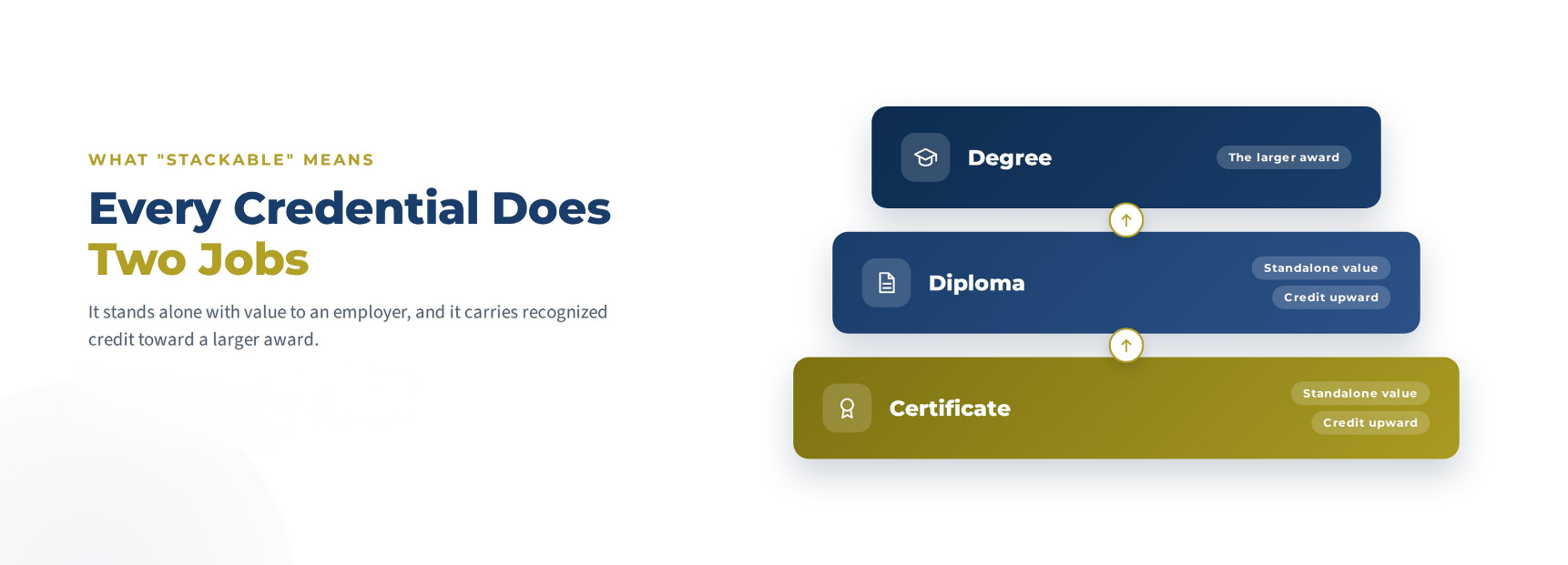
From the university’s side, a stackable pathway is a design and policy decision, not just a set of short courses. Each credential, whether a certificate, diploma or degree, must serve two purposes: demonstrate value to employers on its own and carry formally recognized credit toward a larger qualification, so learners can progress without repeating learning they have already completed.
This is why the micro-credentials that universities offer become stackable only when the institution recognizes them as credit toward a larger award.[BS1.1] The same applies to modular digital skills pathways: modules matter to learners when they accumulate into something the institution will credit. For lifelong learning universities, the product shifts from a one-off program to a sequence a learner can enter, leave and re-enter.
Why Do Working Adults Need This Format?
Working adults face three constraints that a conventional degree can struggle to meet: time, cost risk and income continuity. Study has to fit around work and family rather than replace them. A large commitment up front is harder to justify when the outcome is uncertain. Leaving work to study is not realistic for every adult. Stackable credentials for working adults respond to these constraints by letting a learner commit to a smaller unit, gain something usable, and decide later whether to continue.
There are signs the demand is already there. A Strada Education survey, as reported by the US publisher BestColleges, found that 40% of working-age adults have completed a non-degree credential. It is a single survey reported secondhand, so treat it as an indicator of demand, not a forecast for any one institution’s catchment.
For the learner’s view of the same idea, see this guide to business management pathways in Singapore.
How Should a University Design the Pathway?
Five design decisions shape whether a pathway works in practice:- Entry points and prior learning: offer more than one way in, and publish how prior learning and work experience are assessed for credit, within the rules of the institution’s own regulator.
- Credit mapping between levels: decide in advance how each credential counts toward the next, and take the mapping through normal academic governance, so a learner can see the route before starting.
- Modular scheduling: repeatable intakes and formats that fit around work, with the rules on how long credit remains valid stated up front.
- Employer co-design: involve employers in defining the skills each credential should evidence. BestColleges reports that the State University of New York (SUNY) system offers hundreds of stackable micro-credentials designed with industry partners. The scale is specific to SUNY, but the practice is transferable.
- Assessment of applied skills: assess what a learner can do in a workplace-style task, not only what they can recall, and apply the same quality assurance to short credentials as to degree modules.
What Operational Barriers Appear, and How Do Institutions Handle Them?
Stackable pathways raise operational questions a degree-only catalogue rarely has to answer, and each is easier to settle before launch than after enrolment:- Credit transfer and policy: rules are needed for how short credentials convert to credit, who approves the conversion and how long credit stays valid.
- Pricing per module: modular pricing differs from annual tuition and affects how adults budget and how employers or funders pay, so set it deliberately and keep it consistent across routes.
- Advising: learners need help planning a route across several credentials, so advisers must understand the whole stack, not single programs.
- Marketing to adults: messaging should speak to working-adult constraints and employer value, which differ from school-leaver recruitment.
- Systems for partial progress: student records, billing and credit systems built around degree cohorts may not capture credentials earned, credit banked or routes taken, so test them before launch.
How Do You Know It Is Working?
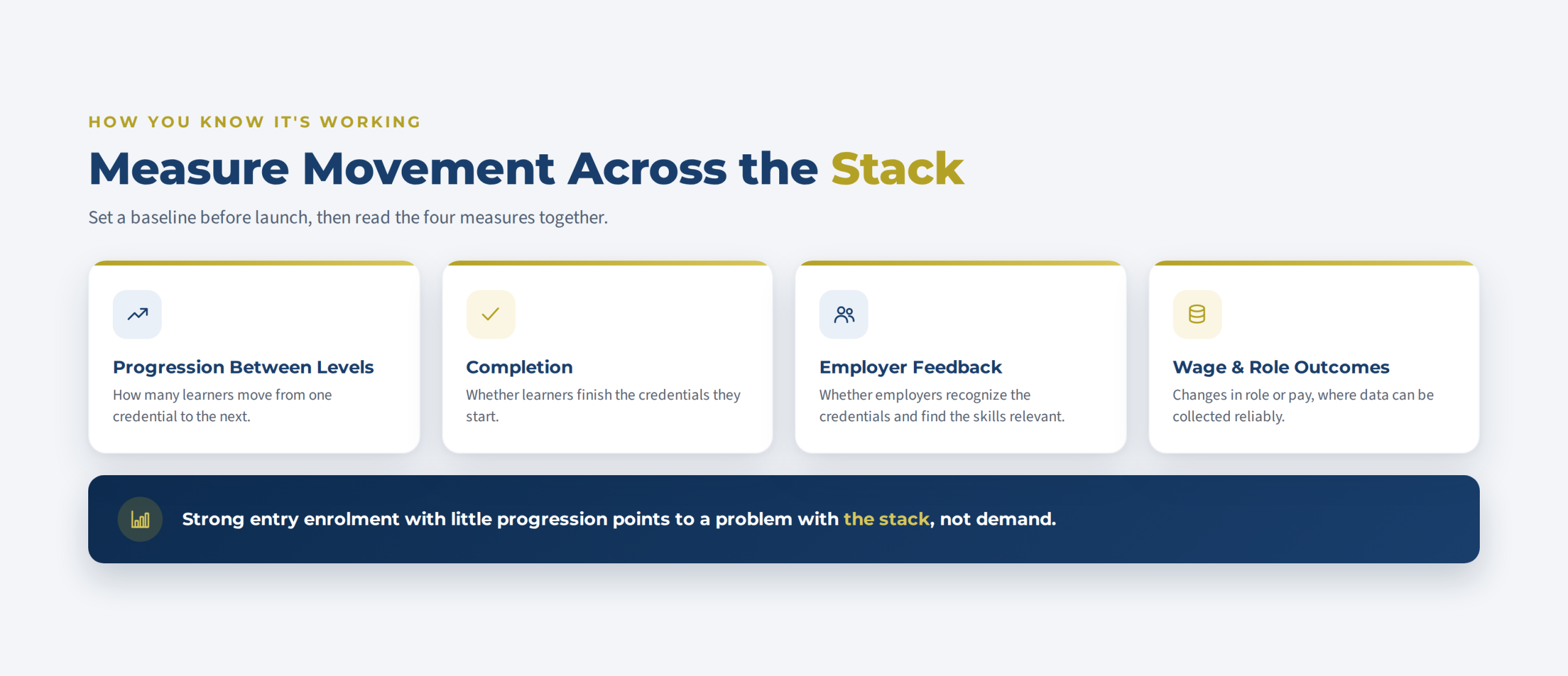
Measure movement across the stack, not only enrolment in the entry credential:
- Enrolment and progression between levels: how many learners move from one credential to the next
- Completion: whether learners finish the credentials they start
- Employer feedback: whether employers recognize the credentials and find the skills relevant
- Wage and role outcomes, where tracked: changes in role or pay, where the institution can collect that data reliably
Frequently Asked Questions
What is the difference between a micro-credential and a stackable credential?
A micro-credential is a short, focused qualification. It becomes stackable when the institution formally recognizes it as credit towards a larger award, so a learner can accumulate shorter credentials and later combine them into a diploma or degree instead of starting over.
Do stackable pathways lower the value of the full degree?
Stackable pathways do not inherently reduce the value of a full degree. Their credibility depends on academic standards, assessment quality and the integrity of the credit awarded. Universities should ensure that shorter credentials meet defined learning outcomes, apply appropriate quality assurance and monitor learner outcomes as credentials accumulate toward a larger qualification.
How do universities recognize prior work experience?
Recognition-of-prior-learning policies vary by institution and country. Follow your own regulator’s rules, and set out in advance what evidence is accepted and how it is assessed against the credential’s outcomes.
Who pays for these pathways?
Funding varies by country and context. It may come from individuals, employers or government schemes, and no single model applies everywhere. Check which routes apply in your market before setting module pricing.
How long should each stack take?
There is no standard length. Duration depends on the credit framework, the awarding body’s requirements and the time working adults can commit, so define each stack in your own credit or module terms and test it with working adults.
Further reading: Explore how CLaaS2SaaS approaches the transformation of universities into an AI-first, adaptive lifelong learning institution through skills-first, work-integrated learning and modular digital skilling. This offers an example of how institutions can rethink learning delivery and lifelong learning to serve changing learner and workforce needs.
Share


Want to check if this career is for you?