What Is Work-Integrated Learning? A Complete Guide for Career Switchers
What Is Work-Integrated Learning? A Complete Guide for Career Switchers
Isi kandungan
Isi kandungan
The term ‘Pembelajaran terintegrasi dengan dunia kerja‘ gets used in very different ways depending on who is using it. For some, it refers to university internship modules. For others, it describes something closer to a co-op placement. If you have been searching what is work-integrated learning and found conflicting answers, that is why. This guide defines the term clearly, explains how it works in an applied upskilling context, and maps out what a real work-integrated pathway looks like for career switchers.
Work-Integrated Learning, Defined (and What It Is Not)
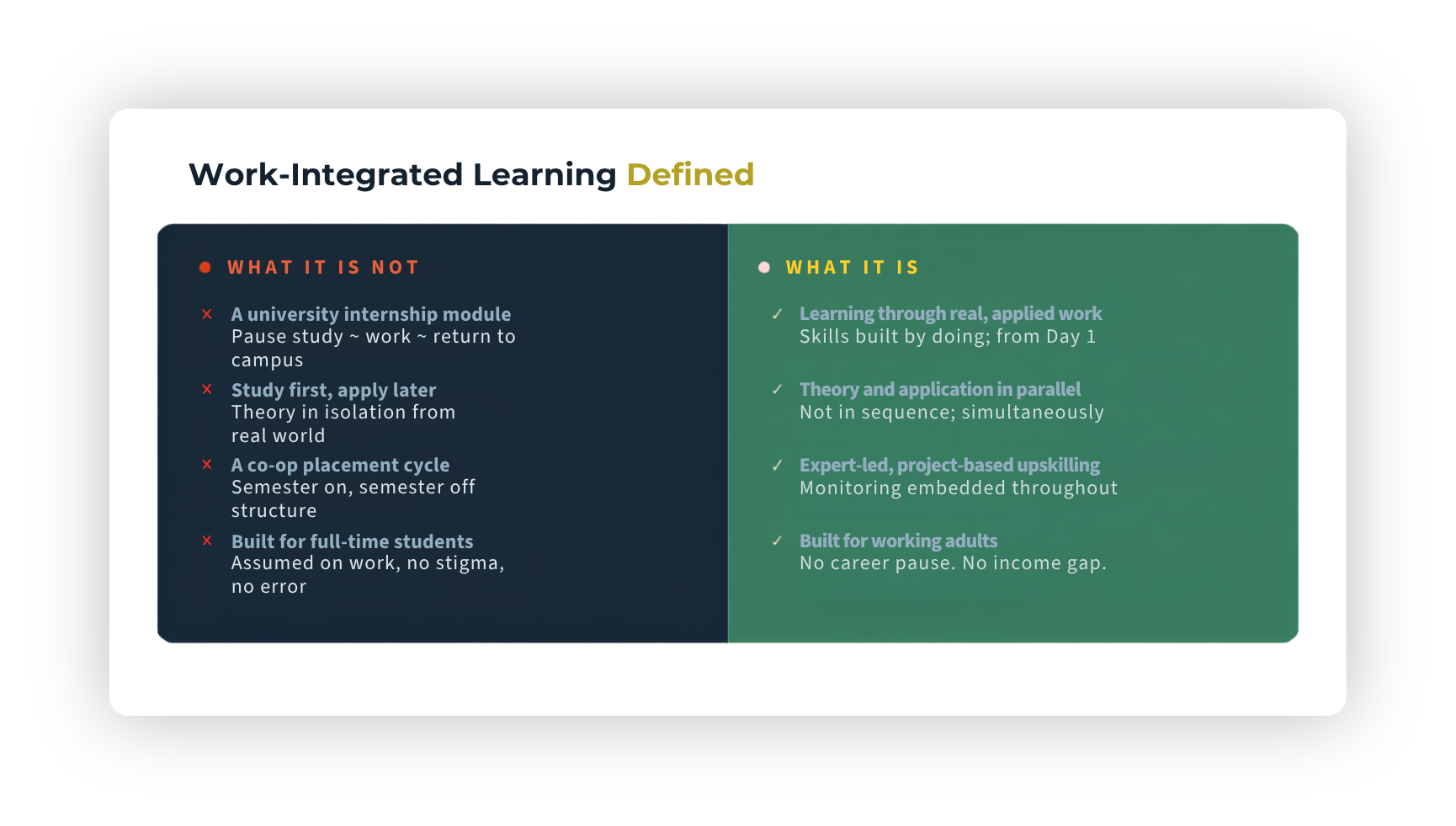
Work-integrated learning is an approach to education that combines structured learning with applied, real-world work. Instead of studying a subject in isolation and hoping to apply it later, you develop skills by doing actual work as part of the learning process itself. Theory and application happen in parallel, not in sequence.
In university settings, work-integrated learning is often synonymous with co-op programmes or internship modules: a semester-long placement that forms part of a full-time degree. The student pauses academic study, works at an employer, then returns to campus. This is the framing that dominates most search results on the topic, particularly those originating from Australian and North American higher education contexts.
The work-integrated learning offered through CLaaS2SaaS is applied upskilling for working adults and career switchers. It is not a university internship add-on. It is a structured, expert-led programme where learning happens through industry-relevant projects, mentoring, and guided application from day one. There is no campus to return to between placements. The entire model is built on the principle that adults learn most effectively through doing, not just listening.
This distinction matters if you are a working adult, evaluating your options. The two models serve different people in different situations and conflating them leads to the wrong conclusions about what work-integrated learning can offer you.
How the 70:20:10 Model Works
Central to understanding work-integrated learning explained is the 70:20:10 learning model, the framework that underpins how this approach allocates learning activity.
The model works like this. Roughly 70 percent of learning comes from hands-on experience: working on real projects, solving real problems, and making decisions under actual conditions. This is the dominant mode because it is where skills become durable. Reading about data analysis is very different from cleaning a messy dataset for a live project with a deadline.
Approximately 20 percent of learning comes from social and collaborative experience: working with mentors, receiving expert feedback, collaborating with peers, and learning from people who have done the work before. This layer is what converts raw experience into structured understanding. Without it, hands-on learning can reinforce bad habits as easily as good ones.
The remaining 10 percent comes from formal instruction: structured content, frameworks, models, and theory that give context to the applied work happening in the other 90 percent. Formal instruction matters, but in this model it is the scaffolding rather than the building.
A well-designed work-integrated programme should intentionally balance practical experience, mentoring, and structured learning. CLaaS2SaaS applies this approach through its 70:20:10 learning model. Expert mentoring is embedded throughout, not bolted at the end. Formal instruction provides the conceptual backbone that makes the project work legible and transferable.
For career switchers, this matters because the 70:20:10 can help learners build job-relevant skills earlier than programmes focused primarily on classroom instruction. You are not studying toward a future application. You are applying now, with structure and support around you.
E-Commerce dan Manajemen Bisnis Digital
Seiring semakin banyak perusahaan beralih ke dunia online untuk pertumbuhan, penjualan, dan keterlibatan pelanggan, ini merupakan salah satu jalur karir paling langsung yang dapat diambil dari gelar ini. Manajer e-commerce, pemimpin operasi digital, dan manajer bisnis online bertanggung jawab atas kinerja komersial saluran digital. Mereka mengelola daftar produk, saluran konversi, pengalaman pelanggan, dan pelaporan pendapatan. Komponen e-commerce dari kurikulum ini secara langsung terkait dengan tanggung jawab tersebut, dan lulusan yang memiliki pengalaman proyek di bidang ini memiliki posisi yang baik untuk memulai karier di level koordinator atau eksekutif dan berkembang pesat.
Peran Data dan Analisis
Seiring dengan meningkatnya ketergantungan perusahaan terhadap data dan pengambilan keputusan berbasis AI, organisasi di berbagai sektor mulai merekrut tenaga kerja yang memiliki keterampilan dalam bidang data literacy. gelar bisnis digital Dengan komponen analisis, kesempatan untuk bekerja di berbagai posisi seperti analis data, analis bisnis intelijen, dan analis kinerja digital terbuka lebar. Posisi-posisi ini berada di jantung pengambilan keputusan komersial, yang mengubah angka menjadi strategi. Siswa yang telah bekerja dengan data riil selama studi, seperti yang diwajibkan oleh program CLaaS2SaaS, akan membawa portofolio pekerjaan mereka, bukan hanya transkrip saja.
Peran Pemasaran Digital
Pemasaran digital tetap menjadi salah satu bidang perekrutan yang paling diminati dalam ekonomi digital. Lulusan memasuki posisi yang mencakup media berbayar, SEO, strategi konten, manajemen media sosial, dan analisis kampanye. Hal yang membedakan lulusan bisnis digital dengan lulusan pemasaran murni di bidang ini adalah konteks komersial dan data yang mereka bawa: mereka memahami bagaimana aktivitas pemasaran berhubungan dengan pendapatan, yang membuat mereka lebih efektif dan lebih mudah dipromosikan.
Usaha Wirausaha dan Jalur Pendiri
Tidak semua lulusan bergabung dengan perusahaan. Pilar-pilar kewirausahaan dan inovasi strategis dalam kurikulum ini dirancang untuk para lulusan yang berniat memulai usaha sendiri atau bergabung dengan perusahaan tahap awal dalam peran pendiri atau pertumbuhan. Kombinasi keterampilan komersial, digital, dan analitis adalah hal yang dibutuhkan para pendiri untuk meluncurkan, mengembangkan, dan memperluas bisnis digital modern.
Peran Strategi dan Inovasi Digital
Seiring dengan peningkatan pengalaman para lulusan, banyak di antara mereka yang dipindahkan ke posisi yang berfokus pada strategi digital, transformasi bisnis, dan inovasi. Posisi-posisi ini menjadi semakin penting seiring dengan percepatan inisiatif transformasi digital dalam organisasi. Mereka berada lebih dekat dengan pimpinan senior dan membutuhkan kemampuan untuk menghubungkan inisiatif teknologi dengan strategi bisnis dan perubahan organisasi. Komponen inovasi strategis dalam kurikulum merupakan jalur paling jelas menuju jalur ini dari waktu ke waktu.
Why Career Switchers Choose Work-Integrated Learning
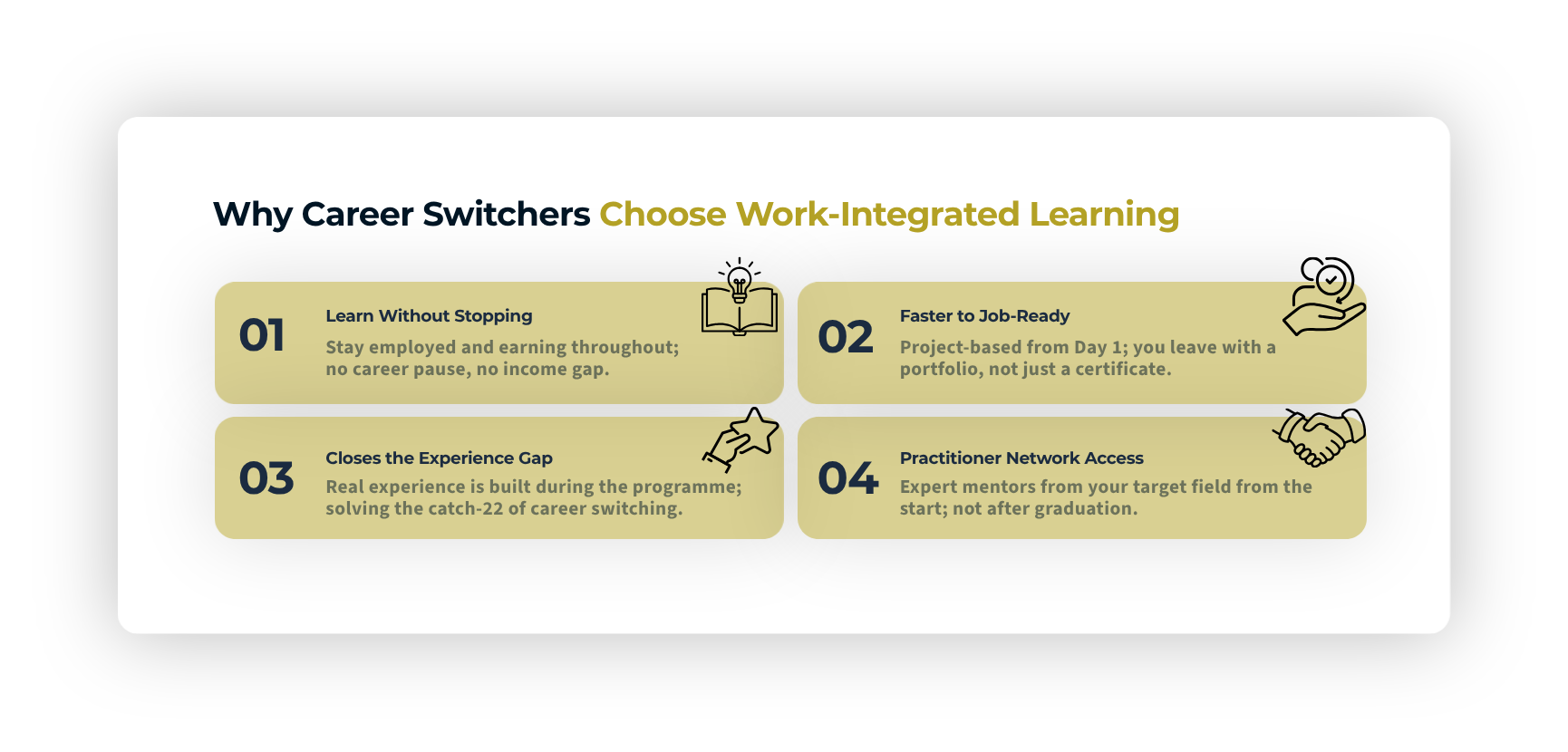
The benefits of work-integrated learning are significant for anyone switching careers, but they are particularly well matched to working adults who cannot afford to step away from income, pause their careers for years, or gamble on qualifications that do not translate into employable skills.
The most immediate benefit is the ability to learn without stopping. A traditional full-time study programme asks you to pause your career, your income, and in many cases your professional network while you acquire new skills. A work-integrated model inverts this. You are building skills while remaining active, earning, and present in a professional context. The risk profile of switching careers drops considerably when you do not have to exit your current life to do it.
The second benefit is speed to job-readiness. Because learners apply new skills throughout the programme, you are not waiting until the end of a programme to have something to show an employer. By the time you complete a work-integrated pathway, you have a portfolio of applied project work, not just a certificate. That distinction is significant to hiring managers to evaluate candidates with similar credentials. If you are aiming for a tech role, our software engineer interview prep guide shows how to get ready for the job search.
Work-integrated learning for career switchers also addresses one of the most common barriers to career change: the experience gap. Employers routinely want experience in a new field before they will hire into it, which creates a circular problem for anyone trying to switch. A work-integrated model closes that gap by generating real experience as part of the learning process.
Finally, the expert mentoring component provides professional network access that traditional study rarely offers. Learning from practitioners who are active in the field you are moving into accelerates not just skill development but industry awareness, which is often the soft factor that separates a candidate who gets interviews from one who does not.
What a Work-Integrated Pathway Looks Like
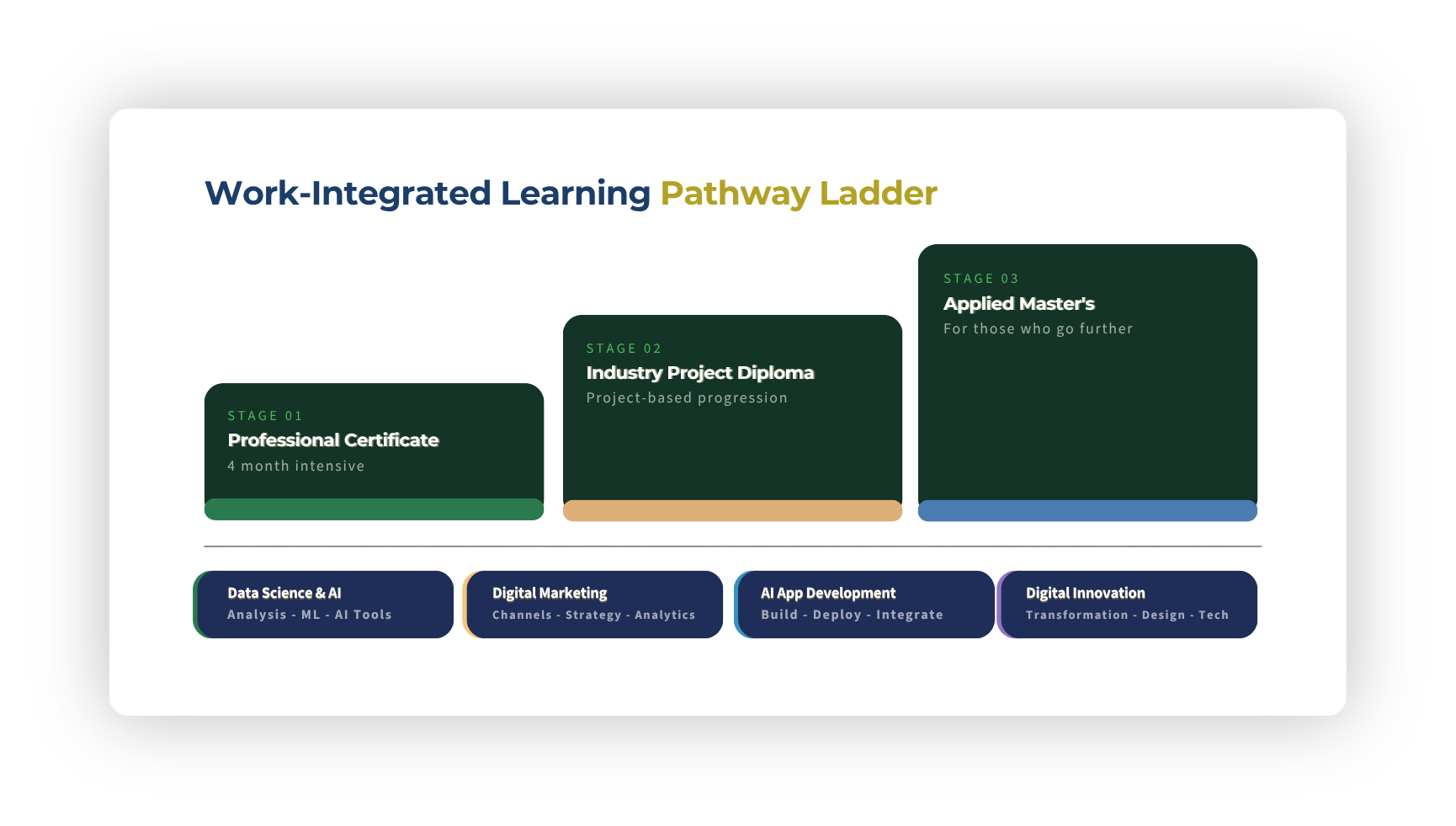
The CLaaS2SaaS work-integrated model follows a clearly structured progression rather than a single fixed endpoint. The pathway runs from a 4-month intensive skilling bootcamp delivering a Professional Certificate, through to an industry project-based Diploma, and on to an Applied Master’s for those who want to go further. Each stage builds the last, and the ladder is designed to be climbed without necessarily stepping away from work.
The four tracks available on the work-integrated digital programs hub reflect the areas of highest demand in the current digital economy.
The Data Science and AI track covers the tools and applied methods driving data-led decision-making across industries, from analysis to machine learning applications.
The Digital Marketing track covers the commercial, strategic, and channel-specific skills that modern marketing roles require, with applied project work running throughout.
The Pengembangan Aplikasi AI track focuses on building practical AI-enabled applications through applied projects, helping learners develop modern digital solution development.
The Digital Innovation track is designed for those looking to lead transformation and build new digital capabilities within organisations, combining strategy, design thinking, and applied technology.
Each track follows the same 70:20:10 structure: expert-led, project-based, and designed around the needs of working adults switching careers rather than students entering the workforce for the first time.
Pertanyaan umum
Apa itu pembelajaran terintegrasi dengan dunia kerja?
Work-integrated learning blends structured study with applied, real-world work, mentoring, and hands-on practice. At CLaaS2SaaS, it follows a 70:20:10 model: most learning happens through projects, supported by mentoring and formal instruction.
Apakah pembelajaran terintegrasi dengan dunia kerja sama dengan magang?
No. A university internship is typically a placement module within a full-time degree, where a student pauses academic study to work at an employer and then returns to campus. Work-integrated learning in an applied upskilling context is a different model entirely: learning happens through real projects and expert mentoring from day one, with no campus placement cycle. It is built for working adults, not full-time students.
Apa itu model pembelajaran 70:20:10?
The 70:20:10 model is a framework for how adults develop skills most effectively. Approximately 70 percent of learning comes from hands-on, on-the-job experience; 20 percent from social learning, mentoring, and collaboration; and 10 percent from formal instruction. Work-integrated programmes structured around this model are designed to support faster application of skills through continuous practice and mentoring.
Is work-integrated learning good for career changers?
Yes. It is particularly well suited to career changers because it builds real, demonstrable skills without requiring you to stop working. You develop a project portfolio during the programme, which addresses the experience gap that typically makes career switching difficult. The mentoring component also provides access to practitioners in your target field from the start of the pathway.
What programs use work-integrated learning at CLaaS2SaaS?
CLaaS2SaaS offers work-integrated pathways across four tracks: Digital Marketing, Data Science and AI, AI App Development, and Digital Innovation. Each follows the 70:20:10 work-integrated learning model and is structured as a progression from Professional Certificate through to an Applied Master’s pathway.
Work-integrated learning enables career switchers to build practical capabilities while continuing to work, making career transition more achievable without putting life on hold. The structure, mentoring, and applied learning model are in place from day one. If you’re ready to explore how this approach could support your next move, let’s talk.
Bagikan


Ingin tahu apakah karier ini cocok untuk Anda?