How Adaptive Learning Platforms Help Enterprises Build Future-Ready Workforces
How Adaptive Learning Platforms Help Enterprises Build Future-Ready Workforces
အကြောင်းအရာ
အကြောင်းအရာ
An adaptive learning platform for employees adjusts training content, pace, and difficulty to each person’s demonstrated skills and role. For enterprises, that means moving beyond a single training track toward personalized employee training that keeps pace with the business.
Many corporate programs still apply one fixed curriculum to a workforce that spans different roles, skill levels, and learning speeds. This post explains why that falls short, how enterprise adaptive learning personalizes training at scale, what future-ready workforce learning requires, and what to check before rollout.
Why Does One-Size-Fits-All Corporate Training Fall Short?
One-size-fits-all corporate training falls short because skill baselines vary widely. The same module is too basic for some employees and too advanced for others, so neither group is well served. Advanced learners waste time on material they already know, while those who are behind get too little support to close their specific gaps.
Consider a data-literacy course rolled out to an entire operations team. Some employees already build spreadsheets and dashboards daily. Others have never opened a data analysis tool.
The experienced group disengages because the content is redundant. The beginners struggle because the fixed pace assumes a baseline they lack. Both groups finish with a completion record, yet neither necessarily reaches the intended outcome.
Completion shows that people sat through the material, not that a skill gap closed. That gap between “completed” and “capable” often stays invisible until it surfaces in a performance review or in a role the employee is not ready for. Adaptive learning instead uses demonstrated capability to decide what an employee studies next.
How Does an Adaptive Learning Platform Personalize Training at Scale?
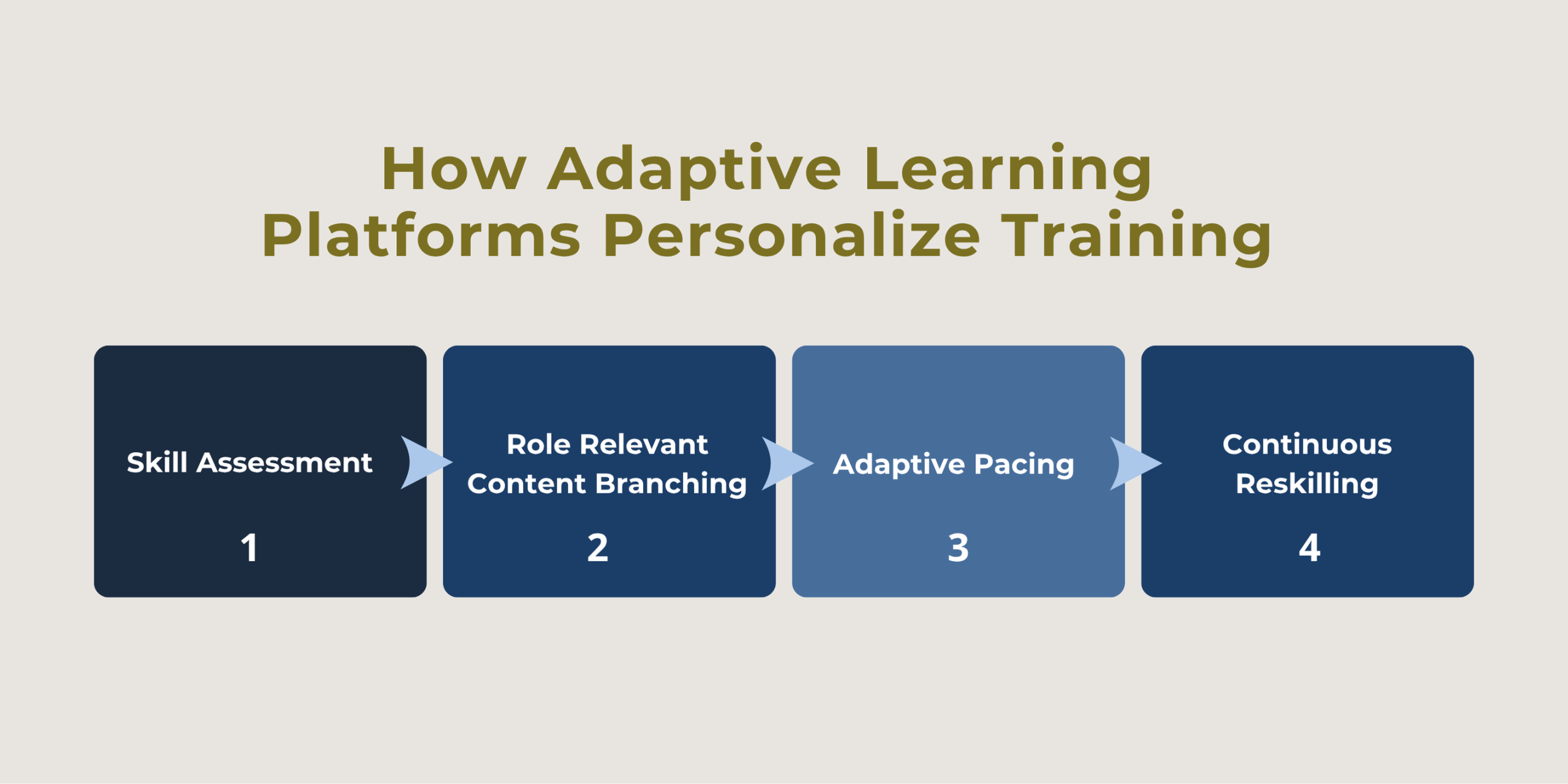
An adaptive learning platform personalizes training in four connected steps: skill assessment, role-relevant content branching, adaptive pacing, and continuous reskilling.
First, it assesses what each employee already knows before assigning anything, rather than assuming everyone in a role starts from the same baseline. Next, it branches content by role relevance, so the path reflects the employee’s actual job function instead of a generic company-wide curriculum. Pacing then adjusts continuously: faster for quick mastery, with added support where needed, and without a coordinator tracking each path by hand.
At enterprise scale, the value extends beyond a single course. With appropriate governance and employee consent, verified skill data from onboarding, role changes, and leadership development can inform later learning plans, so each one builds earlier progress instead of starting from scratch.
The research is encouraging but should be read with care. A 2024 scoping review in Heliyon examined 69 studies of adaptive learning among undergraduate students, published between 2012 and 2024. It found improved academic performance in 41 studies (59%) and increased engagement by 25 (36%). Because those studies involved university students rather than employees, treat the results as directional, not proof of workplace impact, and measure outcomes in your own pilot.
What Does “Future-Ready” Actually Mean for a Workforce?
Future-ready workforce learning means building the capacity to reskill continuously as roles evolve, not completing a one-time training event. A workforce trained only on today’s tools and processes can struggle when those tools, processes, and requirements change.
This continuity is what adaptive learning platforms are built to support. The same mechanics that personalize an initial program also drive ongoing reskilling as role requirements shift, helping the enterprise develop capabilities alongside changes in technology, processes, and business priorities. When a new analytics tool or compliance rule arrives, employees can be reassessed and routed only to the gaps that matter, instead of waiting for the next annual training cycle.
Practical Use Cases Across an Enterprise Workforce
Three use cases show the potential value of adopting adaptive learning:- Onboarding personalization adapts ramp-up training to a new hire’s experience level. Experienced hires move through foundational material faster, while others get extra support without being singled out.
- Role-transition reskilling targets the gap between an employee’s previous role and the new one, rather than repeating training designed for someone starting from zero.
- Leadership and succession development tailors training to each candidate’s development areas instead of running every future leader through an identical curriculum.
What to Evaluate Before Rolling This Out Enterprise-Wide
Before rolling out, review these five areas. A limited pilot in one function can also give you real workplace data before you commit to wider investment.- Integration. Confirm that the platform connects to your existing LMS and HR systems rather than requiring a wholesale replacement.
- Assessment of validity and fairness. Check that skill assessments measure what they claim to and do not disadvantage employee groups.
- Privacy, security, and accessibility. Understand what employee data is collected, how it is stored, and who can access it, and confirm that every employee can use the platform.
- Human oversight and employee trust. Personalized recommendations only work if managers and employees trust and act on them, so plan to change management alongside the technical rollout and keep people involved in consequential decisions.
- Outcome measurement. Decide in advance how you will measure learning outcomes beyond course completion.
Within an AI-First Adaptive Enterprise, employee skill data, role requirements, learning pathways, and business priorities can continuously inform workforce development. Explore how Adaptive CLaaS® supports enterprise adaptive learning and personalized workforce development.
မျှဝေပါ


ဒီအလုပ်ကသင့်အတွက်လားဆိုတာ စစ်ဆေးချင်ပါသလား?