အဖွင့်စာမျက်နှာ ဘလော့ HigherEd Transformation How AI-Assisted Grading and Feedback Help University Faculty Focus on Teaching
HigherEd Transformation
How AI-Assisted Grading and Feedback Help University Faculty Focus on Teaching
How AI-Assisted Grading and Feedback Help University Faculty Focus on Teaching
အကြောင်းအရာ
အကြောင်းအရာ
Grading and feedback compete with teaching, mentoring and research for the same faculty hours. AI-assisted grading offers one way to ease that pressure, and the working principle is simple: AI handles the repeatable first pass, faculty keep the judgment.
What Does ‘AI-Assisted Grading’ Actually Cover?
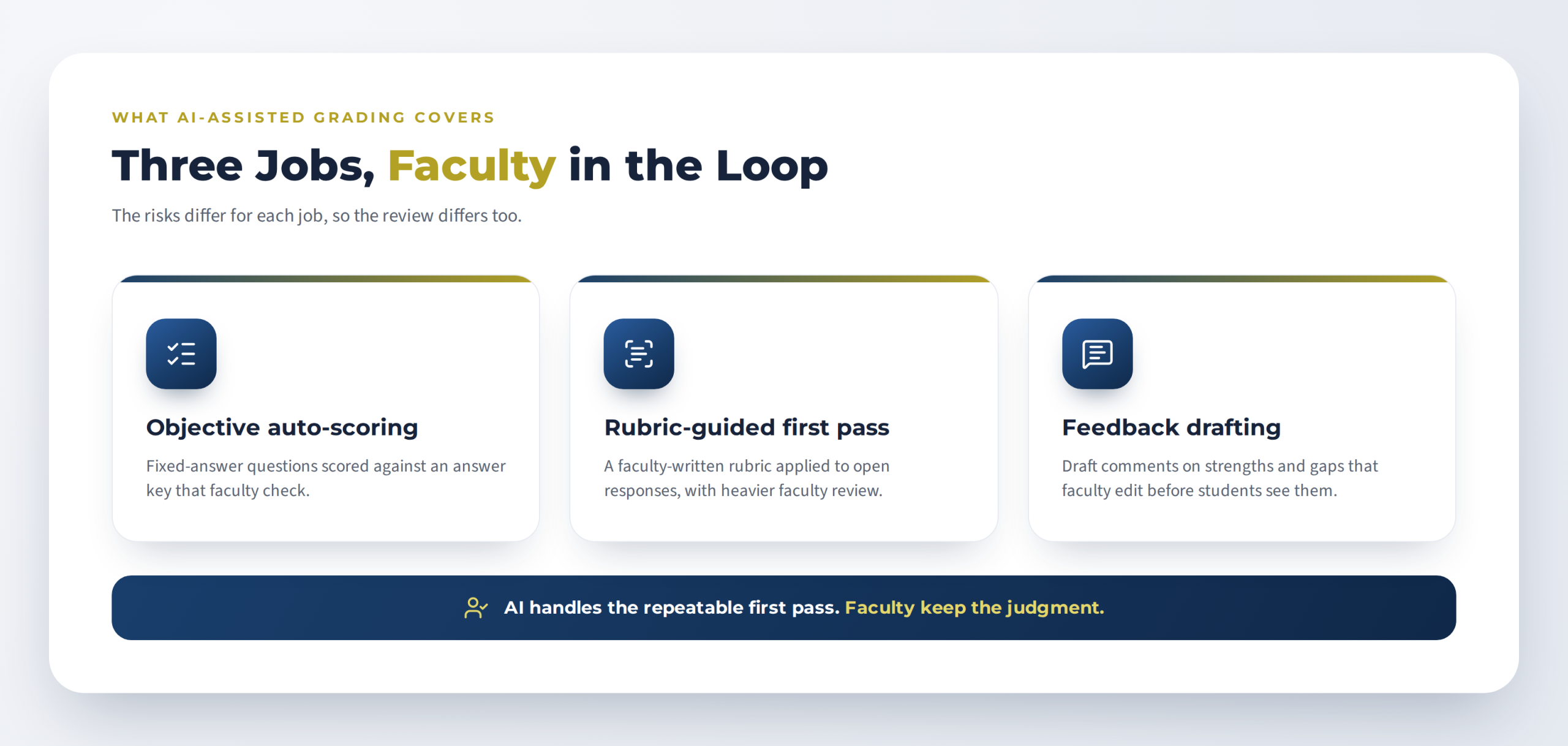
AI grading tools for universities cover three different jobs, and the risks differ for each:
- Objective auto-scoring: scoring multiple-choice, numerical or fixed-answer questions against an answer key. Faculty still check the key, since a wrong key affects every student’s score.
- Rubric-guided first-pass scoring: applying a faculty-written rubric to open responses such as essays or reports and proposing a score for each criterion. This needs heavier faculty review because it involves interpretation.
- Feedback drafting: producing draft comments on strengths and gaps, so AI feedback on student work starts as a suggestion that faculty edit before students see it.
How Do Rubric-Based First Passes and Feedback Drafts Work?
The rubric becomes the instruction. The tool can only apply the criteria it is given, so the quality of a first pass depends on how clearly the rubric describes each performance level. A realistic workflow runs as follows:- Write or refine the rubric: state each criterion and level in specific, observable terms, with examples of work at each level.
- Calibrate on marked work: run the tool on scripts faculty have already marked, compare the results and adjust the rubric wording where they diverge.
- Generate the first pass: the tool proposes a score per criterion and draft comments tied to the rubric.
- Review, edit or override: a faculty member reads each submission alongside the proposal and accepts, changes or rejects it. Cases the tool handles poorly go to full human marking.
- Moderate: a second marker checks a sample, as for any marking.
- Release: faculty-approved feedback goes to students, and the faculty member owns the final grade.
Where Does the Time Go Back to Teaching?
Whether a first pass saves time is an empirical question. Review takes effort, and results vary with the task, the rubric and the tool, so any figure for hours saved should come from a department’s own pilot, not a vendor’s claim. Where a first pass does reduce routine marking effort, the freed time can go to work that depends on a person:- Feedback quality: more attention on comments that need judgment, such as a student’s line of argument, and less on restating rubric descriptors.
- Office hours and mentoring: more time for students whose work shows a specific difficulty.
- Assessment redesign: time to rework tasks and rubrics so they measure the intended learning, including how students use AI in the course.
What Safeguards Should Faculty Insist On?
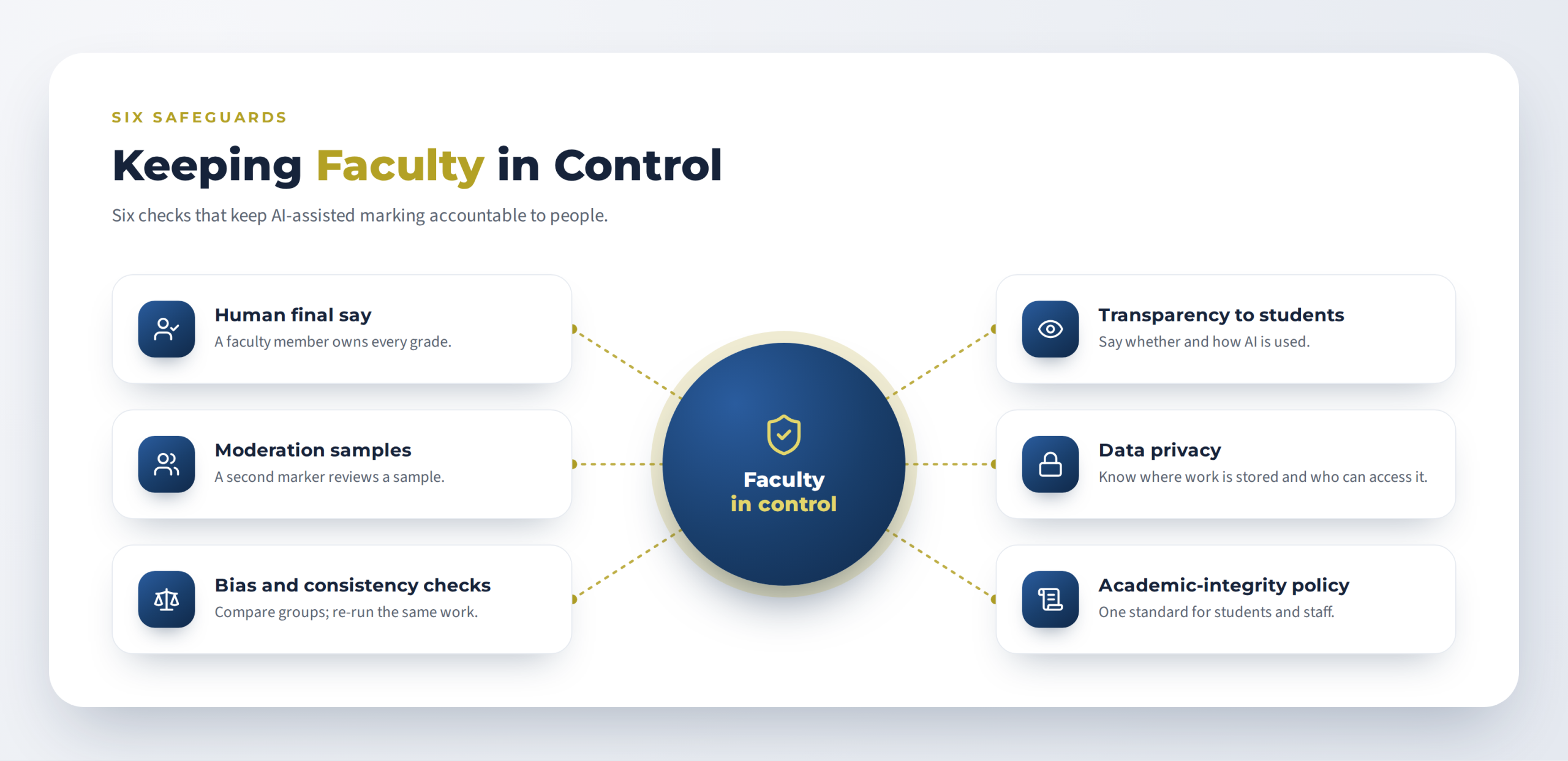
Six safeguards keep faculty in control:
- Human final say: a faculty member owns every grade, AI proposals are inputs, and students have a clear route to ask a person to re-review.
- Moderation samples: a second marker reviews a sample of AI-assisted marks across the full score range, widened wherever the tool and faculty disagree.
- Bias and consistency checks: compare outcomes across student groups and writing styles, and check whether the same work receives the same proposal when run again.
- Transparency to students: say whether and how AI supports marking and feedback, in line with institutional policy.
- Data privacy: know where student work is stored and processed, how long it is retained, whether it trains models, who at a vendor can access it, and which data-protection rules apply.
- Academic-integrity policy: keep marking practice consistent with the institution’s rules on AI use by students and staff, so one standard applies on both sides.
How Should a Department Pilot It?
Start narrow: one course, one assignment type, one clear rubric, preferably a structured task, since subjective or creative work needs heavier review. Mark the same sample two ways, faculty-only and AI-assisted with faculty review, and compare the results criterion by criterion across a full assessment cycle. Record where faculty override the proposal and why, track review time as well as marking time, and gather student and faculty feedback. Agree in advance what would lead to extending, adjusting or stopping, and treat the outcome as evidence for the department’s own policy, not a demonstration of any product.
AI-assisted grading is one part of a broader shift toward AI-First Adaptive Universities. The goal is not simply to automate marking, but to use AI responsibly across teaching and learning while keeping educators in control of assessment, feedback and student development. Each institution can start with a focused pilot, evaluate the evidence and determine where AI can meaningfully support its academic goals.
မေးလေ့ရှိသော မေးခွန်းများ
Can AI grade essays accurately enough to replace markers?
Not on its own. The more defensible approach is to treat AI as a first-pass assistant that applies a rubric and drafts feedback, while a faculty member reviews, adjusts and owns the final grade. Institutions should validate any tool against faculty marking before relying on it.
Does AI grading introduce bias?
It can. Tools can reflect patterns in their training data or score some groups of students differently, so use moderation samples and subgroup checks. No bias rate is quoted here because it varies by tool, task and student group.
Will students know AI was used?
That depends on institutional policy, but transparency is good practice. Tell students whether and how AI supports marking and feedback, and who makes the final decision.
What kinds of assessments suit AI-assisted marking?
Structured, rubric-friendly tasks are a sensible starting point. Subjective or creative work needs heavier faculty review, and some tasks may stay entirely human-marked.
Is student work safe when AI is used?
It can be, but only once the arrangement has been checked. Treat student work as personal data, involve the institution’s privacy lead before any pilot, and ask the vendor to document its handling in writing. The safeguards above list what to ask.
မျှဝေပါ


ဒီအလုပ်ကသင့်အတွက်လားဆိုတာ စစ်ဆေးချင်ပါသလား?