Moving Beyond ERP Automation: How AI Enables Smarter Institutional Operations
Moving Beyond ERP Automation: How AI Enables Smarter Institutional Operations
Nội dung
Nội dung
Agentic ERP enables smarter institutional operations in higher education by adding a reasoning layer on top of ERP workflows, one that doesn’t just flag a problem for a human, but takes approved routine action within defined guardrails and escalates only the exceptions and higher-stakes decisions that need a person. Most universities already automate routine ERP workflows, but limitations grow more visible as exceptions increase.
The sections below name the specific limits rule-based ERP automation hits once routine workflows are automated, explain what changes once AI reasoning and agent action sit on top, name where this shift matters most across finance, procurement, facilities, and compliance, and identify why change management, not the technology, determines whether it succeeds.
What Are the Limits of Rule-Based ERP Automation in Higher Education?
Rule-based ERP automation handles only workflows an institution can fully define in advance, following an explicit if-this-then-that structure. This works reliably for a routine invoice approval, payroll run, or standard purchase order, since each follows the same steps every time. It breaks down the moment a workflow hits an exception the rules never anticipated, such as an invoice missing a required field or a request spanning two departmental budgets at once.
An institution that has already automated its routine workflows typically discovers this limit. Staff find themselves manually routing an increasing share of exceptions around the system, because no rule, and no one empowered to act on the system’s behalf, covers the case in front of them.
The facilities department illustrates this concretely. Automated workflows approve a standard maintenance work order without difficulty, following the same three-step chain every time. The system stalls on a work order requesting emergency repair funding beyond a department’s remaining budget, since nothing can decide who approves it or how fast, so a staff member routes it manually by email, the exact workaround the automation was meant to eliminate.
What Changes When AI Sits on Top of ERP Workflows?
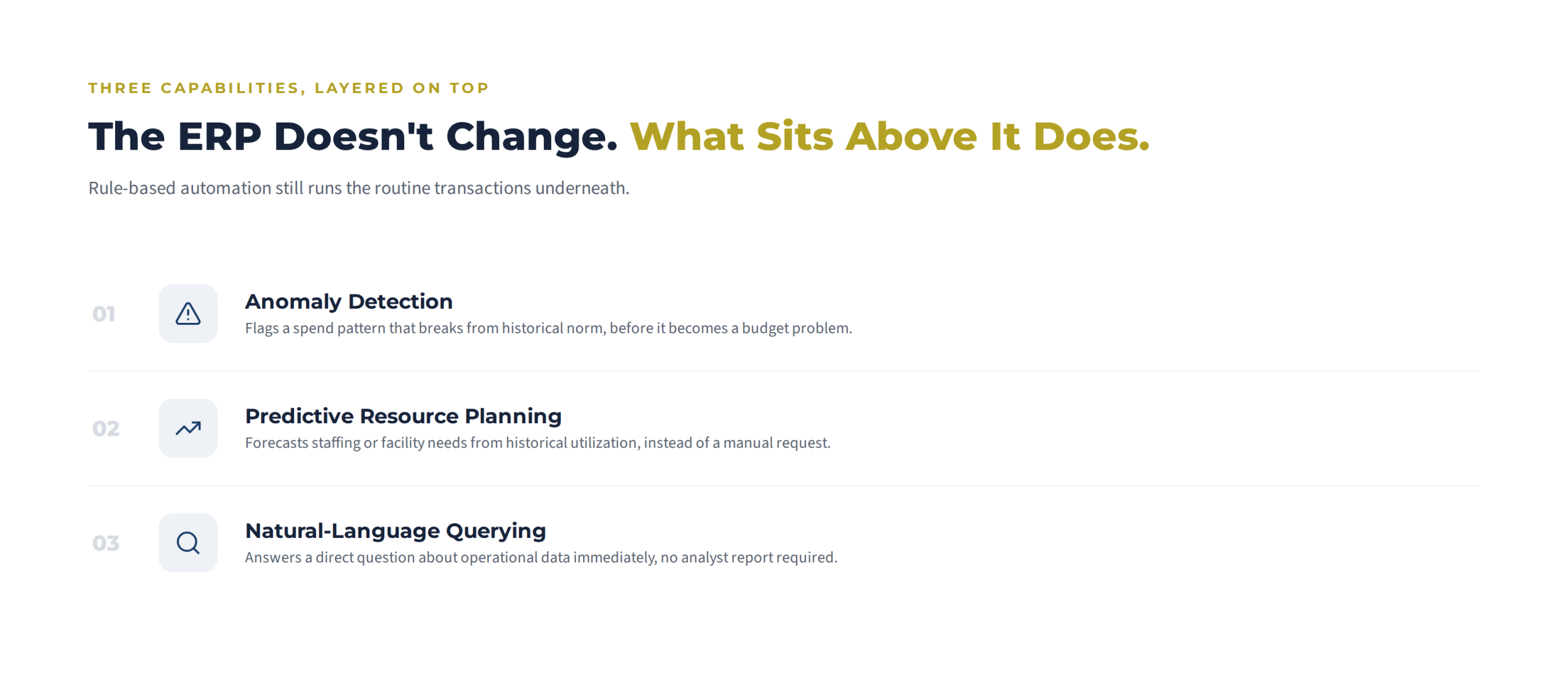
AI in university ERP adds two things rule-based automation cannot: reasoning across operational context, and agents that can act on that reasoning directly. Anomaly detection flags a spend pattern that deviates from historical norm. Predictive resource planning forecasts staffing or facility needs from historical utilization. Natural-language querying lets a staff member ask a direct question and get an answer immediately.
A 2025 review of AI in higher-education transformation, “What is Ethical: AIHED Driving Humans or Human-Driven AIHED?”, cites the University of Melbourne’s use of predictive analytics to forecast enrollment trends and improve resource-allocation efficiency, a secondary reference, the review cites the example rather than presenting original research, so treat it as illustrative rather than independently verified.
The real shift isn’t a better report for someone to act on. Within defined guardrails, financial thresholds, and segregation-of-duties controls, an agent can complete a pre-authorized routine action directly, such as approving a purchase request under an approved budget line, with every action logged in an audit trail. Only exceptions and higher-stakes decisions, exceeding an authorized threshold or carrying meaningful financial or compliance weight, escalate to a human, the same distinction the facilities example turned on.
What Institutional Operations Use Cases Are Worth Prioritizing?
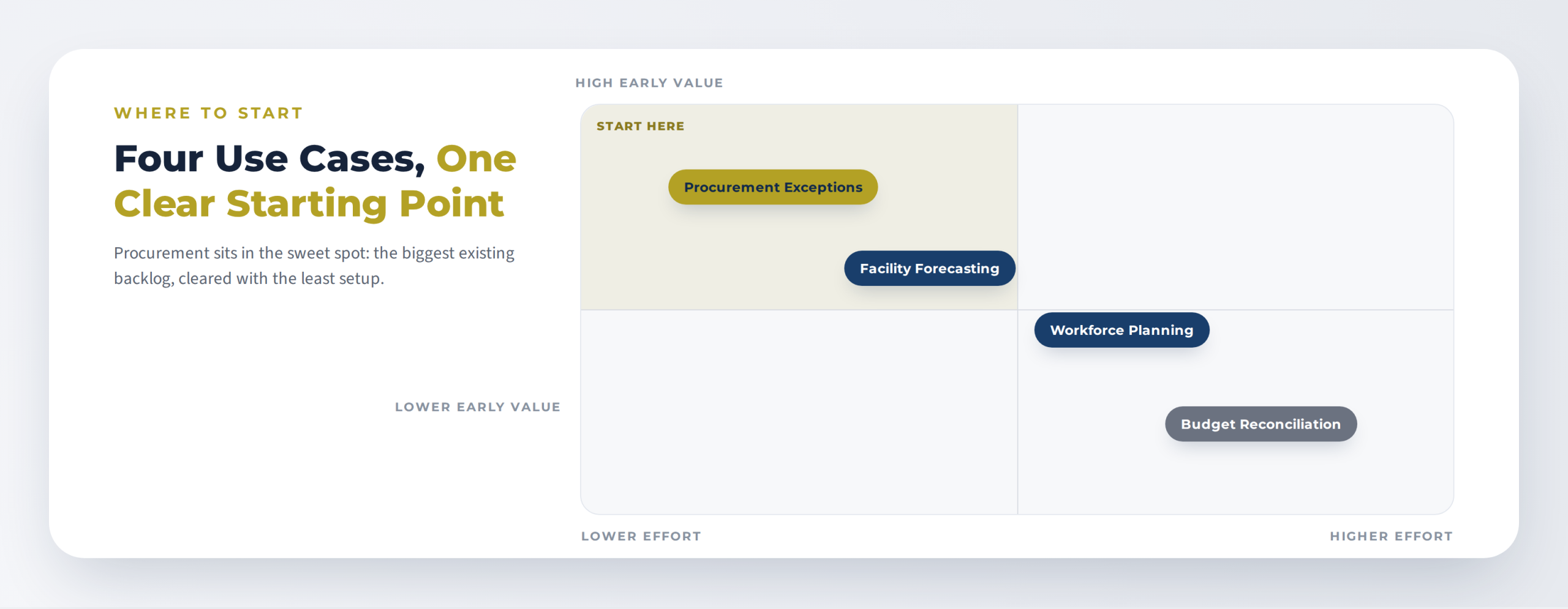
Institutional operations automation becomes more adaptive once agents can act within guardrails instead of only flagging, across four domains:
- Procurement. Purchase requests within pre-authorized budget lines are approved and routed automatically; requests crossing a financial threshold or falling outside segregation-of-duties rules escalate for human approval.
- Facilities and resources. Maintenance and space-booking requests within approved budget and capacity limits proceed automatically; requests exceeding those thresholds escalate.
- Workforce planning. Staffing adjustments within pre-approved forecast ranges proceed without a manual request; exceptions affecting headcount authorization escalate.
- Finance and compliance. Cross-budget reconciliation within defined tolerances completes automatically, logged in an audit trail; a pattern crossing two budgets or a compliance threshold escalates before it becomes a year-end issue.
Why Is Change Management the Real Barrier, Not the Technology?
Change management, not the technology, determines whether agentic ERP reduces workload. Staff who don’t trust an agent’s routine action will manually recheck every case anyway, eliminating the time saved. This trust gap widens without a transparent audit trail: if staff can’t see what the agent did, why, and where the guardrail applies, they won’t trust it.
A phased rollout by department works better than an institution-wide deployment. A department that lets agents handle routine action first, measures the time saved, and shares that result builds trust a simultaneous rollout can’t generate as quickly, starting with high-volume, well-bounded workflows where guardrails are easier to define and measure.
What Does ‘Smarter Operations’ Look Like After Adoption?
A year into adoption, smart campus operations means agents handle the routine volume across procurement, facilities, workforce planning, and finance/compliance within their guardrails, while staff spend most of their time on the exceptions and judgment calls the system escalates. The balance shifts by domain, with procurement and facilities typically reaching this state faster than finance and compliance, where higher-stakes decisions escalate more often by design.
Institutions mature on this timeline when leadership treats the first year as a measurement period, extending agent guardrails into new domains only as each prior one demonstrates a documented result. An institution that declares the project complete after the first rollout leaves the remaining gains uncaptured.
Agentic ERP is therefore not simply an ERP upgrade. It is an operational layer that helps an AI-First Adaptive University respond to institutional needs with greater speed, context, and consistency while keeping human oversight where it matters.
Chia sẻ


Bạn muốn kiểm tra xem nghề nghiệp này có phù hợp với mình không?