Học tập suốt đời CET
How to Scope an SME Automation Project Before You Build It
How to Scope an SME Automation Project Before You Build It

Nội dung
Nội dung
Unexpected requirements, repeated rework, and unhappy clients can turn a promising SME automation project into a frustrating engagement. Poor automation project scoping often causes these problems before development begins.
An automation project scope defines what will be automated, what is excluded, and how successful delivery will be assessed.
What Does ‘Scoping’ an Automation Project Mean?
Scoping translates a business problem into agreed boundaries before anyone builds a workflow. Three documents serve different purposes:- Scope: What the project includes and excludes.
- Requirements: How the workflow should behave, including its rules, inputs, and outputs
- Project plan: When work will happen, who is responsible, and when approvals are needed.
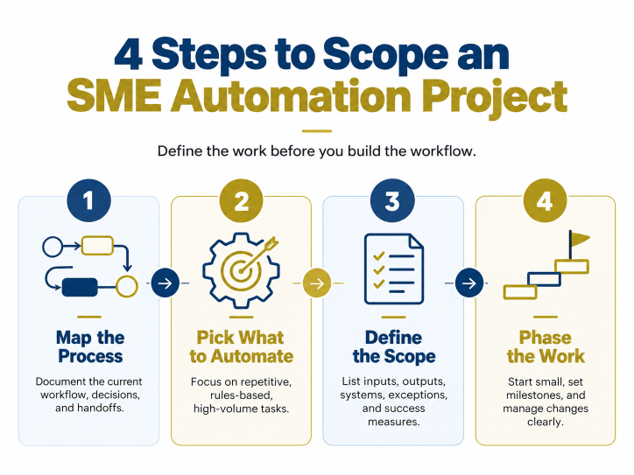
How Do You Map the Process and Pick What to Automate?
Before deciding what to automate, understand how the existing process works.
Start by speaking with employees who perform the tasks daily. Ask them to explain where information comes from, what actions they take, and how they handle unexpected situations
Map the Current Workflow
Ask employees to walk through a real request, including unusual cases. Record where information enters, who makes decisions, and where handoffs occur.
For a customer inquiry, the workflow might be:
Inquiry received → Details captured → Request categorized → Team notified → Acknowledgment sent
Complaint or unclear request → Human review
This current-state map reveals repetitive steps and exceptions that a simplified diagram might hide.
Identify Suitable Tasks
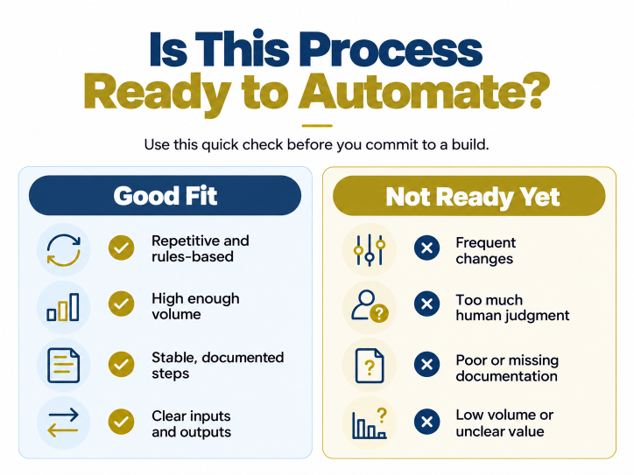
Choose a process that occurs frequently, follows stable rules, uses reliable data, and produces an outcome you can measure. Leave sensitive decisions and complex judgment to people unless appropriate safeguards exist.
If you’re deciding which service to offer, see what SMEs will actually pay to automate. The next step is to turn the chosen process into precise requirements.
What Must the Scope Document Define?
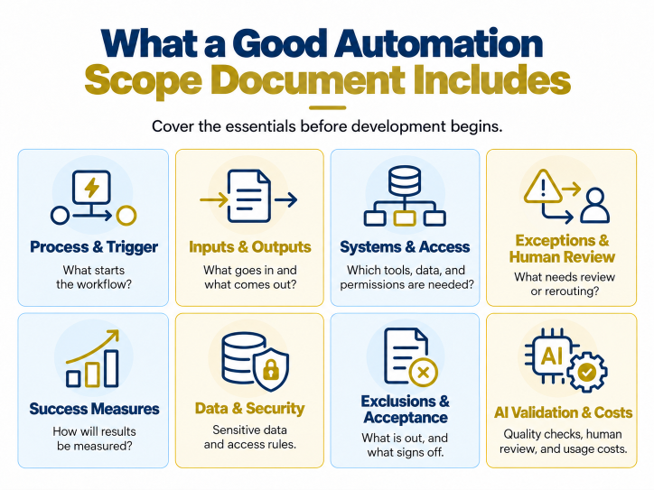
An automation scope document should capture these essential process automation requirements:
- Process and trigger: Name the workflow and the event that starts it.
- Inputs and outputs: Identify required information and expected results.
- Systems and access: List applications, integrations, permissions, and responsible owners.
- Exceptions and human review: Decide how missing data, duplicates, and unusual requests are handled.
- Success measures: Set measurable targets, such as processing time or correct routing rate.
- Data and security: Define authorized access, sensitive data handling, and applicable controls.
- Exclusions and acceptance: State what is not included and the tests required for sign-off.
- AI validation and costs, where applicable: Describe output checks, human oversight, and likely subscription or usage charges.
For example, an inquiry workflow could be accepted when valid requests are recorded correctly, the assigned employee receives a notification, and incomplete submissions follow the agreed exception path.
A scope should describe verifiable outcomes rather than promise that automation will work perfectly in every situation.
For AI-enabled automation, specify the proposed model or tool, acceptable output quality, and how results will be tested. Define when uncertain or incorrect outputs require human review, along with expected usage costs, including subscriptions or model-based charges. These requirements help clients understand both the system’s limitations and ongoing operating needs.
How Do You Size and Phase the Work?
Good SME automation planning starts with a small, deliverable first phase. Estimate effort based on workflow steps, integrations, data readiness, exception paths, testing, and approvals. Document assumptions that might change the estimate.
A practical delivery sequence is:
- Prepare: Confirm requirements, access, and responsibilities.
- Build: Implement the approved workflow.
- Test: Check normal cases, exceptions, and acceptance criteria.
- Deploy: Hand over operating instructions and obtain approval.
Agree on a change approval process before development begins. If a client requests additional features, assess their impact on deliverables, timelines, and fees. Obtain written approval before starting the extra work to prevent misunderstandings and unpaid scope changes.
This phased approach supports the incremental implementation discussed in CLaaS2SaaS’s guide to AI-first digitalization for SMEs.
For more insights on adoption costs and ROI, read AI Adoption for SMEs: Costs, ROI & Common Mistakes to Avoid.
What Mistakes Make Scopes Fail?
Even a detailed scope can fail when project boundaries, approvals, or process readiness are overlooked. Three common mistakes deserve attention.
Hidden Exceptions
A workflow looks simple until duplicated requests, missing fields, or complaints appear. Map these cases with the people doing the work, then specify what the automation handles and what goes to human review.
Undocumented Systems
A project can stall when an essential spreadsheet, CRM, approval step, or permission is discovered late. Inventory every system and integration dependency, including who grants access, before estimating delivery.
Vague Success Measures
“Improve efficiency” cannot serve as an acceptance test. Agree on observable measures, such as correct routing of test inquiries or reduced manual data entry, and define who verifies them.
A practical starting point is choosing a repetitive, low-risk workflow. The CLaaS2SaaS guide to AI for small businesses explores this approach further.
One-Page SME Automation Project Scoping Checklist
☐ Identify the process and its starting trigger.
☐ Map every workflow step, decision, and exception.
☐ Confirm the required inputs and expected outputs.
☐ List systems, permissions, and integration dependencies.
☐ Define data handling and security requirements.
☐ Specify AI validation and human review, where applicable.
☐ Estimate project effort, milestones, and ongoing costs.
☐ Establish measurable success and acceptance criteria.
☐ Document exclusions and the change approval process.
☐ Obtain written sign-off from the process owner and budget holder.
Câu hỏi thường gặp
1. What should be in an automation project scope?
A good scope names the process and its trigger, inputs and outputs, systems and access, exceptions, success measures, exclusions, and acceptance criteria.
2. How detailed should the process map be?
Show every meaningful action, decision, handoff, and exception. Include enough detail to test how the workflow should behave.
3. Who should sign off on the automation project scope?
The process owner and budget holder should approve it, with technical or security review when needed.
4. How do I handle exceptions in an automation project?
List each foreseeable exception and decide whether to automate it, route it to a person, or exclude it.
5. When is a process not ready to automate?
When it changes constantly, lacks documentation, depends heavily on judgment, or runs too infrequently to justify the effort.
Chia sẻ


Bạn muốn kiểm tra xem nghề nghiệp này có phù hợp với mình không?