AI Is Transforming Industries Faster Than Leadership Models Are Evolving

Artificial intelligence is fundamentally altering the structure of industries.
AI systems are now embedded across business functions including predictive analytics, customer experience platforms, supply chain optimization, and decision support systems. As these technologies scale, the boundaries between business strategy, operations, and technology are rapidly disappearing.
Organizations are no longer competing solely on products or services. Increasingly, they compete on data capabilities, automation speed, and digital innovation capacity.
This transformation is already visible in the labor market. Research highlighted by LinkedIn’s Future of Work insights shows that roles related to digital transformation and data-driven leadership have grown dramatically in recent years, reflecting the growing demand for executives capable of managing technology-enabled organizations.
At the same time, Gartner’s research on digital business acceleration indicates that the majority of organizations are actively scaling digital initiatives across their operations. As these efforts expand, the demand for leaders who can align business strategy with emerging technologies continues to grow.
For executives, this environment creates unprecedented expectations. Leadership now requires not only strategic thinking, but also a working understanding of how digital systems shape competitive advantages.
The Traditional MBA Was Designed for a Different Business Era
Traditional MBA programs were originally designed for an economic landscape defined by relative stability.
Core disciplines such as finance, operations management, and marketing strategy were developed to help leaders optimize organizations within predictable market conditions. These frameworks proved extremely effective throughout the industrial era and into the early stages of the digital economy.
However, the pace of change in today’s business environment has fundamentally altered the leadership equation.
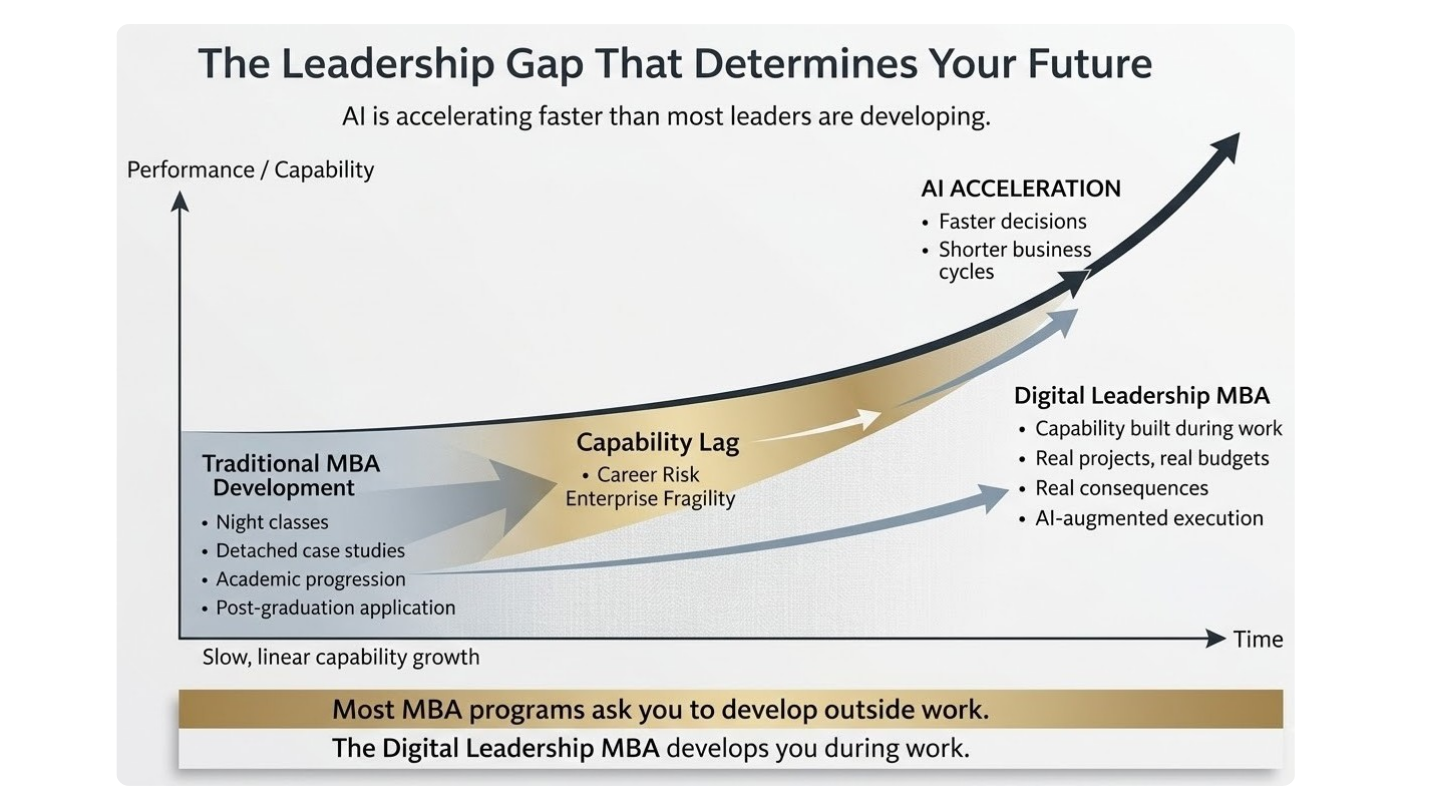
- Business models evolve faster.
- Technology cycles shorten dramatically.
- Competitive advantages disappear more quickly than ever before.
Most importantly, data and AI systems are now central drivers of strategy.
Yet many MBA programs still rely heavily on historical case studies and theoretical frameworks. While these approaches remain valuable for understanding business fundamentals, they often struggle to prepare leaders for environments where AI tools, automation platforms, and digital ecosystems are constantly reshaping how organizations operate.
The result is a growing digital leadership capability gap between the skills organizations need and the skills many executives were originally trained to develop.
Four Capabilities Every Digital Leader Must Develop

To succeed in the AI economy, executives must develop capabilities that extend beyond traditional management education.
Four competencies increasingly define modern digital leadership.
Why Digital Leadership Is Becoming a Strategic Priority for Organizations

For organizations, the implications of this shift are significant.
Even the most advanced technologies cannot create value without leaders who understand how to deploy them effectively.
Companies led by digitally fluent executives are often able to adopt new technologies faster, accelerate innovation initiatives, and respond more effectively to market disruptions.
This is why many organizations are increasingly investing in leadership development initiatives focused on digital innovation and technological strategy.
Programs like our Digital Innovation Leadership program represent one response to this challenge, helping executives build the capabilities needed to lead in an AI-driven economy.
The Future of Leadership in the AI Economy
With how the AI economy is redefining what leadership looks like, executives who develop digital innovation capabilities today will be far better positioned to guide their organizations through the next wave of technological transformation. We are moving beyond the era where “digital” is becoming an isolated department; it is now the very language of business strategy. Leaders who fail to speak this language risk becoming observers of disruption rather than the architects of it.
Success in this new landscape requires a dual focus: the ability to maintain high-level strategic foresight while possessing the practical technical fluency to oversee complex implementation. It is no longer enough to simply approve an AI budget; leaders must understand the ethical, operational, and competitive implications of these systems to ensure they deliver true ROI.
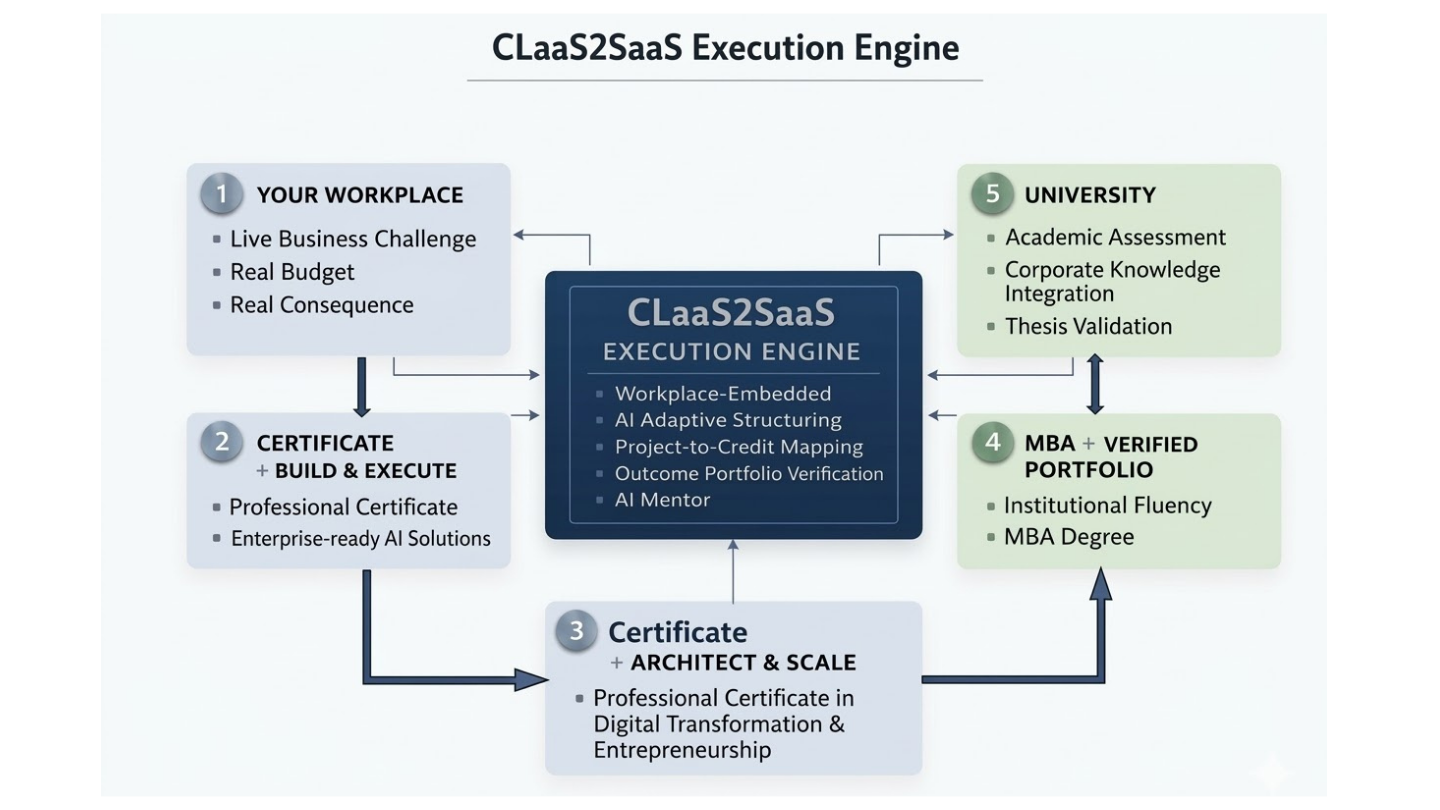
For leaders seeking to bridge this widening gap and build a future-ready toolkit, the CLaaS2SaaS Digital Innovation Leadership initiative provides a definitive pathway.
It helps executives develop hands-on experience with AI tools, automation platforms, and digital innovation frameworks. Built around the Learn2Work model, the program emphasizes learning through real-world application, allowing participants to engage directly with digital technologies, transformation scenarios, and industry-driven challenges.
Rather than focusing solely on theoretical management concepts, these programs aim to equip leaders with the practical capabilities required to navigate technology-driven change while bridging the gap between executive education and real digital implementation.
By combining rigorous strategic thinking with hands-on digital expertise, the program empowers executives to transform traditional managers into visionary digital pioneers, ensured not just to survive the transition, but to lead the charge.