Digital Transformation in Higher Education: A Practical Guide for University Leaders
Digital Transformation in Higher Education: A Practical Guide for University Leaders
Content
Content
Digital transformation in higher education can stall between the steering committee and the classroom. New portals and isolated AI pilots may digitise activity without improving curriculum currency, industry alignment, or graduate outcomes. For university leaders, meaningful transformation means an AI-first, work-integrated operating model — not another technology upgrade.
Why Traditional Digital Transformation Efforts Stall in Higher Education
For many institutions, “digital transformation” has quietly become shorthand for a technology refresh: a new student information system, a modernized learning management system, maybe a chatbot for admissions. These projects are useful, but they are not necessarily transformation — they can remain digitization. The distinction matters because digitization alone doesn’t always touch the two things that most determine whether a degree serves students well: how current the curriculum is, and how closely it’s tied to what employers need.
Two warning signs are worth watching for. First, graduate employability can plateau even as enrollment and program catalogs grow — degrees may look comprehensive on paper without mapping cleanly to the skills employers are hiring for. Second, industry alignment can stay weak: advisory boards meet, feedback is collected, and a curriculum committee may still need many months to update a syllabus, by which point the underlying skill has already shifted again.
The reason point-solution digitization often doesn’t fix this is structural. A better portal doesn’t change who decides what’s taught, how fast, or how it’s validated against real industry demand. Closing that gap typically requires changing the institution’s operating model — how curriculum gets built, updated, delivered and personalized — not just the software layer sitting on top of it. That’s the shift the rest of this guide focuses on: what an AI-first, work-integrated operating model can look like in practice, and how a university or polytechnic might move toward it deliberately rather than accidentally.
What AI-First, Work-Integrated Transformation Can Look Like
An AI-first, work-integrated institution treats artificial intelligence and adaptive learning as part of how curriculum is built and delivered — not as an add-on layered onto an unchanged program. In practice, that can mean three things shifting at once.
Curriculum currency moves from a periodic committee exercise toward a more continuous, data-informed process, with content and skills mapping revisited more frequently against real industry signal.
Delivery becomes more adaptive. Instead of every student moving through the same sequence at the same pace, the learning path can adjust to where each student already has strength and where they need more support.
And learning becomes more work-integrated by design. Rather than a single capstone or optional internship added to an otherwise conventional program, real-world application can be built into the model throughout, so students practice industry-relevant work continuously rather than for one semester at the end.
This kind of AI-first university transformation is what HigherEd CLaaS2SaaS is built to support for universities and polytechnics — an approach also outlined in CLaaS2SaaS’s broader Future-Ready Talent framing — delivered through an Agentic CLaaS2SaaS + Adaptive CLaaS model and CLaaS Academy’s library of 100+ Digital Skilling Modules. In practice, curriculum delivery and personalization are supported by an AI-driven (“agentic”) layer designed to help keep pace with skills change, while the adaptive engine adjusts learning paths per student rather than per cohort. The goal isn’t to replace an institution’s academic identity — it’s to give that identity a delivery model built to stay current and stay tied to employability outcomes.
A Practical Framework for University Leaders
Before evaluating any partner or platform, it helps to have a shared internal framework — a way for leadership, faculty and IT to agree on what “ready for AI-first transformation” actually means for your institution. The factors below are a starting point for that conversation, not a vendor comparison, and each pairs a factor with a diagnostic question leadership can ask internally before scoring it.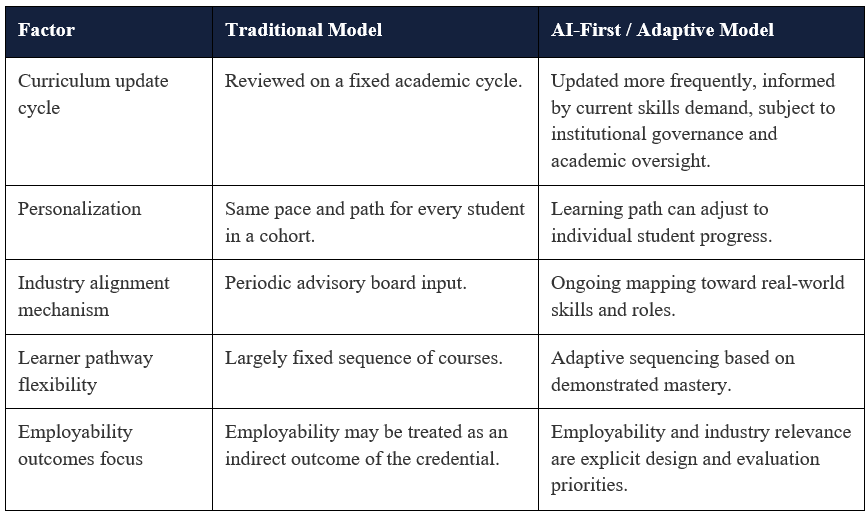
- Curriculum update cycle — How long does it currently take your institution to revise a syllabus once a skills gap is identified?
- Personalization — Do students in the same course today move through identical material regardless of prior mastery?
- Industry alignment — How often does employer or industry feedback actually change what’s taught, versus simply being logged?
- Pathway flexibility — Can a student’s sequence change based on demonstrated competency, or is the order fixed by year level?
- Employability focus — Is employability tracked as a named institutional metric, or assumed as a byproduct of accreditation?
Use this table and these questions as a working diagnostic, not a scorecard: most institutions will sit somewhere in between on each row today. A practical higher education technology strategy should connect adaptive learning for universities with work-integrated learning in higher education, curriculum governance, and digital skilling for polytechnics — rather than treating each as a separate technology initiative. The point is to turn a vague mandate to “modernize” into a concrete, factor-by-factor conversation about where transformation needs to start.
Where to Start: A Phased Roadmap
Institution-wide transformation rarely succeeds as a single big-bang rollout, and it doesn’t need to. A phased approach lets leadership build internal confidence and evidence before scaling.- Assess: Map your current curriculum, delivery model and industry-alignment mechanisms against the framework above. Identify which programs are most exposed to skills obsolescence and where employability data already signals a gap.
- Pilot: Choose one department, faculty or cohort to run an AI-first, work-integrated model end-to-end, rather than testing a single tool in isolation. A contained pilot makes it possible to observe real outcomes — engagement, completion, employability signal — before wider investment.
- Scale: Use pilot evidence to build the case for institution-wide adoption, sequencing rollout by faculty or program rather than attempting a simultaneous, all-at-once switch.
This is the kind of phased adoption HigherEd CLaaS2SaaS is designed to support — an institution doesn’t need to rebuild everything at once to become AI-ready; it needs a model that can start with one cohort and scale deliberately from there.
Frequently Asked Questions
What does digital transformation mean for a university or polytechnic?
It’s not just digitizing paperwork or rolling out a new LMS — real digital transformation in higher education means redesigning how an institution teaches, assesses, and connects students to industry, using AI-first and adaptive methods so curriculum stays current with real skills demand. CLaaS2SaaS frames this as a shift toward an AI-first, work-integrated model — delivered through HigherEd CLaaS2SaaS’s Agentic CLaaS2SaaS + Adaptive CLaaS approach and CLaaS Academy’s skilling modules. Book a 1:1 consultation to map this to your institution’s specific context.
What’s the difference between “digital transformation” and an “AI-first university”?
Digital transformation is the broad, strategic shift covered in this guide — rethinking how an institution teaches, delivers and aligns with industry using AI and adaptive methods. “AI-first university” describes the specific operating model that can result from that shift: an institution where AI and adaptive learning aren’t supplemental tools but part of how curriculum is built and delivered day to day. See What Is an AI-First University? for a full breakdown of that model.
How does digital transformation improve graduate employability?
By working to close the gap between what’s taught and what employers are hiring for — more continuously, rather than on a multi-year review cycle — and by building work-integrated practice into the curriculum rather than treating it as an add-on. The actual improvement depends on your institution’s starting point, program mix and industry sector; book a 1:1 consultation to map this to your context specifically.
Is this approach only for large universities, or does it work for polytechnics too?
It’s built for both. HigherEd CLaaS2SaaS is intended for larger universities and polytechnics alike — institutions where scale makes a phased, department-by-department rollout both necessary and practical.
How long does a university digital transformation typically take?
It varies by institution and is best planned in phases rather than as a single timeline — assess, pilot, then scale, as outlined above. Exact sequencing depends on your current systems and program structure; a 1:1 consultation is the fastest way to get a realistic view for your institution.
Every institution’s starting point is different — the right first move depends on your current systems, program mix and where employability gaps are showing up. The fastest way to find that starting point is a direct conversation.
Share


Want to check if this career is for you?