How to Finish a Bachelor's Degree in 2 Years (Without Cutting Corners)
How to Finish a Bachelor's Degree in 2 Years (Without Cutting Corners)

Content
Content
Can you really finish a bachelor’s degree in 2 years without skipping essential coursework? Legitimate accelerated pathways get there through program design, credit recognition, intensive pacing, and integrated learning — not by removing academic requirements. This guide walks through exactly how the timeline works, and what to check before you commit.
Can You Really Finish a Bachelor’s Degree in 2 Years?
Yes — for some students, in some programs, a bachelor’s degree genuinely can be completed in around two years. But that answer comes with real conditions attached, and it’s worth understanding them before assuming it applies to your situation.
Feasibility depends on several factors working together: the specific institution and how its accelerated pathway is structured, your entry requirements and starting point, whether you have transferable credits or recognized prior learning, and how intensive a study schedule you’re realistically able to sustain. A program built from the ground up around a two-year completion timeline is a very different thing from a traditional four-year degree where a student simply tries to take more classes per term.
That distinction matters. A legitimate accelerated pathway is intentionally designed — the curriculum, pacing, and credit structure are built around reaching the same academic outcome in less calendar time. Simply overloading your course schedule within a traditional program’s structure isn’t the same thing, and can risk both your academic performance and your wellbeing if the underlying program wasn’t designed to support that pace.
What Makes a 2-Year Bachelor’s Degree Possible?
- Credit recognition and transfer. If you already hold relevant qualifications or recognized prior learning, a program may count some of that toward the degree — though exactly how much depends entirely on the receiving institution’s policies.
- Compressed academic periods. Rather than spreading coursework across a traditional academic year, an accelerated program often runs shorter, more concentrated terms back-to-back.
- Year-round study. Continuing to study through what would normally be semester or summer breaks is one of the most straightforward ways to compress a timeline without reducing total content.
- Competency-based progression. Some programs let students progress once they’ve demonstrated mastery of required material, rather than being paced strictly by a fixed calendar, where this model is used.
- Intensive schedules. A genuinely accelerated pathway usually involves a heavier weekly study load, since the same total academic content is covered in less calendar time.
- Integration of practical learning. Building real-world projects or work-based learning directly into the academic schedule can help a pathway stay efficient without cutting either academic or practical content.
Step 1: Start With the Right Entry Point
Where you start matters as much as how the program is structured. A student entering with recognized prior credits, a relevant diploma, or other qualifications may have access to a meaningfully different — and potentially shorter — pathway than a student starting with no previous higher-education credits at all.
This is the first thing worth clarifying before assuming a two-year timeline applies to you specifically: what does your starting point actually qualify you for within a given program’s structure? Two students considering the exact same accelerated degree can face genuinely different realistic timelines depending entirely on what they bring in at the start.
Rather than assuming your prior study, diploma, or work experience will count toward the degree, ask the institution directly and get it confirmed in writing. Credit and entry policies vary significantly between programs, and assuming credits will transfer without confirmation is one of the most common ways students end up with a longer, more expensive pathway than they expected.
Step 2: Understand Credit Transfer and Prior Learning
If part of your accelerated timeline depends on transferring in prior credits or recognized learning, it’s worth understanding how that process actually works before you rely on it.
- Transcript evaluation. Most institutions require a formal evaluation of your previous transcripts before confirming what will transfer — this can take time, so it’s worth starting early.
- Credit equivalency. Not all prior study maps directly onto a new program’s requirements. An institution assesses whether your previous coursework is genuinely equivalent in content and level.
- Requirement type varies by institution. Where accepted credits apply — general education, electives, or program-specific requirements — depends on the receiving institution and the target degree, not a fixed rule that applies everywhere.
- Transfer limits vary. Institutions differ in how many credits they’ll accept, so even extensive prior study won’t automatically shorten a pathway by a predictable amount — check the specific policy rather than assuming a standard cap.
Step 3: Use Accelerated Pacing Without Sacrificing Quality
Once your entry point and credit situation are clear, the next lever is pacing — and this is where the real trade-off of an accelerated degree shows up most directly. Compressed terms mean covering the same amount of material in a shorter block of time, which requires a higher weekly study intensity than a traditional pace. Year-round enrollment, without the long breaks a traditional academic calendar includes, is often what makes the overall math work.
None of this works well without structured scheduling and genuine time-management discipline. Accelerated pacing is about faster delivery of the same required content, not less learning but a well-designed program compresses the calendar, not the curriculum.
Step 4: Build Work-Integrated Learning Into the Pathway
A well-designed accelerated pathway doesn’t just compress academic content — it also finds ways to connect that content to real-world application, rather than treating practical experience as something to add on after graduation.
Real-world industry projects give students the chance to apply what they’re learning to genuine problems, which can deepen understanding while building a practical portfolio. Workplace exposure and mentoring, where available, connect students with people already working in their target field. Work-study components, where a program includes them, let students earn income or gain direct workplace experience alongside their academic study.
Where relevant, the CLaaS Higher Eduaction model is described as emphasizing competency-based learning and real-world industry projects as part of its accelerated pathway — though the exact structure, scope, and requirements of any work-integrated component should be confirmed directly against the specific program page rather than assumed from a general description.
Step 5: Plan Your Two-Year Study Schedule
With the mechanics understood, it helps to see how they typically fit together into an actual timeline. The exact sequence varies significantly by program and institution, but a general planning framework looks something like this:
- Admissions and credit evaluation. Your entry qualifications and any prior credits get formally assessed, determining your actual starting point.
- Foundational or bootcamp-style learning. Many accelerated pathways begin with an intensive foundational stage before moving into more advanced material.
- Advanced study. Once foundational competencies are established, the pathway typically moves into more specialized coursework.
- Practical projects and work experience. Real-world projects, mentoring, or work-study components are typically integrated throughout, not saved for the end.
- Degree completion. The pathway concludes with whatever final assessment or requirement confirms you’ve met the full academic standard.
What You Should NOT Cut to Finish Faster
Finishing in two years should never come at the cost of the things that actually make a degree worth having.
Required academic credits shouldn’t be skipped or substituted just to save time — a legitimate pathway compresses delivery, not the underlying requirement. Assessment quality matters too: a program that waters down how learning is evaluated isn’t accelerating your education, it’s undermining it.
Practical experience, qualification recognition, and faculty or mentor support are also worth protecting, since they’re often what separates a genuinely valuable accelerated degree from one that’s simply fast. Appropriate rest is easy to deprioritize under an intensive schedule too, but it’s part of what makes the pace sustainable rather than something you simply survive.
2-Year Bachelor’s Degree vs Traditional Bachelor’s Degree
Set side by side, the practical differences between a 2-year accelerated pathway and a traditional bachelor’s degree become clearer.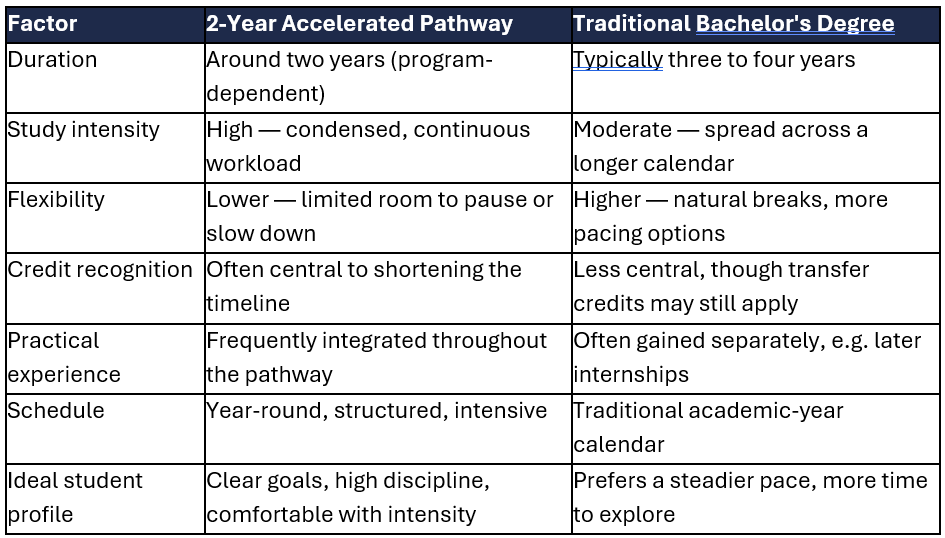
The accelerated option trades a longer, more flexible timeline for a shorter one delivered at a higher intensity — it doesn’t trade away the underlying academic requirement, just the pace and structure used to meet it.
Who Is a 2-Year Bachelor’s Pathway Best For?
A two-year bachelor’s pathway tends to work best for students who already have clear career goals, since an intensive, condensed schedule leaves less natural space for exploring different directions along the way.
Strong time-management skills matter more here than almost any other factor. A willingness to study intensively for a defined period, in exchange for finishing sooner, is essential; this isn’t a pathway for students hoping to ease into higher education gradually. Relevant prior qualifications or credits, where applicable, can make the pathway more achievable, though they’re not always required.
Finally, students who are specifically interested in gaining practical, real-world experience while they study — rather than purely classroom-based learning — tend to find accelerated, work-integrated pathways particularly well-suited to how they want to learn.
How CLaaS Higher Education’s 2-Year Pathway Works
With the mechanics, trade-offs, and questions to ask now covered, here’s how CLaaS Higher Education’s own two-year pathway is currently described on its program pages.
The pathway is positioned as an accelerated route to an international bachelor’s degree, completed in around two years, with Digital Business and Software Engineering as the two published options. It combines intensive digital skilling with degree-level academic study and real-world industry projects, built around competency-based learning rather than a purely lecture-driven format.
Personalized mentoring and a flipped-classroom model are part of the published structure, with independent study of core material paired with applied, hands-on class time. Flexible study options — including a work-study pathway and a fully online route — are also described as part of the offering.
As with any accelerated program, exact details — entry requirements, credit-transfer policy, the specific awarding institution, and the precise program structure — should be confirmed directly against the current CLaaS Higher Education program page before enrolling, rather than relied on from a summary.
Questions to Ask Before Choosing a 2-Year Bachelor’s Degree
Before committing to any two-year bachelor’s pathway, working through a specific set of questions with the institution directly will tell you more than any marketing page can.-
- Who awards the degree? Confirm the specific institution issuing the qualification, not just the program’s marketing brand.
- What accreditation or recognition applies? Verify this independently, for the specific program.
- Which credits can transfer? Get this confirmed formally and in writing for your specific prior study.
- What are the entry requirements? Understand exactly what you need to qualify.
- How intensive is the schedule? Ask for a realistic weekly workload, not a general description.
- What assessments are required? Understand how learning is actually evaluated.
- Is practical experience included? Confirm whether real-world projects or work-study components are built in, and how.
- What support is available? Ask about mentoring, faculty access, and academic support.
- What happens if I need more time? Understand your options if the pace doesn’t work out.
Frequently Asked Questions
Can you finish a bachelor's degree in 2 years?
Yes, some accelerated bachelor’s pathways are designed around a two-year completion timeline. Whether you can complete one in two years depends on the program structure, entry requirements, eligible transfer credits, study intensity, and the institution’s academic requirements. A shorter timeline should come from an efficient, recognized pathway rather than skipping required learning.
Can transfer credits help you finish a bachelor's degree faster?
Yes, where the institution accepts eligible credits toward the specific degree requirements. Students should obtain a formal credit evaluation rather than assuming all previous study will transfer.
Is a 2-year bachelor's degree harder than a traditional degree?
It can be more intensive, since more learning may be compressed into a shorter period. Students should assess the weekly schedule, assessment load, support, and learning format before enrolling.
Are 2-year bachelor's degrees legitimate?
Some are legitimate, but students should independently verify the awarding institution, accreditation and recognition, qualification awarded, entry requirements, and pathway structure. Never assume every program marketed as a ‘2-year degree’ has equivalent recognition.
Who is a 2-year bachelor's degree best for?
Students with clear goals who can manage an intensive study schedule and want to accelerate their academic and career timeline. Students who need a slower pace or greater schedule flexibility may prefer a traditional pathway.
A faster bachelor’s degree should mean a smarter pathway, not fewer academic standards. If you’re considering completing your degree in two years, compare the entry requirements, credit structure, study pace and practical learning before deciding. See how the CLaaS Higher Education pathway works and discuss your options.
Read the companion guide: Are Accelerated Bachelor’s Degrees Worth It?
Share


Want to check if this career is for you?