Blog
How TVET & Smaller Institutions Can Launch Job-Role Digital Pathways Without Building From Scratch
How TVET & Smaller Institutions Can Launch Job-Role Digital Pathways Without Building From Scratch

Content
Content
Technical and vocational education and training (TVET) institutions and smaller higher-education providers launch job-role digital pathways more efficiently by adopting modular, stackable credential structures instead of building a full custom curriculum from scratch. Job-role design maps training directly to a named workplace position, and stackable credentials let an institution start with one role and expand without a full curriculum rebuild.
This guide explains how job-role digital pathways complement traditional curricula, the building blocks institutions need, how to launch with limited faculty and budget capacity, and how to measure whether the pathway is producing workforce-relevant outcomes.
Why Does Job-Role Digital Skilling Complement Traditional Curriculum Design?
Job-role digital skills training complements traditional curriculum design by mapping instruction directly to a named workplace position instead of a broad academic subject. Job-role digital skilling shortens the distance between a training exercise and a deliverable an employer actually expects. The model adds demonstrated competency alongside traditional academic progression.
Subject-based curricula remain important for foundational knowledge, while job-role credentials make the connection between learning and a specific workplace function more explicit. A credential aligned to a role such as Digital Marketing Executive, Data Analyst or Full-Stack Developer can help learners communicate the capabilities they have developed in terminology employers already use.
UNESCO-UNEVOC provides broader context for the digitalization challenges facing TVET systems. Its research on TVET teacher and trainer digital-skills development examines conditions before and during the COVID-19 pandemic and identifies barriers including weak policies, limited access to relevant training, infrastructure constraints, insufficient technical support, cost, time, and resistance to change.
Although the study does not directly compare job-role and subject-based curriculum models, it demonstrates why institutions may need more flexible ways to strengthen digital capabilities and respond to changing teaching and workforce requirements.
One challenge is that curriculum revision can require coordination across multiple subjects, approvals and institutional processes, making it difficult to respond quickly to emerging workforce needs. For institutions with limited curriculum-development capacity, modular approaches can provide one way to introduce new digital-skills pathways without requiring every component to be developed internally.
Three conditions can make role-first design a stronger fit than subject-first design for institutions with constrained budgets and small curriculum-development teams.
- Job markets can evolve faster than subject-based curriculum review cycles are able to keep pace with.
- Role-based pathways can make demonstrated task competency more visible alongside the learner’s formal qualification.
- Many learners face limited study time and can benefit from a visible link between coursework and employability.
What Are the Four Building Blocks of a Job-Role Digital Pathway?
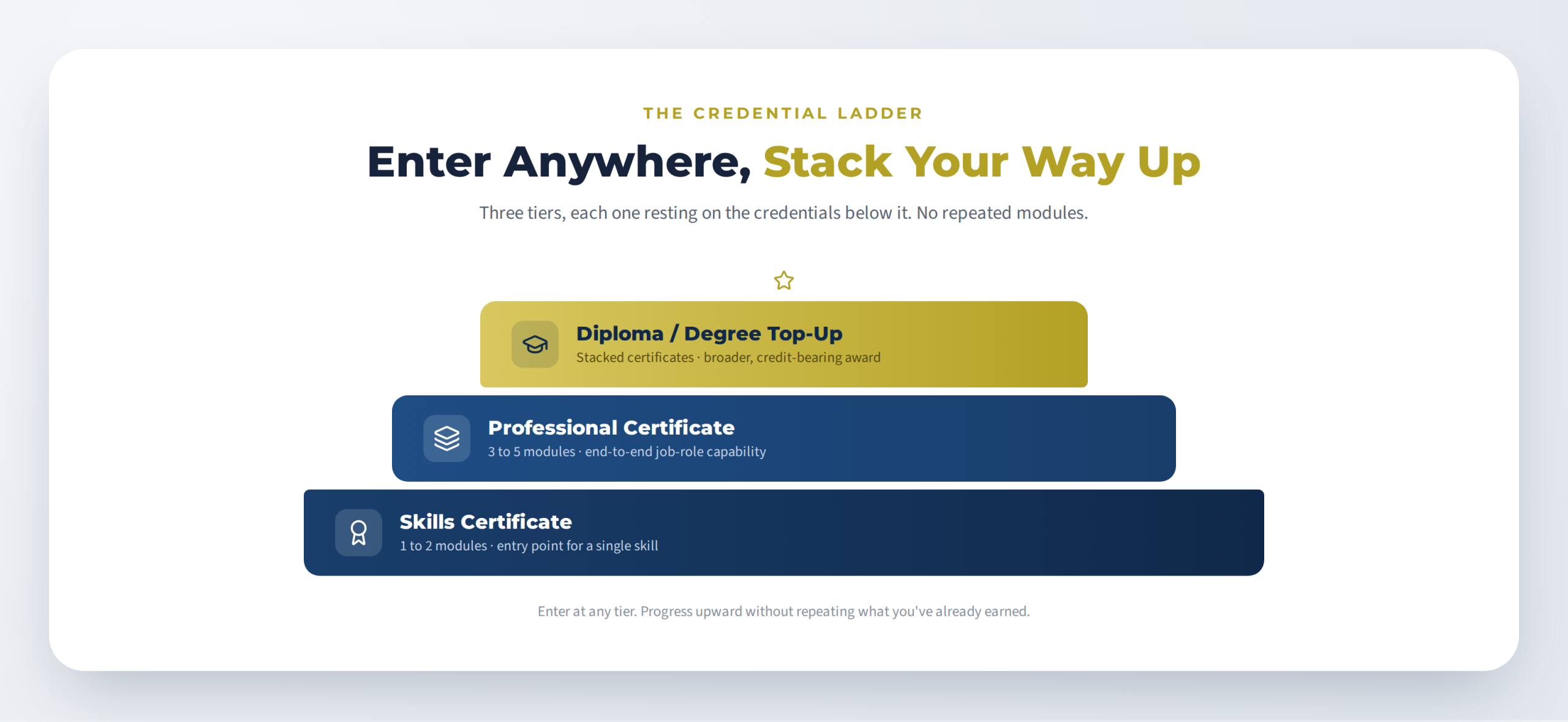
A job-role digital pathway rests on four building blocks: a role-mapped competency framework, modular stackable content, applied assessment, and industry-aligned credentialing. A role-mapped competency framework anchors every module to a specific, named job function rather than a general subject area. Modular, stackable content lets a learner accumulate credit through short units instead of committing to a full-length course upfront. Applied assessment ties evaluation to a task a working professional actually performs, not a written exam alone. Industry-aligned credentialing presents the completed pathway in terminology that reflects recognizable job roles and workplace capabilities.
These four blocks stack into a credential ladder with three progressive tiers.
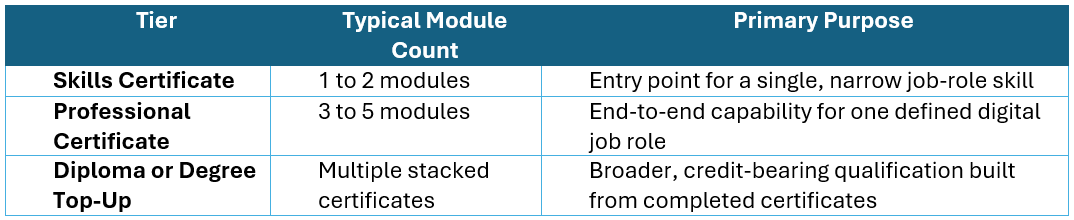
A stackable pathway may progress from individual skills certificates to broader professional certificates and, where institutional articulation arrangements allow, into larger credit-bearing qualifications.
How Can Smaller Institutions Launch Without Building Curriculum From Scratch?
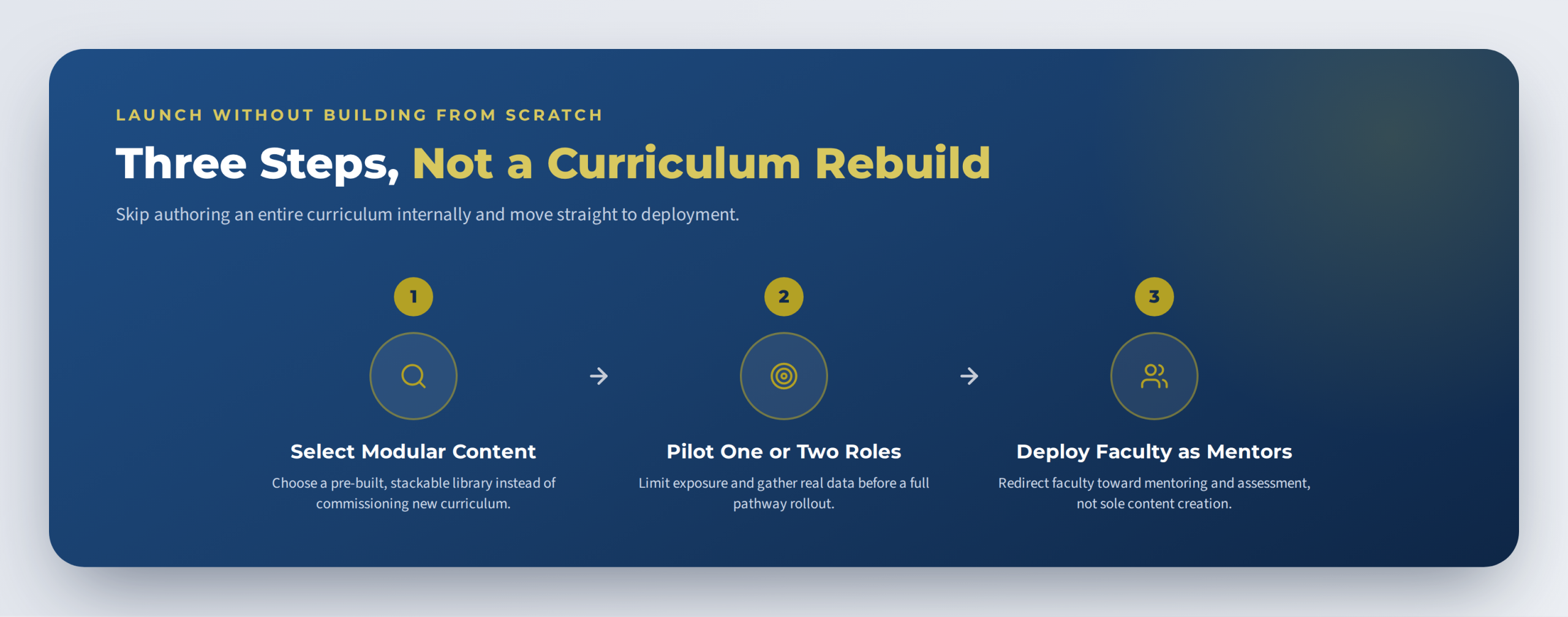
Smaller institutions launch fast by adopting three sequential steps instead of authoring an entire curriculum internally: selecting modular content, piloting one or two job roles, and enabling faculty to focus more on mentoring and facilitation.
- Select a modular, pre-built content library instead of commissioning original curriculum development.
- Pilot one or two job roles before committing to a full pathway rollout.
- Enable faculty to focus more on mentoring, facilitation and assessment rather than requiring them to develop every learning component from scratch.
A pilot covering one or two job roles limits financial exposure while giving academic leadership early evidence on enrollment, completion, learner performance and stakeholder feedback before a larger rollout decision.
How Do Institutions Measure Whether a Pathway Is Actually Working?
Institutions measure whether a pathway is actually working using two categories of indicator: leading indicators that appear earlier in the pathway, and lagging indicators that become visible after learners have progressed further or entered the workforce. Leading indicators include module completion rate and competency-assessment pass rate. Lagging indicators include graduate employment rate and employer satisfaction score.
Leading indicators matter because they let an institution correct course before a full cohort completes the program. A completion rate that falls below expectation signals a content or pacing problem long before graduation. Lagging indicators help assess whether learner and employment outcomes are improving, though they don’t on their own prove the pathway caused it. Recording a baseline for both indicator categories before launch, and comparing pilot results against historical cohorts or similar programs, gives academic leadership a real comparison point rather than an isolated post-launch number, one that also accounts for shifts in the labor market, learner profile, and employer demand.
What Does a Realistic Launch Timeline Look Like?
A practical launch timeline for TVET digital transformation spans three phases: needs assessment and module selection, a pilot against one or two job roles, and evaluation before a scaled rollout, with each phase’s length depending on institutional approval processes, curriculum integration, faculty readiness, and pilot scope.
The three phases should stay distinct even in a shorter rollout, compressing them into one step can make it harder to establish a meaningful baseline or see what’s actually driving results. Longer timelines may be appropriate where curriculum approvals, articulation arrangements, or institutional governance require additional review.
Job-role digital pathways are more suitable for expansion when pilot evidence shows that learners are completing modules, demonstrating the intended competencies, and achieving stronger workforce-relevant outcomes.
CLaaS® Academy gives institutions access to modular, job-role-aligned learning pathways that can be introduced progressively, helping institutions expand workforce-relevant programs without developing every learning component from the ground up. Explore CLaaS® Academy or talk to the CLaaS2SaaS team about developing workforce-ready certification programs for your institution.
Share


Want to check if this career is for you?