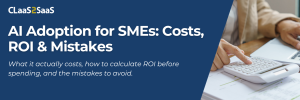
AI Adoption for SMEs: Costs, ROI & Common Mistakes to Avoid
AI Adoption for SMEs: Costs, ROI & Common Mistakes to Avoid
Content
Content
AI adoption for small and medium enterprises (SMEs) can make costs and results easier to evaluate when a business starts with one clearly defined, repetitive process rather than adopting AI broadly across the organization at once.
Small business owners reasonably wonder whether AI investment makes sense for a business their size, since the AI success stories that get the most media attention tend to come from large enterprises with bigger budgets and dedicated technical teams — not businesses working out AI adoption costs on a small business budget.
The sections below break down what AI adoption costs a small business, walk through how to calculate AI ROI before spending anything, name the most common mistakes SMEs make when adopting AI, and outline a realistic, low-risk way to start.
What Does AI Adoption Actually Cost a Small Business?
There’s no single number for what AI adoption costs an SME, and any source that gives you one flat figure is oversimplifying. OECD research on AI adoption by small and medium-sized enterprises identifies several categories of cost and barrier — software and subscription fees, hardware, integration with existing systems, staff training time, data readiness, and access to finance — and which one dominates depends on your starting point, not a fixed hierarchy that applies to every business, according to the 2026 OECD SME survey.
For a rough sense of what to budget, it helps to think in three broad categories — understanding that which one costs the most varies by business:
Software and subscription costs. Most AI tools relevant to SME use cases price on a per-user, monthly-subscription basis rather than requiring a large upfront license, which keeps this cost relatively predictable. That doesn’t make it automatically the smallest cost — a business needing multiple tools or higher-tier plans for larger data volumes can see this add up quickly.
Implementation and setup. The hours spent configuring a tool to work with existing business processes and data. This can be minimal for a business with clean, centralized data, or the single largest line item for a business connecting a new tool to spreadsheets, legacy software, or fragmented records.
Staff training time. The hours employees spend learning to use a new tool effectively rather than reverting to their previous manual process out of familiarity. This is frequently underestimated regardless of how the other two costs compare.
To get a real estimate for your business rather than a generic one, check your starting point against each OECD-identified factor: how clean is your data, how many systems does the tool need to connect to, how deep is your team’s existing digital skill level, and do you have — or need — financing to cover the upfront cost before it pays back.
How Do You Calculate AI ROI Before You Spend Anything?
A practical return-on-investment framework starts before any money changes hands, and it starts with one idea: measure against your own baseline, not a vendor’s claim or an industry average.
Step 1: Identify the task and set a baseline. Find the single highest-friction, most repetitive task in the business — the process consuming the most staff time relative to its complexity — and estimate its current time and cost.
Step 2: Total the cost of adoption. Add the software/subscription cost over your evaluation period, the one-time implementation and setup cost, and the training cost (staff hours × hourly cost).
Step 3: Estimate the value created. This might be time saved and redeployed to other work, a cost avoided (such as not needing to hire), or new revenue enabled. Time saved only counts as ROI if that freed-up capacity is actually redeployed to something valuable, avoids a cost, or contributes to revenue — time saved that simply evaporates isn’t a financial return, even if it’s still a reasonable justification for adopting the tool.
Step 4: Calculate ROI.
ROI (%) = [(Value Created − Total Cost of Adoption) ÷ Total Cost of Adoption] × 100
What Are the Most Common Mistakes SMEs Make When Adopting AI?
Adopting a tool without a clear use case. Purchasing AI capability because competitors are discussing it, rather than because a specific, identified problem needs solving. This produces a tool that sits mostly unused, since nobody defined what success would look like before the purchase.
Underestimating change management and training. AI adoption is a workforce capability challenge as much as a technology one. Businesses assume staff will pick up a new tool naturally, but under workload pressure people default to the familiar manual process unless training time is explicitly protected.
Expecting instant return on investment. Even a well-chosen AI tool needs enough time against its own baseline to show a real signal — the right evaluation window depends on your transaction volume and seasonality, not a fixed default.
Skipping the data privacy and security review. Feeding customer or business data into a tool without checking where that data goes, whether the vendor uses it to train other models, and whether it meets the privacy or compliance obligations that apply to your industry and location.
Adopting AI before the underlying data is ready. Feeding a tool messy, inconsistent, or scattered data and being surprised when the output is unreliable. Data readiness is one of the OECD’s identified adoption barriers, not an afterthought.
Trusting outputs without a validation step. Treating AI output as automatically correct rather than building in a routine check — especially for anything customer-facing, financial, or compliance-related.
Removing human oversight too early. Pulling the human checkpoint out of a workflow before the tool has a track record, instead of keeping someone reviewing edge cases until it’s earned that trust.
Underestimating integration effort. Treating the AI tool as a standalone add-on rather than accounting for the work of connecting it to existing systems such as a CRM, point-of-sale system, or accounting software.
Leaving the tool without a clear owner. Nobody is explicitly responsible for monitoring performance, catching drift, or deciding whether to expand or retire the tool — so it quietly becomes shelfware, or worse, keeps producing unreviewed output indefinitely.
What’s a Realistic, Low-Risk Way to Start With AI?
A realistic, low-risk starting approach follows directly from the ROI framework above. Start with one process — the highest-friction task identified during the baseline exercise — rather than multiple processes at once.
Set a defined evaluation window before drawing conclusions about whether the investment paid off, based on your own transaction volume and seasonality. Measure the result against the specific baseline established before adoption, not against a general industry average that reflects a different business’s starting conditions entirely.
If the pilot delivers measurable value, use what the team learned to improve the workflow and identify the next process where AI can create value. This creates a repeatable approach to adoption rather than attempting business-wide transformation at once.
Our companion guide, AI for Small Business: A Practical Guide to Getting Started, walks through this same starting-point framework in more depth.
What’s the Bottom Line on AI Adoption for SMEs?
AI adoption for an SME deserves the same discipline you’d apply to any other business investment — a specific problem, a concrete baseline, and a defined way to measure whether it paid off — not blanket enthusiasm or blanket skepticism based on how a large enterprise uses comparable tools at a completely different scale.
Treating your first AI adoption as a pilot rather than a permanent commitment lowers the risk and gives you a real answer, win or lose, on what to try next. Cost and ROI are the starting filter, not the only lens — but they’re the filter that keeps the decision grounded in your business rather than the hype cycle.
Want help identifying a suitable first use case, establishing a baseline, and evaluating the potential return? Book a 1:1 consultation with CLaaS2SaaS to plan a practical SME AI pilot.
Share


Want to check if this career is for you?