Business Management Course Singapore: Career-Ready Skills for the Digital Economy
Business Management Course Singapore: Career-Ready Skills for the Digital Economy
Content
Content
What skills do employers value most in today’s business professionals?
Business management roles are evolving beyond traditional supervision and business administration. Across Singapore and the wider ASEAN region, employers increasingly value professionals who can combine leadership, operational thinking, digital execution, data-informed decision-making, and cross-functional collaboration.
Business management is no longer separate from digital capability. Managers today are expected to understand customer journeys, automation workflows, analytics dashboards, CRM systems, AI-enabled tools, and performance metrics that directly influence business growth and productivity.
Choosing the right business management course therefore requires looking beyond the credential itself. The stronger question is whether the program helps you build workplace-ready capability, apply business skills in practical settings, and prepare for higher-responsibility roles.
- Will the course help you move from supervisor to manager?
- Can it support a career switch into business operations, human resources, marketing, supply chain management, or digital transformation?
- Does it offer flexible learning for working adults?
- Can it help you build skills that are relevant across today’s digital economy?
This guide compares course pathways, career outcomes, learning models, and CLaaS2SaaS’s practical approach to business and management learning.
Why Formalize Your Business Management Skills in 2026?
Many professionals already manage people, customers, vendors, or projects before they hold a formal management title. The gap is that experience alone may not always signal readiness for progression, role expansion, or career transition.
A structured program helps professionals convert informal workplace experience into recognized capability that employers can evaluate more clearly.
As organizations adopt AI-enabled workflows and data-driven operations, professionals who can connect business strategy with execution are becoming increasingly valuable. This includes understanding how to improve productivity, manage digital processes, interpret operational data, and coordinate teams in hybrid or cross-border work environments.
Singapore is often seen as one of ASEAN’s more digitally advanced business ecosystems. For professionals across the region, this makes Singapore a useful benchmark for the skills increasingly expected in modern business roles: digital fluency, data awareness, customer-centric thinking, automation readiness, and the ability to lead execution across teams.
For many mid-career professionals, the challenge is not lack of experience. It is the ability to show broader business capability beyond their current job scope.
Course Options: Short Course vs Diploma vs Degree Pathway
Not every learner needs the same pathway. A team leader seeking promotion may need a focused short course. A mid-career switcher may need a more structured diploma in business management. A manager preparing for senior leadership may want an MBA-style pathway without committing immediately to a traditional MBA.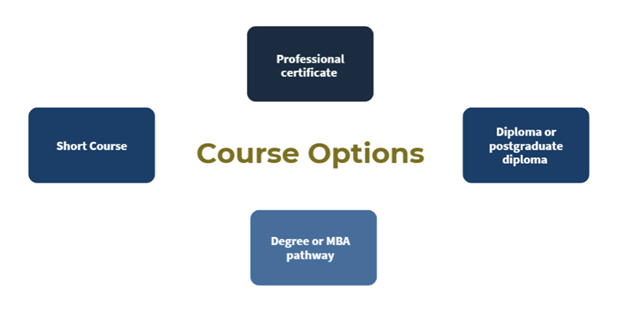
The best pathway depends on your career stage, target role, and how quickly you need to apply new skills in the workplace.
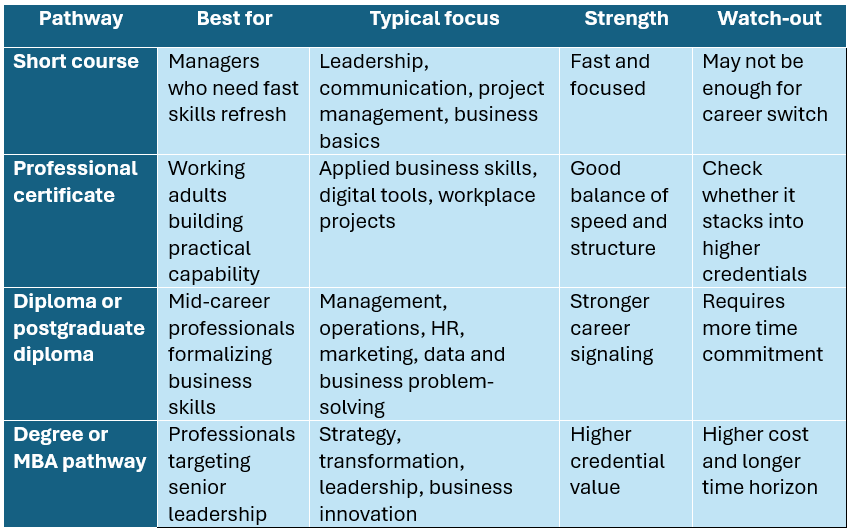
A shorter course may help you close an immediate skills gap. A diploma may help you make a stronger career move. A degree or MBA pathway may support long-term leadership progression.
Stackable pathways are also becoming increasingly popular because they allow professionals to start with shorter credentials while keeping the option to progress into higher qualifications later without restarting from the beginning.
For professionals exploring digital business, growth management, or transformation-related roles, pathways that integrate applied projects and digital capability building may provide stronger long-term career value than purely theoretical management programs.
Career Outcomes: What Salary Uplift Should You Look For?
A course will not guarantee a salary increase by itself.
The more practical question is not whether a certificate automatically increases salary. It is whether the course helps learners qualify for roles with broader ownership, stronger business impact, and higher strategic value.
Salary uplift depends on your current role, industry, experience, performance, employer demand, and how effectively you apply new skills at work.
Employers also increasingly reward professionals who can manage both people and digital business processes. This includes areas such as operations optimization, analytics interpretation, customer lifecycle management, automation workflows, and AI-assisted decision-making.
A useful way to assess career return is to compare your current role against your target role.
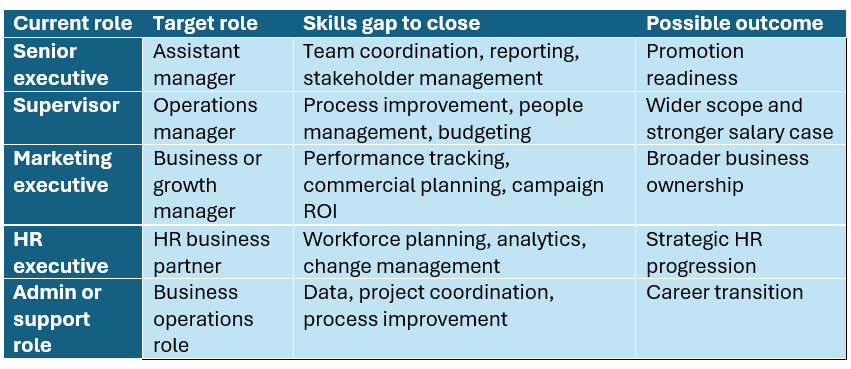
A strong course should help you build evidence, not just knowledge. This can include workplace projects, portfolio outputs, applied case studies, business improvement plans, or measurable team outcomes.
CLaaS2SaaS’s approach is designed around practical, skills-first learning. Learners are expected to connect business concepts to workplace application, so the course is not just about studying management theory. It is about using management skills to solve real business problems.
CLaaS2SaaS vs Other Business Management Courses: What Should You Compare?
Comparing business management programs requires more than looking at institutional reputation alone. Professionals should also consider how closely the learning experience connects to workplace execution, employability outcomes, and future-of-work skills.
Many universities or courses may offer strong academic foundations, broad credentials, or brand recognition. CLaaS2SaaS takes a more applied approach by helping learners build skills they can use in real workplace situations.
For learners across ASEAN, including professionals who look to Singapore as a benchmark for digital business maturity, the key question is whether the course helps you perform better at work, not only understand management frameworks.
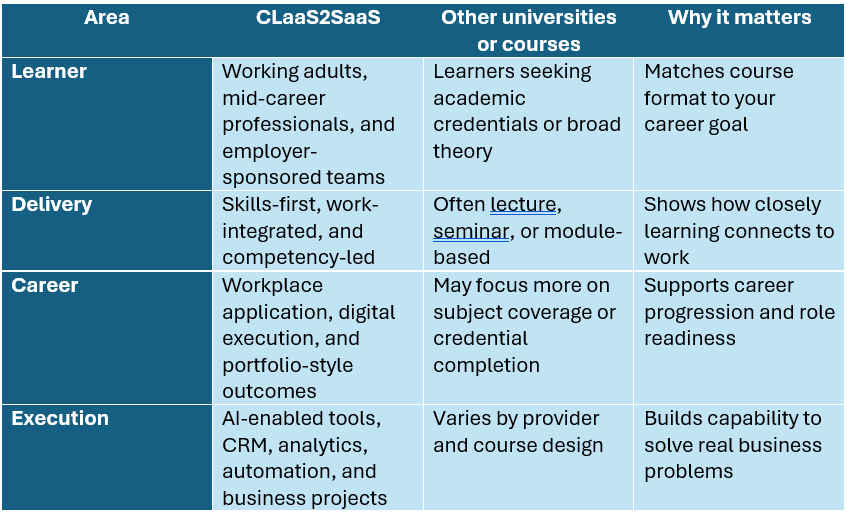
A transparent comparison helps learners make a more confident decision. Brand matters, but so do outcomes, flexibility, employability orientation, and the ability to apply what you learn at work.
Why CLaaS2SaaS’s Adaptive CLaaS® Pathway Works for Mid-Career Professionals
Many working adults do not want to return to school in a traditional way. They want to keep working while building workplace-ready capabilities that help them perform better, take on more responsibility, and prepare for future roles.
This is especially relevant for professionals balancing career growth, family commitments, and changing industry expectations while needing flexible learning schedules.
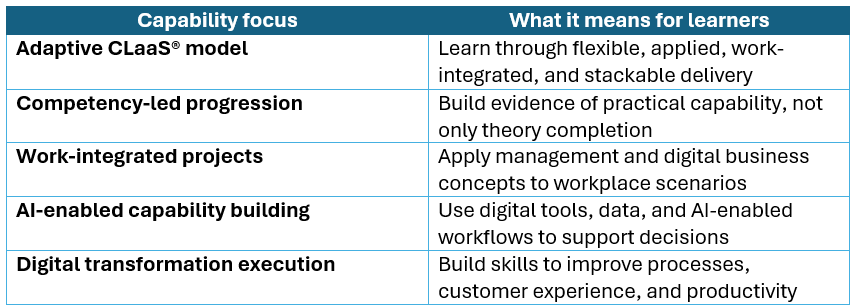
CLaaS2SaaS’s pathway uses the Adaptive CLaaS® learning model, combining work-integrated projects, AI-enabled business tools, competency-based progression, and flexible stackable pathways for working professionals.
Learners connect business and management concepts to practical execution. This includes business planning, team communication, process improvement, data-informed decision-making, digital marketing, human resources, supply chain management, and digital transformation execution.
For professionals operating in increasingly technology-driven workplaces, this matters because employers value people who can execute, not just explain frameworks.
Business Management Program Details and Fees
CLaaS2SaaS’s stackable business and digital capability pathway is designed for working adults seeking practical, workplace-oriented progression into management, marketing, automation, analytics, and digital transformation roles.
The program pathway allows learners to start with a Professional Certificate, progress into a Professional Diploma or Postgraduate Diploma, and continue into a Master’s Degree top-up pathway, depending on their academic background and career goals.
Unlike traditional programs that separate management from digital capability, these pathways integrate business execution with modern tools and applied projects.
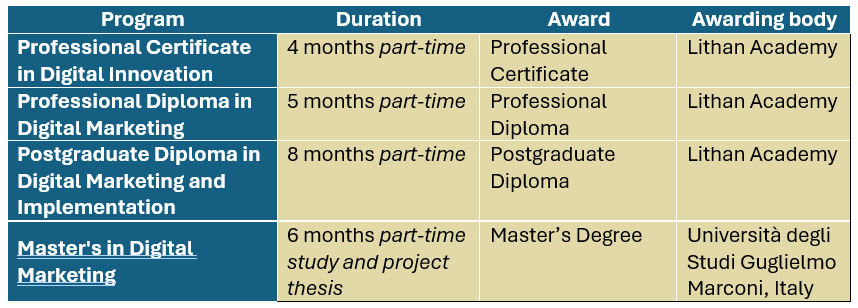
The whole journey is designed to reflect how management roles increasingly require professionals to combine leadership capability with digital execution and data-informed decision-making.
The Professional Certificate in Digital Innovation focuses on low-code application development, AI model development, data analytics, and a capstone project. It is designed to equip learners with practical digital innovation skills using tools such as Microsoft Power Platform, Power Apps, Power Automate, Copilot Studio, AI Builder, and Power BI.
The Professional Diploma in Digital Marketing builds deeper capabilities in digital marketing, content marketing and video, marketing automation, CRM applications, omni-commerce campaigns, low-code applications, AI model development, data analytics, and a capstone project. Learners gain hands-on experience with platforms such as Google Ads, Meta Ads, HubSpot CRM, Microsoft Power Platform, Copilot Studio, Dataverse, and Power BI.
For learners who already hold a bachelor’s degree or relevant background, the Postgraduate Diploma in Digital Marketing provides a more advanced route into digital marketing and implementation. It covers digital marketing strategies, content, automation, omni-channel campaigns, data-driven decision-making, and real-world implementation projects.
The Master’s in Digital Marketing top-up pathway is awarded by Università degli Studi Guglielmo Marconi, Italy. It includes advanced digital marketing management, marketing practice, communication and media, marketing theory, and a final thesis.
Learning Mode
The Adaptive CLaaS® learning model is designed for working adults, with virtual learning, flipped classes, mentoring, self-paced e-learning, assessments, and project-based learning.
Part-time training sessions are typically held from 7pm to 10pm, around two to three sessions per week, with additional self-learning commitment outside class.
This structure helps learners build practical skills while continuing to manage work commitments. Instead of studying business concepts in isolation, learners apply digital marketing, CRM, automation, AI, and analytics skills through projects that reflect real workplace needs.
Employer Perspective: Building Management Capability for the Future of Work
As AI, automation, and digital operations reshape industries, organizations need managers who can lead change, coordinate teams, improve workflows, and translate business objectives into measurable execution.
In CLaaS2SaaS’s Future of Work discussion, “Overcoming Hiring Challenges with Global Talent,” the conversation highlights a key reality for employers: talent strategy must go beyond filling roles. Companies need people who can adapt, collaborate across markets, and contribute to business outcomes in a changing workplace.
For employers, structured management training is more than a staff development initiative. It becomes a practical way to strengthen team leads, supervisors, and business professionals who are expected to manage people, improve processes, and support growth.
A practical business and management pathway can help teams:
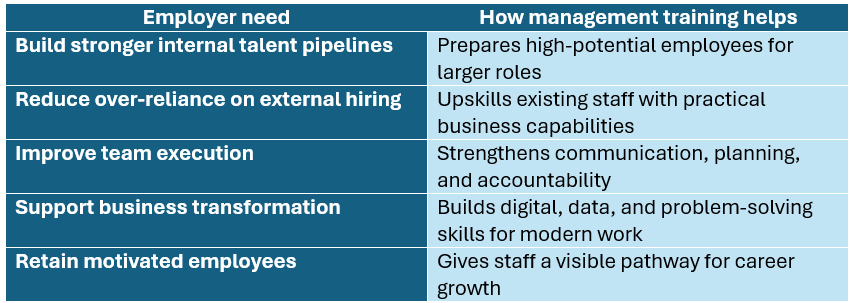
For HR and business leaders, the value is clear. When employees learn how to lead teams, manage projects, interpret business needs, and apply digital tools, they become better equipped to contribute beyond their current job scope.
The goal is not just to complete a course. The goal is to help working professionals apply management skills in real workplace situations, so businesses can build stronger, more adaptable teams.
Choose the Course That Proves Career Value
The best business management course is not simply the one with the strongest brand. It is the one that helps you build the skills employers value, apply them in real work situations, and move closer to your target role.
For mid-career professionals, the decision should come down to four questions:
- Can the course support career progression?
- Can it show practical outcomes?
- Can it fit around work?
- Can it help you apply business and digital skills in real workplace situations?
Ready to Start?
Your next step depends on what you want to achieve.
Some learners may prioritize promotion readiness, while others may focus on career transition, leadership development, or digital business capability building.
| Your goal | Recommended action |
|---|---|
| I want to enroll as an individual learner | Explore the Business Management Course |
| I want to upskill my team | Consult an Advisor for Your Team |
| I want help choosing the right pathway | Speak with a Course Advisor |
Whether you are preparing for promotion, formalizing your management skills, or building stronger workplace capability for your team, the right pathway can help you build stronger long-term career mobility in a rapidly evolving business environment.
Frequently Asked Questions
What business management courses does CLaaS2SaaS offer?
CLaaS2SaaS offers stackable learning pathways designed for working adults who want to build practical business, digital marketing, automation, analytics, and management-related capabilities. Learners can explore certificate, diploma, postgraduate diploma, and master’s top-up options depending on their background and career goals.
Can I get a job with a business management qualification?
Yes, but the qualification should be paired with applied skills and workplace evidence. Employers typically look for management capability, communication, project ownership, data awareness, and the ability to solve business problems.
A strong program should help you build practical outputs that show what you can do, not just what you have studied.
How does a business management short course compare to an MBA?
A short course is faster and more focused. It is useful when you need to close a specific skills gap, such as leadership, project coordination, digital marketing, automation, or analytics.
An MBA is broader, longer, and often more strategic. For working adults who want practical leadership and digital business capability without immediately committing to a full MBA, a stackable pathway can offer a more flexible route.
Can I study part-time while working?
Yes. The learning model is designed for working adults, with part-time sessions, virtual learning, mentoring, self-paced e-learning, assessments, and project-based learning.
This helps learners continue working while building skills they can apply in real workplace situations.
How do I choose between a short course, diploma, and degree?
Choose based on your current role, target role, time commitment, and career goal.
Pick a short course if you need immediate skills. Choose a diploma or postgraduate diploma if you want stronger career signaling and deeper practical capability. Consider a degree or master’s top-up pathway if you are preparing for longer-term leadership or specialist progression.
Is this pathway suitable for teams?
Yes. The pathway can support employer-sponsored teams that need stronger capability in leadership, digital execution, CRM, analytics, automation, and workplace problem-solving.
For teams, the main value is building a shared capability base so employees can lead better, work more efficiently, and contribute more directly to business goals.
Share


Want to check if this career is for you?