Home Blog Lifelong Learning CET Data Analyst Course Singapore
Lifelong Learning CET

Data Analyst Course Singapore: Build In-Demand Skills

Data Analyst Course Singapore: Build In-Demand Skills

Header Banner With The Text “From Raw Data To Real Careers. Your Data Analyst Roadmap For Southeast Asia”

Data analyst roles are multiplying across Southeast Asia, and this is one of the best moments to step into one. Singapore’s demand for data analysts is already at hiring scale. In late March 2026, JobStreet listed more than 5,200 data analyst roles in Singapore, while SkillsFuture describes data analytics as one of the country’s fastest-growing skill areas, with demand spreading across industries.  

Salaries are strong too, with JobStreet placing the typical data analyst pay range at around SGD 4,500 to SGD 6,700 per month. The hiring is especially visible across banking, logistics, and healthcare, making this a smart time to start a data analyst course in Singapore. 

The difference between stalling out and landing a role often comes down to one thing: whether your training is built around the Singapore job market or a generic global template. Browse the full range of Courses and Training, or go straight to the Data and Analytics pathway built for what SG and most employers are hiring for right now. 

Why Singapore’s Demand for Data Analysts Is Growing Fast 
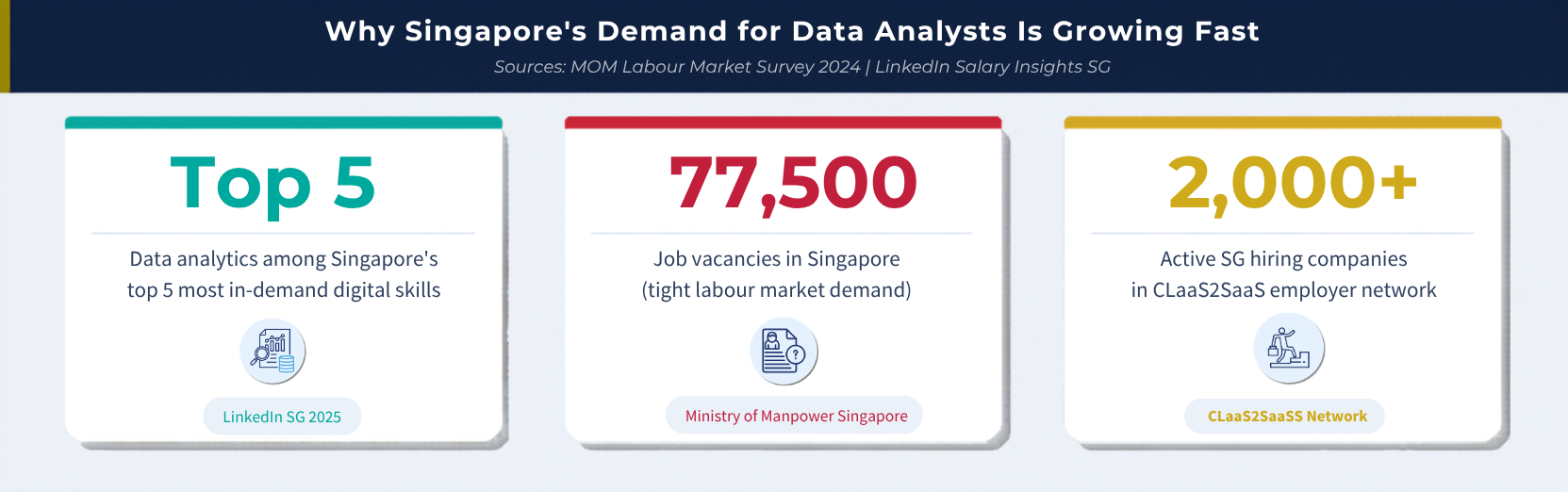
Singapore data analyst job demand 2025: top 5 digital skill, 40% role growth, 2000 SG hiring companies

Singapore’s Smart Nation initiative and the rapid digitization of industries like banking, retail, and government services have created sustained demand for professionals who can analyze and visualize data. Roles in data analysis consistently appear on Singapore’s top job platforms, including JobStreet SG and LinkedIn Singapore. 

The Singapore Ministry of Manpower (MOM) Labour Force in Singapore 2024 and the Occupational Wages 2024 tables identifies analytics and digital skills as priority competency areas across multiple sectors. This translates directly into hiring: organizations want professionals who can query databases in SQL, model data in Python, and communicate insights through Tableau and Power BI dashboards. 

This also applies to employers across Asia, that they aren’t just looking for “dashboard makers,” they need analysts who can translate data into actionable insights using artificial intelligence. This helps companies make data driven decisions that are critical for Singapore’s Smart Nation initiatives. 

SG Data Analyst Salary by Experience Level

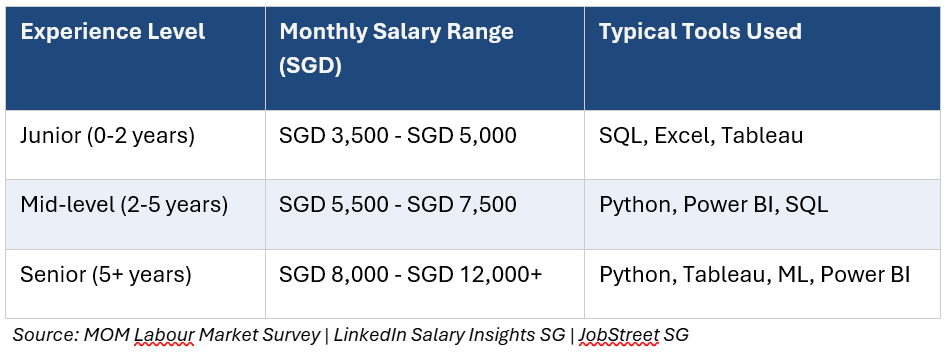
Based on MOM Labour Market Survey data and LinkedIn Salary Insights SG, here is what data professionals in Singapore can expect across career stages:
Why Demand for Data Analysts Is Growing Across ASEAN

Singapore’s Smart Nation initiative and the rapid digitisation of banking, retail, logistics, and public services have created sustained, large-scale demand for professionals who can analyse and visualise data. The Singapore Ministry of Manpower (MOM) identifies analytics and digital skills as priority competency areas across multiple sectors, and that demand is visible in real hiring volume on JobStreet SG and LinkedIn Singapore. 

But Singapore is not an isolated case. Across the ASEAN region, similar digital economy shifts are generating comparable demand: 

  • Philippines: The country’s BPO and fintech sectors are rapidly expanding data analytics functions. Government digital transformation programmes, including the Philippine Digital Infrastructure Project (PDIP), are creating public sector data roles alongside private-sector growth. 
  • Indonesia: As Southeast Asia’s largest economy, Indonesia’s e-commerce, banking, and logistics sectors, led by companies like GoTo, Tokopedia, and Traveloka, have placed data skills among the most sought-after competencies in the country’s expanding tech workforce. 
  • Malaysia: The Malaysia Digital Economy Blueprint and initiatives like MyDIGITAL are driving government-backed demand for data professionals across manufacturing, financial services, and the public sector. Kuala Lumpur is emerging as a regional analytics hub. 
  • Vietnam: Vietnam’s technology sector is among the fastest-growing in the region, with demand for data roles rising sharply in Ho Chi Minh City and Hanoi. Global technology firms establishing regional operations are actively hiring analytics talent. 

What unites these markets is a common skills gap: organisations across ASEAN can find graduates, but they struggle to find professionals with practical, job-ready data skills, the ability to query databases, build dashboards, clean datasets, and communicate insights to business stakeholders. That gap is an opportunity. 

What You Will Learn in This Data Analyst Course
This course is structured for working professionals in Singapore and in the ASEAN region who want to transition into data roles or upskill for career progression. The curriculum focuses on practical, job-ready competencies that SG employers look for in candidates, not theoretical frameworks designed for academic assessment. 

Skills and Tools Covered 
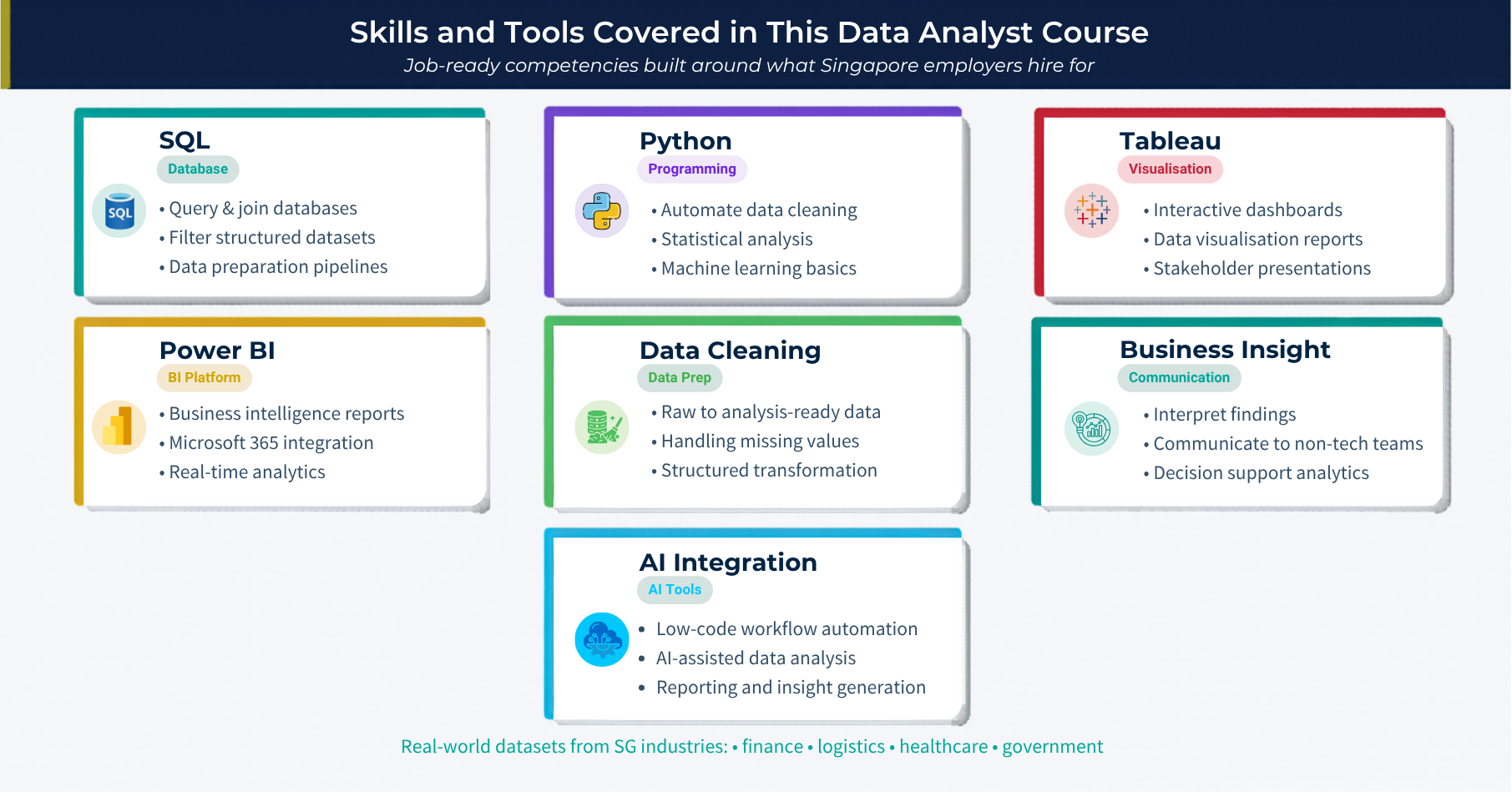
Data analyst course skills: SQL, Python, Tableau, Power BI, data cleaning and business insight

  • SQL: Query databases, filter and join datasets, and prepare structured data for analysis 
  • Python: Automate data cleaning, perform statistical analysis, and apply machine learning basics 
  • Tableau: Build interactive dashboards and data visualization reports for business stakeholders 
  • Power BI: Create business intelligence reports integrated with Microsoft 365 environments 
  • Data Cleaning and Preparation: Transform raw data into structured, analysis-ready formats 
  • Business Decisions from Data: Interpret analytical findings and communicate them clearly to non-technical teams 
  • Low-Code & AI Integration: Combining low-code workflows with AI-assisted analysis.  

Real-world data projects use datasets drawn from SG industries including finance, logistics, and healthcare. This means you are practicing with scenarios relevant to Singapore employers, not US-market case studies. 

Looking to pair data skills with engineering or infrastructure capabilities? See also the Software and Web Development track and the Cloud and Infrastructure programme if you want a broader digital profile.

Why Market-Relevant Training Matters More Than a Global Certificate

Platforms like Google and Coursera offer popular data analytics certificates. They are useful as introductions, but they are built around the US job market. They do not reflect SG employer expectations, local salary benchmarks, SkillsFuture eligibility, or which industries in Singapore are actively hiring. 

Here is what sets a CLaaS2SaaS data analyst course apart: 

  • SkillsFuture eligible: Course is registered for SkillsFuture Credit, reducing out-of-pocket cost significantly specifically for Singaporeans 
  • SG employer recognition: Curriculum is co-designed with industry partners active in the Singapore market 
  • Hands-on projects: Case studies drawn from SG sectors including banking, government, and supply chain 

A global certificate tells an employer you completed a course. Certified with hands-on projects in a Singapore-based environment, ready to excel not only in the SG job market but ahead in other regions as well.

Career Path After Certification

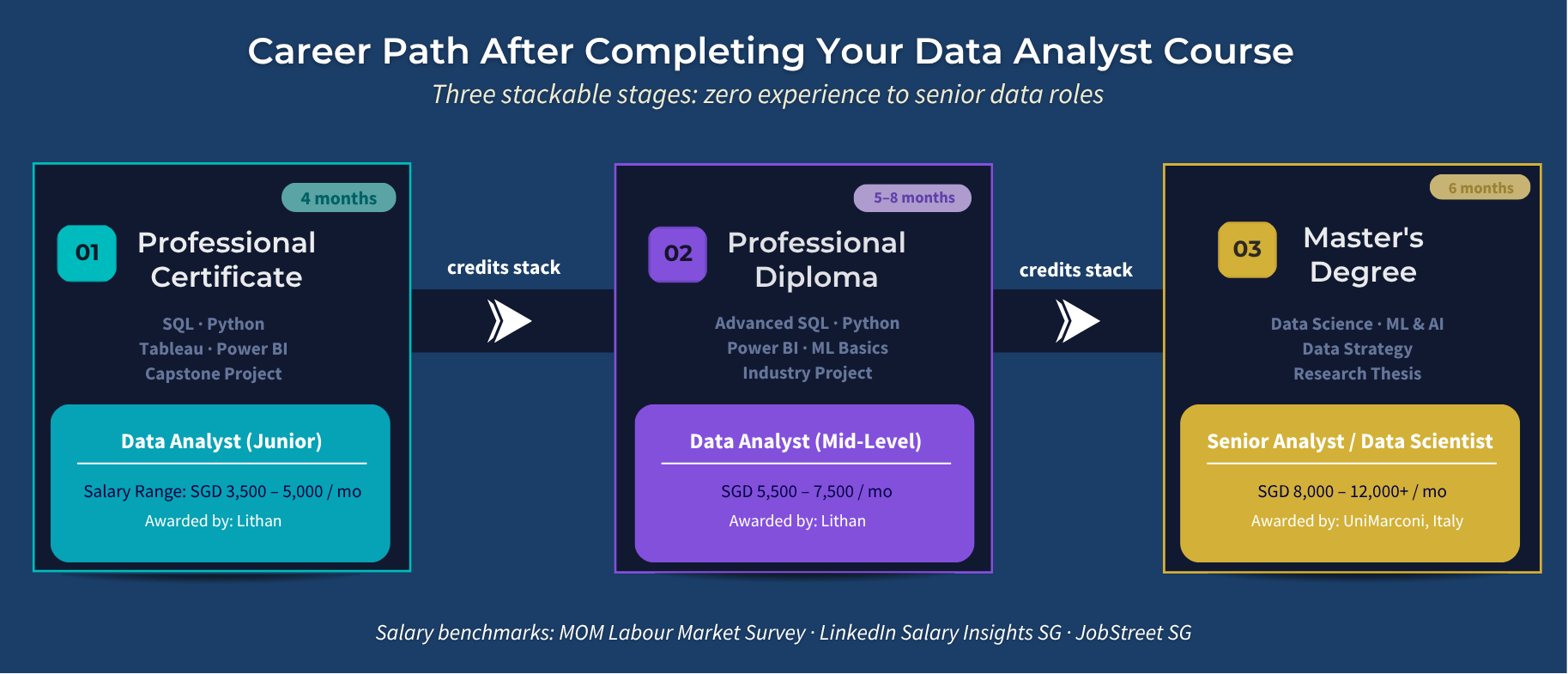
Data analyst career path: Professional Certificate to Master's Degree with SGD salary benchmark

Completing a data analyst course opens multiple career directions in the ASEAN region. Common roles graduates move into include: 

  • Data Analyst in banking, insurance, or fintech 
  • Business Intelligence Analyst with reporting responsibilities 
  • Operations Data Analyst in logistics or retail 
  • Junior Data Scientist with a programming languages focus 
  • Marketing Analytics Specialist using dashboards and attribution models 

A typical finance-to-data-analyst career transition in Singapore takes 4 to 6 months of structured learning followed by project-based experience. Graduates who complete hands-on projects with Tableau and Python report stronger interview outcomes because they can demonstrate specific data project results, not just course completion. 

Data professionals who continue into data scientist jobs or machine learning roles often start with this foundational data analyst course and progress over 12 to 18 months, building on SQL and Python fundamentals with more advanced modelling work. 

Course Duration, Schedule and Prerequisites 

Duration: The core data analyst course runs over 3 to 4 months part-time, with weekend and evening cohorts designed for working professionals. 

Schedule: Flexible learning modes including blended online and in-person sessions to fit around existing work commitments. 

Prerequisites: No prior experience in data analysis is required. Basic computer literacy is sufficient. For Python modules, some comfort with logical thinking or spreadsheet use is helpful but not mandatory. Prior experience in any analytical or finance-adjacent role is a useful starting point but not a gatekeeping condition. 

Cost and SkillsFuture Funding 

This data analyst course qualifies for SkillsFuture Credit. Singapore Citizens aged 25 and above can apply their SkillsFuture Credit balance to offset course fees, reducing the upfront cost significantly. 

Additional funding support may be available under: 

  • NTUC UTAP, 50% unfunded course fee support up to SGD 250/year (SGD 500/year for members aged 40 and above) 

For professionals based in the Philippines, Indonesia, Malaysia, Vietnam, and other ASEAN countries as well, Contact the CLaaS2SaaS team for the current course code, exclusive special pricing, and updated fee schedule. Fees and subsidy amounts are reviewed periodically and should be confirmed at enrollment. 

Want to plan your full SG data career?
Download the SG Data Career Roadmap →

CLaaS2SaaS Data Analyst Pathway: From Zero to Job-Ready

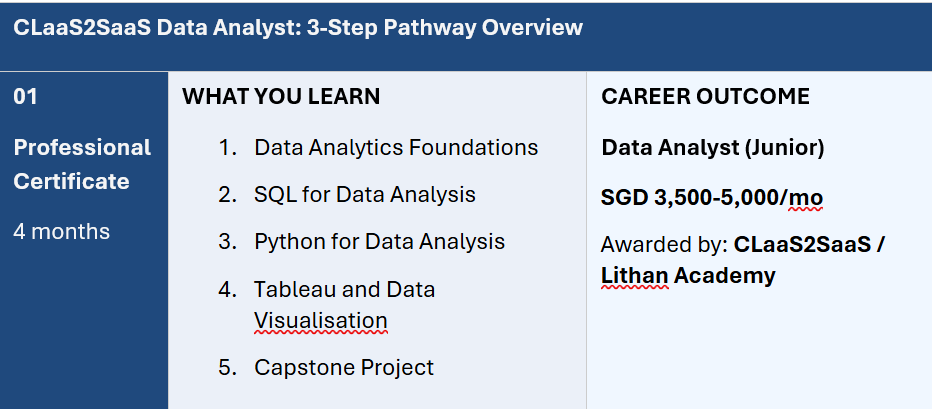
Knowing which skills you need is one thing. Having a structured, accredited path to build and prove them to employers is another. CLaaS2SaaS Data Analyst Programme runs across three stackable stages, each unlocking a higher career and salary tier.
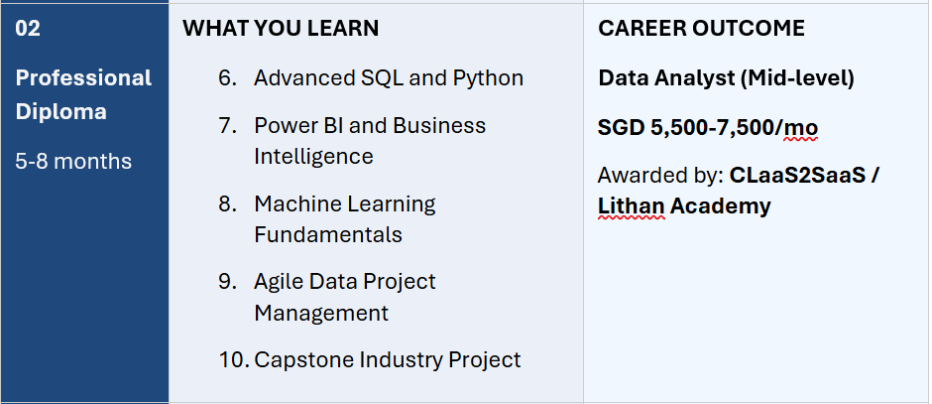
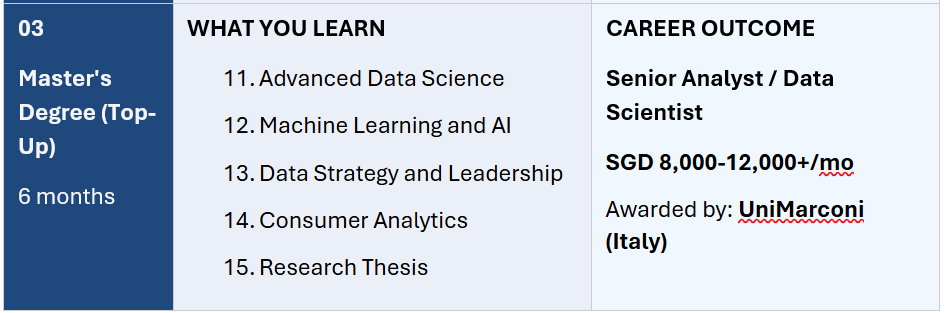

* Salary benchmarks: MOM Labour Market Survey, LinkedIn Salary Insights SG, and prevailing SG employment market rates. 

Disclaimer: The salary ranges shown are for general guidance only, based on Singapore market benchmarks and publicly available data. Individual outcomes may vary and are not guaranteed. 

Stage 01 is a 4-month intensive. You learn the full practical stack: SQL, Python, Tableau, Power BI, and data cleaning workflows, and complete a real capstone project for your portfolio. No prior data experience required. Graduates are ready to step into junior data analyst roles immediately. 

Stage 02 shifts from learning to delivering. Over 5 to 8 months, you run live industry data projects, advance your Python and machine learning skills, and add Agile project management to your toolkit. This stage moves you from analyst to specialist. 

Stage 03 is a 6-month part-time top-up to a fully accredited Master’s degree from Guglielmo Marconi University (UniMarconi), Italy. It adds strategic data leadership, advanced analytics theory, and a supervised research thesis, building the credential needed to lead data functions at a senior or director level. 

All three stages are underpinned by a 70:20:10 learning model: 70% hands-on project work, 20% mentoring, and 10% structured instruction, supported by CLaaS2SaaS’s network of over 2,000 active SG hiring companies. 

Not sure which stage to start from?
Download the SG Data Career Roadmap →

Frequently Asked Questions

A data analyst collects, cleans, and interprets raw data to help organisations make better business decisions. Day-to-day tasks include writing SQL queries, building Tableau dashboards, analyzing trends in Python, and presenting findings to business stakeholders. The role sits at the intersection of technical ability and business communication, and it is one of the most transferable tech-adjacent careers in Singapore today.
Yes. Data analyst jobs in Singapore are consistently among the most searched roles on JobStreet SG and LinkedIn. Demand is strong across financial services, government-linked companies, logistics, and healthcare. The combination of SkillsFuture support, competitive salaries, and a rapidly growing digital economy makes Singapore one of the strongest markets in Southeast Asia for data professionals.
With a structured data analyst course, most working professionals in Singapore become job-ready within 3 to 6 months. This assumes consistent study of 10 to 15 hours per week, completion of hands-on projects, and active engagement with SG employer networks.
Yes. CLaaS2SaaS data analyst course is SkillsFuture eligible. Singapore Citizens aged 25 and above can use their SkillsFuture Credit to offset course fees. Contact us for the current course code and subsidy amount, as these are updated periodically.
Based on the MOM Labour Market Survey and LinkedIn Salary Insights SG, data analyst salaries in Singapore range from SGD 3,500 per month for entry-level roles to SGD 12,000 and above for senior positions. Mid-level analysts with 2 to 5 years of experience typically earn between SGD 5,500 and SGD 7,500 per month. Salaries vary by industry, tools expertise, and the size of the organisation.
Yes. The curriculum, tools, and skills covered are directly applicable to data analyst roles across the ASEAN region. The Singapore market context serves as a benchmark and regional career reference point, not a limitation. Professionals based in the Philippines, Indonesia, Malaysia, and Vietnam consistently find that Singapore-grounded training strengthens their regional career positioning and, in many cases, opens pathways to roles with Singapore-headquartered companies or MNCs operating across Southeast Asia.
A data analyst focuses on interpreting existing data to answer business questions using SQL, Tableau, and Python for data analysis and reporting. A data scientist builds predictive models and applies machine learning to generate new insights from data. Many data scientists begin their careers as data analysts, making a solid analyst foundation the most practical starting point for anyone targeting data scientist jobs in Singapore over the medium term.

Start Your Data Analyst Journey

You already have the most important asset: the decision to begin. Every month without a structured path is a month of skills, portfolio projects, and career momentum you do not get back. 

Whether you want to transition from finance into data, upskill from admin into analytics, or move from data entry into a proper analyst role, a locally grounded data analyst course is the most direct route. CLaaS2SaaS has built the Data Analyst Programme specifically for professionals where you are right now: motivated, ready to move, and looking for training that maps directly to Singapore employer expectations. 

Explore the full range of Lifelong Learning programmes to find the path that fits your schedule, background, and goals. 

Ready to take the first step? Enroll in the Data Analyst Course →
Want to check if this career is for you?