Best BSBA Course in the Philippines for Business Careers
Best BSBA Course in the Philippines for Business Careers

Content
Content
Filipino high school graduates, working adults, parents, and OFWs face a critical decision when choosing among the thousands of college courses available in the Philippines. Among many college programs and degree options available, the Bachelor of Science in Business Administration (BSBA) continues to remain a popular choice because of its flexibility, broad industry relevance, and practical business applications.
Business administration graduates can pursue roles across marketing, operations, finance, human resources, logistics, e-commerce, and management while building transferable skills that remain relevant even as industries evolve. As businesses continue to adopt digital tools and modern operational strategies, graduates with business, communication, and analytical skills remain valuable across both traditional and modern industries.
The numbers further support the program’s growing relevance. While overall youth unemployment remains at 7.2% based on Philippine Statistics Authority Q1 2026 data, BSBA graduates reportedly achieve high employability rates according to CHED labor market outcomes data. Long-term earning potential also remains competitive, with business administration graduates reaching median monthly salaries of around PHP 60,000 within five years of graduation. In metro cities like Manila and Cebu, growing demand across BPO, logistics, retail, and e-commerce sectors continues to create opportunities for graduates with skills in operations management, business communication, and market research.
The program’s continued relevance is supported by growing demand across sectors such as BPO, logistics, fintech, retail, and e-commerce. Employers increasingly look for graduates who possess foundational business knowledge alongside practical skills in communication, operations management, digital marketing, project coordination, and business analytics. For many students and working professionals, this versatile baccalaureate degree remains a practical pathway toward long-term career mobility.
Part of what makes the degree adaptable is the range of specialization pathways available within the program itself. Rather than following a single fixed career track, students can tailor their studies based on their interests and intended industries.
Most BSBA programs in the Philippines begin with foundational subjects in business management, economics, accounting, communication, and organizational leadership before allowing students to pursue a specialization aligned with their career goals. These specialization tracks typically include major subjects alongside internship, practicum, or industry immersion components designed to help students apply classroom concepts in real-world business environments.
Explore BSBA programs built for real-world business careers and long-term growth
What Subjects Are Included in a BSBA Course?
One of the reasons it stands out among various courses in Philippines’ colleges, is its balanced, comprehensive curriculum. Students gain a broad understanding of how businesses operate while developing practical skills that can be applied across different industries.
Although specific subjects may vary across different colleges and universities, most business-related undergraduate programs begin with foundational courses that build core business competencies.
Common BSBA Subjects
Principles of Management
Introduces students to organizational structures, planning, decision-making, leadership, and business operations.
Introduces students to organizational structures, planning, decision-making, leadership, and business operations.
Financial and Managerial Accounting
Provides an understanding of financial statements, budgeting, cost analysis, and business performance measurement.
Provides an understanding of financial statements, budgeting, cost analysis, and business performance measurement.
Economics
Covers microeconomics and macroeconomics, helping students understand market behavior, consumer decision-making, and economic trends.
Covers microeconomics and macroeconomics, helping students understand market behavior, consumer decision-making, and economic trends.
Business Communication
Develops professional writing, presentation, negotiation, and workplace communication skills that are essential across industries.
Develops professional writing, presentation, negotiation, and workplace communication skills that are essential across industries.
Marketing Management
Introduces market research, branding, customer behavior, digital marketing, and sales strategies.
Introduces market research, branding, customer behavior, digital marketing, and sales strategies.
Operations Management
Focuses on process improvement, supply chain management, logistics, quality control, and resource optimization.
Focuses on process improvement, supply chain management, logistics, quality control, and resource optimization.
Human Resource Management
Covers recruitment, employee development, performance management, and organizational behavior.
Covers recruitment, employee development, performance management, and organizational behavior.
Business Law and Ethics
Provides knowledge of legal frameworks, contracts, business regulations, and ethical decision-making.
Provides knowledge of legal frameworks, contracts, business regulations, and ethical decision-making.
Entrepreneurship
Teaches students how to identify opportunities, develop business models, and create sustainable ventures.
Teaches students how to identify opportunities, develop business models, and create sustainable ventures.
Leadership and Strategic Management
Helps students understand long-term business planning, organizational growth, and leadership in modern business environments.
Helps students understand long-term business planning, organizational growth, and leadership in modern business environments.
BSBA Specializations
Many universities also allow students to pursue specialized tracks such as:
- Marketing Management
- Financial Management
- Human Resource Management
- Operations Management
- Business Economics
- Entrepreneurship
As businesses continue adopting AI, automation, and digital technologies, many institutions are also integrating digital business, analytics, and technology-enabled management concepts into their curriculum to better prepare graduates for modern workplaces.
BSBA Programs in the Philippines: Tuition & Academic Pathways
Tuition fees for BSBA programs vary depending on the institution, location, learning format, specialization offerings, and industry exposure opportunities available. Public universities may offer subsidized tuition, while private institutions and alternative learning pathways may provide additional features such as hybrid learning, internships, project-based training, and international academic collaborations.
The table below provides sample tuition ranges and academic structures from institutions and learning pathways offering business administration programs in the Philippines.
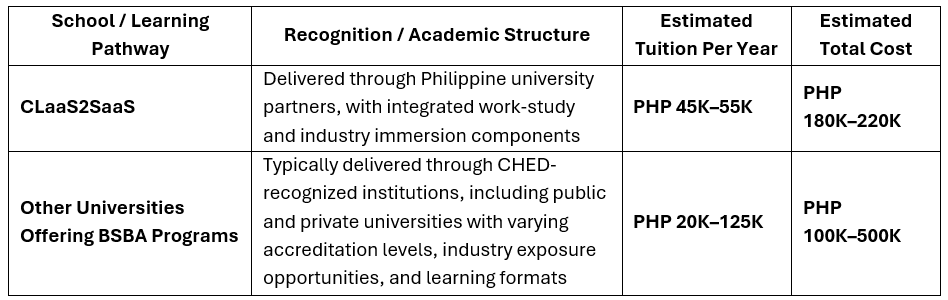
Tuition ranges are estimates based on publicly available information and may vary by institution, location, and specialization.
Beyond tuition costs, students may also consider factors such as internship access, project-based learning opportunities, faculty expertise, hybrid learning flexibility, industry immersion, and exposure to digital business tools when evaluating BSBA pathways.
Some modern work-study learning models, including programs offered through CLaaS2SaaS’ university partnership pathways, combine academic coursework with practical industry exposure to help students build workplace experience alongside their degree studies.
Why BSBA Continues to Thrive in 2026
As businesses continue adapting to AI, automation, and digital transformation, companies are placing greater value on professionals who understand both business strategy and operational execution. BSBA programs help students develop practical skills in leadership, communication, problem-solving, analytics, and project management — competencies that remain valuable across industries even as technologies evolve.
According to projections from the Department of Trade and Industry (DTI), sectors such as e-commerce, fintech, logistics, and digital services are expected to continue expanding throughout 2026 and beyond. This creates growing demand for graduates who can manage teams, coordinate operations, analyze markets, and support business growth initiatives. Especially them who can operate in hybrid and AI-assisted environments.
BSBA courses are often valued for their flexibility and broad industry applicability. The program equips graduates with foundational business, communication, and management skills that can be applied across different sectors, allowing many professionals to explore a variety of career opportunities over time. This adaptability makes the degree appealing for students seeking long-term career mobility and evolving professional pathways.
This also explains why BSBA course remains popular among:
- Senior high school graduates exploring versatile career options
- Working adults planning career shifts into business or management roles
- Parents seeking practical and stable degree pathways for their children
- OFWs looking for flexible hybrid learning options while working abroad
BSBA vs Accountancy: Which Is Better?
Both BSBA and Accountancy can lead to strong career opportunities, but they are designed for different goals.
Accountancy is ideal for students pursuing CPA licensure and highly specialized careers in auditing, taxation, and public accounting. BSBA, meanwhile, is generally better suited for students seeking broader opportunities in management, operations, marketing, sales, entrepreneurship, and business development.
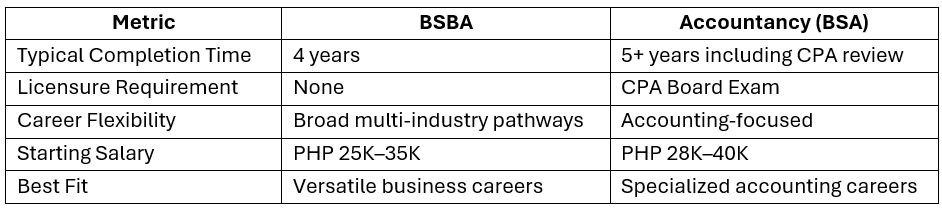
Salary ranges are estimated averages and may vary depending on factors such as industry, location, employer, internship experience, certifications, and individual skill level.
Students who value flexibility, management opportunities, and broader industry access often find BSBA aligned with their long-term goals, while Accountancy remains ideal for those committed to becoming licensed CPAs.
BSBA Career Paths & Salary Benchmarks
A BSBA degree opens opportunities across both local and international markets. In the Philippines, graduates commonly enter industries such as banking, retail, BPO, logistics, digital marketing, hospitality, and e-commerce.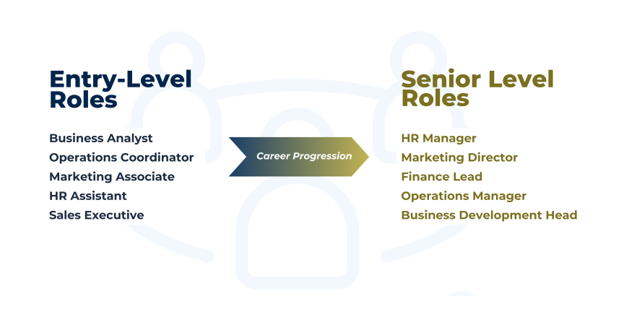
Typical entry-level roles include:
- Business Analyst
- Operations Coordinator
- Marketing Associate
- HR Assistant
- Sales Executive
- Customer Success Associate
As graduates gain experience, career progression may lead toward positions such as:
- HR Manager
- Marketing Director
- Finance Lead
- Operations Manager
- Business Development Head
Choosing the Right BSBA Program
When selecting a BSBA program, students should look beyond tuition fees alone. Factors such as curriculum quality, internship exposure, hybrid learning flexibility, faculty experience, and industry partnerships often have a direct impact on graduate employability.
Traditional BSBA vs Work-Study Degree Programs
While traditional BSBA programs continue to provide strong academic foundations, some students now seek learning models that combine classroom learning with practical workplace experience.
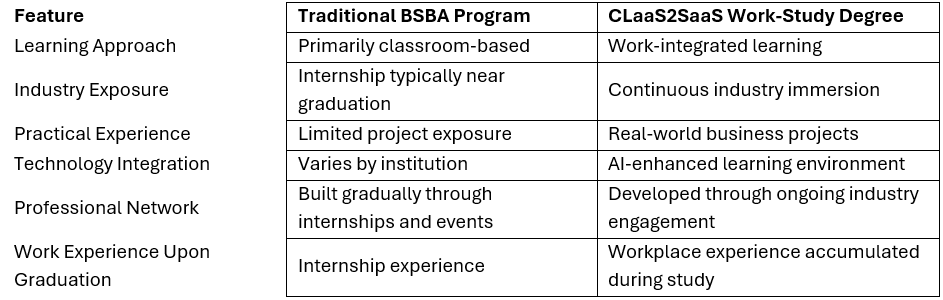
For students who value hands-on learning and early professional exposure, work-study models provide an opportunity to apply business concepts in real-world settings while completing their degree. This approach allows learners to build both academic credentials and workplace experience simultaneously.
A Practical Path to a Career in Business
This growing demand for more industry-relevant and digitally aligned education has led to the rise of modern business degree pathways such as the CLaaS2SaaS’ Work-Study Degree. Designed around practical business applications, digital transformation, and real-world industry exposure, the program combines core business foundations with hands-on learning in areas such as digital marketing, business analytics, entrepreneurship, and emerging technologies.
CLaaS2SaaS emphasizes applied learning through industry projects, adaptive learning models, and AI-enhanced learning experiences that personalize skill development and expose students to the same digital tools increasingly used in modern workplaces. This integration of AI into the learning process helps students develop practical, future-ready capabilities while studying.
For learners seeking a future-proof degree, especially those interested in digital business, remote work opportunities, and global career pathways, programs like these offer a digitally integrated and industry-aligned approach to business education.
Take the next step toward a flexible, future-ready business degree
Take the next step toward a flexible, future-ready business degree
Frequently Asked Questions
What does BSBA stand for?
BSBA stands for Bachelor of Science in Business Administration, a specialized degree offered to students focusing on management, business operations, leadership, and organizational strategy.
What are the common BSBA specializations?
Common specializations include Marketing Management, Financial Management, Human Resource Management, and Operations Management.
Is BSBA a good course in the Philippines?
Yes. BSBA remains one of the most versatile and employable degree programs in the Philippines due to its broad industry applicability and transferable business skills.
How many years is a BSBA course in the Philippines
Most BSBA programs require four years of study, although program structures may vary depending on the institution and learning pathway.
Is BSBA a difficult course?
BSBA is generally considered manageable as it is prepared for students who are interested in business, communication, management, and problem-solving. The program combines analytical subjects with practical business applications.
What jobs can I get with a BSBA degree?
Graduates commonly work in marketing, HR, finance, operations, sales, logistics, customer service, and business development roles.
Can I study BSBA while working?
Many institutions now offer hybrid or flexible learning formats that support working students and OFWs.
How much is BSBA tuition in the Philippines?
Tuition varies widely depending on the institution, ranging from around PHP 20K annually in subsidized public universities to over PHP 100K annually in some private schools.
Share


Want to check if this career is for you?