How AI Application Developers Turn Business Problems Into Working AI Prototypes
How AI Application Developers Turn Business Problems Into Working AI Prototypes
Isi kandungan
Isi kandungan
Sorting customer emails can become time-consuming when support teams handle inquiries about refunds, orders, and damaged products. The AI application development process can turn this repetitive task into a working prototype. Here’s how developers move from identifying the problem to building and testing a practical AI solution.
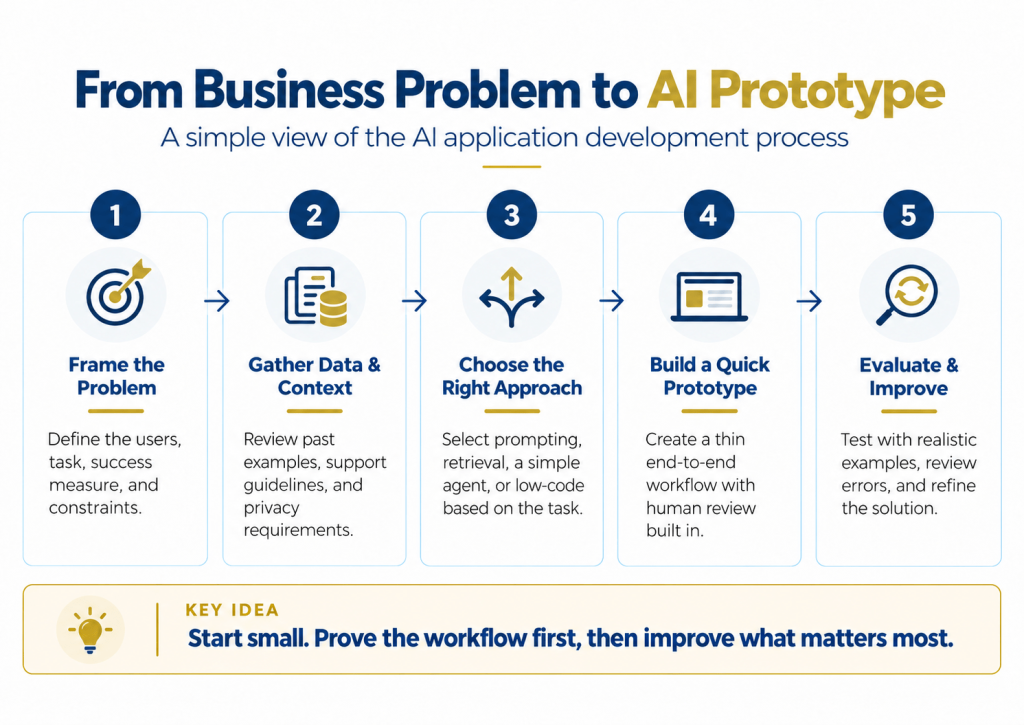
How Do You Frame the Business Problem?
Before choosing tools, developers need to understand the problem and who the application will serve.
Consider a customer support team that receives emails about refunds, order updates, and product inquiries. Employees manually read each message and forward it to the appropriate department.
An AI assistant could help, but developers must first define four requirements:
- Users: Customer support employees.
- Task: Categorize incoming emails.
- Success measure: Accurate classifications with manageable corrections.
- Constraints: Customer privacy, access permissions, and human approval.
A clear problem statement keeps development focused on a specific business need rather than unnecessary features.
What Data and Context Does the Prototype Need?
Once the problem is defined, developers identify the information needed to complete the task.
For the email-sorting assistant, useful inputs include historical emails, routing guidelines, and category descriptions. Developers must check for inaccurate labels, outdated rules, and personal information that needs protection.
Anonymized or synthetic messages can also provide safer testing examples.
Next, developers define what a correct result should look like.
Customer message: “My order arrived damaged. Can I request a replacement?”
Expected category: Product issue – replacement request.
Incorrect category: General product inquiry.
These examples provide a foundation for evaluating the assistant’s recommendations.
Preparing representative information is also part of the problem-solving process described in CLaaS2SaaS’s project-based data science training article.
With suitable data and clear expectations, developers can decide how the application should work.
Which Approach Fits: Prompting, Retrieval, an Agent, or Low-Code?
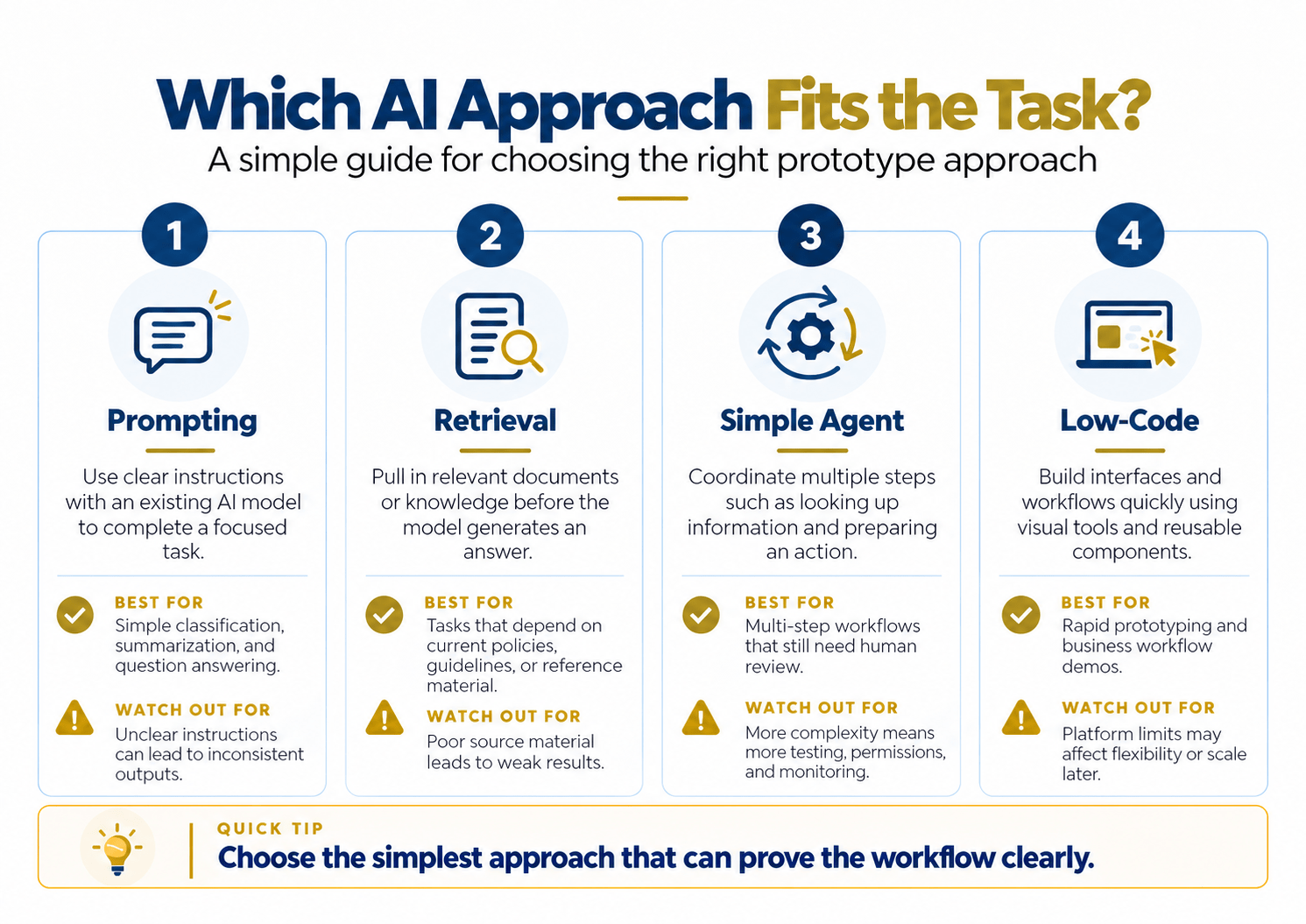
For anyone learning how to build an AI prototype, choosing the right approach is an important step. The simplest approach is often the best starting point.
Prompting
Developers give an existing AI model instructions to classify messages into predefined categories. This works well for straightforward tasks with clearly defined outputs.
Retrieval
Retrieval allows the application to access relevant documents, such as updated support guidelines, before generating a recommendation.
Simple AI Agents
AI agents coordinate multiple steps, such as checking order information and preparing routing suggestions. These workflows require appropriate permissions and human oversight.
Low-Code Development
Low-code platforms help developers build interfaces and connect workflows using visual components.
These approaches can work together. For example, prompting can classify emails, retrieval can provide additional context, and low-code can create the review interface.
Explore CLaaS2SaaS’s systems and software application development article for related technical skills.
Once developers have selected an approach, they can begin building a small version of the solution to see how it performs.
How Do You Build the First Prototype Quickly?
Once an approach is selected, developers build a small but functional version of the application.
Instead of automating the entire customer support operation, they create a thin end-to-end slice: a basic workflow that demonstrates whether the idea works.
The initial AI app development steps include:
- Create an input screen where employees can submit sample customer emails.
- Connect an AI model that analyzes each message and recommends a category.
- Display the recommendation alongside the original email.
- Allow human review so employees can approve or correct suggestions.
- Record feedback using appropriately protected test data.
The employee can then approve or correct the classification.
Developers can initially simulate integrations instead of connecting live customer databases.
This keeps the prototype focused on demonstrating the complete workflow before additional features are developed.
How Do You Evaluate and Improve It?
A working prototype still needs testing to determine whether its recommendations are reliable
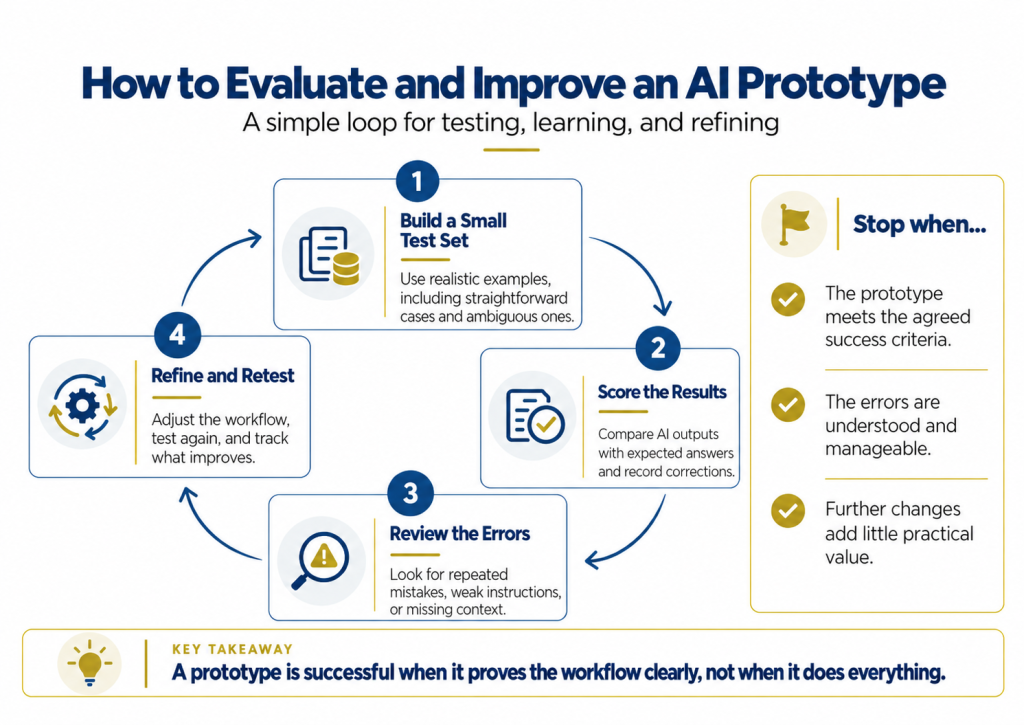
The final stage of the AI prototype process involves evaluating realistic examples, reviewing mistakes, and refining the application.
Measure the Results
Developers prepare a small test set containing straightforward emails, ambiguous requests, and messages involving multiple issues.
Each message has an expected category agreed upon by the support team.
The team compares the AI’s recommendations with these expected answers and records classification errors and manual corrections.
Review Errors and Improve
Suppose the application repeatedly classifies damaged-product complaints as general inquiries.
Developers investigate whether the problem comes from unclear instructions, category definitions, or insufficient examples.
They then make adjustments and test the application again.
Know When to Stop
Testing continues until the prototype meets agreed acceptance criteria or further changes provide limited value.
If results remain unreliable, developers may need to reconsider their approach.
A successful prototype demonstrates feasibility, but production deployment still requires security, integration, scalability, and ongoing monitoring.
Pertanyaan umum
What does an AI application developer do?
An AI application developer builds software that uses AI models to solve specific business tasks. Their work includes defining problems, preparing data, selecting development approaches, building prototypes, and evaluating results.
Do I need to train my own model?
Not necessarily. Many prototypes use existing AI models through application programming interfaces (APIs), allowing developers to focus on application workflows.
How long does an AI prototype take?
The timeline depends on task complexity, data readiness, integration requirements, and testing needs. Simple demonstrations generally require less preparation than connected applications.
What can go wrong when building an AI prototype?
Common challenges include unclear requirements, poor-quality data, inconsistent outputs, privacy risks, and insufficient evaluation.
Is AI application development the same as software engineering?
The disciplines overlap, but their focus differs. AI application development emphasizes integrating AI models into practical applications, while software engineering covers broader system design and maintenance. Read AI Application Developer vs Software Engineer for a deeper comparison.
From Prototype to Practical AI Skills
Turning a business problem into a working AI prototype requires problem-solving, application development, and systematic evaluation.
Professionals interested in building these capabilities can explore the AI Application Developer learning pathway
Bagikan


Ingin tahu apakah karier ini cocok untuk Anda?