How Much Does a Work-Study Bachelor's Degree Cost? Fees, ROI & Salary Outcomes
How Much Does a Work-Study Bachelor's Degree Cost? Fees, ROI & Salary Outcomes
Content
Content
Is a fast work-study degree actually cheaper than a traditional three or four-year degree? It is a question worth asking carefully, because the real answer is not about the sticker price alone. When you factor in work-study degree cost through the lens of what you earn, what you forgo, and how quickly you enter your career, the math shifts considerably. This post breaks down the full cost picture, the ROI framework you need, and why earning while you learn changes the calculation entirely.
The Real Cost of a Degree Is More Than Tuition
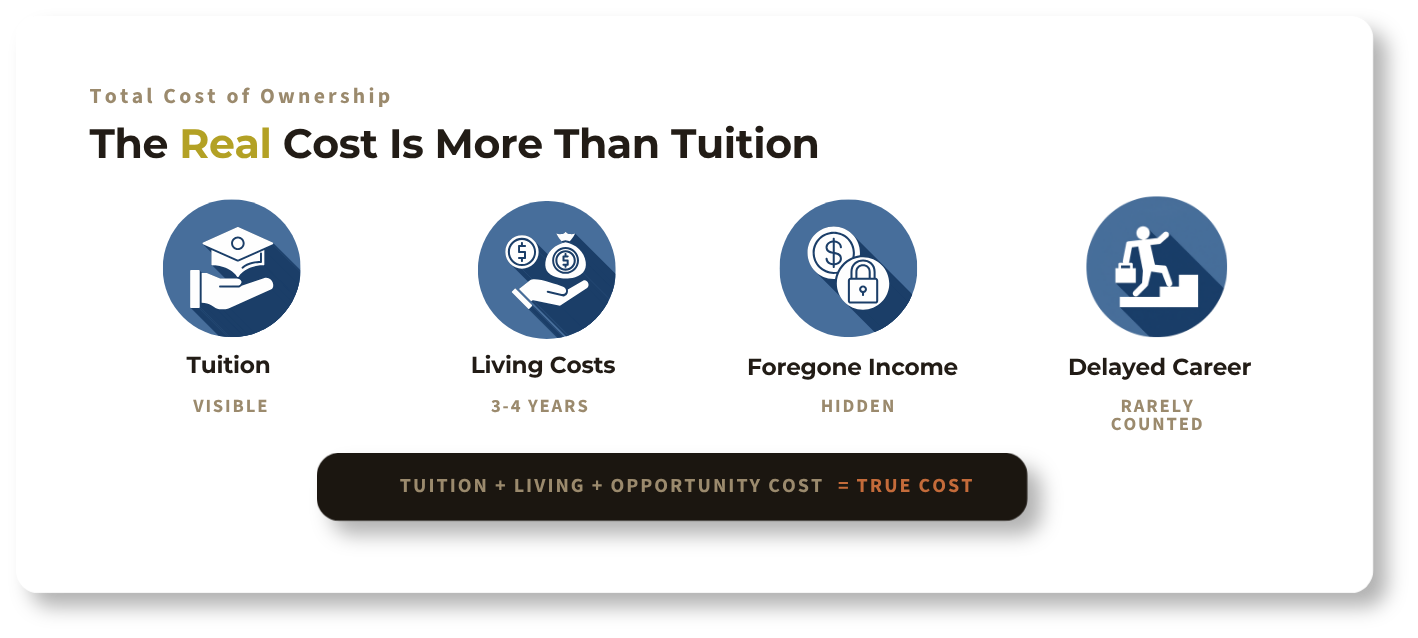
Most cost comparisons stop at tuition fees. That is the wrong place to stop.
The true cost of any degree includes tuition, yes, but it also includes living expenses across the full duration of study, the opportunity cost of time spent not working, and the income you do not earn while you are sitting in a lecture hall full-time for three or four years. When you add those factors together, a traditional university degree carries a significantly higher total cost of ownership than the headline fee suggests.
Consider the time dimension alone. A student who takes four years to complete a degree delays their career entry by four years. That means four years without a professional salary, four years of accumulating living costs, and four years before employer contributions, career progression, and compounding work experience begin. The opportunity cost of that delay is real, even if it never appears on a fee invoice.
Duration matters to cost in a way that most prospective students are never shown. A programme that gets you to a full International Bachelor’s Degree in 2 years does not just reduce tuition exposure. It compresses the entire cost timeline, including the hidden costs that traditional programmes rarely discuss. Understanding this framing is the starting point for any honest comparison between a work-study pathway and a conventional university route.
How Earning While You Learn Changes the Math
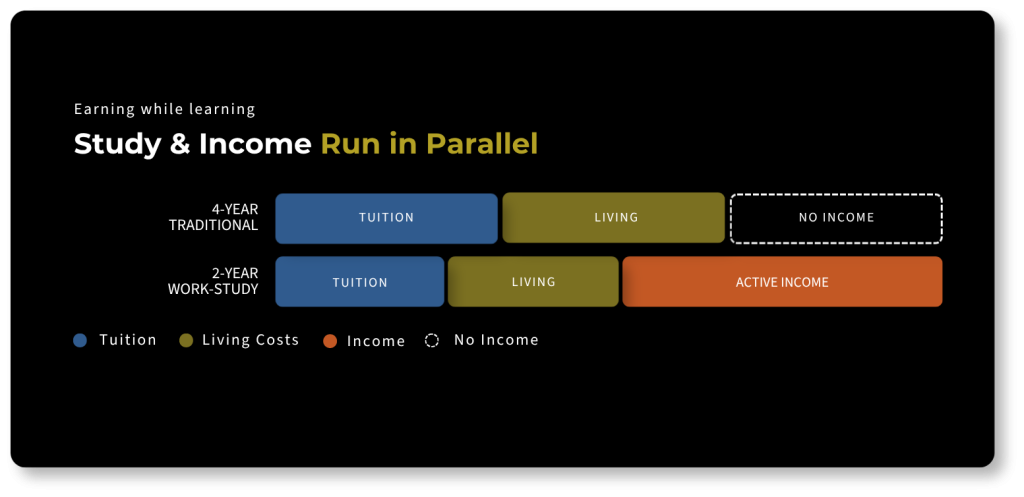
The core differentiator of the CLaaS2SaaS HigherEd work-study model is straightforward: you work full-time and study part-time simultaneously. That structure creates something a traditional full-time degree cannot offer. Rather than a gap in income during study, there is the potential to maintain an active income stream throughout the study.
For a student in a conventional three or four-year programme, every month of study is typically a month away from professional earnings. The work-study model is designed differently. From the point of enrolment, you may be generating income, building your CV, and completing real-world industry projects as part of the programme itself. The degree and the career run in parallel rather than in sequence.
This is where, ‘Is an accelerated degree worth it?’ becomes a more interesting question than it first appears. Worth it compared to what? Compared to a programme where you step back from earning for years and cover living costs throughout, a model that keeps you in the workforce while you credential yourself carries a structurally different ROI profile.
The 2-year degree return on investment case rests on two compounding factors. First, learners may complete the pathway sooner than a traditional three or four-year route. Second, the earning-while-learning model may reduce the period spent outside the workforce, depending on each learner’s employment situation and programme track.
The CLaaS2SaaS pathway offers two tracks: a Bachelor’s in Digital Business and a Bachelor’s in Software Engineering, both completed through the same Higher Diploma plus Top-Up Bachelor’s structure, with full-time work and part-time study integrated from day one. The result is an internationally accredited degree built around the way careers actually work, not around the assumption that study and work are mutually exclusive.
For exact fees and payment options specific to your track, a consultation is the right next step.
2-Year Work-Study vs 4-Year Traditional Degree: An ROI Framework
Rather than comparing invented figures, the most useful thing this post can offer is a comparison framework: the factors that determine which route delivers better value for you.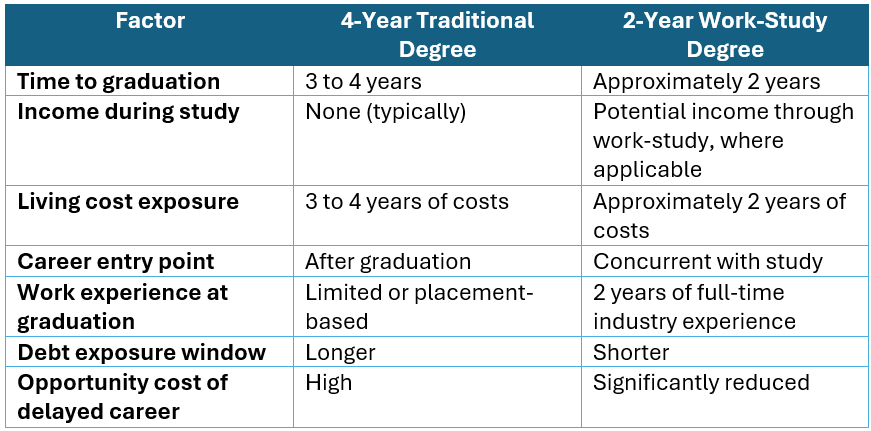
This framework shows why degree fees vs traditional university comparisons based only on tuition can be incomplete. A work-study pathway may offer a stronger ROI profile when it helps reduce time away from work, supports practical experience, and shortens the path to graduation.
The work-study degree salary outcomes discussion should also be framed carefully. Outcomes depend on the learner’s role, employer, industry demand, performance, and prior experience. The value is not a guaranteed salary result, but the potential to combine study with relevant work exposure and earlier career momentum.
Questions to Ask Before You Commit
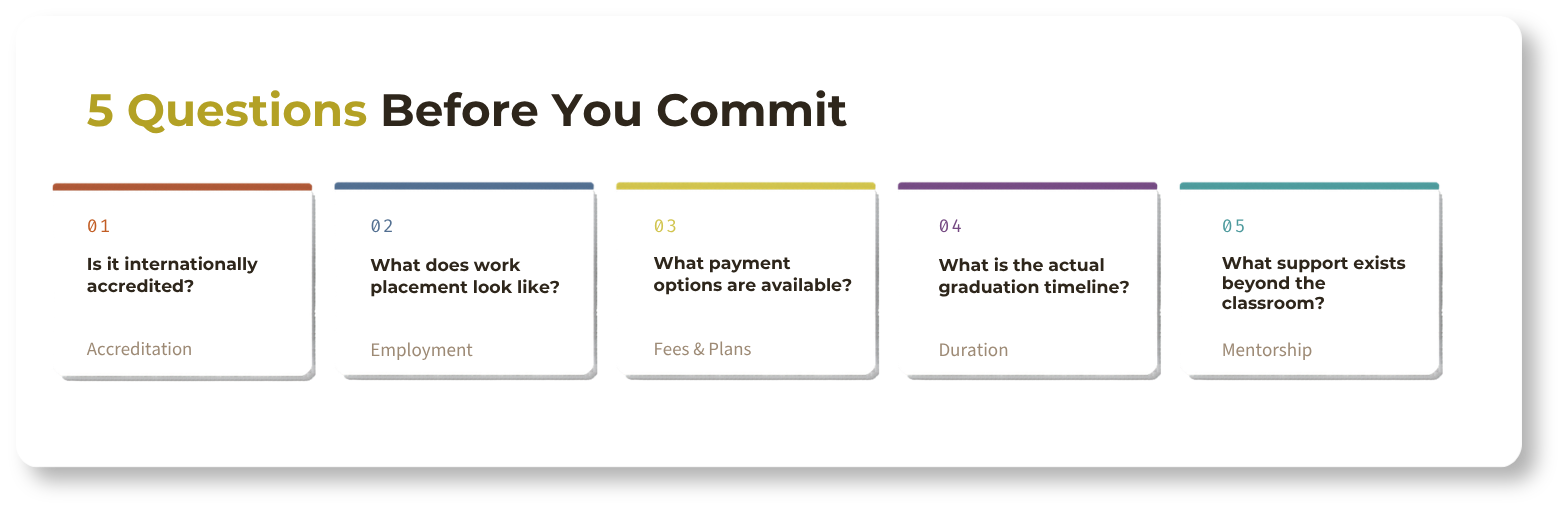
Before committing to any degree programme, whether work-study or traditional, these are the questions that matter most for your cost and ROI assessment.
- Is the degree internationally accredited? Accreditation determines whether your qualification is recognised by employers across markets. Without it, the ROI case collapses regardless of cost.
- What does the work placement or employment structure look like? A work-study model only delivers its earning-while-learning benefit if the employment component is real, structured, and integrated into the programme.
- What payment options are available? Fee structures, instalment plans, and any support available vary by programme and track. Do not assume, ask.
- What is the actual time for graduation? A programme marketed as accelerated should have a clear and realistic timeline. The CLaaS2SaaS pathway is structured as a one-year Higher Diploma followed by one year Top-Up Bachelor’s, completed while working full-time.
- What support exists beyond the classroom? Industry projects, mentorship, and career guidance are part of what converts study time into employable skills. Ask what is included.
Frequently Asked Questions
Is a work-study bachelor's degree cheaper than a traditional university degree?
It depends on the total cost picture, not just tuition. Because a work-study degree like the CLaaS2SaaS 2-year pathway lets you work full-time while you study part-time, you earn an income during the programme and enter your career roughly two years sooner than a traditional 3-4 year degree. That combination of earning-while-learning plus a shorter timeline can significantly improve your overall return on investment, even where headline tuition is similar. For exact fees and payment options, book a consultation.
What is the return on investment (ROI) of an accelerated degree?
The ROI of an accelerated degree may come from a shorter time to completion, reduced opportunity cost and the ability to gain work exposure while studying. The exact return depends on programme fees, employment situation, role progression and individual outcomes.
Does a work-study degree cost the same as a normal bachelor's degree?
Headline tuition varies by programme and track. CLaaS2SaaS does not publish a flat fee because the pathway is personalised based on your study pathway and career goals. The more important comparison is total cost over time, including income earned during study. Book a consultation for a breakdown relevant to your situation.
Can I work and earn while completing the degree?
Yes. The CLaaS2SaaS model is designed around work-study integration, combining work exposure with part-time study. Learners may be able to earn while completing the programme, depending on eligibility, placement, employment arrangement, and track requirements.
Are there payment plans or scholarships available?
Payment options and any available support depend on your chosen track and pathway. CLaaS2SaaS does not publish specific figures online. Book a free consultation to get an accurate picture of fees and available options for your circumstances.
The most useful way to compare work-study degree cost is with a personalised breakdown, because fees depend on your track and pathway. A career advisor can walk you through the full picture, including how the earn-while-learning structure may affect your overall financial position.
Share


document.addEventListener("DOMContentLoaded", function () {
var url = encodeURIComponent(window.location.href);
document.getElementById("fb-share").href =
"https://www.facebook.com/share.php?u=" + url;
document.getElementById("li-share").href =
"https://www.linkedin.com/sharing/share-offsite/?url=" + url;
});
Want to check if this career is for you?