AI in University Enrollment: How AI Agents Automate Admissions & Student Engagement
AI in University Enrollment: How AI Agents Automate Admissions & Student Engagement
Content
Content
A prospective student fills out an inquiry form on a Friday evening. Nobody responds until Tuesday, if at all. Multiply that across every open program, and you get the real story of AI in university enrollment: not a lack of interest, but a lack of speed and follow-through.
Where Universities Lose Prospective Students
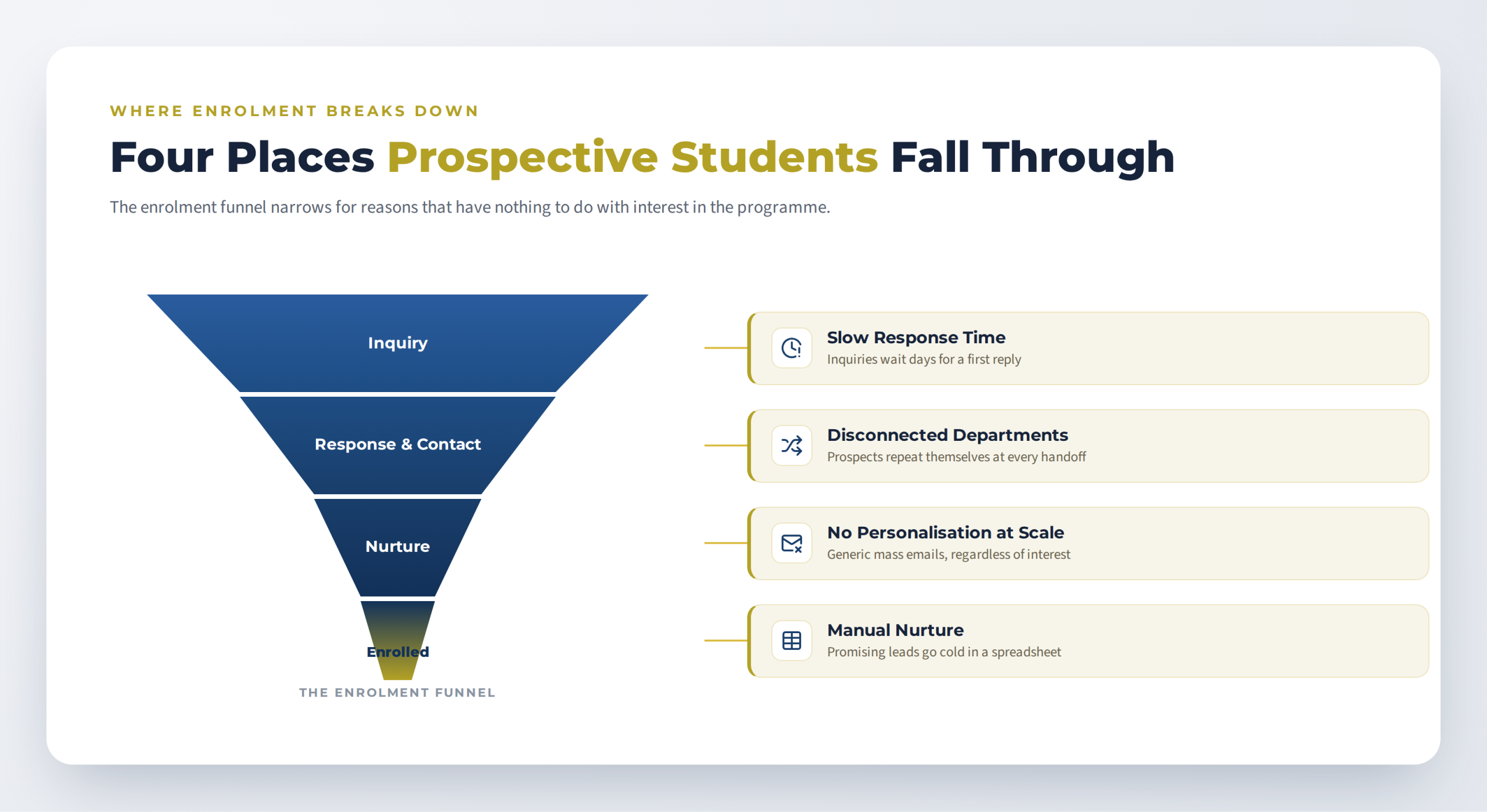
Most enrollment funnels leak in predictable places. A prospective student submits an inquiry and waits days for a reply. A question sent to the admissions office does not always reach the financial aid team or faculty adviser who could answer it. Interested applicants can end up on the same generic follow-up track as everyone else, regardless of their program or stage in the funnel.
None of this looks dramatic in isolation, but across a full admissions cycle it can add up to lost interest and slower enrollment than necessary. This pressure is especially familiar for universities and polytechnics in fast-growing education markets like Southeast Asia, where inquiry volumes can climb quickly while recruitment teams stay the same size. Inconsistent follow-up is rarely a staffing problem alone. It is usually a workflow problem, and it tends to show up first in the departments handling the highest inquiry volume.
The Enrolment Funnel, Agent by Agent
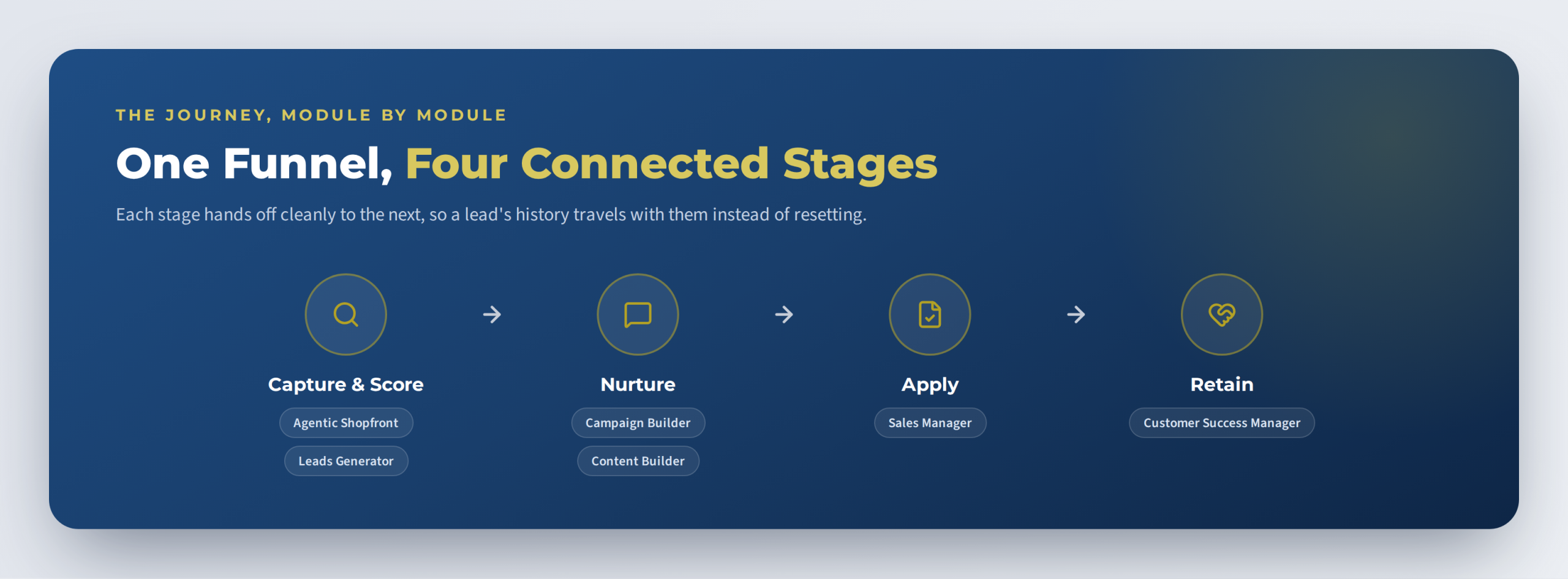
Mapped onto Agentic CRM’s modules, and built for the enrolment funnel rather than adapted from a generic sales CRM, the process looks less like a single tool and more like a relay, from the first conversation with a prospect through to a retained, enrolled student.
Capture and score: Agentic Shopfront and Agentic Leads Generator
Agentic Shopfront gives prospective students a conversational, personalized way to explore programs instead of clicking through a static site, answering questions and surfacing options based on what they’re actually asking about. Leads Generator sits behind it, capturing every inquiry, enriching it with available context, and scoring it so staff know which leads are ready for a call today and which need more nurture first. This is what Agentic CRM for universities looks like in practice: not enrollment management software that just stores a record, but something that acts on the inquiry the moment it arrives.
Nurture across channels: Campaign Builder and Content Builder
Once a lead is scored, Campaign Builder runs multi-channel nurture, email, SMS, and other touchpoints, tailored to program interest and where a prospect sits in the funnel. Content Builder supplies the material those campaigns draw on, so messaging stays relevant to a specific program instead of generic marketing that could apply to any university.
Move from interest to offer: Sales Manager
Sales Manager handles the workflow once a prospect is ready to apply, tracking opportunities and offer or contract steps so nothing depends on one staff member remembering to follow up. Humans still make every admissions decision, the workflow just makes sure applications don’t stall for lack of a nudge at the right moment. The same principle, automating the repetitive workflow steps rather than the decisions themselves, is explored more broadly in AI Agents for Enterprise Workflow Automation.
Watch for drop-off: Customer Success Manager
Customer Success Manager picks up once a student accepts an offer, monitoring engagement and flagging early signs that someone might not show up on day one or might disengage soon after enrolling, so staff can reach out sooner rather than later.
Student Engagement & Retention After Enrolment
From applicant to alumni
Enrollment is not the finish line, and treating it that way is an expensive assumption for a university to make. The same Customer Success Manager workflows that flag drop-off risk during the applicant stage continue after a student enrolls, watching for disengagement signals, missed check-ins, declining participation, that tend to show up well before a formal withdrawal. These are treated as signals worth a human conversation, not automated verdicts about a student’s likelihood to stay.
Student engagement AI in this context means something specific: not a generic satisfaction survey, but ongoing, personalized outreach triggered by what a student is actually doing, or not doing. A flagged student might get a check-in from an advisor rather than an automated email, since the goal is a human conversation at the right moment.
On the learning side, this connects to Adaptive CLaaS, which personalizes the coursework a student encounters once they’re enrolled. Recruitment and retention teams monitor engagement patterns, while Adaptive CLaaS shapes the learning experience itself. Together, a student’s path from applicant to alumnus runs through fewer disconnected systems, so a risk signal in one place is less likely to stay invisible to the team that could act on it.
Scaling Enrolment Without Adding Headcount
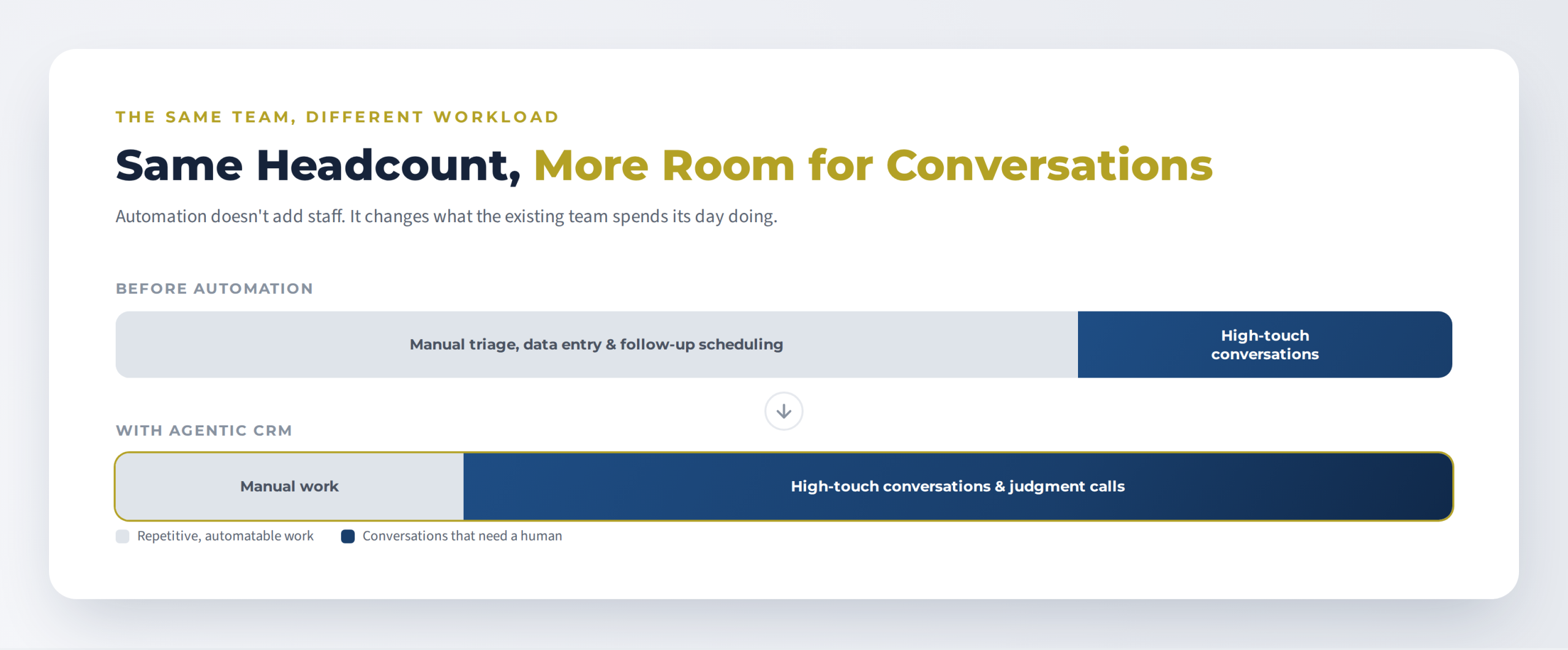
The promise underneath AI in university enrollment is straightforward: automate the repetitive, high-volume work, so the same recruitment and student-success team can handle more inquiries without more hires. Student enrollment automation doesn’t replace the staff who run high-touch conversations with a prospective student weighing two offers, it removes the manual triage, data entry, and follow-up scheduling around those conversations.
It also means marketing, admissions, and student-success data sit on one layer instead of three separate systems that don’t talk to each other. A lead’s history can travel with them from first inquiry through to enrolled student, instead of resetting at every handoff. For enrollment and marketing leaders, that unified view is usually the actual gap worth closing. If that’s the gap your team is facing, seeing the modules in action is a reasonable next step.
Frequently Asked Questions
How do AI agents help with university enrollment?
AI agents automate the repetitive, high-volume work in the enrolment funnel — instantly answering inquiries, capturing and scoring leads, running personalised multi-channel nurture campaigns, and flagging applicants at risk of dropping off — so recruitment teams can focus on the conversations that need a human. In CLaaS2SaaS Agentic CRM, modules like the Leads Generator, Campaign Builder and Customer Success Manager cover the journey from first inquiry to enrolled (and retained) student, all under staff oversight.
Can AI automate admissions without removing the human decision?
Yes. AI agents for higher education handle triage, follow-up and workflow, surfacing the right information at the right time, but admissions decisions stay with staff. The goal is fewer administrative bottlenecks, not fewer humans in the decision.
What is an agentic CRM for higher education?
An agentic CRM for higher education is an AI-native system where specialized agents actively run the enrolment and engagement funnel, capturing, nurturing and flagging leads, rather than a passive system that only stores records for staff to work through manually.
How does AI reduce student drop-off after enrolment?
It monitors engagement signals such as participation and check-ins, flags early risk before a student formally withdraws, and triggers personalized outreach so an advisor can step in while there’s still time to help.
Will AI enrolment tools integrate with our existing student systems?
In most cases, yes. Agentic CRM runs on the Intelligence OS integration and governance layer, which connects to approved existing systems rather than requiring a university to replace them.
For enrollment and marketing leaders, the ceiling usually isn’t interest, it’s the team’s capacity to follow up on all of it. Automating the repetitive parts of the funnel means more of those conversations happen with the same headcount.
Share


Want to check if this career is for you?