What Is a Digital Skilling Platform? A Buyer's Guide for Education Leaders
What Is a Digital Skilling Platform? A Buyer's Guide for Education Leaders
Content
Content
What exactly is a digital skilling platform, and how does it differ from the learning management system your institution already runs? It’s the question most education leaders ask before requesting a demo. This guide covers the definition first, then a practical framework for evaluating any platform against your own programmes.
Digital Skilling Platform: A Direct Definition
A digital skilling platform is a system built to deliver, track, and validate job-relevant competencies at scale. Instead of simply hosting course content the way a learning management system does, it centers on proving that a learner can do something: apply a skill, meet an employer-defined standard, or demonstrate a competency that can be reported to an accreditation body, an employer partner, or the learner themselves. Some vendors and analysts call this a skills-based learning platform, since progress is measured in skills or competencies rather than completed modules or seat-time hours.
This distinction matters because institutions are increasingly asked to show outcomes, not just enrollment or completion numbers. Boards, funders, and accreditation reviewers want evidence that graduates can perform specific, named competencies. A completion certificate alone doesn’t answer that question. A digital skilling platform builds competency frameworks, applied assessment, and outcomes reporting in from the start, rather than adding them onto a course catalog after the fact.
In practice, most institutions layer a digital skilling platform onto specific programmes, certificates, or workforce-facing initiatives where verifiable skill outcomes are the point, rather than rolling it out across the whole institution on day one. Your registrar systems, academic catalog, and faculty-led instruction stay exactly where they are.
Digital Skilling Platform vs. LMS vs. MOOC
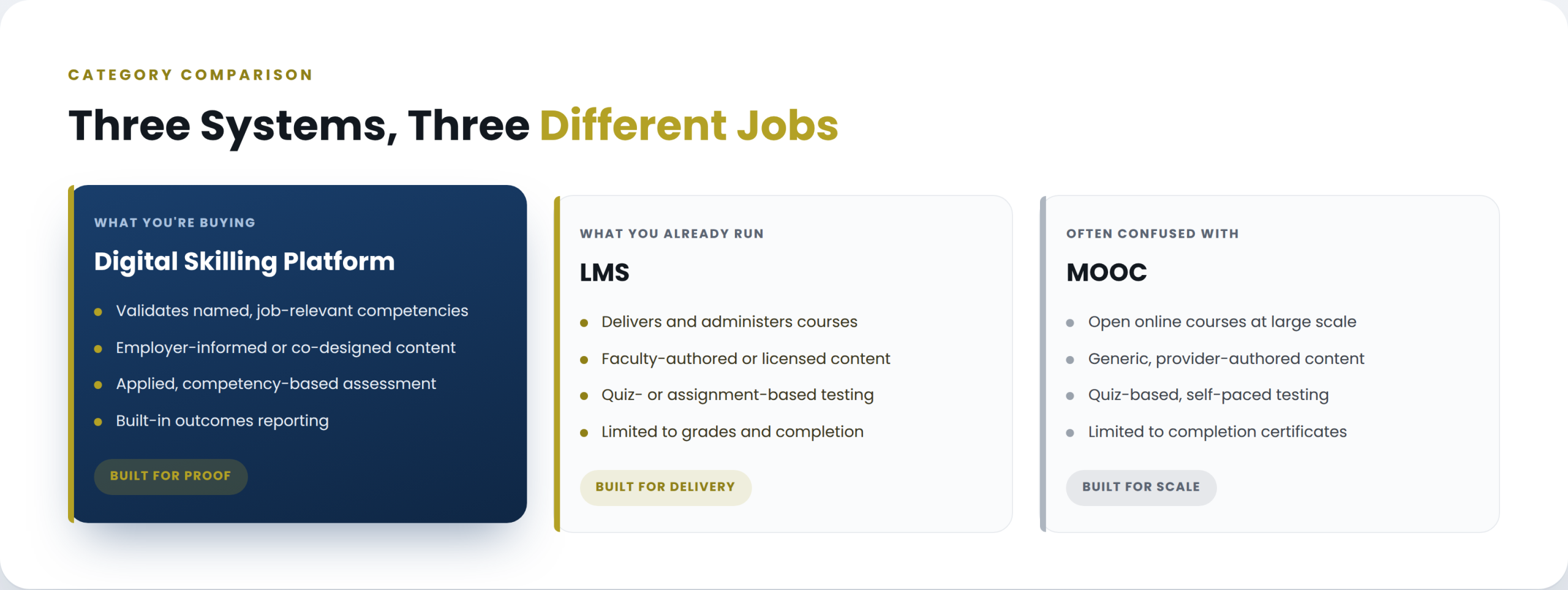
If you’ve searched for a digital skilling platform vs LMS comparison, here’s roughly how the two, plus MOOCs, line up:
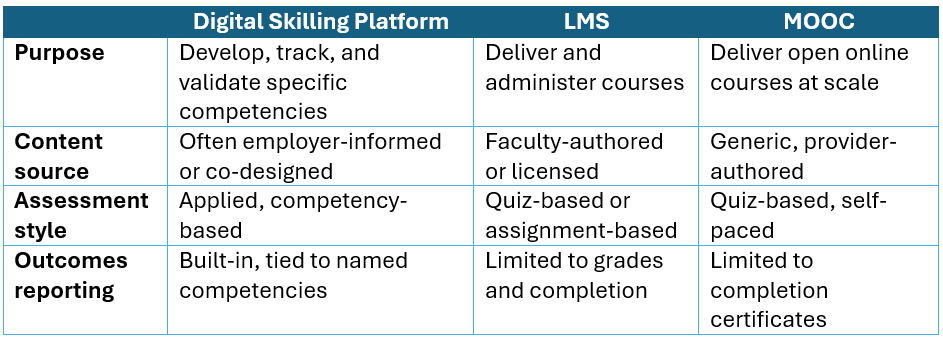
A digital skilling platform, an LMS, and a MOOC solve different problems, and none of them is a strict upgrade over the others. An LMS administers and delivers courses, tracking enrollment, grades, and completion. A digital skilling platform adds a layer focused on named competencies: what a learner can demonstrably do, how that’s assessed, and how it’s reported to employers or accreditation bodies. A MOOC serves a third purpose again, built for open, self-paced delivery at large scale, usually with less employer input into what’s taught or how it’s assessed.
Most institutions that bring in a digital skilling platform keep their LMS in place for general course administration. They run the skilling platform for programmes where employer-recognized competencies are the actual deliverable: workforce-development certificates, applied technical programmes, or industry-credential partnerships. In practice, the two systems tend to exchange data, with the LMS handling enrollment and grades while the skilling platform handles competency evidence and outcomes reporting.
Core Components to Expect
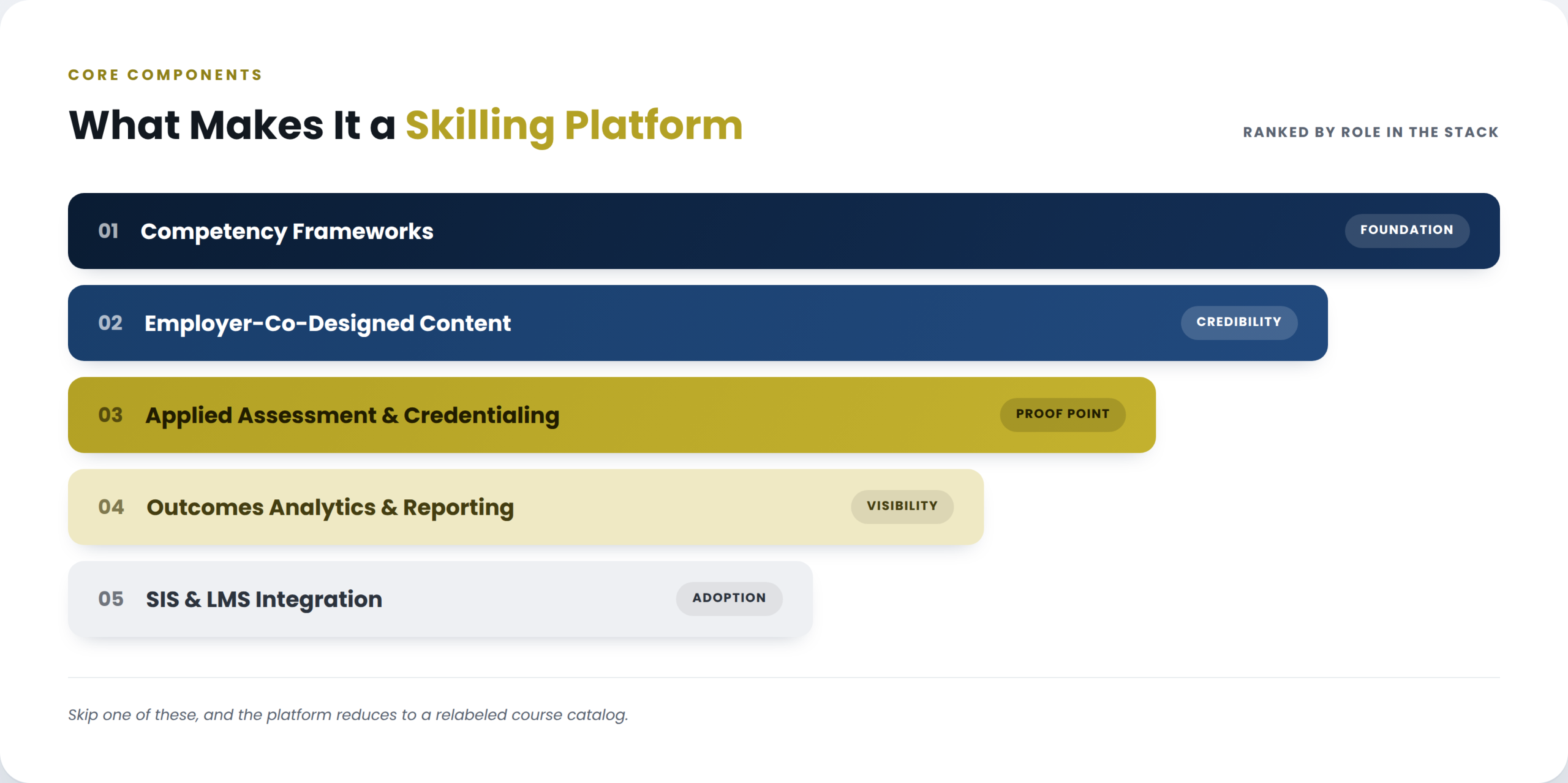
Whatever vendor you’re evaluating, a genuine digital skilling platform tends to share a handful of core components. Use these as evaluation questions rather than a features list to nod along to:
- Competency frameworks. Is there a structured map of the specific skills the programme is meant to build, informed by employer or industry input rather than a generic subject taxonomy?
- Employer-co-designed content. Which named employers actually contributed to the content? This is sometimes marketed as an employer-aligned upskilling platform for exactly this reason, but without real employer involvement, a framework can look complete on paper while still missing what hiring managers screen for.
- Applied assessment and credentialing. Do learners demonstrate competencies through projects, simulations, or evaluated tasks, and is the resulting credential portable and verifiable outside the institution, not just a line on an internal transcript?
- Analytics and outcomes reporting. Can programme leaders and accreditation bodies see which competencies learners have actually met, at what rate, and where gaps persist across cohorts, without building a separate reporting process by hand?
- Integration with existing SIS and LMS systems. What does it take to pass data back and forth with the systems you already run, and how much of that work falls on your own IT team? A platform that can’t do this easily tends to create more administrative work than it saves, and often ends up under-used as a result.
Why Education Leaders Are Adopting These Platforms Now
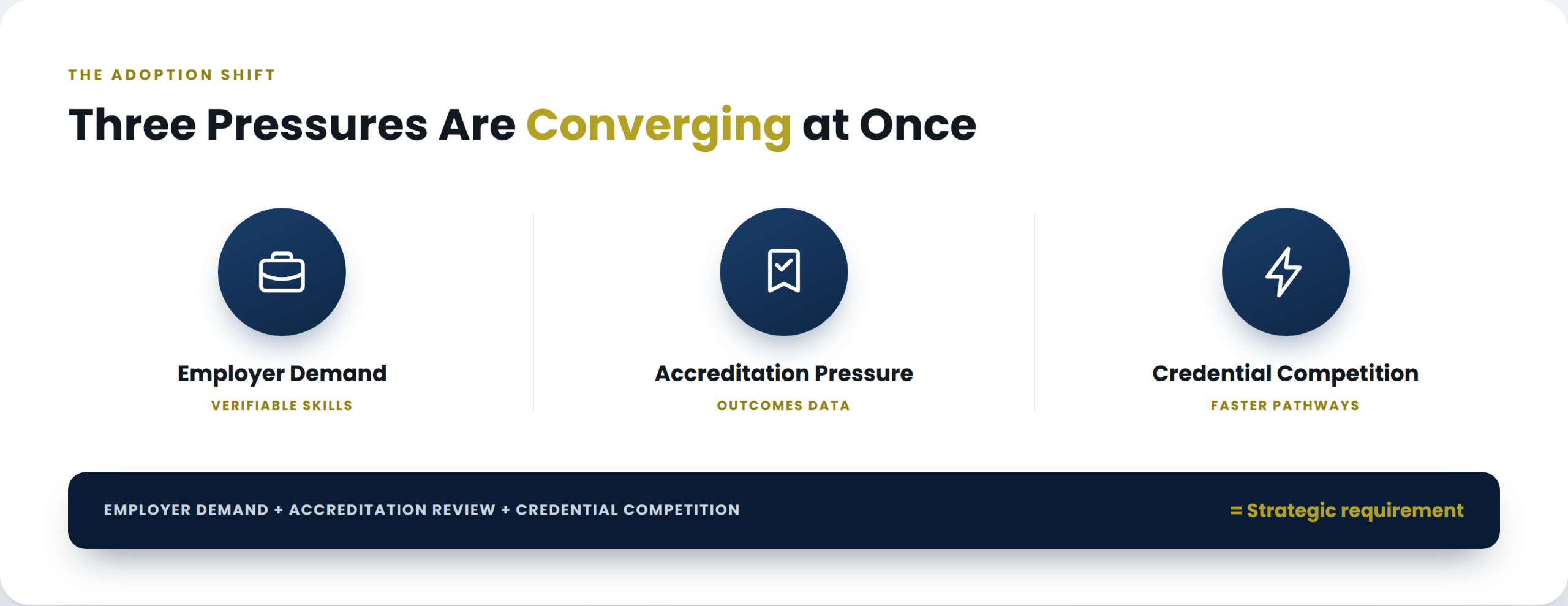
Three forces are pushing adoption from a nice-to-have into something closer to a requirement:
- Employer demand. Employers increasingly screen and hire on demonstrated skills rather than transcripts alone. According to NACE’s Job Outlook 2026 survey, 70 percent of employers now use skill-based hiring for entry-level roles, up from 65 percent the year before, and most use it in at least half of their hiring decisions.
- Accreditation pressure. Accreditation bodies are increasingly asking for outcomes data as part of programme review, which is difficult to produce from an LMS that was only ever built to track completion.
- Competition from alternative credentials. Bootcamps, certificate programmes, and employer-run academies compete for the same students by promising faster, more legible paths to employment.
For many institutions, this is the same pressure covered in Why Industry-Aligned Curriculum Is Now a Survival Issue for Universities: the curriculum question and the platform question are really the same question, approached from different angles. A digital skilling platform for universities is, in effect, the technology layer that makes an industry-aligned curriculum measurable and reportable, instead of running as a separate initiative competing for the same faculty attention and budget.
What to Look for When Evaluating a Platform
Once you’ve confirmed the category fits your goals, evaluation comes down to a short list of practical questions rather than a long RFP. Work through these with any vendor you’re considering:- Employer-partnership depth. How many named employers actually contributed to the competency framework, and in which field? Ask for names, not a general claim of industry input.
- Credential portability. Can learners take the credential with them, and is it recognized outside the platform by the employers your graduates actually apply to?
- Integration effort. What does it take to connect the platform to your existing SIS and LMS, and who on your team needs to be involved?
- Evidence of outcomes. Does the vendor have outcomes data you can independently verify, rather than a single case study or a marketing claim?
- Implementation timeline. What does a realistic rollout look like for a programmeme your size, from contract to first cohort, including faculty onboarding?
- Pricing structure. How is cost calculated, by learner, by programme, or by seat, and does that model scale the way your enrollment is likely to grow?
Common Buying Mistakes
The most common mistake is judging a digital skilling platform on course-hosting features, video quality, or interface polish, the things an LMS purchase usually turns on, while missing whether the competency framework and assessment model are actually sound.
The second is underestimating faculty change management. Applied, competency-based assessment asks instructors to grade differently than they’re used to, often moving from a rubric they’ve used for years to evaluating demonstrated skill against an employer-defined standard. That shift needs planning, training time, and buy-in, not a login email sent the week before launch.
The third is signing based on a vendor’s stated employer network without confirming which relationships are active and specific to your program, versus listed as a general partner. This tends to surface only after the first cohort has enrolled, once the credential doesn’t carry the weight learners expected.
Each of these is avoidable by asking the questions in the checklist above before you sign, not after your first cohort is already enrolled.
Frequently Asked Questions
Is a digital skilling platform the same as an LMS?
A learning management system is built to deliver and administer courses. A digital skilling platform develops, tracks, and validates job-relevant competencies, often using employer-informed content and applied assessment instead of quiz-based testing. Many institutions run both side by side rather than replacing one with the other. Book a 1:1 consultation for a walkthrough of how the two fit together.
How much does a digital skilling platform cost?
Cost depends on program scope, learner volume, and integration needs, so it’s best addressed directly rather than estimated here. Book a 1:1 consultation to get a figure based on your institution’s specifics.
Who uses digital skilling platforms?
Universities, workforce-development offices offering continuing education for working professionals, and enterprises running their own digital upskilling programs in partnership with academic providers.
Can a digital skilling platform integrate with our existing LMS or SIS?
Typically yes, though the specific integrations available depend on the systems already in place at your institution. Confirm exact compatibility for your setup during a consultation.
How do we evaluate whether a digital skilling platform is worth adopting?
Start with the evaluation checklist above: employer-partnership depth, credential portability, integration effort, evidence of outcomes, and implementation timeline. A 1:1 consultation can walk through it against your specific programmes.
The fastest way to know if a digital skilling platform fits your institution is to walk through the checklist above against your programmes, not a generic feature list.
If you want to see how CLaaS® Academy holds up against these same questions, see our digital skilling platform for details on its employer partnerships, credentialing model, and integration options.
Share


Want to check if this career is for you?