How to Scale Revenue Without Scaling Headcount (AI-First Playbook)
How to Scale Revenue Without Scaling Headcount (AI-First Playbook)

Content
Content
For most companies, more revenue has always meant more people, and that ceiling is now optional. Scaling revenue without scaling headcount means increasing output through intelligence and automation instead of adding a new hire for every new deal, ticket, or account. This playbook outlines five practical moves to make that shift real, including what to automate first.
Why Revenue Is Still Tied to Headcount and Why That’s Breaking

The old default is simple: grow revenue, grow the team. More customers need more account managers; more tickets need more support agents; more transactions need more back-office staff. It has worked for decades because the constraints were real. Skilling lagged behind the work, service quality was limited by how quickly companies could hire and train people, and decision-making slowed down because data lived in disconnected systems.
Those three constraints are now becoming more negotiable:
- Skilling that lags behind the work: Training cycles can’t keep pace with how quickly roles change.
- Human-led services capped by headcount: Quality and speed only scale as quickly as you can hire.
- Disconnected data delaying decisions: Insights remain trapped in separate systems instead of informing action in real time.
The AI-First Playbook: 5 Moves to Scale Revenue Without Hiring
Five practical moves, each grounded in a specific part of the CLaaS2SaaS Service-as-Software Operating System. Together, they provide a worked example of how the playbook can run in practice.
Move 1: Build a Unified Intelligence Foundation First
What: Give every agent and team the same version of the truth before automating anything.
How: CLaaS2SaaS’s Intelligence OS connects ERP, CRM, and LMS data into one foundation through an Integration Hub, Knowledge Hub, Operation Hub, and Intelligence Hub. This allows gains from one automation to reinforce the next instead of staying siloed. Skipping this step can lead to automation in disconnected silos, which limits how far any individual automation can scale.
Move 2: Put AI Agents Into Operations
What: Let AI agents handle operational work that would otherwise require additional staff.
How: Agentic ERP puts intelligent operations agents into finance, procurement, supply chain, and facilities. This turns them into self-optimising workflows rather than dashboards that a person has to check and act on manually.
Move 3: Scale Customer Experience With Agents
What: Serve more customers effectively without scaling the service team headcount-for-headcount.
How: Agentic CRM deploys a prospect-intelligence agent, AI-powered sales portal, proposal automation, and a customer-service manager agent. The team is amplified, not replaced, allowing it to manage more relationships at the same headcount.
Move 4: Turn Staff Into Citizen Developers
What: Make your existing team the people who extend the automation, not just its users.
How: Adaptive CLaaS® delivers a unified Learn2Work Window and work-integrated skilling, enabling employees to become citizen developers who configure and supervise agents. This creates a practical “do more with the same team” lever.
Move 5: Measure Revenue Per Employee and Compounding Intelligence, Not Headcount
What: Track whether output is actually growing faster than the team.
How: Monitor revenue per employee and how much intelligence is compounding across the business. These are stronger signals of whether the model is working than simply measuring headcount avoided.
See how these five moves come together as a system: AI-First Adaptive Enterprise Transformation.
What to Automate First (and What to Keep Human)
The prioritization rule is simple: automate work that is high-volume, repeatable, and rules-based. Focus especially on tasks that consume significant time or create value at scale. Keep work that requires judgment, relationships, or genuinely novel decisions with people. People should also supervise and govern the agents handling everything else.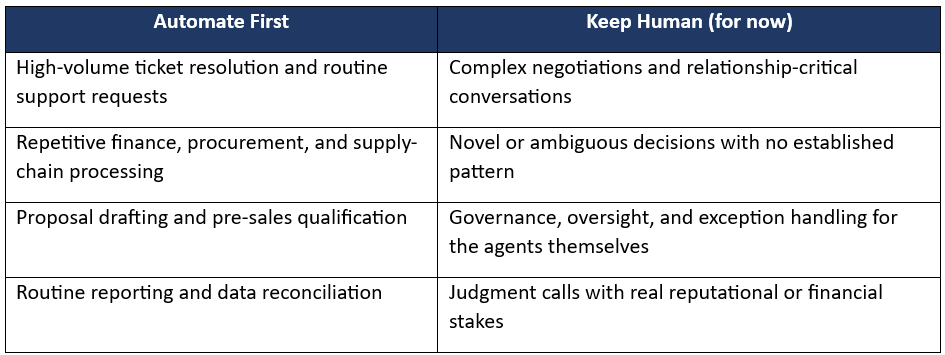
This is the point where the “layoffs” objection usually comes up, and it’s worth addressing directly. The goal isn’t fewer people. It’s people doing less of the repeatable work and more of the work only they can do. Teams are amplified by the agents around them, not replaced by them. That’s also why governance remains a human responsibility even as execution shifts to agents.
Service-as-Software: The Operating Model Behind Headcount-Efficient Growth
The five moves above aren’t a one-off automation project. Sustained headcount-efficient growth is an operating model, not a collection of point tools. That model is known as Service-as-Software. Instead of buying software that your team operates, you build toward software and agents that complete the work itself. Read the full explainer: What Is Service-as-Software?
CLaaS2SaaS’s version of that model is the Service-as-Software Operating System, delivered through the CLaaS2SaaS Self-Service Intelligence Automation Platform. It brings one intelligence foundation, Intelligence OS, underneath three solution clusters: Adaptive CLaaS®, Agentic ERP, and Agentic CRM.
That distinction between a system and individual tools is what determines whether headcount-efficient growth compounds or plateaus. A point tool automates one task. An operating model means each new automation can reinforce the ones already in place because they all reason from the same intelligence foundation. See the full offering: AI-First Adaptive Enterprise Transformation.
CLaaS2SaaS is one implementation of the Service-as-Software model built for enterprise adoption. It is not the definition of the category, which is broader than any single vendor.
Common Mistakes When Scaling Without Adding Headcount
A few patterns show up repeatedly in organisations that try this shift and stall:- Automating a broken process. If the underlying workflow is inefficient, automation simply scales the chaos faster.
- Buying point tools with no shared foundation. Without a unified intelligence layer, gains from each tool stay siloed instead of compounding.
- Treating it as cost-cutting instead of growth. Framing this as headcount reduction misses the actual lever. The goal is to use AI to grow output faster than the team, not to shrink the team.
- Skipping workforce enablement. If no one on staff can configure or extend the agents, the model can stall once the initial setup is complete.
- Ignoring governance and one version of the truth. Agents making decisions from inconsistent data can create new problems as quickly as they solve old ones.
Frequently Asked Questions
Can you really grow revenue without adding headcount?
Yes, by shifting growth from labour to leverage. Instead of hiring for every new unit of demand, you can let AI agents and automation handle high-volume, repeatable work across operations, service, and pre-sales while your people focus on judgment, relationships, and novel decisions. The number to watch is revenue per employee. When output grows faster than the team, revenue can scale without proportional hiring. This works best when automation sits on a shared intelligence foundation so gains can compound instead of remaining siloed.
What does "scale revenue without scaling headcount" actually mean?
It means growing revenue and output faster than you grow your team, using automation, AI agents, and shared systems to absorb repeatable work. In short, it means improving revenue per employee instead of adding a person for every unit of new demand.
Which tasks should I automate first to scale without hiring?
Start with high-volume, rules-based, repeatable work, such as routine support tickets, pre-sales qualification, and finance or procurement processing. Keep judgment calls, relationship-critical conversations, and novel decisions with people. The goal is to have agents amplify the team, not replace it.
Does scaling without adding headcount mean replacing employees?
No. The model is designed to amplify staff and upskill them into citizen developers who configure and supervise the AI handling repeatable work. It reduces the need to hire linearly as demand grows without removing the people needed for work that requires judgment.
How does AI help scale revenue without hiring?
AI agents can handle operations, customer service, and sales tasks end-to-end on a shared intelligence foundation, allowing output to grow without headcount increasing in lockstep. This is the Service-as-Software model in practice.
Stop scaling by hiring. Start scaling by intelligence. Map this playbook to your own enterprise.
Want the full offering? Explore AI-First Adaptive Enterprise Transformation
Share


Want to check if this career is for you?