Blog
4-Month Digital Transformation Course: Intensive Training

SHARE THIS:


Digital transformation isn’t coming; it’s already disrupting careers, industries, and entire business models. Professionals who fail to adapt to risk become irrelevant, while those who build digital leadership skills are moving into higher-impact, higher-paying roles.
If you feel stuck watching AI, automation, and data-driven decision-making reshape your industry, you’re not alone. Many professionals know change is happening, but don’t know where to start or how to reskill without quitting their jobs.
This is exactly where a 4 month digital transformation course becomes a strategic advantage. Instead of spending years in theory-heavy programs, professionals can now gain practical, job-ready skills in months.
Why Digital Leadership Matters in Today’s Economy
Technology is reshaping how businesses operate, compete, and grow. Organizations are no longer experimenting with digital tools; they are restructuring them.
According to Gartner, over 80% of organizations are accelerating digital initiatives, increasing demand for leaders who understand transformation, not just technology. At the same time, the World Economic Forum reports that 50% of employees will need reskilling by 2027 due to automation and AI.
Digital leadership matters because it delivers real outcomes:
- Operational efficiency: Automation reduces manual work and speeds up decision-making
- Financial impact: Digitally mature companies outperform peers on revenue growth
- Career resilience: Leaders with digital skills adapt faster during disruption
Without structured upskilling, many professionals fall behind. This is why an accelerated digital leadership program built around practical applications is becoming essential.
What Is a 4-Month Digital Transformation Course?
A 4-month digital transformation course is a fast-track, skills-first program designed for immediate practical results.
Unlike traditional degrees, this format focuses on doing, not just learning. In four months, learners develop hands-on expertise in:
- Low-code application development using Microsoft Power Platform
- AI automation and chatbot creation with Copilot Studio and AI Builder
- Data analytics and visualization using Power BI and Dataverse
- Capstone project applying end-to-end digital solutions to real business problems
This structure delivers intensive digital transformation training without forcing professionals to pause their careers. The outcome isn’t academic theory, it’s workplace-ready capability.
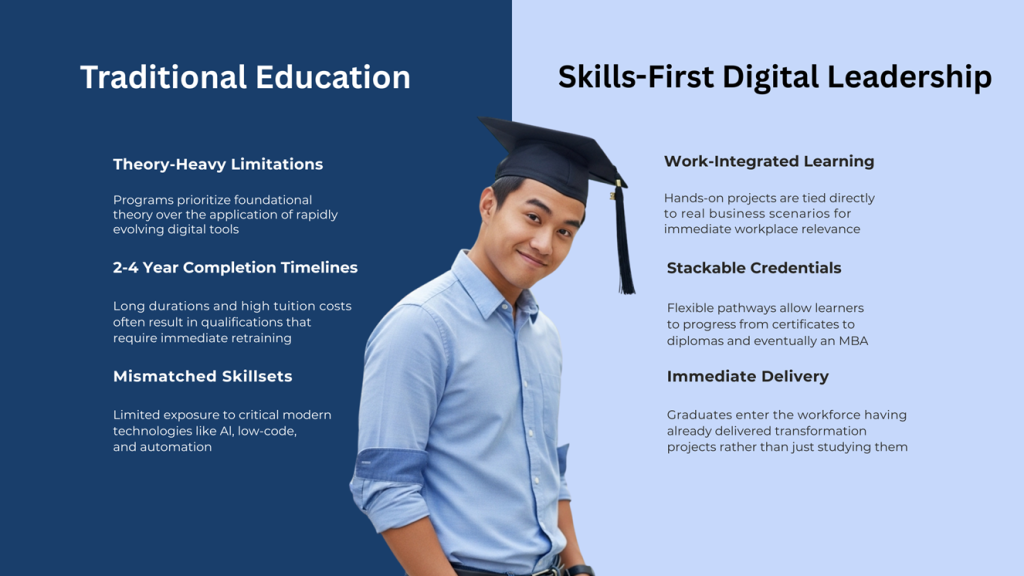
Traditional Learning vs CLaaS2SaaS’ Accelerated Digital Leadership Program
When considering advancing their careers, the choice often comes down to conventional academic programs versus modern, skills-first pathways. Understanding the differences helps clarify why a fast-track digital transformation course is more aligned with today’s economy.
Traditional Academic Programs
Conventional programs emphasize theory over application. While they provide foundational knowledge, they struggle to keep pace with rapidly evolving digital tools.
Key limitations include:
- Long timelines (2–4 years)
- High tuition and opportunity cost
- Limited exposure to AI, low-code, and automation
- Graduates requiring retraining after completion
Skills-First, Work-Integrated Learning
An accelerated digital leadership program flips this model by prioritizing skills that employers need now.
Key advantages include:
- Hands-on projects tied to real business scenarios
- Stackable credentials leading from certificate to diploma to MBA
- Flexible structure for working professionals
- Immediate workplace relevance
Project-Based Training That Builds Real Confidence
One of the biggest failures of traditional education is the gap between theory and execution. Employers don’t hire potential, they hire proven capability.
This is why a 4 month digital transformation course centers on project-based learning.
Learning by Doing
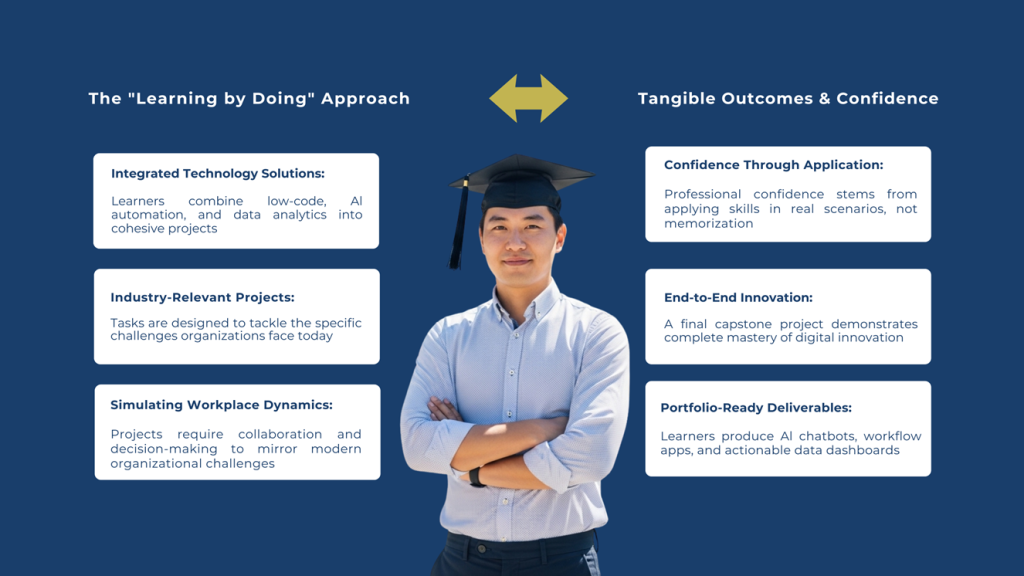
Instead of passively absorbing lectures, learners tackle industry-relevant projects that mirror the challenges organizations face today. These projects are designed to:
- Simulate workplace dynamics by requiring collaboration, problem-solving, and decision-making.
- Low-code development, AI automation, and data analytics into cohesive solutions.
- Deliver tangible outcomes that can be showcased in a professional portfolio.
Building Confidence Through Application
Confidence doesn’t come from memorizing frameworks; it comes from applying skills in real scenarios. By the end of the program, learners will have:
Key takeaway: Confidence comes from application, not memorization. - Designed apps that streamline workflows.
- Built AI-driven chatbots that enhance customer engagement.
- Created dashboards that turn complex data into actionable insights.
- Delivered a capstone project that demonstrates end-to-end digital innovation.
Career Outcomes That Justify the Path
Investing four months in intensive digital transformation training pays off in tangible career outcomes. The program is designed not only to teach skills but to position learners for roles that are in high demand across industries.
Immediate Career Opportunities
Graduates of the Professional Certificate in Digital Innovation are prepared for entry-level and mid-level digital roles such as:
These roles are critical as companies seek professionals who can contribute immediately to digital projects. - Digital Transformation Associate – supporting organizational change initiatives and implementing digital tools.
- Junior Consultant – advising businesses on adopting AI, automation, and analytics solutions.
- Low-Code App Developer – building scalable applications that streamline workflows.
- Data Analyst – turning raw data into actionable insights for decision-making.
Progression Through Stackable Credentials
The certificate is the first step in a stackable pathway that leads to advanced qualifications:
Financial impact: Digitally skilled leaders are 2.5x more likely to hit growth targets (PwC), making these skills valuable across industries and geographies. The certificate is the first step in a stackable pathway that leads to advanced qualifications:
- Professional Diploma in Digital Transformation – equipping learners with leadership and entrepreneurial skills to manage transformation initiatives.
- International MBA in Digital Innovation & Entrepreneurship – preparing professionals for senior leadership roles in global markets.
Long-Term Career Growth
With stackable credentials, professionals can advance into high-impact roles such as:
- Digital Innovation Lead – spearheading transformation projects and managing agile teams.
- Head of Digital Innovation – shaping organizational strategy and driving innovation culture.
- Digital Transformation Director – overseeing enterprise-wide initiatives and aligning technology with business goals.
Why Employers Value Skills-First Graduates
Employers today face a critical challenge: finding talent that can contribute immediately to digital transformation initiatives. Traditional graduates often arrive with theoretical knowledge but lack the applied experience needed to drive results. Skills-first graduates, however, stand out because they are trained to deliver from day one.
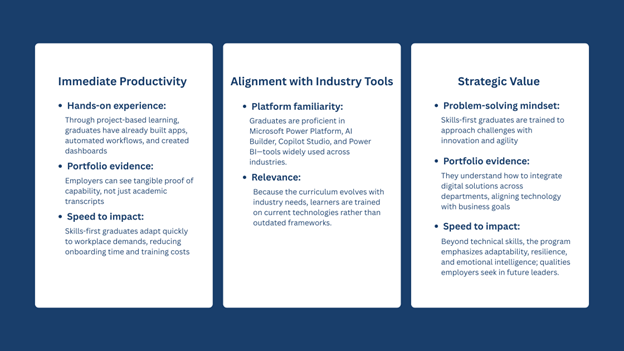
According to LinkedIn’s Workforce Report, digital transformation roles are growing at 40% year-on-year. Employers are not looking for “digital awareness.” They are looking for professionals who can execute transformation initiatives, work across functions, and deliver measurable outcomes. Skills-first graduates reduce onboarding time, training costs, and execution risk.
Is This Path Right For You?
Choosing a fast-track program is a strategic decision. It’s right for you if:
- You want to gain practical digital skills in months, not years.
- You’re motivated to apply learning immediately in your workplace or business.
- You prefer a skills-first approach that cuts unnecessary theory and focuses on what employers demand.
- You’re looking for a globally recognized credential that can lead to advanced qualifications.
- You want to future-proof your career against disruption by AI, automation, and digital transformation.
Key Considerations
- If you thrive in applied learning environments, this program will suit you.
- If you’re seeking career acceleration rather than academic prestige, this pathway is ideal.
- If you value flexibility and efficiency, the 4-month structure ensures you don’t lose momentum.
This path is not for everyone, but for those who are ready to embrace change, lead digital initiatives, and accelerate their careers, it’s a smarter, faster, and more practical alternative to traditional programs.
Course

Your Next Step
Digital disruption won’t wait, and neither should your career.
Explore how our accelerated digital leadership program helps gain real-world expertise through a 4-month digital transformation course built for working professionals. This skills-first approach equips you to lead transformation initiatives, deliver measurable business outcomes, and future-proof your career.
Get started today and move from learning about digital transformation to leading it.
Digital Transformation Consulting Certification & Career Path
Blog
Why a Digital Transformation Consulting Certification & Career Path Is in High Demand Today
SHARE THIS:
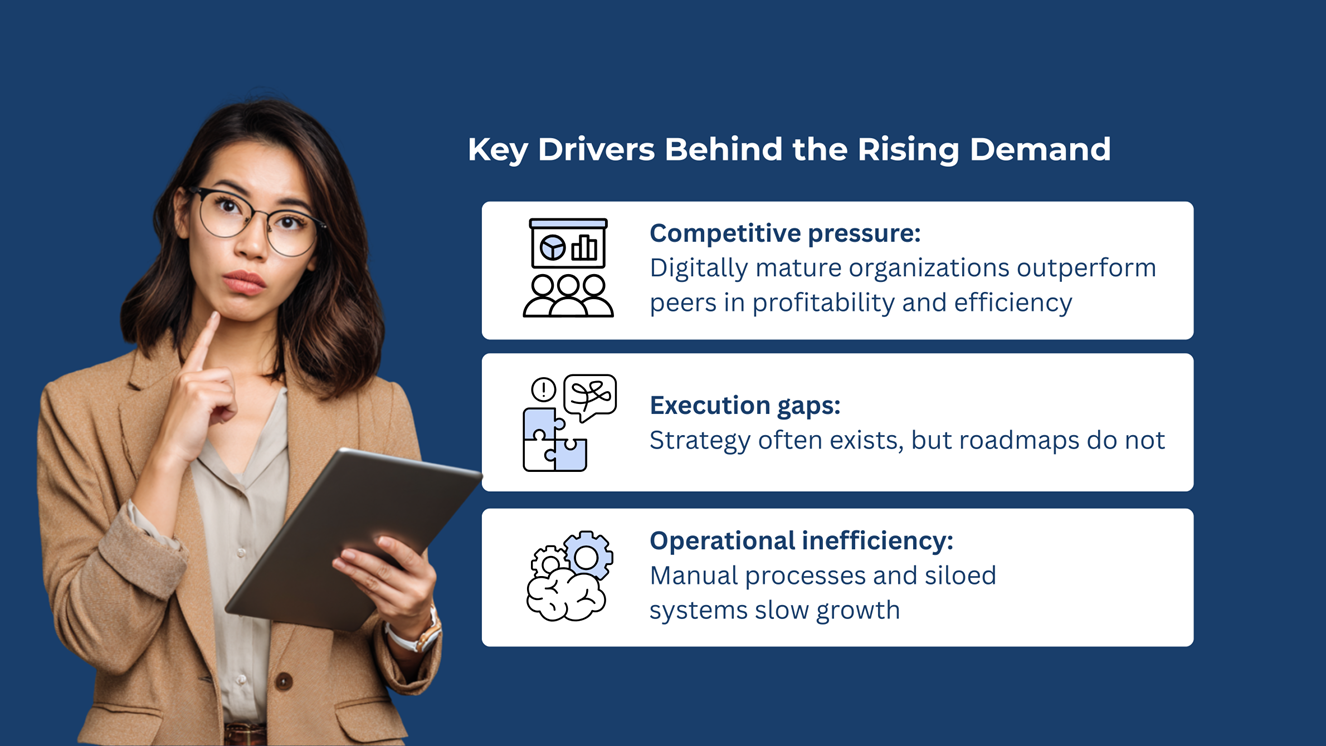
Most digital transformation initiatives fail. Not because of technology, but because organizations lack people who can connect strategy, execution, and change.
Companies are investing heavily in AI, automation, cloud platforms, and data analytics. Yet many still struggle to turn these investments into measurable business outcomes. This gap has made digital transformation consulting certification one of the most in-demand credentials in today’s market.
If you want to become a digital transformation consultant, this article is for you. It explains why certification matters now, what skills are in demand, and how professionals are using certification to accelerate careers and deliver real transformation results.
You’ll learn:
- Why organizations urgently need certified consultants
- What a digital transformation consulting certification actually validates
- How certification impacts career growth and long-term value
Why Digital Transformation Consulting Matters Now
Digital transformation is no longer optional. It is a survival requirement.
Organizations face constant pressure to modernize operations, improve customer experience, and adopt AI-driven decision-making. However, execution remains the biggest challenge.
According to IDC, global spending on digital transformation is expected to reach $3.9 trillion by 2027, reflecting massive investment, and equally massive risk when transformation fails.
This is where certified consultants create value.
A digital transformation consulting certification signals that a professional can move beyond theory and deliver structured, outcome-driven change.
The Execution Gap Driving Demand for Certified Consultants
Most organizations already know what they want to do. They struggle with how to do it.
Common challenges include:
- Unclear transformation priorities
- Disconnected technology decisions
- Resistance to change across teams
- Poor measurement of ROI
A digital transformation consulting certification directly addresses these challenges by equipping professionals with practical frameworks, execution discipline, and leadership skills.
This is why organizations increasingly prefer consultants who are certified rather than relying solely on general experience or theoretical knowledge.
What Is a Digital Transformation Consulting Certification?
A digital transformation consulting certification is a structured program that validates your ability to guide organizations through digital change.
Unlike short-term consultant courses, a certification validates applied consulting capability through assessed projects and enterprise-aligned frameworks.
With CLaaS2SaaS’ Digital Innovation program, professionals gain:
- Learn how to assess digital maturity and design clear, actionable transformation roadmaps.
- Build communication, leadership, and change management skills to align teams and decision-makers.
- Gain hands-on exposure to cloud platforms, automation tools, CRM systems, and data visualization.
- Ensure digital initiatives to improve customer journeys while meeting security and compliance standards.
- Apply AI-driven innovation to solve business problems using modern, scalable tools.
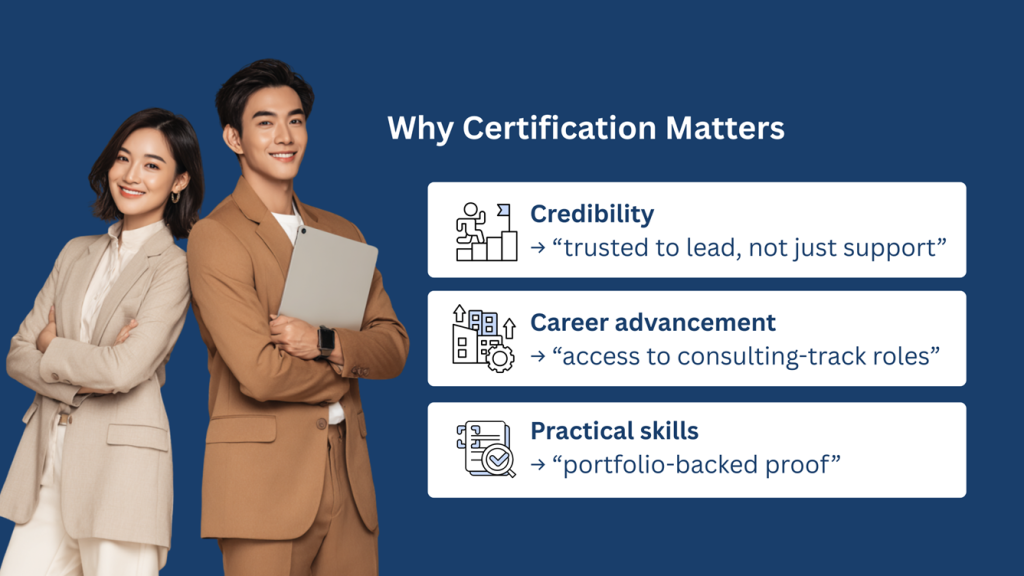
CLaaS2SaaS’ certification pathway is designed to be skills-first and work-integrated, meaning learners graduate with both the knowledge and the portfolio evidence to prove their consulting expertise.
Skills You Gain as a Certified Consultant
A digital transformation consulting certification from CLaaS2SaaS equips professionals with a comprehensive skill set that blends technical expertise, strategic thinking, and leadership capabilities.
These skills are designed to meet the demands of organizations navigating rapid digital change.
1. Strategic & Analytical Skills
- Evaluate an organization’s readiness for transformation.
- Align technology adoption with clear business objectives.
- Use analytics to identify opportunities and measure impact.
2. Technology Integration Skills
- Build scalable applications that streamline workflows
- Apply intelligent tools to improve efficiency and customer experience.
- Integrate cloud platforms while ensuring secure data handling.
3. Leadership & Change Management Skills
- Communicate effectively with executives, teams, and clients.
- Guide organizations through cultural and operational shifts.
- Ensure digital initiatives are adopted across departments.
4. Emerging Technology Skills
- Gain hands-on experience with generative AI and intelligent automation.
- Design solutions that meet compliance and security standards.
- Build digital solutions that improve user journeys and satisfaction.
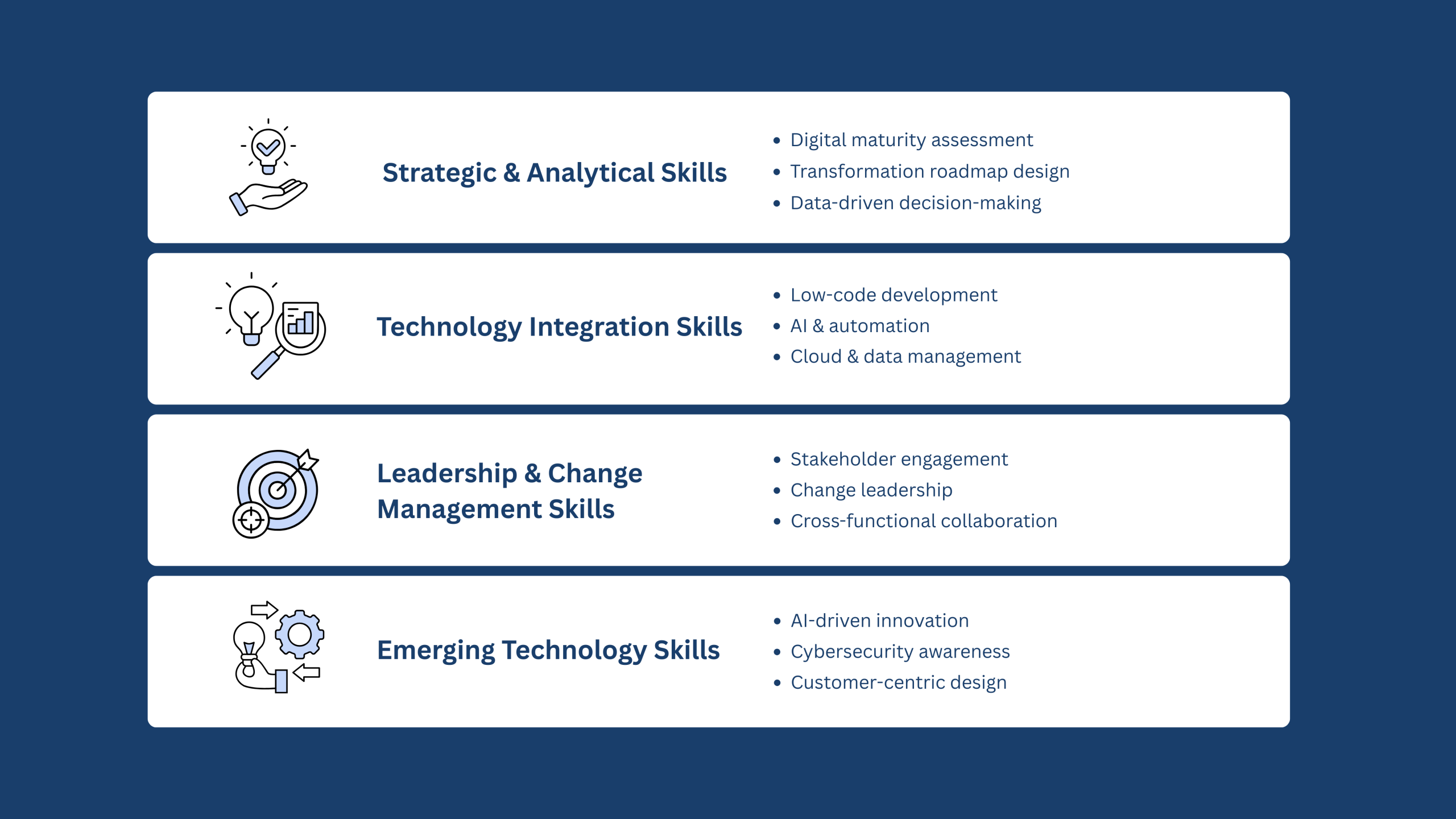
By 2027, 50% of employees will require reskilling as digital transformation accelerates, and consultants who can bridge the gap between technology and strategy will be indispensable.
CLaaS2SaaS ensures graduates don’t just understand digital transformation, they can lead it, implement it, and prove it through portfolio-ready projects.
Career Pathways After Certification
Completing a digital transformation consulting certification with CLaaS2SaaS opens doors to a wide range of career opportunities. Because the program is designed to be skills-first and work-integrated, graduates are prepared not only for consulting roles but also for leadership positions in digital innovation.
Entry-Level & Mid-Career Roles
- Digital Transformation Associate: Support organizations in implementing digital strategies and tools.
- Junior Consultant: Work with consulting firms or corporate teams to advise on technology adoption and process improvement.
- Low-Code Developer / Automation Specialist: Build applications and workflows that streamline operations.
- Data Analyst: Translate complex data into actionable insights for decision-makers.
Advanced Consulting Roles
- Digital Transformation Consultant: Lead projects that integrate AI, analytics, and automation into business processes.
- Innovation Strategist: Design long-term digital roadmaps that align with organizational goals.
- Change Management Specialist: Guide teams through cultural and operational shifts during transformation.
Leadership Pathways
- Digital Innovation Lead: Spearhead transformation initiatives within organizations.
- Head of Digital Transformation: Oversee enterprise-wide adoption of digital tools and strategies.
- Transformation Director / CIO Track: Align technology investments with business growth, ensuring resilience in competitive markets.
Digital transformation roles are among the fastest-growing globally, with demand for consultants and strategists. Organizations increasingly seek professionals who can bridge the gap between technology and business strategy, making certified consultants indispensable.
How CLaaS2SaaS Supports Your Consulting Journey
Earning a digital transformation consulting certification is only the beginning. What sets CLaaS2SaaS apart is its skills-first, work-integrated approach that ensures learners don’t just graduate with knowledge; they graduate with confidence, portfolio evidence, and career momentum.
1. Project-Based Learning
CLaaS2SaaS emphasizes learning by doing. Every module is tied to real-world projects that simulate consulting scenarios, such as:
- Assessing digital maturity for a client.
- Designing a transformation roadmap.
- Building AI-driven solutions to improve customer engagement.
- Delivering a capstone project that integrates strategy, technology, and leadership.
2. Mentorship & Guidance
Consulting is as much about people’s skills as it is about technology. CLaaS2SaaS provides mentorship from industry experts who guide learners through:
- Stakeholder communication strategies.
- Change management frameworks.
- Best practices for aligning digital initiatives with business goals.
3. Stackable Credentials
The certification is part of a stackable pathway that allows learners to progress seamlessly:
This pathway ensures learners can grow from consultant-level expertise to executive leadership without starting over. - Start with the Professional Certificate in Digital Innovation.
- Advance to a Professional Diploma in Digital Transformation.
- Reach leadership readiness with an International MBA in Digital Innovation & Entrepreneurship.
4. Career Services & Support
CLaaS2SaaS also provides career support through its Career Services, helping graduates connect with employers, prepare for interviews, and position themselves for consulting opportunities.
CLaaS2SaaS ensures learners are not just certified; they are career-ready consultants equipped to thrive in this evolving landscape.
Start Your Consulting Career Today
The digital economy is evolving at a pace that leaves no room for hesitation. Organizations worldwide are investing billions into transformation, and the demand for consultants who can bridge technology and strategy has never been higher. Waiting to upskill means risking irrelevance in a market where certified consultants are already leading change.
With CLaaS2SaaS’ Digital Innovation program, you gain more than a certificate; you gain the confidence, portfolio evidence, and leadership skills to position yourself as a trusted advisor in digital transformation.
Why Act Now
- Accelerate your career: Move into consulting roles in months, not years.
- Future-proof your skills: Stay relevant in a market where half of all employees will need reskilling by 2027.
- Lead with credibility: Graduate with a recognized certification backed by stackable credentials that progress toward advanced qualifications.
Course
Your Next Step
Don’t let outdated education models slow you down. Choose a pathway that is focused, flexible, and outcome-driven. Whether you’re a mid-career professional, manager, or entrepreneur, CLaaS2SaaS equips you to thrive in the consulting industry and lead digital transformation initiatives with confidence.
Project Based Software Engineering Degree
Blog
Project Based Software Engineering Degree: Learn by Building Real Projects
SHARE THIS:
For many students researching software engineering degrees, one question comes up early: “Will I actually know how to build software when I graduate?” This concern is common, especially among students comparing traditional programs with more applied options like CLaaS2SaaS Software Engineering, which emphasizes learning through real projects rather than theory alone.
Traditional degrees often promise strong foundations, but many graduates still struggle to apply what they learned to real-world problems. They understand concepts, yet lack confidence working with real codebases, professional tools, and collaborative teams. This gap is one reason students begin exploring CLaaS2SaaS Bachelor’s Degree pathways that progress is measured by what students can actually build.
Software engineering, however, is not a purely academic discipline. Engineers are hired to design, build, maintain, and improve real systems, often under real constraints such as deadlines, bugs, performance issues, and changing requirements. Success in this field depends as much on hands-on experience as it does on conceptual understanding.
That is why interest in a project based software engineering degree continues to grow. Students want to learn software engineering the same way engineers actually work, by building, testing, iterating, and solving real problems.
Why Project Based Learning Matters in Software Engineering
Modern software development is hands-on by nature. Engineers spend most of their time writing code, reviewing changes, fixing issues, and improving existing systems rather than studying theory.
This reality is reflected in the GitHub Octoverse Report, which tracks real-world developer activity globally. The report shows continuous growth in collaborative coding, open-source contributions, and practical software development across industries, reinforcing that hands-on experience is central to modern engineering work.
McKinsey research on the future of learning and work highlights that digital upskilling and hands-on experience are increasingly crucial in preparing the next generation of knowledge workers. Digital skill-building is no longer optional, it’s essential for career readiness in tech roles, suggesting that education models must evolve to include active, applied learning experiences.
Project-based learning exposes students to complexity early and repeatedly, helping them develop confidence and technical judgment, exactly the skills employers look for when hiring software engineers.
Rather than asking, “Do I understand this concept?” students learn to ask, “Can I build something that works with this?”, a practical mindset that bridges education and employment.
What Is a Project Based Software Engineering Degree?
A project based software engineering degree organizes learning around real software projects rather than isolated lectures.
Students still learn core concepts, but each concept is immediately applied. Instead of studying programming, databases, or system design in isolation, students use them to build actual software.
This approach helps students:
- Learn faster through application
- Retain knowledge longer
- Build confidence through results
- Create a portfolio of real work
How a Project Based Software Engineering Degree Works
Project-based degrees follow a different rhythm from traditional programs.
Instead of long semesters dominated by lectures and exams, learning happens in cycles. Students learn a concept, apply it in a project, receive feedback, and improve their work.
This cycle repeats across the program, increasing in complexity over time.
Learning Software Engineering Through Real Projects
Projects are not side activities. They are the core learning method.
Students build applications, systems, or features that reflect real engineering tasks. These projects may involve creating user interfaces, writing backend logic, fixing bugs, or improving performance.
Early projects focus on fundamentals. Later projects simulate professional-level challenges, including teamwork and system integration.
From Theory to Application: How Projects Reinforce Skills
Theory still matters, but it serves a clear purpose.
Students learn concepts such as algorithms or system logic and immediately use them. This prevents knowledge from staying abstract and reduces the “why do we need this?” problem common in traditional degrees.
Over time, students naturally think in terms of application, not memorization.
Hands-On Software Engineering Program vs Traditional Degree
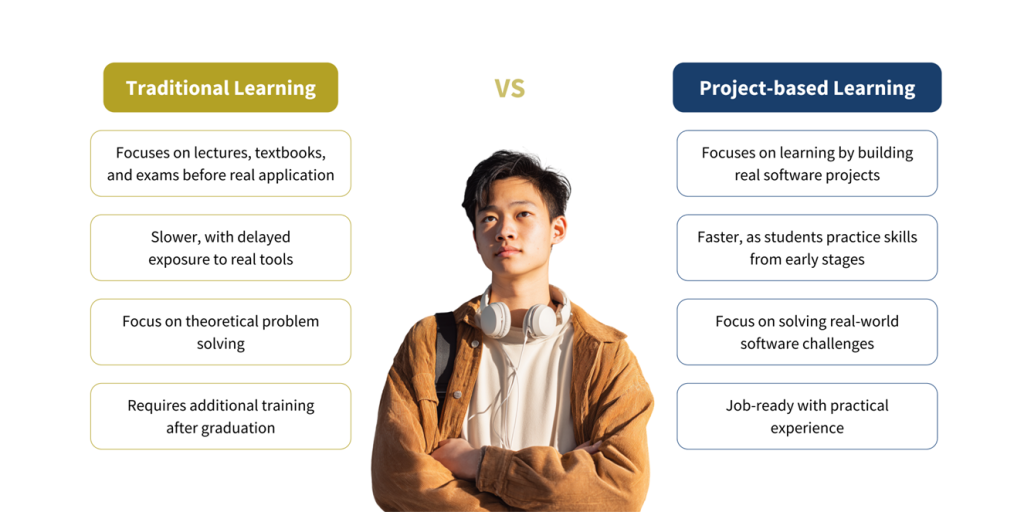
Not all software engineering degrees prepare students in the same way.
Traditional Theory-Heavy Software Engineering Programs
Traditional programs often delay hands-on work.
Students spend much of the early years studying theory before applying it meaningfully. Practical exposure may be limited to a final-year project or short internship.
As a result, graduates may understand concepts but feel unprepared to work on real codebases or collaborate in engineering teams.
Hands-On, Project Driven Software Engineering Programs
A hands-on software engineering program integrates projects throughout the learning journey.
Students practice applying knowledge continuously. They gain experience with tools, workflows, and collaboration early rather than at the end.
This approach reduces the gap between graduation and employment and helps students feel job-ready sooner.
Practical Software Engineering Degree: What Students Actually Learn
A practical software engineering degree focuses on usable skills rather than exam performance alone.
Assessment often includes project outcomes, code quality, teamwork, and problem-solving ability.
Technical Skills Built Through Projects
Through repeated project work, students develop:
- Programming and debugging skills
- Experience with development tools
- Understanding of testing and version control
- Familiarity with real development workflows
Professional Skills Developed Through Team-Based Work
Real software engineering is rarely a solo activity.
Project-based programs emphasize collaboration. Students learn to communicate ideas, manage tasks, handle feedback, and work within teams.
These professional skills are critical in real engineering roles and often underdeveloped in theory-heavy programs.
Why Employers Prefer Graduates From Project Based Programs
Employers hire based on capability.
A graduate from a project-based program can show:
- Real projects they have built
- Problems they have solved
- Tools and technologies they have used
- How they work in teams
Between 2020 and 2025, employers increasingly valued portfolios and project experience when hiring junior engineers. Candidates who can demonstrate applied skills often adapt faster and require less onboarding.
Projects act as proof, not promises.
How CLaaS2SaaS Delivers a Project Based Software Engineering Degree
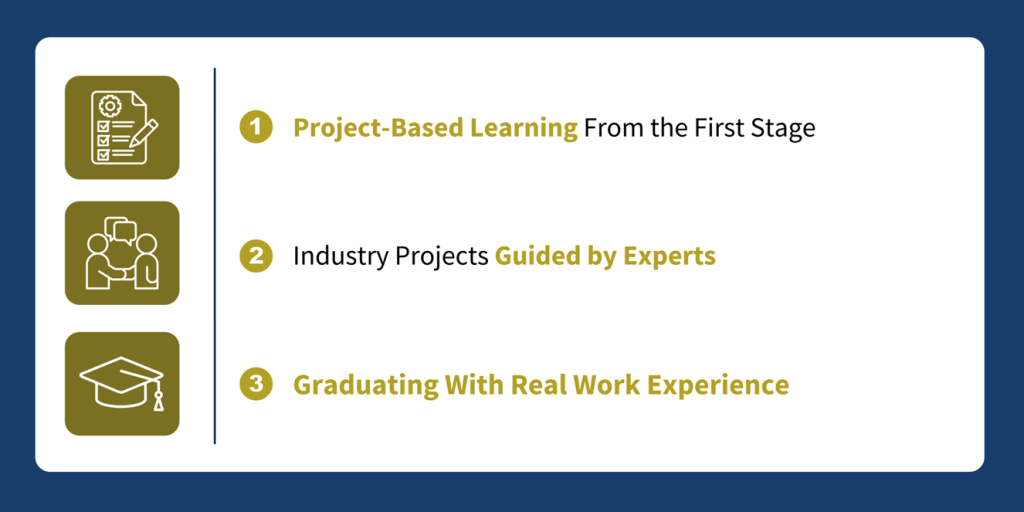
CLaaS2SaaS Software Engineering is designed around hands-on, project-driven learning from the very beginning.
Project-Based Learning From the First Stage
Students begin applying concepts early, even while learning fundamentals. Rather than waiting until advanced semesters, they work on small but meaningful projects alongside core topics such as programming logic, databases, and system design.
This early exposure helps students understand why concepts matter. By building simple applications from the start, students develop confidence and avoid the common gap between “knowing the theory” and “knowing how to use it.”
Industry Projects Guided by Experts
Projects reflect real industry challenges.
As students progress, projects evolve into industry-aligned assignments that reflect real software engineering challenges. These are not hypothetical case studies, but practical problems inspired by how software teams operate in real companies.
Students receive guidance from experienced professionals who have worked in modern engineering environments. Feedback focuses on code quality, problem-solving approach, documentation, and collaboration, mirroring how work is reviewed in professional teams rather than graded like a traditional exam.
Capstone Project: Building a Real Software Solution End-to-End
In the final stage, students complete a capstone project that brings together everything they have learned. This project simulates a real-world software development cycle, from problem definition to deployment.
For example, a capstone project may involve:
By the time students complete the capstone, they have experienced what it means to work like a software engineer, not just study software engineering. - Designing and building a full-stack application to solve a real user or business problem
- Working in teams using version control, issue tracking, and agile-style workflows
- Developing features, fixing bugs, and iterating based on feedback
- Presenting the final product with technical documentation and a working demo
Technical Skills Built Through Projects
Through repeated project work, students develop:
- Programming and debugging skills
- Experience with development tools
- Understanding of testing and version control
- Familiarity with real development workflows
Professional Skills Developed Through Team-Based Work
Real software engineering is rarely a solo activity.
Project-based programs emphasize collaboration. Students learn to communicate ideas, manage tasks, handle feedback, and work within teams.
These professional skills are critical in real engineering roles and often underdeveloped in theory-heavy programs.
Technical Skills Built Through Projects
Through repeated project work, students develop:
- Programming and debugging skills
- Experience with development tools
- Understanding of testing and version control
- Familiarity with real development workflows
Professional Skills Developed Through Team-Based Work
Real software engineering is rarely a solo activity.
Project-based programs emphasize collaboration. Students learn to communicate ideas, manage tasks, handle feedback, and work within teams.
These professional skills are critical in real engineering roles and often underdeveloped in theory-heavy programs.
Graduating With Real Work Experience
The CLaaS2SaaS Bachelor’s Degree in Software Engineering integrates apprenticeship-style learning.
Students can graduate with up to 12 months of real work experience, gaining exposure to professional environments before entering the job market.
Learn more here.
Technical Skills Built Through Projects
Through repeated project work, students develop:
- Programming and debugging skills
- Experience with development tools
- Understanding of testing and version control
- Familiarity with real development workflows
Professional Skills Developed Through Team-Based Work
Real software engineering is rarely a solo activity.
Project-based programs emphasize collaboration. Students learn to communicate ideas, manage tasks, handle feedback, and work within teams.
These professional skills are critical in real engineering roles and often underdeveloped in theory-heavy programs.
Technical Skills Built Through Projects
Through repeated project work, students develop:
- Programming and debugging skills
- Experience with development tools
- Understanding of testing and version control
- Familiarity with real development workflows
Professional Skills Developed Through Team-Based Work
Real software engineering is rarely a solo activity.
Project-based programs emphasize collaboration. Students learn to communicate ideas, manage tasks, handle feedback, and work within teams.
These professional skills are critical in real engineering roles and often underdeveloped in theory-heavy programs.
Project Based Software Engineering Degree vs Bootcamps
Bootcamps are often compared to project-based degrees.
Bootcamps move fast and focus on specific tools. They may help students learn quickly, but they often lack depth, structure, and recognized academic credentials.
A project based software engineering degree combines:
- Structured, progressive learning
- Academic recognition
- Long-term skill development
- Sustained project experience
This balance makes it suitable for students seeking both credibility and real capability.
Common Misconceptions About Project Based Degrees
Some students worry that project-based learning means “less theory.”
In reality, theory still exists. It is simply taught with context and purpose, making it easier to understand and apply.
Others assume project-based programs are only for advanced learners. In fact, many are designed to support beginners through structured progression and guidance.
Project-based does not mean unstructured. It means applied.
Who Should Choose a Project Based Software Engineering Degree?
This pathway suits students who prefer learning by doing.
It works well for learners who enjoy building, experimenting, and solving problems rather than memorizing concepts. It also suits students who want a clear connection between what they study and the careers they pursue.
Parents often value this approach because it focuses on employability, confidence, and real outcomes alongside academic recognition.
Is a Project Based Software Engineering Degree Worth It?
A project based software engineering degree is worth it when it delivers real capability.
By graduation, students have:
- Built multiple real projects
- Used professional tools
- Worked in teams
- Gained real-world exposure
This reduces uncertainty and improves confidence when entering the workforce.
Learning by building creates stronger engineers.
Course
Start Building Your Software Engineering Career With CLaaS2SaaS
Software engineering is learned through practice.
With the CLaaS2SaaS Bachelor’s Degree in Software Engineering, students:
- Learn through real projects
- Develop job-ready skills early
- Graduate with real work experience
Career Change to Software Engineering Degree
Blog
Career Change to Software Engineering Degree You Can Finish in Just 2 Years
SHARE THIS:
For many students exploring tech degrees, software engineering feels like a powerful but intimidating choice. The field promises strong demand, global opportunities, and long-term career growth. At the same time, traditional degree paths often feel long, expensive, and slow to deliver real outcomes, driving interest toward CLaaS2SaaS Software Engineering, a program designed to help students graduate faster while focusing on real, job-ready skills instead of theory alone.
Here’s the reality most students only realize late: the software industry moves faster than traditional education timelines. Programming languages evolve, frameworks update, and development practices shift continuously. What matters today may no longer matter by the time a four-year degree ends, which is why many students explore CLaaS2SaaS Bachelor’s Degree pathways that use an adaptive, personalized, and outcome-based learning method, aligning education with real industry expectations and measurable career outcomes.
If you are considering a career change to a software engineering degree, the biggest risk is not difficulty. The real risk is choosing a pathway that delays your readiness for the job market while technology keeps moving forward.
This article explains how modern software engineering degrees work, why experience is not required to start, and how accelerated programs help students graduate faster with real work experience already built in.
Why Pursuing a Career Change to Software Engineering Degree Matters
Software engineering is no longer limited to technology companies.
Banks rely on software to process transactions securely. Healthcare systems depend on digital platforms for patient data and diagnostics. Retail, logistics, education, and entertainment all run on software infrastructure built and maintained by engineers.
Between 2020 and 2025, global workforce reports consistently highlighted digital and software skills as among the most in-demand capabilities worldwide. Automation, cloud computing, and AI have accelerated this demand rather than reduced it.
This demand is reinforced by government labor data. The U.S. Bureau of Labor Statistics projects software developer roles to grow significantly faster than the average occupation through the mid-2020s, reflecting sustained demand rather than short-term trends.
At the same time, employers have changed how they evaluate graduates. They now prioritize practical ability, adaptability, and speed to productivity, not just academic credentials.
Many traditional degrees still emphasize:
- Theory before application
- Exams instead of real outputs
- Fixed timelines that ignore industry urgency
What Is a Career Change Software Engineering Degree?
A career-focused software engineering degree is designed around outcomes rather than traditional.
Instead of spreading learning across four years, this model compresses essential content into a focused 2-year pathway. Non-essential electives are reduced, while core engineering subjects receive deeper, more practical attention.
Students spend less time memorizing abstract theory and more time:
- Learning programming fundamentals
- Understanding software development workflows
- Building, testing, and improving applications
- Working with tools used in professional environments
Can You Start a Software Engineering Degree With No Experience?
Yes, and for most learners, that is the expected starting point.
A no experience software engineering degree is designed with beginners in mind. Programs start with foundational logic, problem-solving, and introductory programming concepts before progressing to more advanced topics.
Industry data supports this pathway. The Stack Overflow Developer Survey 2025 shows that a significant portion of professional developers entered the field without strong technical backgrounds, acquiring skills progressively through structured learning and practice.
This approach reduces early overwhelm and builds confidence. Students learn how to think like engineers before being asked to perform like professionals.
The degree exists to teach software engineering, not to filter out beginners.
Career Change to Software Engineering Degree: How the Learning Path Works
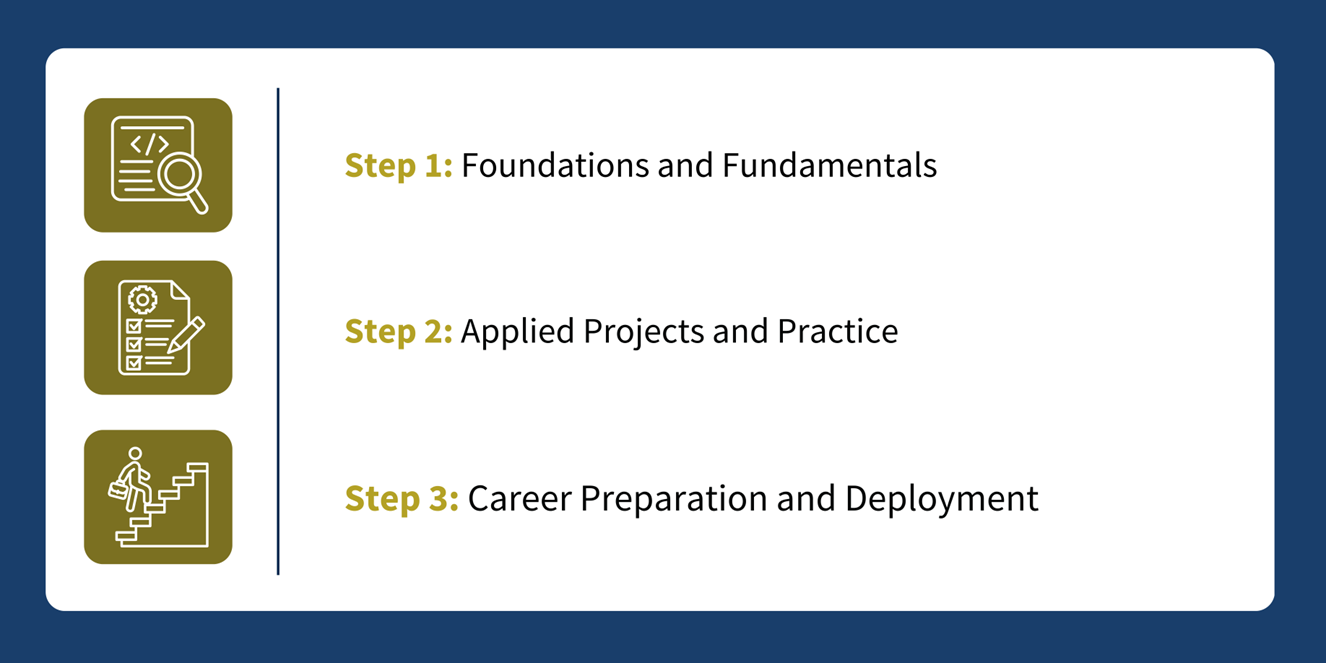
A well-designed degree breaks learning into phases that build upon each other.
Step 1: Foundations and Fundamentals
Students begin with programming logic, basic syntax, and an overview of development environments and tools. This stage builds conceptual understanding before complexity.
Step 2: Applied Projects and Practice
Once fundamentals are established, learning becomes hands-on. Students build projects that simulate real engineering tasks, reinforcing concepts through practice.
This aligns with findings from McKinsey & Company, which emphasize that learning models aligned with real-world job skills significantly improve workforce readiness and employability.
Step 3: Career Preparation and Deployment
The final phase is about readiness: building portfolios, sharpening professional habits, and understanding how engineers contribute in teams.
This progression helps students transform abstract learning into real capability.
How the CLaaS2SaaS Software Engineering Program Structure Works
Unlike traditional degrees that rely on rigid academic semesters, the CLaaS2SaaS Software Engineering program uses a progressive, stage-based structure.
Each stage is designed to build confidence first, capability second, and employability last. This ensures students do not jump into complex engineering tasks too early.
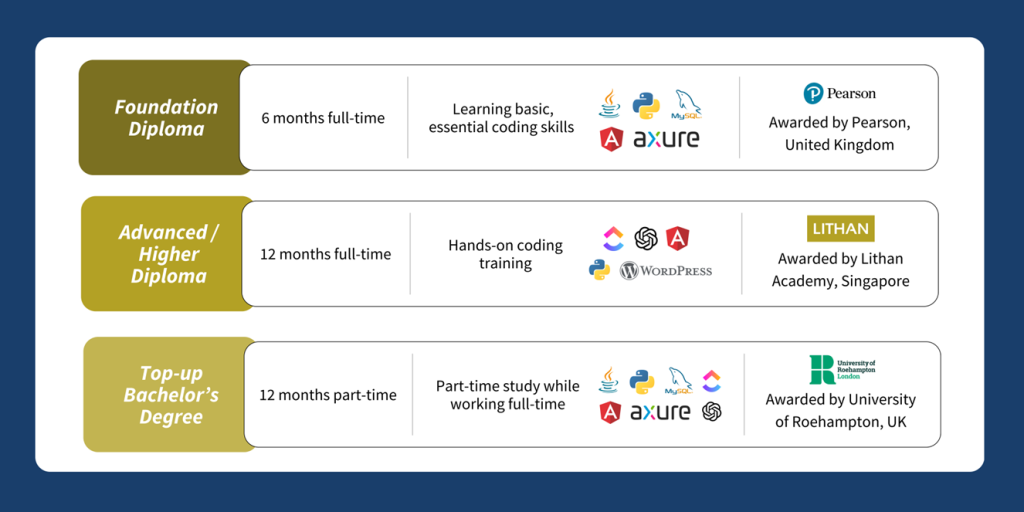
Foundation Diploma (O ptional): Building Confidence From the Ground Up
The Foundation Diploma supports students who want additional preparation before entering core software engineering modules.
At this stage, students build confidence in digital literacy, logical thinking, communication skills, and basic technical concepts. The focus is not advanced coding, but developing the mindset required to succeed in software engineering.
This stage is especially helpful for students entering a no experience software engineering degree pathway. It ensures everyone begins the core program with a strong, stable foundation
Advanced / Higher Diploma: From Theory to Applied Software Engineering
The Advanced / Higher Diploma marks the transition from learning concepts to executing real software engineering work.
Students work with programming languages, frameworks, and tools used by real engineering teams. They practice version control, debugging, testing, and collaborative development.
Learning becomes project-driven. Instead of isolated theory, students solve realistic engineering problems and build working applications. This is where a career change to software engineering degree becomes practical and tangible.
Top-Up Bachelor’s Degree: Bridging Education and Employment
The Top-Up Bachelor’s Degree is the final stage of the CLaaS2SaaS pathway.
This phase focuses on bridging education with real employment outcomes. Students refine their technical skills while gaining exposure to professional engineering environments through industry projects and apprenticeships.
Graduates leave with:
This stage ensures students graduate with experience, not just knowledge. - A recognized bachelor’s degree in software engineering
- Up to 12 months of real work experience
- First-hand understanding of how engineering teams operate
Become Software Engineer Degree vs Other Learning Paths
Students rarely choose a degree without comparison.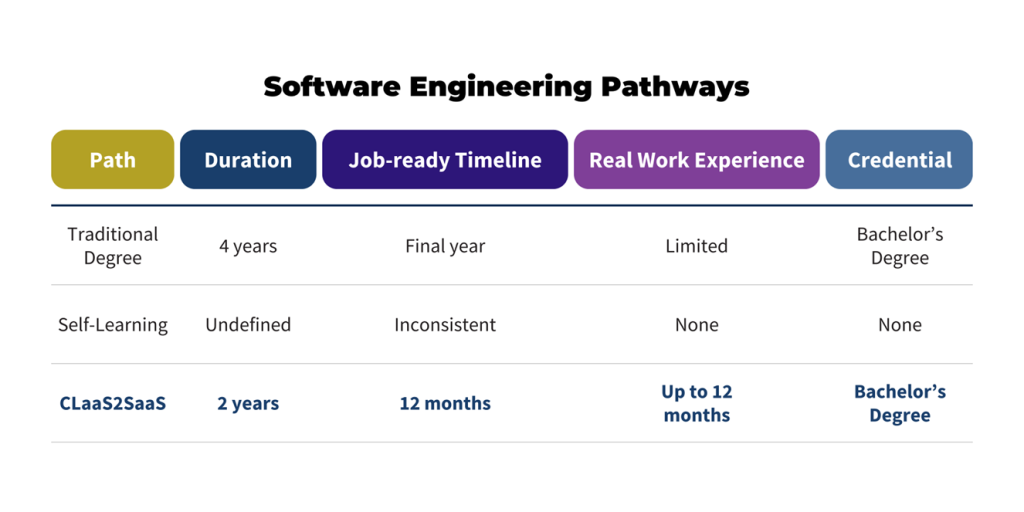
A become software engineer degree delivers the strongest outcomes when it balances structure, speed, and experience.
Why Speed and Experience Matter in Software Careers
Employers today want new hires who can hit the ground running.
Technical interviews often test real coding ability, familiarity with version control, and problem-solving skills in code. Graduates who have built real applications, not just written academic code, are more competitive.
According to several 2025 job market analyses, demand for developers is stabilizing but increasingly selective. Candidates with portfolios and relevant project experience stand out to hiring teams.
Graduating earlier with built-in experience helps close the gap between education and first employment.
How CLaaS2SaaS Redefines the Software Engineering Degree
CLaaS2SaaS Software Engineering is built around real-world engineering expectations.
Graduate in Just 2 Years
The program removes inefficient curriculum elements and focuses on what hiring managers truly value. This allows students to enter the workforce sooner without sacrificing academic credibility.
Job-Ready Skills Within 12 Months
Students start working on real industry projects early. This experiential learning helps them develop practical skills that mirror what professionals do daily.
Graduate With Real Work Experience
By integrating an apprenticeship model, CLaaS2SaaS Bachelor’s Degree enables students to graduate with up to 12 months of real work experience, a powerful differentiator in hiring.
Career Outcomes That Justify the Fast Track
Degrees that focus on outcomes help graduates succeed long-term.
Graduates move into diverse roles, including:
- Software Engineer
- Application Developer
- Systems Engineer
- Full-Stack Developer
Across industries, tech, finance, healthcare, media, logistics, software roles continue to be crucial. Even though hiring trends shift, engineers with relevant skills and experience remain in demand.
Addressing Common Misconceptions
“Is a faster degree less credible?”
No. Credibility comes from accreditation and curriculum relevance, not duration.
No. Credibility comes from accreditation and curriculum relevance, not duration.
“Does learning faster reduce quality?”
No. A focused, applied pathway removes inefficiencies, not core learning.
No. A focused, applied pathway removes inefficiencies, not core learning.
“Is this only for elite students?”
No. Programs designed for beginners can support motivated learners from the ground up.
No. Programs designed for beginners can support motivated learners from the ground up.
Course
Start Your Software Engineering Journey Now
Technology will not slow down, and neither should your learning.
With the CLaaS2SaaS Bachelor’s Degree in Software Engineering, you can:
- Graduate faster than traditional programs
- Become job-ready within 12 months
- Gain real work experience before graduation
Fast Track Data Science Certification
Blog
Fast Track Data Science Certification: The 4-Month Roadmap
SHARE THIS:
A Fast Track Data Science Certification is one of the most efficient ways to move from “interested in data” to “I can confidently deliver analysis or models that answer real business questions.” Speed, however, only works when it is paired with structure, accountability, and a clearly defined outcome.
This guide walks through how fast-track certifications work, how they compare to degrees, what a realistic 4-month workload looks like, and how to choose intensive training without wasting time or money. If you want to explore structured, time-efficient options built for working adults, many learners begin with a data science certification path for working professionals under the Claas2SaaS Lifelong Learning framework.
What A Fast-Track Certification Is (And What It Isn’t)
A fast-track program is a compressed, outcome-driven learning path. It focuses on the highest-leverage skills used in real data roles: SQL, Python, applied statistics, core modeling techniques, and communication.
What makes it “fast” is not skipping fundamentals but sequencing them efficiently. Concepts are introduced only when you need them, reinforced immediately through practice, and evaluated through projects rather than exams. This approach is common in a well-designed intensive data science training program.
What it is not:
- A magic shortcut that eliminates effort
- A theory-heavy academic replacement
- A collection of disconnected tutorials
The goal is simple: build applied competence quickly and prove it through portfolio work.
When evaluating any fast-track option, judge it by two outputs:
- Portfolio quality: Does the work look like something used in a real company?
- Decision clarity: Can you explain why you chose certain metrics, features, or models?
Fast Track Data Science Certification Vs Degree: How To Decide
Degrees and certifications both lead to data roles, but they solve different problems. Choosing the wrong one can cost years.
According to the U.S. Bureau of Labor Statistics, data scientists earned a median annual wage of $112,590 (May 2024), with projected employment growth of 34% from 2024–2034. That demand is why employers increasingly focus on demonstrable skills, not just credentials.
When A Degree Makes Sense
- A degree is usually the right path if you need:
- Deep theoretical grounding for research-heavy or academic roles
- Access to internships, labs, or campus recruiting pipelines
- A slower pace to build strong math and statistical foundations
Degrees are also valuable if your target market strongly prefers formal academic credentials.
When A Certification Wins On Speed And ROI
A Fast Track Data Science Certification is often the better choice when you:
Certifications emphasize output: SQL queries, notebooks, models, and write-ups you can show. - Already hold a bachelor’s degree in any field
- Need applied, job-ready skills quickly
- Want to pivot roles or upskill internally without stepping away from work
The “Degree + Certification” Stack Recruiters Like
Many professionals combine both approaches. Keeping an existing degree while adding a fast-track data science learning path signals two things at once: baseline academic credibility and current, applied capability.
Can A 4 Month Data Science Certification Really Work?
Yes—if you treat it like a serious, scoped commitment. A 4 Month Data Science Certification works best when the learning path follows a tight progression: foundations → applied modeling → portfolio → interview narrative.
Speed breaks down when learners try to do everything. Focus wins when you limit scope to one or two realistic project themes.
The Time Math (Hours/Week) You Should Plan For
For most working adults, realistic expectations look like this:
Consistency matters more than motivation. Programs built under Lifelong Learning models are designed around predictable weekly rhythms rather than cramming. - 8–12 hours/week for strong, polished portfolio output
- 6–8 hours/week if you already code and understand basic statistics
- Under 6 hours/week usually results in rushed or shallow projects
Prerequisites That Cut Your Learning Curve In Half
Before starting, aim to be comfortable with:
If these feel shaky, a 7–10 day prep sprint can dramatically improve outcomes in an intensive program. - Basic algebra and chart interpretation
- Spreadsheet logic (filters, grouping, pivots)
- Any prior programming exposure, even minimal Python
The Curriculum That Delivers Results In 16 Weeks
Below is a realistic roadmap followed by most Fast Track Data Science Certification Programs that successfully place graduates into applied roles.
Weeks 1–4: Foundations (SQL, Python, Stats)
You should learn to:
- Write SQL joins, CTEs, and window functions
- Clean and transform data using pandas
- Interpret probability, distributions, and confidence intervals
- Write short summaries that answer one clear business question
Weeks 5–8: Modeling (Supervised Learning + Evaluation)
This phase introduces modeling with emphasis on reasoning, not hype:
Employers value clean evaluation and honest interpretation far more than complex algorithms. - Regression and classification fundamentals
- Train/validation splits and cross-validation
- Baseline models versus improvements
- Evaluation metrics such as RMSE, precision, recall, and ROC-AUC
Weeks 9–12: Real-World Workflow (ETL, Experiments, Storytelling)
Strong Intensive Data Science Training programs extend beyond notebooks to include:
This is where projects begin to resemble real work. - Basic ETL and pipeline thinking
- Experiment design and A/B testing fundamentals
- Decision-focused visualization and communication
Weeks 13–16: Portfolio And Interview-Ready Narrative
By the end of the program, you should have:
- One or two polished, reproducible projects
- A one-page write-up per project (problem → method → result → limitations)
- A repeatable 5-minute walkthrough you can present confidently
How To Choose Intensive Data Science Training Without Wasting Money
Ignore long tool lists and buzzwords. Use outcome-based criteria instead.
The 10-Point Program Checklist
A strong option should include:
- Clear role outcomes (analytics, data science, ML)
- Heavy SQL emphasis
- Python practice with realistic datasets
- Statistics taught through decisions
- End-to-end project pipelines
- Code and project feedback
- Accessible mentorship
- Career materials and interview prep
- Transparent workload expectations
- Visible portfolio standards
Portfolio Standards (What “Job-Ready” Looks Like)
A job-ready project includes:
- A clear business question
- Documented data-cleaning decisions
- A baseline and at least one improvement
- Honest limitations and next steps
- A concise executive summary
Mentorship And Feedback Loops
Fast-track programs fail when learners get stuck silently. Look for:
- Weekly office hours
- Rubric-based project reviews
- Active peer or mentor communities
What To Build: 2 Portfolio Projects That Signal “Hire Me”
You only need two strong projects if they are realistic and well-explained.
Project 1: Decision-First Analysis (SQL + Python)
Examples include churn analysis, funnel drop-off, retention cohorts, or operational metrics.
Project 2: Predictive Modeling With Clean Evaluation
Examples include demand forecasting, lead scoring, fraud flags, or incident prediction.
Clarity, structure, and reasoning consistently outperform complexity.
FAQs About Fast-Track Programs And Outcomes
Do employers accept certifications?
Yes—especially when paired with projects you can clearly defend.
Is a 4 month data science certification enough for a job?
It can be enough for entry-level roles or internal transitions when paired with strong projects.
Why do learners fail fast-track programs?
Inconsistent weekly time and unclear project scope are the most common reasons.
Course
Ready To Improve Your Fast Track Data Science Certification Strategy?
A fast path only works when it is structured. Define the role you want next, control scope, and ship proof through projects that mirror real business work.
If you want a structured reference designed for working professionals, explore the Claas2SaaS Lifelong Learning Data Science Program to compare timelines, outcomes, and certification paths.
Data Science Bootcamp Tech Professionals: A Practical Guide For Busy Builders
Blog
Data Science Bootcamp Tech Professionals: A Practical Guide For Busy Builders
SHARE THIS:
If you already work in tech, you don’t need motivation—you need a plan. A Data Science Bootcamp For Tech Professionals that you can realistically finish after work should give you a clear roadmap, real projects, and feedback that replaces guesswork with momentum.
This guide breaks down what to look for, what to ignore, and how to start building job-ready proof of skill without pausing your career. If you are exploring structured upskilling options, a part-time data science bootcamp for working professionals can provide a clear, time-bound path. If you want a structured and time-efficient path, many working professionals begin with a Data Science Bootcamp For Working Professionals offered under the Claas2SaaS Lifelong Learning framework.
What “Bootcamp” Really Means When You’re Already In Tech
For working engineers, a bootcamp should not mean cramming everything at once. Instead, a Data Science Bootcamp Tech Professionals choose should focus on compressed, curated practice—the specific skills that create leverage in real-world environments.
Well-designed programs respect what you already know:
That’s why many learners prefer a structured online data science bootcamp for working professionals, especially those delivered through Lifelong Learning pathways such as Claas2SaaS. - You understand systems, debugging, and shipping software
- You can learn quickly when noise is removed
- You need help translating technical work into business impact
Why A Data Science Bootcamp Tech Professionals Pick Beats Random Self-Study
Self-study can work, but it often breaks down for full-time employees. Without structure, most learners struggle with consistency.
A Data Science Bootcamp For Professionals adds the right constraints:
- A syllabus that prevents tutorial hopping
- Weekly deadlines that force output
- Reviews that catch mistakes early
- A portfolio outcome at the end
According to the U.S. Bureau of Labor Statistics, employment for data scientists is projected to grow 34% from 2024–2034, far faster than average. This makes structured upskilling—such as a Claas2SaaS Data Science Learning Path—a practical investment rather than a speculative one.
The Skill Stack You Actually Need (And What You Can Skip)
Tech professionals often overestimate the math barrier and underestimate the communication barrier. You don’t need research-level depth to be effective in applied data roles.
Core 1: Data Wrangling And SQL
SQL delivers the fastest ROI because it turns raw tables into answers. Any serious Data Science Bootcamp Tech Professionals enroll in should cover:
If SQL is treated as secondary, that’s a red flag. Most learners benefit from a structured data science learning path for professionals that prioritizes SQL early. Programs aligned with Lifelong Learning in Data Science typically place SQL at the foundation. - Joins, window functions, and CTEs
- Data quality checks
- Analysis-ready datasets
- Business metrics like retention, churn, and LTV
Core 2: Python For Analysis And Modeling
Python remains central across analytics and data science roles. According to the Stack Overflow Developer Survey, Python continues to rank among the most-used languages by professional developers. The Stack Overflow Developer Survey consistently ranks Python among the most-used professional languages.
In a bootcamp setting, Python should be taught as a toolbelt:
Most Claas2SaaS Data Science Programs emphasize applied workflows over theory-heavy instruction. - Pandas and NumPy for analysis
- Visualization for decision-making
- Regression and classification basics
- Model evaluation and leakage awareness
Core 3: Communication And Decision-Making
This is where experienced tech professionals can differentiate quickly. The goal is not “I trained a model,” but “I influenced a decision.”
Look for training that includes:
- Writing concise insights
- Choosing the right metrics
- Explaining tradeoffs clearly
- Storytelling from assumptions to impact
How To Choose The Right Program (Use This Checklist)
Not all bootcamps are built for employed learners. Use this checklist to filter out hype-driven programs.
Curriculum Fit: From Fundamentals To Applied Projects
A strong Data Science Course For Professionals should include:
When comparing options, many learners benchmark against the Claas2SaaS Lifelong Learning Data Science Path to evaluate depth and relevance. - Focused probability and statistics refreshers
- SQL and data modeling fundamentals
- Applied machine learning
- Experimentation and A/B testing basics
- Optional specialization tracks
Schedule Reality: Part-Time Pacing And Deadlines
Ask these questions:
A predictable weekly rhythm is a defining feature of a good Online Data Science Bootcamp For Working Professionals. - Is the program async, live, or hybrid?
- What happens if you miss a week?
- Are deadlines fixed?
- Is mentor support available across time zones?
Portfolio Quality: Projects That Look Like Real Work
Portfolios should resemble professional artifacts, not classroom assignments. Strong projects include:
Many Claas2SaaS Certification Tracks emphasize portfolio-first learning for this reason. - Messy, realistic data
- A clear business question
- Baselines and improvements
- Metrics, tradeoffs, and limitations
Mentorship And Feedback Loops
High-quality feedback accelerates learning. Look for:
Many Claas2SaaS Certification Tracks emphasize portfolio-first learning for this reason. - Code reviews
- Rubric-based project scoring
- Mentor sessions focused on decisions
Career Support (Even If You’re Not Job-Hunting Yet)
Even if you’re staying put, career support should help you:
- Clarify target roles
- Build a narrative from your tech background
- Optimize LinkedIn and GitHub
- Practice case-study walkthroughs
A 10-Week Plan For Working Tech Pros (2–6 Hours/Week)
This pacing mirrors most Data Science Bootcamps For Tech Professionals designed under Lifelong Learning data science programs.
Weeks 1–2: Set Up Your “Data Lab”
Deliverables:
- Python environment or notebooks
- SQL sandbox
- One relevant dataset
- A short README defining your goal
Weeks 3–6: Build One End-To-End Project
Focus on a single question such as:
- What predicts churn?
- Which factors drive incidents?
- How did users respond to a new feature?
Weeks 7–10: Ship A Portfolio And Polish Your Story
Deliverables:
- Clean, reproducible repository
- One-page project summary
- Five-minute walkthrough script
Common Pitfalls (And How To Avoid Them Fast)
- Choosing programs that are too broad → Focus on role-aligned depth
- Over-indexing on deep math → Prioritize interpretation first
- Treating projects like homework → Write them like business deliverables
- Relying on motivation alone → Use deadlines and structure
- Ignoring communication → Always summarize insights for non-technical audiences
FAQs About Part-Time Data Science Learning
How long should a part-time bootcamp take?
Most programs designed for working adults run 8–16 weeks.
Do I need a math degree to start?
No. Logical thinking and interpretation matter more early on.
Is analytics or ML better to start with?
Analytics and SQL deliver faster business impact; ML can follow.
Course
Ready To Improve Your Data Science Bootcamp Tech Professionals Strategy?
You don’t need to start over. You need a learning path that respects your time, builds applied skill quickly, and produces portfolio-ready proof.
A Claas2SaaS Lifelong Learning Data Science Program can help you avoid the tutorial trap, maintain momentum through structure, and gain feedback when it matters most.
Digital Marketing Course for Non-Tech Professionals Starting from Scratch
Blog
Digital Marketing Course for Non-Tech Professionals Starting from Scratch
SHARE THIS:
Can non-t ech professionals really build successful digital marketing careers starting from zero? Absolutely.
I bet you didn’t know that 70% of today’s digital marketers actually started in completely different fields like sales, teaching, journalism, IT, and even healthcare. Yes, you read that right, the majority of successful digital marketers had zero marketing background when they started.
This comprehensive FAQ guide explores how digital marketing for non-tech professionals is no longer a barrier-driven path but a practical, skill-based opportunity. It answers every critical question about the CLaaS2SaaS Lifelong Learning Digital Marketing program, designed specifically for professionals without technical backgrounds who want to learn digital marketing from scratch and become full-stack digital marketers with real-world, hands-on experience.
Frequently Asked Questions
Question #1: Do I need technical skills or coding knowledge to learn digital marketing?
No, you don’t need any coding skills or technical expertise to start the CLaaS2SaaS Digital Marketing program.
This is the biggest misconception stopping non-tech professionals from pursuing this rewarding career. CLaaS2SaaS Lifelong Learning approach focuses on skills-first, work-integrated learning that emphasizes strategy, creativity, customer engagement, and data-driven decision-making, not programming. The program is specifically designed for professionals transitioning from non-technical backgrounds who want to master modern digital marketing.
Modern digital marketing platforms are designed for non-technical users. The CLaaS2SaaS curriculum teaches you to master industry-relevant tools like WordPress, HubSpot, Google Ads, Facebook Ads, and ChatGPT/Copilot, all with intuitive, user-friendly interfaces. You’ll learn to create engaging multimedia content, utilize CRM and marketing automation, develop omnichannel campaigns, and analyze campaign metrics without writing a single line of code.
According to Deloitte’s research on workforce transformation, basic tech savvy and digital literacy are sufficient for most modern marketing roles, deep technological knowledge is unnecessary. What matters is the ability to meet a digital literacy threshold appropriate to the role and industry.
Question #2: What exactly will I learn to do as a Full-Stack Digital Marketer?
Your capabilities will cover:
- Launch and Automate Omnichannel Marketing Campaigns: Execute integrated strategies across social media, email, content marketing, SEO, paid advertising, and physical outreach events.
- Create Engaging Multimedia Content: Develop blog posts, social media content, email campaigns, and videos that enhance audience interaction and brand recognition.
- Utilize CRM and Marketing Automation Tools: Optimize workflows, improve customer relationships, and create automated marketing sequences using platforms like HubSpot.
- Streamline Campaigns with Generative AI: Leverage ChatGPT and Copilot for content creation, strategy development, and campaign planning.
- Analyze Data-Driven Insights: Track campaign metrics, interpret analytics from Google Analytics and other platforms, and make informed decisions to improve performance.
- Develop Strategic Sales Plans: Align marketing initiatives with business objectives to drive measurable growth in digital environments.
- Apply Agile Project Management: Plan and conduct scrum meetings to meet projected leads targets and other marketing outcomes.
The World Economic Forum’s Future of Jobs Report 2025 identifies AI and big data, technological literacy, creative thinking, and analytical thinking as the fastest-growing and most essential skills for the modern workforce, all of which are core to full-stack digital marketing.
Question #3: How long does the Digital Marketing program take, and what credentials will I earn?
CLaaS2SaaS offers a unique 3-step skills-first pathway with stackable credentials that let you enter the job market quickly or continue advancing based on your career goals:
- Step 1: Professional Certificate – 4 months Intensive skilling bootcamp delivering work-ready skills and certification for immediate digital career entry. You’ll master digital marketing fundamentals, content marketing, marketing automation, CRM applications, and omnichannel campaign development through hands-on projects. Awarded by CLaaS2SaaS/Lithan Academy. Career outcome: Digital Marketing Executive ($2,500-$3,000 monthly salary range)
- Step 2: Professional Diploma or Postgraduate Diploma – 5-8 months Industry project development and implementation with expert mentoring for advanced job role accreditation. You’ll gain comprehensive skills across digital marketing, content marketing, video production, marketing automation, CRM applications, and omnichannel commerce campaigns. Awarded by CLaaS2SaaS/Lithan Academy, Singapore. Career outcome: Digital Marketing Manager ($4,800-$6,000 monthly salary range)
- Step 3: Master’s Degree (Top-Up) – 6 months Part-time study and project thesis for an internationally accredited master’s degree. Blend marketing theory with advanced digital strategies, gaining expertise in consumer psychology, digital branding, social media, and communication. Awarded by Guglielmo Marconi University, Italy. Career outcome: Digital Marketing Head/Director ($8,000-$12,000 monthly salary range)
Question #4: What makes CLaaS2SaaS different from other digital marketing courses?
CLaaS2SaaS delivers a complete employment pipeline specifically designed for non-tech professionals.
Addressing challenges other programs ignore:
- Skills-First, Work-Integrated Learning: The 70:20:10 learning approach combines hands-on project work (70%), mentoring and collaboration (20%), and formal instruction (10%), ensuring you build real competencies, not just theoretical knowledge.
- Competency-Based Curriculum: Aligned with Singapore’s Skills Framework, the program focuses on industry-demanded capabilities that employers actually hire for.
- Industry-Relevant Tools Mastery: You’ll master the exact platforms employers need, WordPress, HubSpot, Google Ads, Facebook Ads, Google Analytics, and AI tools like ChatGPT, through guided projects and real campaign development.
- Real Portfolio Projects: Complete capstone projects that demonstrate your ability to execute full digital marketing campaigns, giving you tangible proof of competency during interviews.
- Experienced Practitioners as Instructors: Learn from entrepreneurs and business professionals who understand what career changers experience and what employers actually need.
- Flexible Part-Time Format: Designed specifically for working professionals who need to maintain employment while retraining.
- Stackable Credentials: Start with a 4-month Professional Certificate and enter the job market immediately, or continue building credentials up to Master’s level, your choice based on career aspirations.
- Personalized Career Pathway: Submit your CV and receive a customized career proposal tailored to your background, aspirations, and the current job market.
Question #5: Can I really start from scratch with no marketing experience?
Yes, the Digital Marketing program explicitly requires no prior marketing or technical background.
The curriculum is built specifically for career changers and professionals looking to transition into digital marketing from completely different fields.
The program starts with foundational digital marketing principles and progressively builds your capabilities through structured modules. Each learning phase includes hands-on practice with real tools and platforms, so you’re not just absorbing theory; you’re actively developing skills.
The work-integrated learning method means you’ll complete actual projects throughout the program, building a portfolio of real marketing campaigns you can showcase to employers. By the time you finish the 4-month Professional Certificate, you’ll have demonstrated competency in creating content, launching campaigns, utilizing automation tools, and analyzing results.
The digital marketing industry is projected to grow by 10% annually through 2030 (Digimarcon), creating hundreds of thousands of new roles globally. Employers are actively seeking skilled digital marketers, and the CLaaS2SaaS credentials signal job-ready capability.
Many CLaaS2SaaS graduates successfully transitioned from IT, teaching, healthcare, administration, and numerous other non-marketing backgrounds. The program’s competency-based structure ensures that regardless of where you start, you’ll reach employment-ready proficiency.
The World Economic Forum’s Future of Jobs Report 2025 reveals that 170 million new roles will be created by 2030, with digital and technology roles among the fastest-growing job categories globally.
Question #6: What career support does it provide to help me get hired?
CLaaS2SaaS offers comprehensive job placement assistance backed by over 10 years of track record, helping an average of 500+ professionals transition to high-growth digital jobs annually through partnerships with 2,000+ companies.
Career Builder Workshop: Prepare yourself with professional resume-building guidance, interview coaching techniques, and industry insights sharing to position yourself competitively in the job market.
1-to-1 Career Coaching: Work individually with career advisors to plan and align your career aspirations and expectations with upcoming job opportunities that match your background and goals.
Recruitment Activities & Interviews: Connect directly with CLaaS2SaaS’s active pool of hiring employers across SMEs and MNCs in multiple sectors, with introductions and referrals that improve your chances of securing interviews.
The CLaaS2SaaS network includes relationships with thousands of hiring companies built over more than a decade, giving you access to opportunities you wouldn’t find through traditional job boards alone.
Question #7: How does the learning method work for busy working professionals?
The program is specifically structured for working adults who need to balance career development with existing employment and personal responsibilities.
70:20:10 Learning Approach: The methodology optimizes learning efficiency through 70% hands-on project work, 20% mentoring and peer collaboration, and 10% formal instruction ensuring maximum skill development in minimum time.
Self-Paced E-Learning Components: Outside live sessions, you’ll access self-paced materials that you can complete according to your personal schedule, with mentoring support available when you need guidance.
Competency-Based Progression: The curriculum focuses on demonstrating capabilities rather than seat time, meaning you advance by proving mastery, not just attendance, which respects your time and prior experience.
Multiple Learning Modes: The program employs seven different learning styles, e-learning, flipped classes, assignments, project mentoring, project implementation, self-study with support, and summative assessment, creating an engaging, comprehensive experience that fits different learning preferences.
The 4-month Professional Certificate timeline represents intensive but achievable commitment for working professionals. Many graduates maintain full-time employment throughout the program, then leverage their new credentials and portfolio to transition into digital marketing roles.
Question #8: What happens after I complete the Professional Certificate? Can I continue advancing?
Yes, the CLaaS2SaaS stackable credentials model provides clear advancement pathways that let you continuously build expertise and qualifications as your career progresses.
After completing the 4-month Professional Certificate, you can immediately enter the job market as a Digital Marketing Executive, or you can continue to the Professional Diploma or Postgraduate Diploma (5-8 months additional) to qualify for Digital Marketing Manager roles with higher salary ranges.
After the Diploma level, you can pursue the Master’s Degree Top-Up (6 months) to earn an internationally recognized master’s degree from Guglielmo Marconi University in Italy, qualifying you for senior positions like Digital Marketing Head or Director.
Start Your Digital Marketing Journey with CLaaS2SaaS Today
According to McKinsey’s latest research, 39% of existing skill sets will be transformed or become outdated between 2025 and 2030, making now the perfect time to invest in future-ready digital marketing skills. Stop letting concerns about technical requirements or lack of marketing experience hold you back. CLaaS2SaaS Lifelong Learning Digital Marketing program was built specifically for non-tech professionals like you who want to build rewarding careers in one of the fastest-growing, most accessible fields available.
Course
What you’ll achieve through CLaaS2SaaS:
- Become a Full-Stack Digital Marketer in just 4 months with work-ready skills
- Master industry-relevant tools: WordPress, HubSpot, Google Ads, Facebook Ads, ChatGPT
- Launch and automate real omnichannel marketing campaigns with AI-powered tools
- Build a portfolio of actual projects proving your capabilities to employers
- Earn stackable credentials from Professional Certificate to Master’s Degree
- Access comprehensive career support backed by 10+ years and 2,000+ employer relationships
- Study part-time while maintaining your current employment
- Learn from experienced business practitioners, not just academic instructors
You don’t need technical skills. You don’t need prior marketing experience. You just need to start.
Top 4 Digital Transformation Courses for Non-Technical Professionals
Blog
Top 4 Digital Transformation Courses for Non-Technical Professionals
SHARE THIS:
You’re Facing a Challenge That Keeps You Up at Night
Your company is investing millions in digital transformation. Your competitors are moving faster than ever. Your leadership team expects you to drive innovation and lead change.
But there’s a problem: you’re not a programmer. You don’t have a computer science degree. And every time technical teams start talking about APIs, cloud architecture, or machine learning, you feel lost.
Here’s what you need to know: you don’t need to become a developer to lead digital transformation. In fact, your business background is exactly what makes you perfect for this role with the right digital innovation training.
You just need the right training to bridge the gap between business strategy and digital execution.
What You Really Need to Lead Digital Change
Business Strategy Over Technical Jargon
You need to understand how technology solves business problems, not how to build it. The right program teaches you to evaluate digital opportunities, make smart investment decisions, and communicate effectively with technical teams without getting lost in code.
Change Management Skills That Actually Work
Most digital initiatives fail because of people, not technology. According to McKinsey research, 70% of digital transformations fail due to resistance to change and lack of management support. You need proven change management digital transformation frameworks to overcome resistance and lead your team through uncertainty with clarity and confidence.
Tools You Can Use Monday Morning
You need practical frameworks, templates, and strategies you can implement immediately in your current role. Real solutions that create measurable impact starting this week, not theoretical concepts that sit unused on shelves.
Your 4 Best Options for Digital Transformation Training
1. Professional Certificate in Digital Innovation
Perfect if you’re ready to drive innovation in your organization
The Professional Certificate in Digital Innovation gives you everything you need to identify opportunities, evaluate emerging technologies, and lead innovation projects from concept to implementation.
What You’ll Gain:
- Understanding of AI, blockchain, IoT, and other technologies through a business lens
- Design thinking and customer-centric innovation methods
- Frameworks to evaluate which technologies matter for your industry
- Ability to build business cases that get executive approval
Skills You Can Apply Immediately: This program focuses on practical application. You’ll learn innovation frameworks for improving customer experiences, streamlining operations, and generating measurable business results. All designed specifically for professionals without technical backgrounds.
Your Investment: 3-4 months of flexible online learning that fits your job.
This is for you if: You’re in marketing, operations, finance, HR, or another non-technical role and want to lead digital innovation projects.
2. Professional Certificate in Digital Transformation
Perfect if you’re leading enterprise-wide change
The Professional Certificate in Digital Transformation equips you to lead large-scale organizational transformation, not just individual innovation projects.
What You’ll Master:
- Building digital strategies aligned with business objectives
- Creating transformation roadmaps your teams can execute
- Assessing organizational readiness and addressing resistance
- Measuring transformation success with meaningful metrics
- Leading through ambiguity and fostering innovation cultures
Why It Works: This program weaves change management digital transformation principles throughout every module. You’ll study real transformations across industries, learning from successes and expensive failures. You’ll leave with assessment frameworks, business case templates, and strategic planning tools.
This is for you if: You’re a senior manager, department head, project manager, or consultant responsible for driving digital transformation across your organization.
3. Guglielmo Marconi University Masters Top-Up Program
Perfect if you want academic credentials plus practical skills
The GMU Masters Top-Up Program lets you build on professional certificate work toward a recognized master’s degree.
What Makes This Unique: You get practical skills you can use immediately and academic credentials that open doors to senior leadership roles.
What You’ll Explore:
- Advanced digital strategy and technology management
- Innovation ecosystems and organizational transformation
- Research-based approaches combined with real-world case studies
The Career Advantage: A master’s degree from Guglielmo Marconi University differentiates you in competitive job markets. Whether pursuing C-suite positions or consulting roles, this credential proves your expertise. The top-up structure recognizes your prior learning, significantly reducing time and investment compared to traditional programs.
This is for you if: You want academic credentials for career advancement or you’re transitioning into digital leadership or consulting.
4. Comprehensive Digital Innovation Learning Path
Perfect if you’re committed to becoming a complete digital leader
CLaaS2SaaS’s Digital Innovation solution offers a structured pathway that builds your expertise.
How It Works: Start with foundational digital innovation concepts. Progress to transformation leadership skills. Optionally pursue the master’s top-up. Each stage delivers immediate career value while building toward comprehensive expertise.
Your Personalized Journey: Design your learning path based on your career goals, industry needs, and timeline. You gain access to expert mentors, peer networks, and industry resources that continue beyond program completion.
This is for you if: You’re committed to career development in digital leadership.
How to Choose Your Best Path Forward
Starting from scratch? Begin with the Professional Certificate in Digital Innovation for essential foundations.
Leading company-wide initiatives? Choose the Professional Certificate in Digital Transformation for comprehensive change management frameworks.
Advancing to senior leadership? Consider the GMU Masters Top-Up Program for differentiating credentials.
Building complete expertise? Follow the full Digital Innovation learning path for progressive skill development.
Why You’re Already Perfect for This Role
Your non-technical background is actually your biggest strength.
You Understand Real Business Problems
Your experience in operations, marketing, finance, or other functions gives you insights into where digital transformation creates actual business value. You know which problems are worth solving and which solutions drive real organizational impact.
You Communicate With Humans
Your ability to communicate with stakeholders, build consensus, and translate between business and IT creates the alignment that successful transformations require. This skill is more valuable than programming expertise.
You Focus on Results That Matter
You keep initiatives focused on measurable outcomes: revenue growth, cost reduction, customer satisfaction, competitive advantage. Not just technology for technology’s sake.
The right digital innovation for non-technical professionals program takes these natural strengths and adds the digital literacy and strategic frameworks you need to lead with confidence.
What Happens If You Wait?
Organizations desperately need professionals who bridge business and technology. Research from Harvard Business Review shows that companies report critical shortages of digital transformation talent, with demand for professionals who combine business acumen with digital literacy growing 34% annually. This shortage means enormous opportunities: better positions, higher compensation, access to strategic projects that shape your company’s future.
But waiting has a cost. While you hesitate, competitors are building capabilities that make them indispensable to their organizations and irreplaceable in their markets.
Digital transformation is accelerating. The professionals who thrive will be the ones who can lead organizations through continuous digital evolution.
That can be you.
Your Next Move: From Uncertainty to Leadership
You’ve recognized digital transformation is reshaping your career. You understand you need the right training.
These programs give you proven paths to build the capabilities you need. Each delivers the confidence to lead digital initiatives, the frameworks to drive successful change, and the credentials to advance your career.
The organizations dominating the next decade are being built today by leaders who harness digital technologies for business advantage.
Leaders like you, with the right knowledge and support.
Course
Explore Digital Innovation Programs
Discover which digital transformation course for non technical professionals fits your goals and start building the capabilities that will define your future.
About CLaaS2SaaS
CLaaS2SaaS partners with non-technical professionals to develop the digital leadership capabilities organizations need. We deliver education that creates immediate workplace value while building long-term career advantages. We’re here to support your journey.
How to Switch Career with a Digital Marketing Course without any degree
Blog
How to Switch Career with a Digital Marketing Course without any degree
SHARE THIS:
Think a career change into digital marketing requires a four-year degree and thousands in student debt? Think again. That outdated belief is costing ambitious professionals like you years of fulfillment and earning potential while the digital economy explodes around you. Today, practical skills and hands-on experience matter far more than traditional qualifications, particularly for those exploring digital marketing for non-tech professionals.
Here’s the reality: over 50% of digital marketing professionals don’t have a traditional marketing degree (Marketing Week). Many successfully pivoted from teaching, retail, hospitality, finance, IT, and other industries by learning digital marketing from scratch through structured, skills-first training. Instead of university debt, they invested in practical digital marketing programs that helped them build real portfolios and employer-ready capabilities, exactly what hiring managers value today.
This guide is for career changers, career switchers, and anyone feeling trapped in a role that no longer serves them. Whether you’re 25 or 55, employed or between jobs, this article will show you exactly how to transition into digital marketing without a degree, and why a focused digital marketing course for career change might be your fastest route to a fulfilling new career. The question isn’t whether you’re qualified; it’s whether you’re ready to take action.
Step 1: Understand Why Digital Marketing Doesn't Require a Traditional Degree
The digital marketing landscape operates fundamentally differently from traditional corporate hierarchies. Employers care about one thing above all: can you deliver measurable results? A degree in marketing theory doesn’t teach you how to optimize Google Ads campaigns, analyze conversion funnels, or craft viral social media content, but a specialized digital marketing course for career change does.
Companies like Google, HubSpot, and Meta have publicly eliminated degree requirements for numerous marketing roles, recognizing that practical skills trump academic credentials.
The shift makes perfect sense. Digital marketing moves too fast for traditional education to keep pace. By the time a university updates its curriculum to include TikTok advertising or AI, powered SEO tools, the industry has already moved on to the next platform or technology. Career switchers who invest in targeted, up-to-date training often outperform degree holders because they learn current tools, platforms, and strategies that actually matter today.
According to the OECD’s Skills for the Digital Transition report, employers increasingly value demonstrable digital skills over traditional credentials, with strong demand for data analytics, database management, and practical skills using open-source platforms and programming languages.
What you need instead are demonstrable skills in key areas like SEO, paid advertising, content marketing, and analytics. You need a portfolio showcasing real campaigns and measurable outcomes. You need industry-recognized certifications from platforms like Google Digital Marketing & E-commerce Certificate, Meta Blueprint, or HubSpot Academy. And you need networking and personal branding that positions you as a credible professional.
The democratization of digital marketing education means you can acquire all of these through a well, structured digital marketing course and should explore career paths that don’t require traditional education.
Step 2: Find the Right Digital Career Pathway
Unlike traditional courses that are theory-heavy, siloed, and fail to prepare learners for real-world execution, the CLaaS2SaaS Digital Marketing program delivers skills-first, work-integrated learning that addresses the exact challenges professionals face when switching careers without a degree.
Why professionals struggle with fragmented marketing skills: Most people have scattered knowledge across content creation, CRM systems, analytics tools, and automation platforms, but lack the integrated understanding to execute complete, full-funnel marketing campaigns. Traditional courses teach these as separate subjects, leaving you unable to connect the dots in real business scenarios.
The World Economic Forum’s Future of Jobs Report 2025 highlights AI, big data, cybersecurity, and technological literacy as the fastest-growing skills, with marketing and media also expanding due to digital transformation, showing why tech-driven marketing training is crucial for career changers.
The CLaaS2SaaS solution: Our program covers omnichannel marketing, CRM integration, marketing automation, AI-powered tools, and analytics in an integrated framework. You don’t just learn individual tactics; you build real AI-powered conversational marketing campaigns with stackable credentials and portfolio-ready outcomes that prove you can deliver results from day one.
What you’ll achieve:
- Become a full-stack marketer in 4 months who can deliver AI-powered conversational marketing across all major channels
- Build real campaigns, not just study theory, create actual AI-driven marketing projects you can showcase to employers
- Earn stackable professional certificates recognized by employers, with clear pathways from Professional Certificate to Diploma and Master’s-level credentials
- Learn from business practitioners and entrepreneurs who understand exactly what career changers need and what employers actually want
- Get work-integrated learning experiences that simulate real marketing roles, not classroom exercises
- Master current AI tools and automation platforms that traditional universities haven’t incorporated into curricula yet
Flexible pathways designed for working professionals:
Whether you’re stuck in IT, teaching, retail, or any other field, the CLaaS2SaaS programs give you everything you need to make a successful transition: practical skills, real portfolio projects, recognized credentials, and dedicated career support. - 4 months part-time (Professional Certificate): Perfect for career changers who need to maintain current employment while building new skills
- 5-8 months part-time (Diploma/Postgraduate Diploma): For those seeking deeper expertise and advanced credentials
- 6 months part-time (Master Top-Up): The pathway to international master’s degree recognition for maximum career advancement
Step 3: Build Credibility and Land Your First Digital Role
Lacking a degree only becomes a disadvantage if you let it define your career narrative. Instead of hiding your background, focus on building credibility that employers value more, real skills and proven results.
McKinsey’s research on skills-based hiring demonstrates that hiring skills are five times more predictive of job performance than hiring based on education and more than twice as predictive as hiring based on work experience. Furthermore, employees without a four-year degree stay in roles an average of 34% longer than those with degrees, proving that career changers often make more committed, loyal employees.
A strong portfolio becomes your new qualification, showcasing projects such as:
- SEO strategies
- Social media campaigns
- Paid ads planning
- Content marketing
- Analytics reporting
Complement this with recognized certifications from platforms like Google Ads, Meta Blueprint, and HubSpot Academy to validate your expertise. According to industry research, upon completion of Google Career Certificates, graduates gain access to exclusive job platforms with over 150 U.S. companies like Deloitte, Infosys, Snap Inc., Target, and Verizon committed to considering certificate graduates for entry-level digital marketing jobs.
Position yourself as a digital marketer early by:
- Optimizing your LinkedIn profile
- Documenting your learning journey
- Gaining hands-on experience through real or pro bono projects
Step 4: Learn From Real Success Stories
Abby’s journey perfectly illustrates how career switchers can successfully transition into digital marketing. After spending over 10 years in IT, Abby found herself stuck in a career that no longer fulfilled her passions.
“I have been in IT for more than 10 years and that’s where I am right now. And even before I was in technology, I have a lot of interest in marketing. However, that really never started off because I was just stuck doing my work in IT.”
Despite her stable career, Abby decided a change was necessary. She chose a digital marketing program specifically designed for working professionals. “It’s perfect for people who are busy and working,” she noted. The flexibility allowed her to balance her existing responsibilities while building new marketing skills.
What stood out was the quality of instruction.
“A lot of the trainers here are very experienced. They come from backgrounds of being a business person or entrepreneurs. So they could actually relate what we learners are going through and what we really want and aspire for the future.”
The curriculum structure proved ideal.
“The curriculum of the whole modules were working well with me because as a working professional you need to have a balance between your working hours as well as your learning hours.”
Her IT background became an asset. During one module on generative AI,
“The trainer was so knowledgeable in AI, I could ask him anything about it. He allows me to help with the troubleshooting part with the learners in class.”
The proactive career placement support impressed her most. “The job placement team was the first one to contact me and even if I have not completed all of the modules, she has already contacted me.” The career advisor took time to understand Abby’s goals and even leveraged modern tools in the placement process.
Abby emphasizes that success requires commitment: “Job placement work is not just with the academy but it also comes from the learner’s attitude and mindset.”
Her recommendation is unequivocal: “100% I will recommend. Why? Because it’s perfect for those who really need that career boost. They need to have a career switch or they may not know exactly what they want to go next, but they want to learn something.”
After everything she experienced, Abby feels genuinely satisfied with her decision. “After all that I’ve been through, it’s been really pleasant. I feel really satisfied.”
Watch Abby’s full story: Career Change Success: From IT to Digital Marketing
Step 5: Recognize Why Now Is the Right Time to Make Your Move
The digital marketing talent shortage continues to intensify. Businesses need qualified digital marketers, but traditional education isn’t producing them fast enough. Digital marketing specialist roles remain among the most in-demand positions globally, with demand growing consistently year-over-year.
According to Deloitte’s research on digital transformation, organizations discussed digital change-related ideas more than 600 times in business filings from 2016 to 2022, with 55% of these themes trending upward, meaning the digital change agenda is only getting bigger. The research also found that efforts to digitize customer relationships, operations, and business processes have seen significant growth of +253%, +168%, and +135% respectively.
Remote work normalization means digital marketing roles are among the most remote-friendly careers. Over 60% of digital marketing positions now offer remote or hybrid options (FlexJobs Remote Work Statistics), dramatically expanding your job market beyond your geographic location.
AI is augmenting rather than replacing digital marketers. While AI tools are transforming the work, they’re enhancing productivity. Marketers who understand how to leverage AI tools are in higher demand, and formal education hasn’t caught up to teaching these skills yet.
85% of employers are using skills-based hiring (TestGorilla Skills, Based Hiring Report), and digital marketing leads this transformation because results are measurable regardless of credentials.
The cost of waiting is high. Every month you delay is another month of unfulfilling work, missed earning potential, and career stagnation.
Course
Take Action: Your Career Switch Starts Now
Switching careers to digital marketing without a degree isn’t the risky path; staying in a career that drains you is. The evidence is overwhelming: employers care about skills, portfolios, and results. Thousands of professionals have made this exact transition, and the pathway has never been clearer or more accessible.
At Claas2SaaS, our Digital Marketing program is specifically designed for professionals looking to upskill or transition into a well-defined, future-ready digital marketing career. You’ll build a complete portfolio, earn industry-recognized certifications, and receive dedicated career coaching to help you land your first role.
Explore our comprehensive program designed for career switchers and discover how you can build the skills, portfolio, and confidence to land your first digital marketing role.
Your new career is waiting for you. The only question is: when will you begin?

How To Fast Track Software Engineering Bachelor in 2 Years
Blog
How To Fast Track Software Engineering Bachelor in 2 Years

SHARE THIS:
Stop listening to the “coding is dead” headlines. While skeptics claim AI will render developers obsolete by the time you graduate, the reality is the exact opposite: the industry is desperate for engineers who can actually build and manage these systems. The real danger isn’t AI it’s the four-year lag of a traditional curriculum.
We understand the frustration of watching technology move faster than your syllabus. If you are worried about entering a saturated market with outdated skills, you are right to be cautious. However, you can outpace the disruption. By enrolling in a fast-track software engineering bachelors, you can secure your seat at the table before the next major industry shift.
This article is for high-achieving students and career-changers who need to enter the tech workforce immediately. You will learn how a 2-year software engineering degree provides the essential rigor you need and why a software engineering degree is worth it even in an automated world. We will break down the strategies to help you graduate with a competitive edge, ensuring you become the person who masters AI, rather than the one replaced by it.

Step 1: Understand Why Timing is Everything in the AI Revolution
The tech industry no longer rewards those who wait. In the past, a four-year degree was the standard “ticket” to a stable career. Today, that timeline is a liability. By the time a freshman completes their introductory courses in a traditional setting, the programming languages and frameworks they started with have likely been updated or replaced by AI-driven automation tools.
This is where a 2 year software engineering degree changes the game. Consider the current market: according to the U.S. Bureau of Labor Statistics, employment for software developers is projected to grow 15% from 2022 to 2032, much faster than the average for all occupations. However, this growth is concentrated in emerging sectors like machine learning, cybersecurity, and cloud architecture.
Imagine spending four years studying legacy systems only to find that the “entry-level” roles you expected are now being handled by AI agents. The pain point isn’t a lack of jobs it’s the skills gap created by a slow education. Research from the World Economic Forum suggests that 44% of workers’ skills will be disrupted by 2027, making speed of learning your greatest competitive advantage. To avoid this, you need a curriculum that moves as fast as the industry itself. Check out our software engineering career roadmap to see how shifting market demands favor accelerated learners.

Step 2: Break Down the Fast-Track Model for Maximum Intensity
A condensed program isn’t about “learning less”; it’s about immersive intensity. To succeed in a high-speed environment, several components must align:
- Year-Round Learning: Unlike traditional paths, a fast-track software engineering bachelor eliminates long summer breaks, keeping your coding logic sharp and your momentum high.
- Project-Based Pedagogy: You spend less time reading about theory and more time building full-stack applications that mirror real-world industry demands.
- AI Integration: Using AI as a “co-pilot” to double developer productivity, a trend Gartner identifies as a top strategic priority for 2025.

Step 3: Debunk the "Quality vs. Speed" Myth to Validate Your Path
A common misconception is that a shorter timeline equates to a “watered-down” education. Critics often ask: is a software engineering degree worth it if it’s completed in half the time?
The data suggests otherwise. Industry best practices now prioritize competency-based education. Top tech firms including Google and Amazon have shifted their hiring focus toward demonstrable technical proficiency and portfolio strength over the length of time spent in a classroom. In fact, many intensive programs yield higher retention of complex concepts because the “immersion” phase is never interrupted by long academic breaks.
As highlighted by LinkedIn’s Global Talent Trends, “skills-first hiring” is increasing year-over-year. This means your portfolio of live applications carries more weight than the years on your transcript.

Step 4: Analyze the ROI of Accelerated Engineering
Focusing on the outcome of your education reveals a clear financial and professional advantage:
- Financial Impact: You save two years of tuition and housing costs while gaining two additional years of professional income. Recent Research.com studies indicate that accelerated tracks deliver a higher return on investment, with earnings potentially increasing by 27% over a decade compared to traditional routes.
- Operational Benefits: You enter the workforce with modern toolset fluency. You aren’t unlearning old habits; you are building for the current ecosystem.
- Long-Term Value: Graduating early allows you to reach “Senior Engineer” status by your mid-20s, significantly increasing your lifetime earnings.
Bold takeaways:
- Minimize debt, maximize earnings.
- Beat the saturation of the junior developer market.
- Master AI-assisted development before it becomes the baseline.

Step 5: Review Real-World Success via Case Studies
Focusing on the outcome of your education reveals a clear financial and professional advantage:
This contrast highlights the primary value proposition: speed is a competitive feature. At CLaaS2SaaS, we ensure our graduates aren’t just looking for jobs they are the most sought-after candidates in the room. - Example 1: The Traditional Path Alex enrolled in a standard 4-year program. By Year 3, the “hot” framework he learned in Year 1 was obsolete. He graduated with significant debt and entered a crowded market alongside thousands of other generic applicants.
- Example 2: The Fast-Track Success Sarah chose a fast-track software engineering bachelor at CLaaS2SaaS. By utilizing an intensive year-round schedule, she mastered Python, Rust, and AI integration within 18 months.
- Long-Term Value: Graduating early allows you to reach “Senior Engineer” status by your mid-20s, significantly increasing your lifetime earnings.
- The Result: Sarah secured a Junior Dev Role at a Fintech startup 20 months after starting her degree.
- The Outcome: By the time Alex graduated, Sarah had already received a promotion and a 15% raise, having contributed to three major product launches.
Conclusion: Your Roadmap to a Future-Proof Career
The tech industry waits for no one. As AI continues to redefine the boundaries of what is possible, the window for entering the market as a high-value developer is narrowing. Choosing a traditional, four-year path may have been the standard a decade ago, but in today’s landscape, it often results in graduating with skills that are already behind the curve.
By prioritizing speed and immersive, project-based learning, you effectively bypass the noise and position yourself as a leader in the new digital economy. Why does this matter? Because the most successful engineers are those who master the tools of tomorrow, today.
By enrolling with CLaaS2SaaS fast track software engineering bachelor program, you aren’t just earning a degree; you are gaining a two-year head start on seniority, salary increases, and real-world impact. Don’t let the fear of automation hold you back use it as fuel to accelerate your journey and become the engineer that companies are currently scrambling to hire.
Course
Ready to jumpstart your career?
Building a successful future in tech requires a strategy that values both depth and efficiency. Now that you understand why time is your most valuable asset, it’s time to take the first step toward your professional goals.
Explore how our curriculum helps you achieve better results and a faster graduation date. Checkout our software engineering bachelor’s degree program. Get started today and transform your ambition into a tangible technical career.