Home Blog How Conversational Marketing Is Changing the Digital Customer Journey
Blog

How Conversational Marketing Is Changing the Digital Customer Journey

How Conversational Marketing Is Changing the Digital Customer Journey

blog banner including blog title: How Conversational Marketing Is Changing the Digital Customer Journey
Conversational marketing and the digital customer journey
Have you ever been ready to buy something online, only to leave because one question went unanswered? Conversational marketing helps close that gap by allowing brands to respond through live chat, messaging apps, or AI assistants while interest is still active.
As customers move between social media, websites, chat, and email, a strong conversational marketing strategy connects these interactions, retains useful context, and provides human support when automation is not enough.

What Does Conversational Marketing Actually Mean?

Conversational marketing uses real-time or near-real-time, responsive, two-way dialogue to engage prospects and customers across channels such as website chat, messaging apps, SMS, email, and AI-powered assistants.
Unlike broadcast campaigns that deliver predetermined messages, a conversation adapts to what an individual asks or does next. Someone looking for pricing can receive pricing information, while another prospect asking about integrations can be guided to the relevant details.
This creates a growing challenge for marketers: responding quickly while maintaining relevant customer context. Salesforce’s 2026 State of Marketing found that 83% of marketers say customers expect two-way conversations, while 69% struggle to respond promptly. That gap shows why conversational marketing is also a customer journey design challenge.

How Does the Customer Journey Change When Marketing Becomes a Conversation?

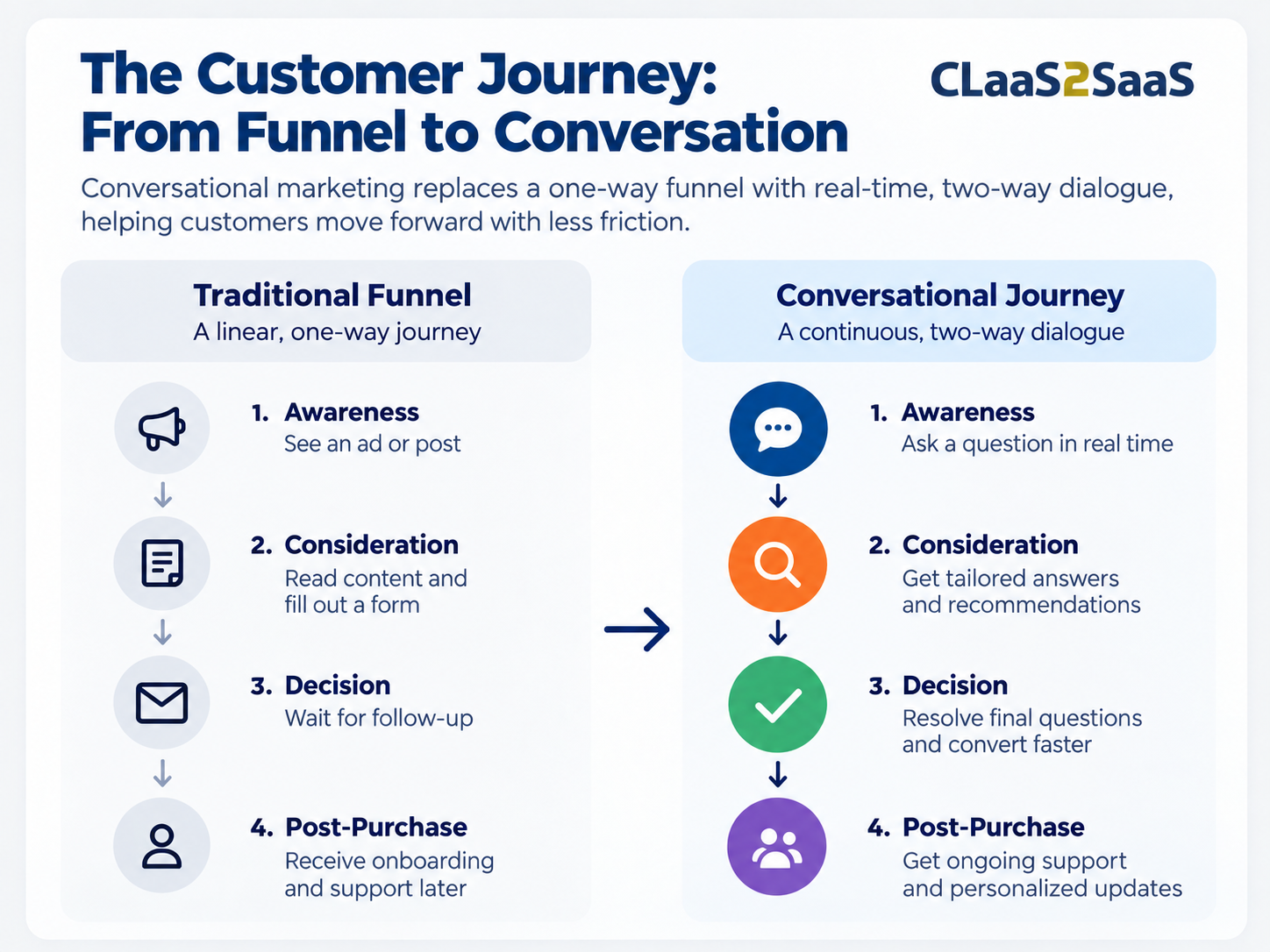
Conversational marketing does not eliminate the customer journey. Instead, it supports chat-based customer engagement by adding real-time dialogue throughout the funnel.
At the awareness stage, discovery can move directly from an ad, post, video, or search result into a question. These early interactions also reveal what prospects care about, giving marketers useful language for improving ads, landing pages, FAQs, and campaign messaging.
During consideration, conversation helps buyers find answers relevant to their specific situation. Instead of relying only on general comparison content, a prospect can ask about pricing, implementation, compatibility, or features and be directed to the most useful information or specialist.
At the decision stage, unanswered questions about price, security, implementation, or terms can delay action. Providing timely answers can help address those barriers, potentially reducing conversion delays.
In Rappi’s Reactivation segment, users who received a WhatsApp message in addition to push notifications and email showed an 80% increase in purchasers compared with a control group that received the same offers through push and email alone.
Pazza Pasta’s weekly-menu WhatsApp campaign also generated six times higher purchase rates than the same campaign delivered through email. These case studies are not universal benchmarks, but they illustrate how channel choice and timely communication can affect customer action.
The journey continues after conversion through onboarding, support, updates, education, and renewals. Connecting conversational channels with marketing, sales, and service can help customers get support without repeatedly explaining their history.
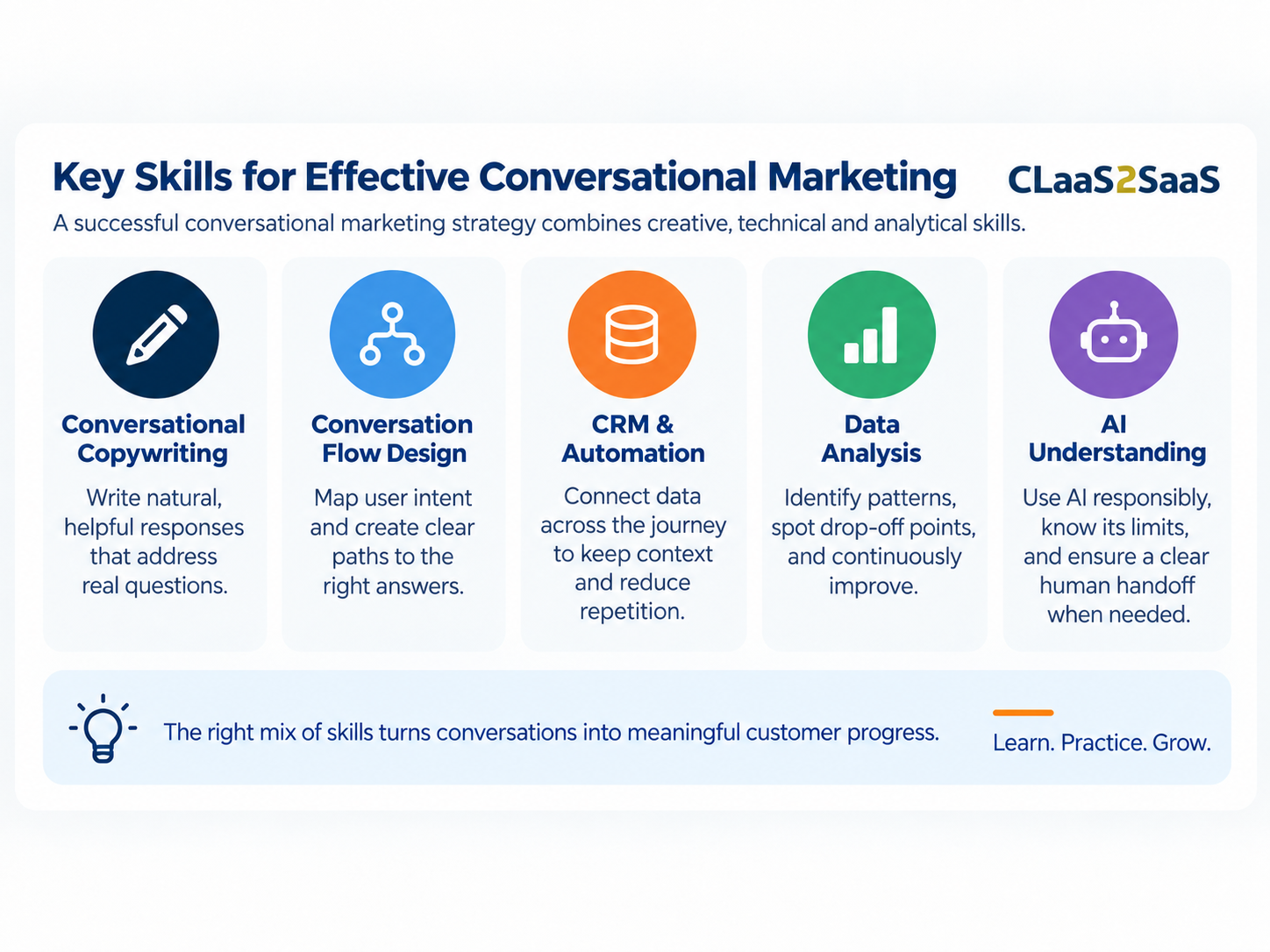
Conversational marketing combines copywriting, journey design, CRM, automation, analytics, and AI awareness. Marketers do not need to be software engineers, but they should understand how conversations are designed, connected, measured, and improved.
Key conversational marketing skills for marketers
Conversational copy should acknowledge what the customer has said and provide a useful next step. The goal is clear, natural communication rather than promotional language or forced informality.
Marketers should map common user goals, likely questions, appropriate responses, and the point at which a conversation should move to a person. Intent-based flows help customers reach relevant answers faster.
Conversational marketing should connect with CRM records, campaign data, lead stages, and previous interactions. If someone has already explained what they need in chat, later marketing or sales interactions should reflect that context.
Conversation data can show common questions, drop-off points, successful prompts, and topics requiring human support. Marketers can use these patterns to improve wording, flows, and next steps.
AI can support intent recognition, response generation, summarization, personalization, and routing, but speed should not replace judgment. Marketers also need to consider data use, transparency, unsupported questions, and human escalation.
Salesforce reports that 72% of customers consider it important to know when they are communicating with an AI agent, reinforcing the need for clear disclosure and access to human support.

What Common Mistakes Do Brands Make With Conversational Marketing?

Common conversational marketing mistakes to avoid
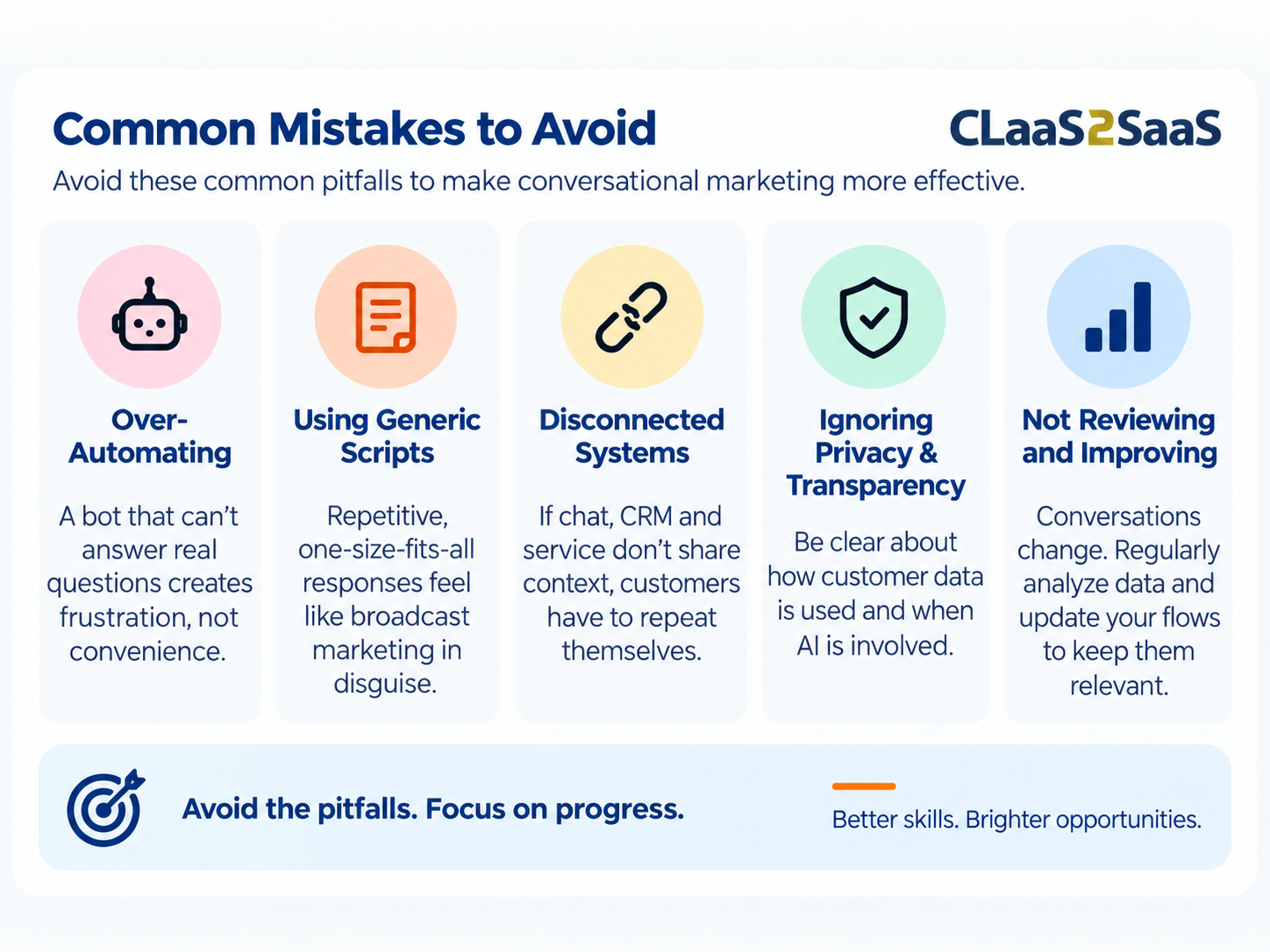
A common mistake is over-automating without a clear human handoff. If an automated system cannot understand or resolve a request, customers need a practical escalation route.
Another issue is generic scripting. When everyone receives essentially the same answer regardless of intent, chat becomes another form of broadcast communication.
Disconnected systems can also create friction. Advertising, website chat, CRM follow-up, and customer service should share relevant context where appropriate.
Marketers should also consider privacy and transparency, including what information is collected, why it is needed, and when customers are interacting with AI.
Finally, conversation flows need ongoing review. Teams should examine unanswered questions, drop-offs, escalation patterns, and conversion paths rather than treating launch as the end of the process.

Where Does This Skill Fit in a Digital Marketing Career?

Conversational marketing builds on core skills such as audience understanding, copywriting, campaign planning, analytics, CRM, and customer journey design. It can be useful across content, lifecycle marketing, performance marketing, CRM, and marketing operations.
A portfolio project could demonstrate a customer problem, conversation flow, sample copy, automation and human escalation rules, measurement approach, and improvements made after reviewing performance.
A marketer entering the field with demonstrated conversational marketing experience can show employers how copywriting, CRM, automation, analytics, and customer journey design work together in practice.
For people considering a career change, CLaaS2SaaS also provides guidance on switching careers to tech with no experience, including digital marketing as one direction for people interested in customers, communication, and campaigns.

How Can You Build Conversational Marketing Skills in Practice?

Start with one narrow customer problem instead of attempting to automate an entire customer journey. Choose a practical use case such as answering course inquiries, qualifying product interest, helping users select a service, or following up after a webinar.
List the questions customers are most likely to ask, define a successful outcome, and map the shortest, useful path to the answer. Give each exchange one clear job. Include a fallback and a route to a human for complex, sensitive, or unsupported questions.
After launch, examine the evidence. Where do users stop? Which questions were not anticipated? Which conversations require escalation? Use those patterns to improve the experience.
That broader foundation matters because conversational marketing works best when it connects with the rest of the marketing system rather than operating as a stand-alone tactic.
For marketers who want to develop these capabilities within a broader marketing skill set, the CLaaS2SaaS AI-Powered Full-Stack Marketer pathway covers digital strategy, content marketing, CRM and marketing automation, analytics, generative AI, and omni-commerce campaigns with practical project work.
Want to check if this career is for you?