Data Analytics Course SG - Tools, Salary & Course Guide
Data Analytics Course SG - Tools, Salary & Course Guide
Content
Content
Businesses today leverage data-driven insights rather than relying solely on intuition for decision-making. Companies now track customer behavior, operational performance, financial forecasting, and business growth through dashboards, business intelligence systems, and AI-enhanced analytics tools. Data analytics is becoming central to how organizations compete and grow.
That’s why data analytics has shifted from being a “technical specialization” into a core business skill. Employers are no longer looking only for data scientists. They are hiring professionals who can work with dashboards, understand reporting systems, analyze trends, and turn data into actionable insights.
Many professionals already recognize the importance of analytics, but execution remains difficult. Some learners are overwhelmed by the number of tools available. Others struggle to understand whether they should start with Tableau, Power BI, SQL, or Python. Traditional courses often focus heavily on theory without helping learners apply analytics skills to real business scenarios.
This is why modern data analytics learning requires more than textbook knowledge. Professionals need practical exposure to dashboards, reporting systems, predictive analytics, and AI-assisted workflows that reflect how businesses actually operate today.
Think of it as the fast-track pathway to making a successful data analytics career switch Singapore professionals can leverage in a market where analytics, automation, and AI are reshaping nearly every industry.
By the end of this guide, you’ll understand which analytics tools matter most,which learning pathway fits your background, and how analytics skills can support long-term career growth.
Data Analytics Tools – Tableau vs Power BI vs Python vs SQL
Choosing the right analytics tool depends on the type of business problems you want to solve. Employers rarely hire based on a single tool; they look for professionals who can combine visualization, reporting, data extraction, automation, and decision-making skills.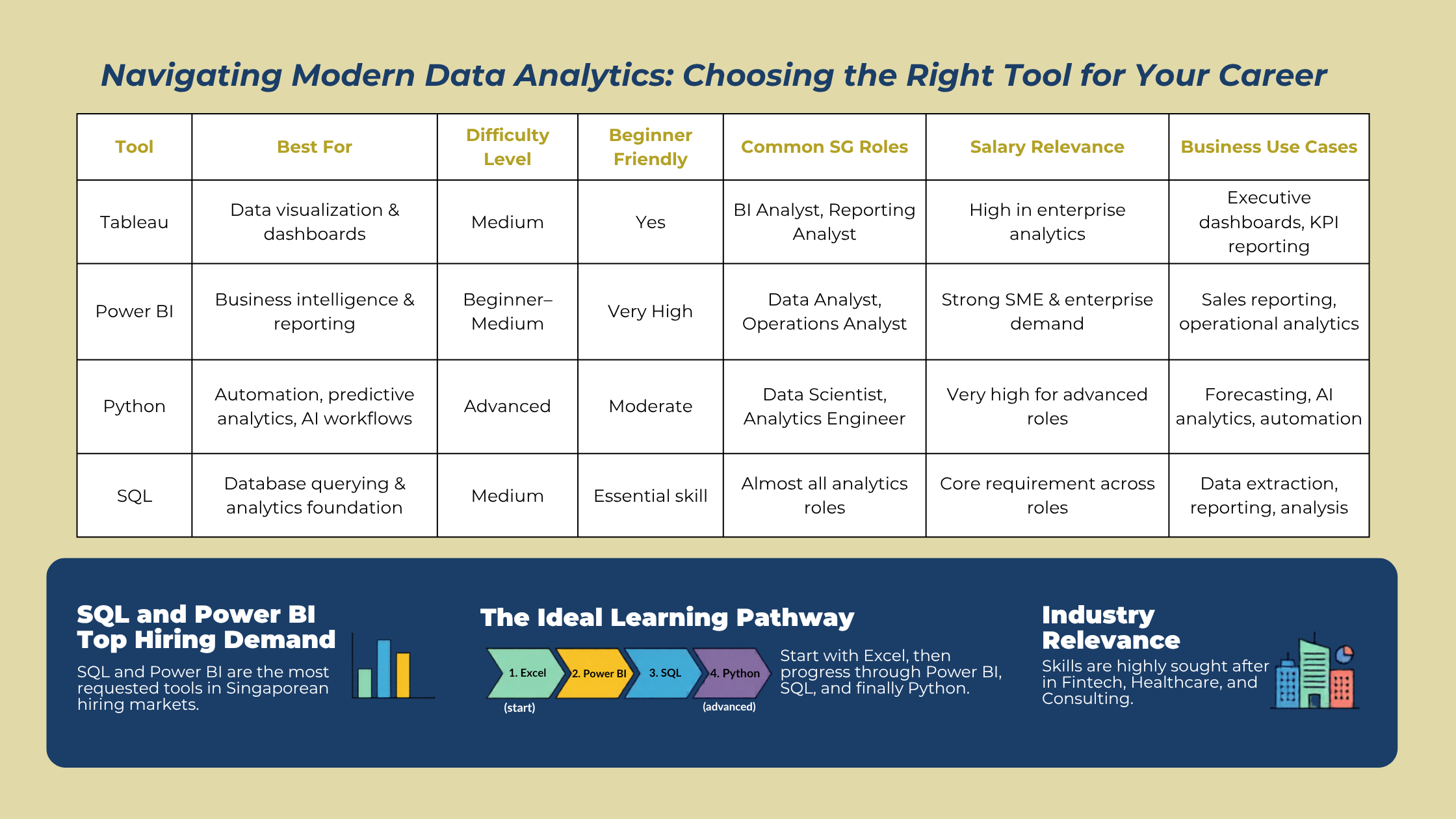
When to Use Tableau
Tableau is widely used for executive dashboards, visual storytelling, and enterprise-level data visualization. It is especially popular in larger organizations were analytics teams support management reporting and strategic business decisions.
Professionals in banking, consulting, healthcare, and multinational corporations often use
Tableau for:
- KPI dashboards
- Business performance reporting
- Customer segmentation
- Operational trend analysis
- Interactive executive reporting
Tableau is a strong starting point for learners who prefer visual analytics over coding-heavy workflows.
When to Use Power BI
Power BI is one of the most requested business intelligence tools in hiring markets because many organizations already operate within the Microsoft ecosystem.
For beginners transitioning into analytics, Power BI often provides the fastest learning curve while still delivering strong employability outcomes.
Power BI is commonly used for:
- Financial reporting
- Sales dashboards
- Inventory monitoring
- Operations reporting
- Management dashboards
- CRM analytics
When to Use Python
Leveraging Python for data analytics becomes important when analytics move beyond dashboards into automation, predictive analytics, machine learning, and AI-enhanced workflows.
Python skills are increasingly valuable in:
- Fintech
- AI product companies
- Data science teams
- Healthcare analytics
- Predictive business intelligence
- Marketing automation
Python is ideal for professionals pursuing:
- Data science
- AI analytics
- Analytics engineering
- Predictive modeling
- Advanced automation
When to Use SQL
SQL remains one of the most essential analytics skills regardless of specialization. Most employers expect analytics professionals to retrieve, clean, filter, and analyze data directly from databases, making an industry-aligned sql data analytics course a necessary foundational step.
SQL is heavily used for:
- Database querying
- Reporting pipelines
- Dashboard integration
- Customer analytics
- Financial analytics
- Operational reporting
Why Knowing One Tool Alone Is No Longer Enough
Modern analytics roles are no longer about mastering a single platform. Employers increasingly look for professionals who can combine dashboards, reporting, SQL querying, automation, and business interpretation into actionable decision-making workflows.
Knowing Tableau without understanding data structure limits reporting depth. Learning Python without business context reduces strategic impact. Even strong dashboard skills become less valuable if professionals cannot translate insights into operational recommendations.
What businesses actually need are professionals who can:
- Connect data across systems
- Interpret trends accurately
- Support faster decision-making
- Build actionable business insights
- Combine analytics with AI-assisted workflows
- Communicate findings clearly to stakeholders
Ready to become a job-ready data analyst? Download the PDF guide
Singapore Data Analytics Salary Benchmarks
Singapore salaries for analytics professionals vary based on technical depth, industry, business domain expertise, and project experience.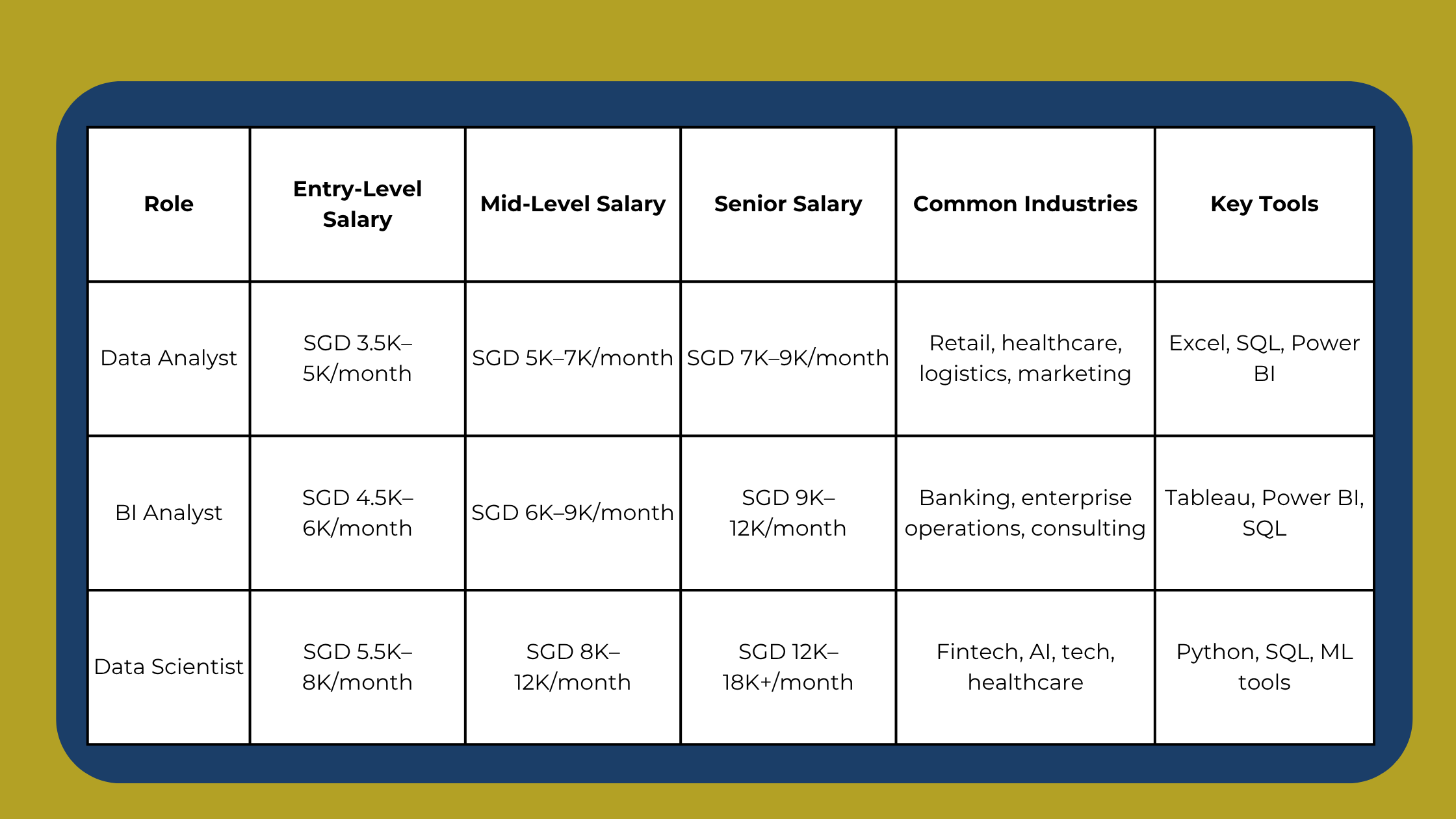
*Salary benchmarks reflect general market observations and should not be interpreted as guaranteed employment or compensation outcomes
Data Analyst Career Progression
Most professionals entering analytics through programs begin as:
- Reporting Analysts
- Operations Analysts
- Junior Data Analysts
- Business Support Analysts<
As technical skills improve, many progress toward:
- BI Analyst
- Senior Analyst
- Analytics Specialist
- Data Product Analyst
BI Analyst Career Progression
BI analysts focus heavily on dashboards, business intelligence systems, stakeholder reporting, and executive analytics.
Employers particularly value professionals who can bridge business operations and technical reporting.
Strong communication and creative data visualization skills have become increasingly important at this stage to transform complex data into clear, executive-friendly narratives.
Data Scientist Career Progression
Data scientists work more deeply with:
- Predictive analytics
- Statistical analysis
- Machine learning
- AI-driven forecasting
- Automation models
These roles generally require stronger Python proficiency, data modeling capability, and business problem-solving experience.
Professionals moving toward data science often start from analyst or BI backgrounds before specializing further.
Beginner vs Advanced Data Analytics Pathways
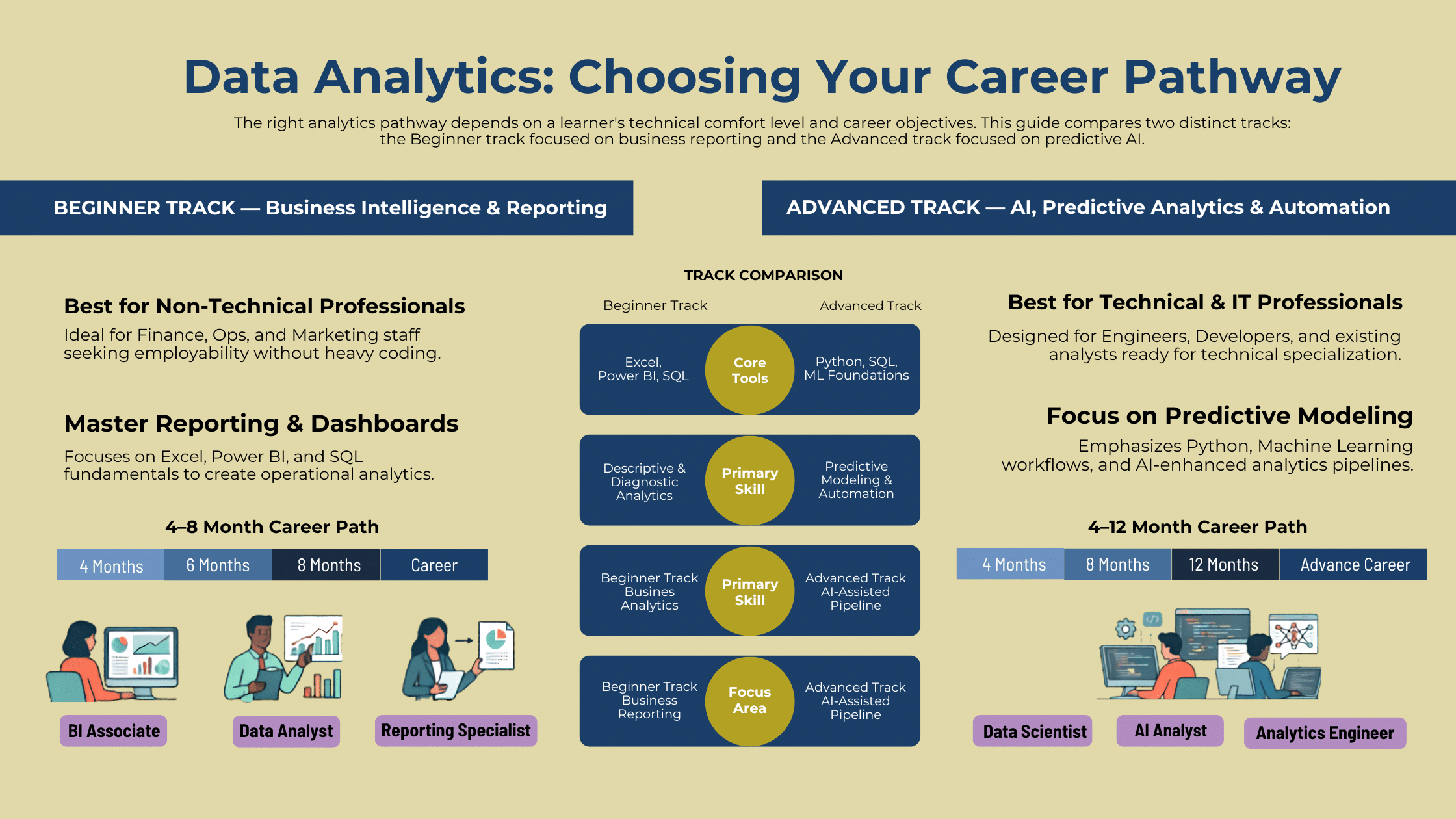
Not every learner should follow the same analytics pathway. Some professionals want to build reporting and dashboard skills quickly, while others aim to specialize in predictive analytics, AI, and automation. The right pathway depends on your technical background, career goals, and preferred learning pace.
Beginner Track – Business Intelligence & Reporting
Ideal for professionals transitioning into analytics through practical reporting and dashboard skills.
- Power BI & Excel analytics
- SQL fundamentals
- KPI dashboards & reporting
- Applied data visualisation techniques
- Career paths: Data Analyst, BI Associate, Reporting Specialist
Advanced Track – AI, Predictive Analytics & Automation
Designed for technical professionals pursuing deeper specialization in AI-driven analytics and automation.
- Python & advanced SQL
- Predictive analytics
- Machine learning workflows
- AI-assisted analytics
- Career paths: Data Scientist, AI Analyst, Analytics Engineer
Both pathways focus on more than learning individual tools. Modern employers value professionals who can turn business data into faster, smarter, and more actionable decisions.
Still wondering if this path fits you? Consult with our experts
Why CLaaS2SaaS Learning Works Better for Analytics
Traditional analytics learning often focuses heavily on theory, technical terminology, and isolated exercises that do not fully reflect how analytics operates inside real organizations.
CLaaS2SaaS takes a different approach through competency-based, work-integrated learning designed around practical execution and industry relevance. Instead of passively studying analytics concepts, learners apply analytics capability directly to operational business scenarios using dashboards, reporting systems, SQL environments, and AI-enhanced analytics workflows.
The learning model combines adaptive CLaaS learning methodologies with SaaS-driven execution capability, helping professionals build measurable, workplace-ready skills aligned with evolving digital workforce needs.
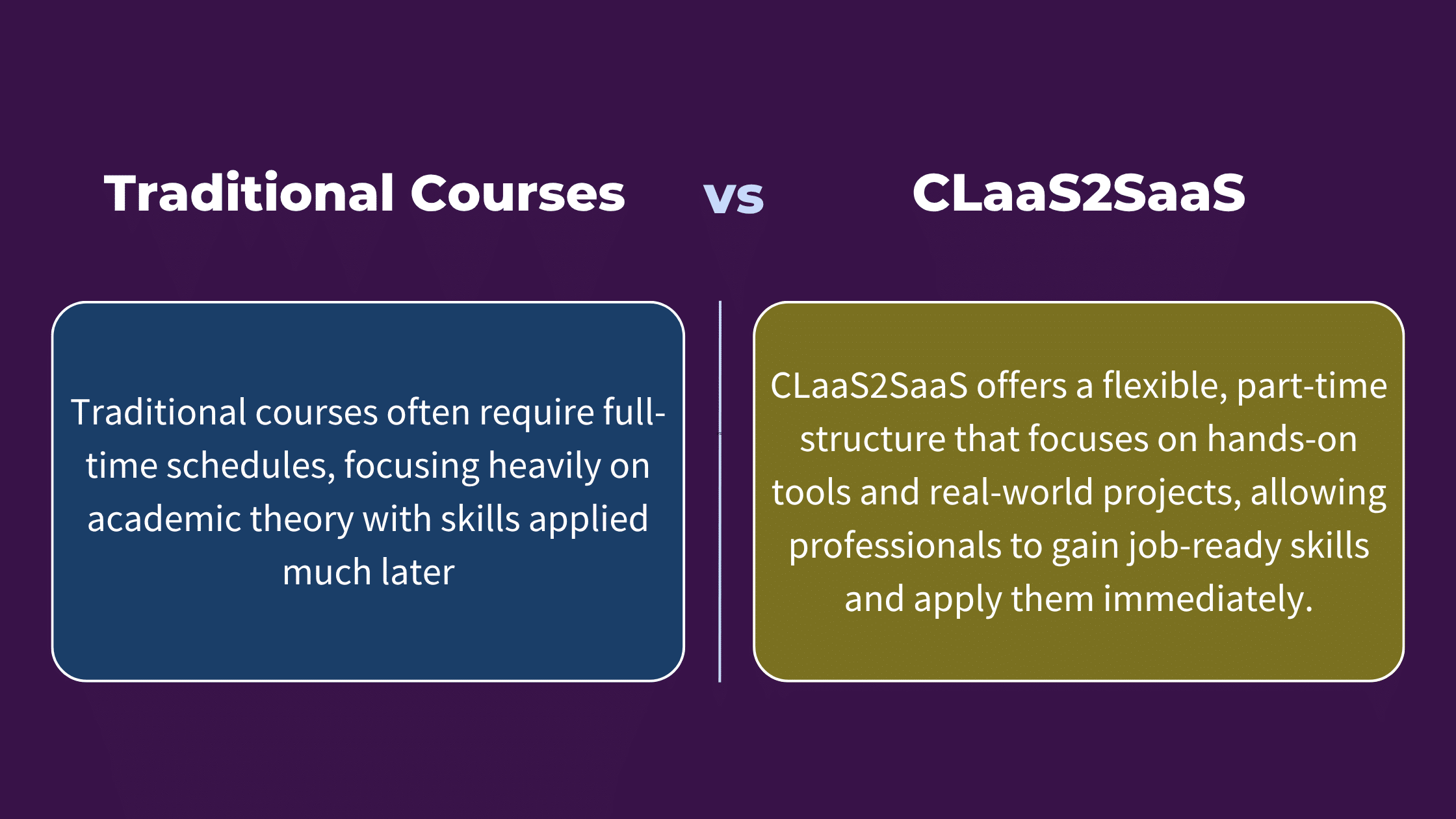
The learning model emphasizes:
- Competency-Based Learning: Apply analytics skills directly to business scenarios and operational workflows.
- Work-Integrated Projects: Build employer-evaluable portfolios using realistic data sets and live reporting environments
- AI-Enabled Learning: Learn how modern analytics increasingly integrates AI-assisted systems and automation.
- Stackable Pathways
Flexible progression pathways allow learners to advance from foundational analytics capability toward advanced AI, automation, and predictive analytics specialization.- Professional Certificate (4 months Part-time)
- Diploma / PG Diploma (5–8 months Part-time)
- Master’s Top-Up (6–12 months Part-time)
- Industry-Relevant Execution: Focus on dashboards, reporting, and actionable business insights rather than theory-heavy instruction.
By the end of the program, learners are not simply “certified.” They are able to demonstrate how they apply analytics tools to business problems, operational reporting, and data-driven decision-making.
Still wondering if this path fits you? Consult with our experts
Frequently Asked Questions
Which data analytics tool should beginners learn first?
For most beginners, Power BI and SQL are strong starting points because they balance employability, usability, and practical business applications.
Is Python necessary for data analytics?
Not always. For dashboard-focused and reporting-focused roles, Power BI, Tableau, Excel, and SQL may be sufficient. Python becomes more important for predictive analytics, automation, machine learning, and advanced analytics roles.
How long does it take to become job-ready in analytics?
Many learners can build practical foundational analytics skills within 4–6 months part-time when focused on business intelligence, reporting, and dashboards. Advanced data science pathways generally take longer.
Are data analytics jobs still in demand in Singapore?
Yes. Demand remains strong across banking, healthcare, logistics, retail, consulting, and digital services as organizations continue investing in AI, automation, and business intelligence capabilities.
Can non-technical professionals transition into analytics?
Yes. Many successful transitions come from finance, operations, admin, customer service, and marketing backgrounds.
Business understanding combined with analytics tools creates strong employability value.
Data Analytics Is No Longer Optional
Businesses are becoming increasingly data driven as AI, automation, and digital transformation reshape how organizations operate. Companies no longer need teams that simply generate reports; they need professionals who can interpret trends, build dashboards, support operational decisions, and turn data into measurable business outcomes.
This shift is redefining hiring expectations across industries. Professionals with skills in Power BI, Tableau, SQL, and Python are becoming more valuable because they can combine analytics capability with practical business understanding to support both operational execution and strategic growth.
But modern analytics is no longer just about learning individual tools. Employers increasingly look for professionals who can transform data into faster, smarter, and more actionable decisions using business intelligence, predictive analytics, and AI-assisted workflows.
As AI continues reshaping business environments, professionals who understand both analytics and automation-driven systems will become even more important.
Why Act Now
Organizations are accelerating investments in AI, business intelligence, automation, and predictive analytics to stay competitive in the digital economy.
The sooner professionals build analytics capability, the sooner they can:
- Develop future-ready digital skills
- Improve long-term employability
- Transition into higher-value digital roles
- Support AI-driven business environments
- Build practical analytics portfolios
- Position themselves for digital transformation opportunities
Your Next Step
If you are ready to move beyond fragmented learning and start building practical analytics capability, now is the time to act.
The CLaaS2SaaS Data Analytics pathway helps professionals develop hands-on experience with dashboards, business intelligence tools, reporting systems, predictive analytics, and AI-enhanced workflows aligned with real industry demand.
Whether your goal is becoming a Data Analyst, BI Analyst, Reporting Specialist, or advancing toward AI-driven analytics roles, the right pathway starts with practical implementation; not theory alone.
Share


Want to check if this career is for you?