Full-Stack Digital Marketing for Creative Professionals
Content
Content
Creative roles are evolving rapidly across Singapore and the wider ASEAN region. Today, employers are no longer just looking for someone who can design visuals or edit videos. They are looking for full-stack digital marketers who can create content and understand how that content performs within a larger, automated, data-driven marketing system. Whether you want to work in branding, content creation, social media marketing, or digital design, success often comes from having a broader creative skill set rather than relying on a single tool.
At CLaaS2SaaS, our vision is that creative and design learning should be built around practical outcomes. The focus should not only be on learning software, but on building a portfolio that shows what you can do in a professional setting. That means creating visual assets, editing social media video, planning content with a clear purpose, and learning how creative work supports marketing strategy, brand awareness, and audience engagement.
In markets like Singapore, Indonesia, Malaysia, and Vietnam, businesses are increasingly investing in omnichannel marketing, CRM systems, and AI-powered tools to engage customers across multiple touchpoints. This shift means that creative work is no longer standalone. It must connect directly to campaign performance, customer journeys, and business outcomes.
For professionals looking to upskill and for career changers moving into design and digital content creation, this matters. A strong portfolio can help you stand out when applying for jobs, freelance projects, internships, or internal growth opportunities. It gives employers and clients a clearer picture of your capabilities than tool knowledge alone.
Why Creative Skills Alone Are No Longer Enough in Modern Marketing
Traditionally, creative roles focused on producing visuals or videos. Today, that is only one part of the job.
Modern marketing teams expect creatives to understand:
- How content fits into the marketing funnel
- How campaigns are executed across multiple channels
- How automation tools deliver content at scale
- How performance data informs future decisions
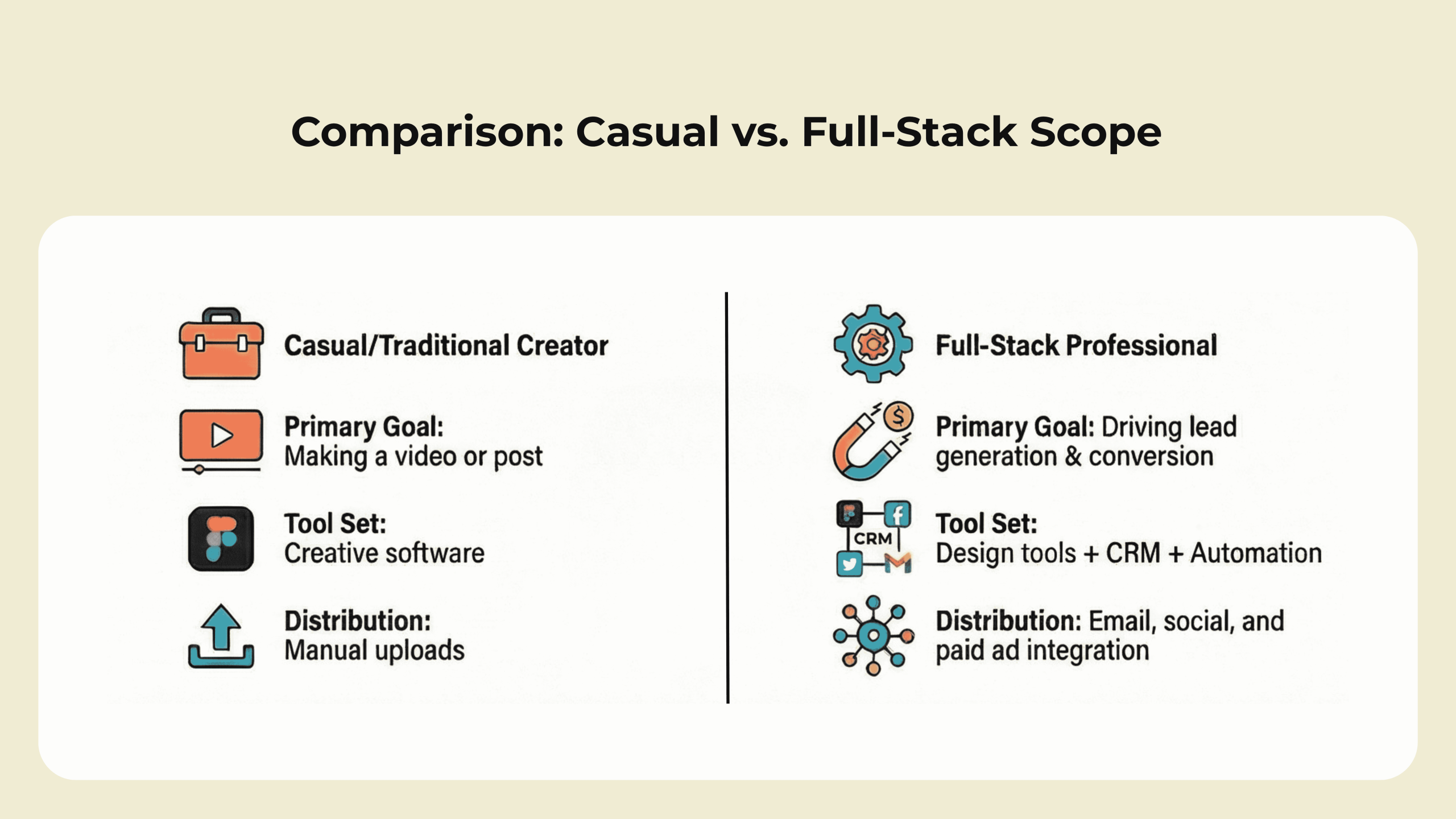
For example, creating a video is no longer just about editing. It involves understanding how that video will be distributed across email, social media, paid ads, and landing pages, and how it contributes to a social media campaign. Every asset you create must align with the broader marketing goals to ensure the brand’s message is consistent.
This is why the demand for full-stack digital marketing skills is growing across ASEAN.
Personal vs Professional Creative Work in Digital Marketing
There is a difference between using creative tools casually and using them in a professional environment. Personal use may involve making a quick social post or editing a simple clip for fun. Professional use requires a stronger understanding of audience needs, content goals, branding, file preparation, collaboration, revisions, and delivery standards.
A professional creative workflow also involves thinking about how visuals and videos perform. It means understanding how to produce high-quality output that supports a campaign, speaks to potential customers, and aligns with brand objectives. This is especially important for people working on social media advertising, digital campaigns, and enterprise creative needs.
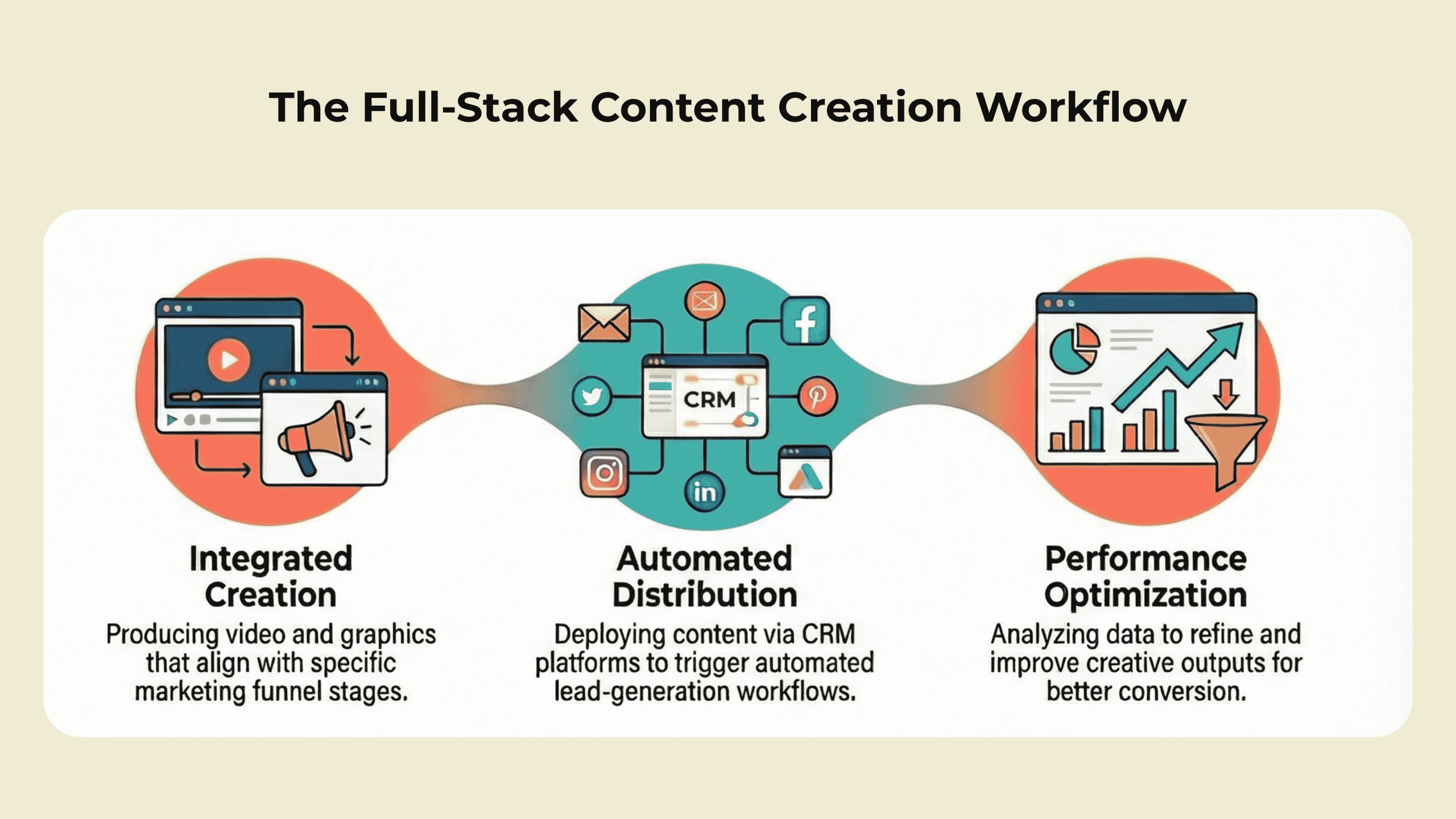
A modern creative professional is expected to:
- Create video, graphics, and digital content
- Understand where that content fits in the marketing funnel
- Use CRM platforms and automation tools to deploy campaigns
- Analyze performance data and optimize outputs
This is what it means to be full-stack in marketing.
It is no longer about just making a video. It is about:
- How that video is distributed across email, social, and paid ads
- How it triggers automated workflows in CRM systems
- How it contributes to lead generation and conversion
Who Should Learn Digital Marketing and Content Automation Skills
This pathway is suitable for:
- Professionals who want to strengthen their skills in digital content, campaign execution, and marketing technology
- Career changers exploring opportunities in digital marketing, content, media, and brand communications
- Marketing executives who want to create content that supports CRM-driven, automated, omnichannel campaigns
- Freelancers who want to offer content, creative, and AI-enabled marketing services to clients
- Teams that want stronger in-house capabilities in content production, campaign execution, and audience engagement
No prior design experience is required. What matters most is a willingness to learn, apply creative skills in a marketing context, and build work that supports real business and campaign goals.
What It Means to Be a Full-Stack Digital Marketer Today
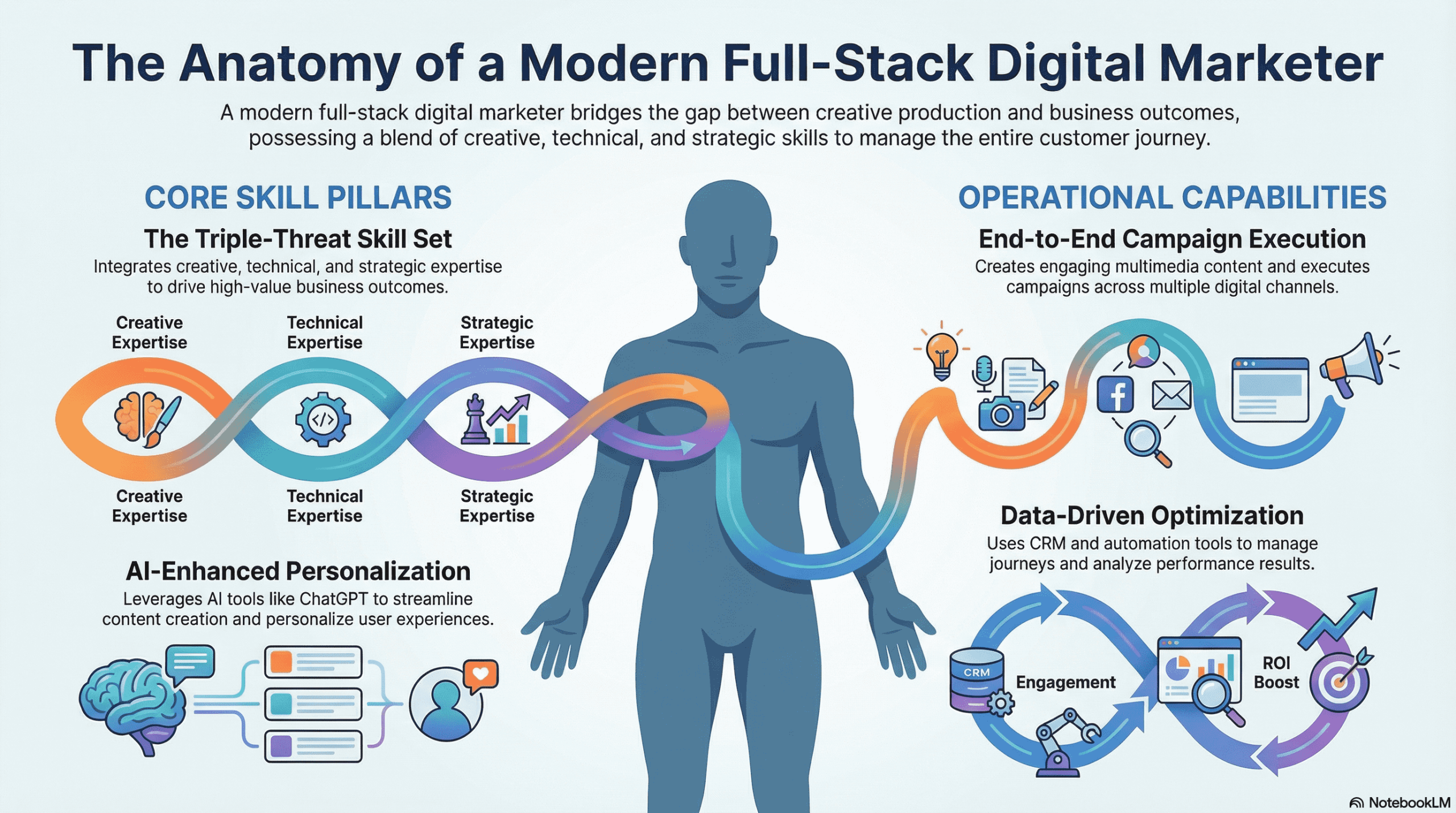
A full-stack digital marketer combines creative, technical, and strategic skills.
They are able to:
- Create engaging multimedia content
- Execute campaigns across multiple channels
- Use CRM and automation tools to manage customer journeys
- Apply AI tools such as ChatGPT for content creation and personalization
- Analyse campaign performance and optimise results
This role bridges the gap between creative production and business outcomes, making it highly valuable in today’s digital economy.
Why Full-Stack Marketers Are in Demand
Employers increasingly prefer professionals who can:
- Execute end-to-end campaigns
- Work across content, data, and technology
- Use AI tools like ChatGPT for content generation
- Manage agile marketing workflows
This is especially important in fast-growing ASEAN economies, where companies need lean teams capable of doing more with less.
How Creative Tools Fit into Modern Marketing Systems
A strong creative career is not built around one platform alone. In real workplaces, creative professionals are often expected to move between design, video, content, and collaboration tools depending on the brief, target audience, and delivery channel. That is why broader creative training gives you an advantage. Instead of learning one tool in isolation, you learn how different tools support different stages of the creative process, from concept development and visual branding to video editing and interface design.
Social Media Video and Content Production Tools
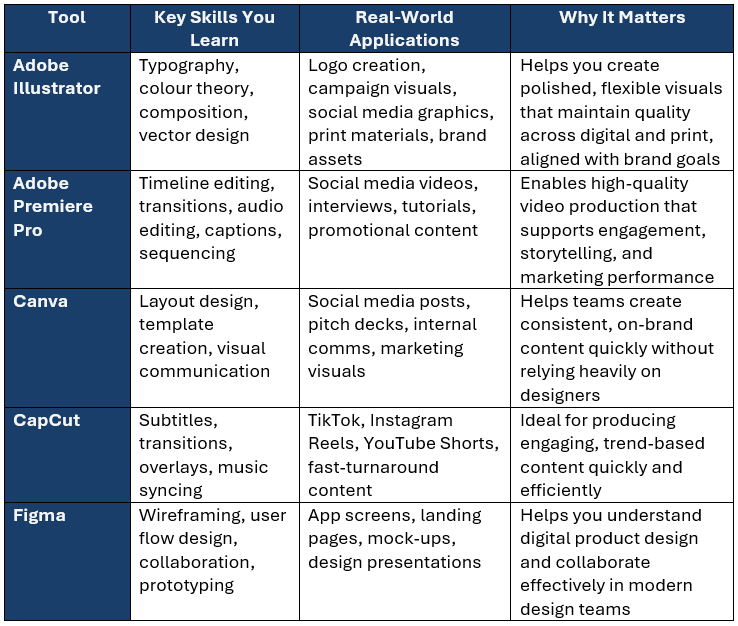
Adobe Illustrator
Adobe Illustrator is one of the most important tools for graphic design because it is built for creating scalable visual assets. This includes logos, icons, social media graphics, poster layouts, illustrations, packaging concepts, and other brand materials that need to stay sharp across digital and print formats.
For learners aiming for roles in graphic design, marketing design, or branding, Illustrator helps build the foundation for professional visual communication. It also teaches precision in typography, colour, composition, and vector graphics.
In a work setting, Illustrator is often used to:
- create logo and identity systems
- design campaign visuals for digital ads and social media advertising
- prepare artwork for presentations, events, or print
- build reusable visual assets for brand consistency
This matters because employers are not only looking for attractive visuals. They are looking for people who can create assets that are flexible, polished, and aligned to brand goals. Adobe Illustrator is also highly relevant for learners searching for graphic design tools, branding software, and design support for social media video production.
Adobe Premiere Pro
Adobe Premiere Pro is widely used in professional video production and post production workflows. It allows learners to work with timelines, transitions, sound, captions, sequencing, and export settings in a more advanced and controlled way than basic editing apps.
For anyone interested in social media video production, content marketing, media roles, or creative agency work, Premiere Pro is highly valuable because it supports everything from short campaign edits to longer-form storytelling. It is especially useful when a video project needs a more polished finish, better pacing, or multi-layer editing.
In practical career terms, Premiere Pro helps learners:
- edit branded content for social media platforms
- produce interview clips, tutorials, explainers, and promotional videos
- manage post production tasks such as audio cleanup, subtitles, and pacing
- create videos that perform better by matching format and style to audience behaviour
This is important because video marketers today are expected to think beyond editing. They need to understand how video content supports brand awareness, engagement, and conversion. dobe Premiere Pro is one of the most valuable tools for learners building skills in video editing, content marketing, and social media video production.
Canva
Canva is often underestimated because it is easy to use, but in professional environments it plays a major role in content creation. It is especially useful for creating social media posts, pitch decks, internal communications, digital posters, branded templates, and campaign visuals quickly.
For marketing teams, business owners, and junior content creators, Canva helps bridge the gap between idea and execution. It allows teams to move fast while still maintaining visual consistency, which is critical when producing content regularly across multiple social media platforms.
In the workplace, Canva is often used to:
- create on-brand social content for ongoing campaigns
- build templates that teams can reuse efficiently
- support social media marketing and communication tasks
- produce quick-turn materials without relying on a full design team for every asset
The value of Canva in a course setting is not just speed. It is learning how to create clear, effective visuals that suit different audiences and business needs. This also makes Canva highly relevant for fast-moving content teams working on social media video production and digital marketing campaigns.
CapCut
CapCut has become one of the most relevant tools for creators and marketers working in short-form video. It is especially useful for editing content for TikTok, Instagram Reels, YouTube Shorts, and other formats where pace, subtitles, and mobile viewing matter. This makes it especially valuable for social media video production where speed, consistency, and trend awareness are essential.
For learners interested in content creation, social media marketing, or freelance video services, CapCut is practical because it enables fast editing workflows without losing creative flexibility. It is often used to create videos that feel current, platform-appropriate, and engaging.
CapCut is useful for:
- editing short-form social media video quickly
- adding subtitles, transitions, overlays, and music
- adapting content to suit platform trends and audience expectations
- producing content for campaigns that need speed and frequent updates
This makes it highly relevant for teams and individuals who want to create videos consistently, test creative ideas faster, and respond quickly to trends without waiting for a full production cycle.
Figma
Figma is most closely associated with UI and UX design, but it is also extremely useful as a broader visual communication and layout tool. It helps learners think in terms of user flow, screen design, structure, and collaborative feedback, all of which are increasingly relevant in digital creative roles.
For those considering digital product design, content design, or a future in UI/UX design, Figma provides a clear introduction to how interfaces are planned and presented. It is also valuable for creative professionals who need to mock up landing pages, app screens, simple wireframes, or campaign layouts before development begins.
In practical use, Figma helps learners:
- create wireframes and interface concepts
- present design ideas clearly to stakeholders or teammates
- collaborate on feedback in real time
- understand how visual design works inside digital products and services
This matters because creative work today often overlaps with digital experience design. Even if your goal is not to become a full-time UI designer, understanding Figma gives you an advantage in digital teams.
Why Learning Multiple Creative Tools Improves Career Outcomes
Professionals today are rarely hired to do just one thing. A marketing executive may need to create content for campaigns, adapt assets across channels, and support CRM-driven automation. A career changer entering digital marketing may need a broader skill set that covers content, media, and brand communications. Freelancers and in-house teams also benefit from being able to manage content production more efficiently while supporting audience engagement and campaign goals.
That is why learning multiple tools creates stronger outcomes than focusing on just one. When you understand tools such as Adobe Illustrator, Premiere Pro, Canva, CapCut, and Figma together, you are not only learning how to produce creative assets. You are learning how to create content for different formats, support omnichannel campaigns, and work more effectively within modern marketing environments.
The result is a more practical portfolio, stronger confidence with professional tools, and better readiness for roles in digital marketing, content creation, campaign execution, and AI-enabled marketing services.
Building These Skills Through Digital Marketing Education
At CLaaS2SaaS, the focus is not on standalone creative courses, but on developing full-stack, AI-driven marketing professionals. This is supported through a stackable credentials model, allowing learners to build practical, industry-relevant skills progressively while working towards a larger qualification.
The Master’s in Digital Marketing is designed to reflect how marketing works today by combining academic depth with stackable credentials that recognise skills development at each stage of learning.
What You’ll Learn
- Digital marketing and content strategy
- Marketing automation and CRM applications
- Omnichannel campaign execution
- Generative AI for content creation
- Agile project management
- Data-driven campaign optimization
What Makes It Different
- Hands-on projects using real-world tools and workflows
- Focus on automation, AI, and CRM-driven marketing
- Integration of creative production with business strategy
- Flexible stackable credentials that help learners demonstrate job-ready skills before completing the full programme
Learners do not just create content. They learn how to:
- Deploy it across automated systems
- Track performance metrics
- Optimize campaigns for business growth
- Build recognised stackable credentials that strengthen their professional profile and support career progression in digital marketing
Schedule and Intake
Flexible learning matters for working adults and career changers. Depending on course availability, intakes may be offered in formats that support busy schedules and progressive learning. This is especially useful for professionals who want to upskill without stepping away from work completely.
For learners who want to combine creative capabilities with wider digital career development, related pathways can also be explored through Software & Web Development.
SkillsFuture Funding
For many learners in Singapore, cost is an important factor when choosing a course. Eligible programmes may qualify for SkillsFuture funding support, helping reduce upfront costs and making creative and digital upskilling more accessible.
This adds value for individuals and teams looking to build practical skills in graphic design, social media video, digital content, and media production.
What our Learners have to say
Creative training becomes more convincing when learners can point to real outcomes. This could include:
- stronger confidence using industry tools
- portfolio work that demonstrates practical ability
- successful career changes into content or design roles
- improved creative capabilities within a business team
The most powerful stories are often the most practical ones. As Andre Lee, a Professional Diploma in Digital Marketing learner, shared: “I was a traditional sales & marketing manager and the trainers are very helpful. I can now gather more than 700 likes for my company Facebook posts and lead to an increase in sales.”
Another learner, Jason Mah, highlighted a different but equally important outcome: “I choose to enrol in Lithan because of their job placement assistance. The learning experience is pretty good and mentors are very knowledgeable in their field.”
If you want to see how others have applied these skills in real-world scenarios, you can explore detailed learner experiences and outcomes.
Creative Career Paths After This Course
A modern digital marketer is no longer defined by a single skill.
They are someone who can:
- Create engaging multimedia content
- Launch automated campaigns across channels
- Build AI-powered conversational experiences
- Align marketing efforts with business objectives and revenue growth
This shift is happening across Singapore and ASEAN, and those who adapt early will have a significant advantage.
With these capabilities, career progression becomes clearer:
- Digital Marketing Executive
- Marketing Automation Specialist
- Digital Marketing Manager
- Head of Digital or Marketing Director
These roles increasingly require a combination of creative execution, technical marketing tools, and strategic thinking. Employers increasingly value people who can contribute across formats, whether that means producing social media video, building campaign visuals, shaping content for different audiences, or supporting digital product teams.
Ready to take the next step?
You can also explore the wider CLaaS2SaaS learning ecosystem to see how creative and digital training can support longer-term career growth.
Ready to future-proof your creative career?
Learn how to combine design, video, and AI-powered marketing into one powerful skill set with CLaaS2SaaS.