What Is Agentic ERP? How AI Agents Are Reshaping Enterprise Operations
What Is Agentic ERP? How AI Agents Are Reshaping Enterprise Operations

Content
Content
What actually is agentic ERP, and is it more than a buzzword? It’s where AI agents move beyond recommendations and take routine ERP actions within business-defined guardrails. This guide explains the sense-decide-act loop, the difference from traditional ERP and RPA, and how the model applies to Epicor ERP.
What Does “Agentic ERP” Actually Mean?
At its core, agentic ERP means an ERP system delegates a slice of its decision-making — not just its data-crunching — to AI agents that can act within limits you define.
Traditional ERP software is a system of record: it stores your data and enforces your workflows, but a person has to trigger almost every action — approving an invoice, releasing a purchase order, adjusting a schedule. Even “AI-powered ERP” typically means the system gets smarter at making recommendations: better forecasts, sharper anomaly flags, more useful dashboards. A human still decides.
This model moves one step further. Instead of surfacing a recommendation and waiting, an AI agent evaluates the situation against rules and thresholds your team has set, then executes the routine part of the decision itself — matching an invoice, releasing a reorder, reassigning a task — while escalating anything unusual, high-value, or ambiguous to a person.
That’s the practical difference between “AI-powered” and “agentic”: AI-powered ERP recommends; the agentic model acts, within guardrails you control.
It’s worth being precise about the word “agent” here, because it gets confused with two other things. It’s not a human sales or support agent, and it’s not the generic “software agent” label used loosely in enterprise IT for years. In this context, an agent is an AI system capable of perceiving data, reasoning about it against a goal, and taking action.
For an operations, finance, or IT leader evaluating this, the more useful question isn’t whether AI agents inside ERP are real or hype — narrow, well-defined agentic capability is already shipping in some ERP platforms today, even if adoption is still uneven across the market. The question that matters is which of your ERP-driven decisions are routine and rule-bound enough to hand to an agent, and which still need a person. Agentic capability is the layer that lets your team draw that line deliberately, task by task.
How AI Agents Work Inside an ERP System
Regardless of platform, agentic capability inside an ERP system generally follows the same three-step loop: sense, decide, act.
Sensing: pulling live data across finance, operations, and supply chain
An agent’s first job is awareness: a current, accurate view of what’s happening — outstanding invoices, inventory levels, order backlogs, workforce schedules, production throughput — pulled directly from the ERP’s own data, not a stale export or a spreadsheet someone updates weekly. The model struggles on top of fragmented or poorly integrated systems, because an agent can only act on what it can actually see.
Deciding: evaluating options against business rules and thresholds
Once an agent has current data, it evaluates the situation against rules your business has already set — approval thresholds, exception criteria, prioritization logic, compliance constraints. This is what makes the approach fundamentally different from a chatbot or a generic AI assistant bolted onto a dashboard: the agent isn’t guessing at what you’d want, it’s applying explicit boundaries your finance, operations, or IT team defined in advance. Get the rules wrong, and the agent will confidently do the wrong thing at scale — which is why this stage deserves real design attention, not a rushed default configuration.
Acting: executing routine tasks and escalating exceptions to a human
Finally, the agent executes: releasing a routine purchase order, matching an invoice to a receipt, reassigning a task when a resource frees up, adjusting a schedule within pre-approved limits. Anything outside the defined rules — an unusual amount, a new vendor, a flagged discrepancy — gets escalated to a person instead of pushed through automatically. The goal isn’t to replace judgment; it’s to absorb the high-volume, low-ambiguity decisions so people spend their time where it actually matters.
This loop is exactly where legacy ERP limitations and day-to-day operational inefficiencies tend to live. A lot of the friction inside finance, operations, and manufacturing teams isn’t caused by a lack of data — it’s caused by the gap between data existing somewhere in the system and a person having enough time to act on it consistently. Closing that gap safely is what autonomous action within guardrails is for.
Agentic ERP vs. Traditional ERP vs. RPA — What’s Actually Different
“Agentic,” “automated,” and “AI-powered” get used almost interchangeably in ERP marketing, which makes it genuinely hard to tell what you’re evaluating. Here’s the distinction that matters in practice.
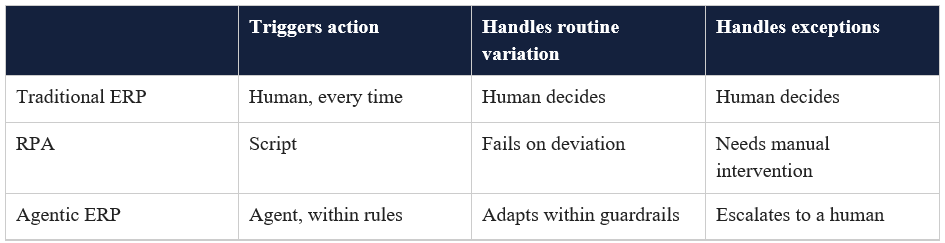
Traditional ERP is a system of record. It stores data and enforces process, but a human triggers essentially every action — approving, releasing, adjusting.
RPA, or robotic process automation, automates a fixed, scripted sequence of steps — genuinely useful for repetitive, high-volume, low-variation tasks. It’s brittle when a process deviates from the script: RPA doesn’t reason about a situation, it replays a recorded set of steps, and when reality doesn’t match what was scripted, it typically stalls, errors out, or needs a person to step in, rather than adapting on its own.
Agentic capability is goal-driven rather than script-driven. It evaluates the current situation against a goal and a set of constraints, adapts to variation within those constraints, and only breaks out to a human when it hits a genuine exception. The difference shows up most clearly in how each one handles the unexpected: traditional ERP waits for a human to notice, RPA needs a person to step in once it hits something outside its script, and the agentic model recognises the exception on its own and routes it to a person automatically.
None of this means traditional ERP or RPA are obsolete — plenty of processes are genuinely fine as fixed scripts, and plenty of decisions genuinely need a human in the loop from the start. The point isn’t to remove humans from operations; it’s to be selective about where a human’s attention actually adds value, and hand the rest to an agent operating inside boundaries your team defines.
If you’re earlier in this shift and want the broader picture of how AI is moving through ERP generally — not just the agentic end of the spectrum — our companion piece, “AI in ERP: From Automation to Autonomous Operations,” walks through that progression in more depth.
What Agentic ERP Looks Like in Practice — and How to Get Started
None of this has to mean ripping out your existing ERP investment. CLaaS2SaaS’s approach to agentic capability is built on Epicor ERP, with Agentic HR as a companion product inside the same Enterprise ERP line — the goal is to layer AI-enabled capability onto a platform you’re already running, focused on modernizing finance, operations, and manufacturing where legacy ERP limitations and operational inefficiencies tend to bite hardest.
In practice, that means starting narrow. Rather than making every decision agentic on day one, a more realistic path is to identify a small number of routine, rule-bound tasks — the kind that already follow a clear approval threshold or known exception pattern — and let an agent take those over first, with a person reviewing outcomes closely early on. As confidence builds, the scope can expand, task by task, rather than all at once.
That’s a different rollout model from a big-bang ERP replacement: you’re extending the system you already have, one well-understood decision at a time.
Before committing to a path, it’s worth asking a few practical questions. Which of your current approval or exception workflows are genuinely rule-bound, versus quietly dependent on someone’s judgment call? Where does your data live cleanly enough for an agent to act on with confidence? Who reviews agent decisions early on, and what does escalation actually look like day to day? Those questions matter more than which vendor markets the word “agentic” most convincingly.
If you’re weighing whether this approach makes sense for your operations, that’s exactly the conversation a 1:1 consultation is for.
Frequently Asked Questions
What is agentic ERP in simple terms?
Agentic ERP describes an enterprise resource planning system in which AI agents don’t just recommend actions — they take them. Instead of a person approving every step, agents monitor data across finance, operations, and supply chain, then execute routine decisions within rules the business sets, escalating only exceptions to people.
How is agentic ERP different from “AI-powered ERP”?
“AI-powered ERP” usually means the system gets smarter at recommending — better forecasts, sharper anomaly detection, more useful dashboards — but a person still makes the call. The agentic model goes a step further: the system can act on routine decisions itself, within guardrails your team defines, rather than only recommending. It’s a spectrum, not a strict binary, and organizations tend to move along it gradually rather than switching overnight.
Does agentic ERP replace human decision-making?
No. Humans set the rules, thresholds, and exception criteria the agent operates inside, and anything unusual, high-value, or ambiguous still gets escalated to a person. The model is designed to absorb high-volume, low-ambiguity decisions so people can spend their time on the judgment calls that actually need them — not to remove people from the process.
What are examples of agentic ERP use cases?
Common early use cases tend to be routine and rule-bound: matching an invoice to a purchase order and receipt, releasing a reorder when stock hits a defined threshold, or adjusting a workforce schedule within pre-approved limits. The common thread is that each task has a clear rule and a known exception pattern, which is what makes it safe to hand to an agent in the first place.
Do we have to replace our existing ERP to adopt agentic capability?
No — and for most organizations, replacing the whole platform isn’t the realistic starting point anyway. CLaaS2SaaS’s approach layers AI-enabled capability onto Epicor ERP, so you extend an existing investment rather than replatforming. Agentic HR is a confirmed companion product within the same Enterprise ERP line, reflecting the same broader shift toward AI-enabled capability across the portfolio.
Legacy ERP systems weren’t built for autonomous decision-making — but they don’t have to be replaced to get there. CLaaS2SaaS helps enterprise and corporate teams modernize finance, operations, and manufacturing with AI-enabled ERP built on Epicor ERP.
Share


Want to check if this career is for you?