What Is Service-as-Software? The Operating Model Beyond SaaS
What Is Service-as-Software? The Operating Model Beyond SaaS
Content
Content
For twenty years, growth meant buying software and putting your own people to work inside it. Service-as-Software (SaS) changes that logic. Instead of a tool you operate, you buy an outcome that AI agents complete on their own. The software becomes the worker, not just the workspace. This guide explains what Service-as-Software means, how it differs from Software-as-a-Service (SaaS), how the operating model works at enterprise scale, and where it shows up in practice.
What Is Service-as-Software (SaS)?
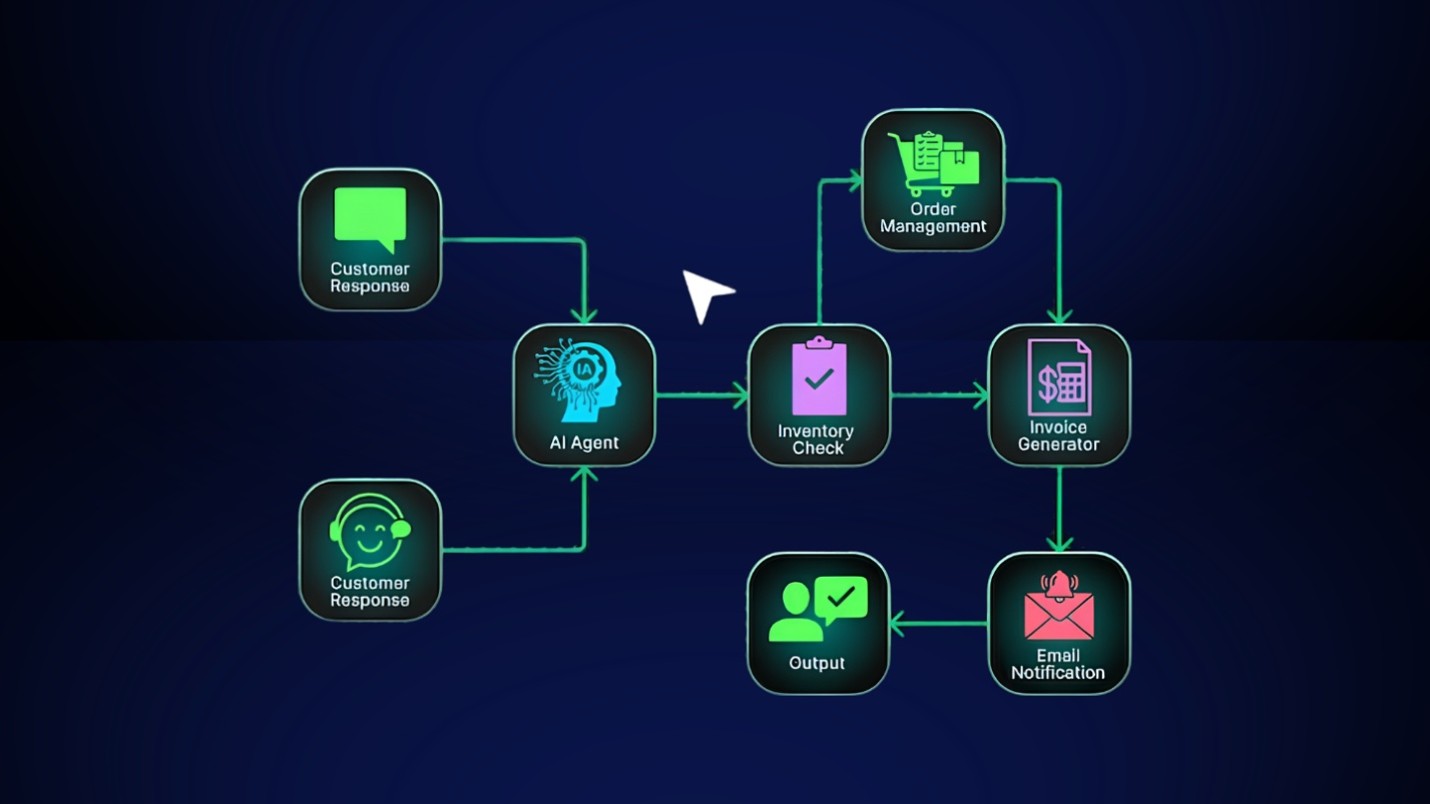
Service-as-Software is a model where the product is the completed work itself. Rather than licensing an application and asking your team to operate it, you engage AI agents that perform a task end-to-end, such as drafting a proposal, resolving a support ticket, or closing the loop on a supply-chain exception. You pay for that outcome rather than for access to a tool.
The shift is in who does the work. Under the traditional software model, software helps a human complete the work. It stores data, runs calculations, presents a dashboard, and supports decision-making, but a person still executes the task. Under Service-as-Software, the software becomes the worker. The agent reasons over the data, makes decisions within its mandate, and completes the task, while a person supervises the process.
You’ll see the term written in a few different ways across the web, including Service-as-Software, Service-as-a-Software, and the shorthand SaS. These terms generally point to the same shift. It is important to keep Service-as-Software distinct from Software-as-a-Service (SaaS), the delivery model used by most business software today.
In plain terms:
- SaaS: You rent a tool and your people use it to do the work.
- SaS: You buy an outcome and an AI agent does the work.
- The key distinction: The category is about who performs the task, not simply how the software is hosted or billed.
Service-as-Software vs SaaS: What Actually Changes
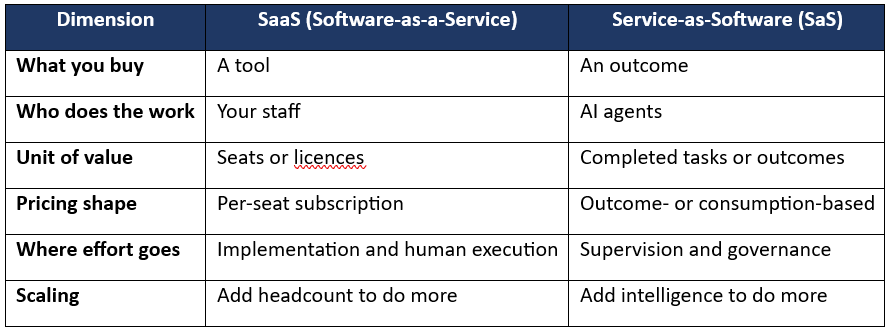
The line is blurrier than it first appears because most Service-as-Software is still delivered as cloud software. Logins, dashboards, and integrations can look similar to SaaS on the surface. What changes is the unit of value. SaaS sells access measured in seats, while SaS sells completed work measured in outcomes.
It’s also worth separating SaS from “Service-as-a-Service.” This generally refers to a human-delivered managed or outsourced service where people, rather than AI agents, perform the work behind the subscription. The terms have a similar structure, but the worker is different.
How the Service-as-Software Operating Model Works
At the level of a single task, Service-as-Software can look like a smart feature. At enterprise scale, it becomes an operating model. The model combines a shared intelligence foundation with AI agents across the business rather than relying on a collection of disconnected point tools.
CLaaS2SaaS’s Service-as-Software Operating System is one working example of this approach. It is delivered through the CLaaS2SaaS Self-Service Intelligence Automation Platform. See the full offering: AI-First Adaptive Enterprise Transformation.
Start With a Unified Intelligence Foundation
Before agents can perform reliable work, they need access to one version of the truth. CLaaS2SaaS calls this layer Intelligence OS. It connects ERP, CRM, and LMS data through an Integration Hub, Knowledge Hub, Operation Hub, and Intelligence Hub. This allows every agent to reason from the same information rather than working from a fragmented view of the business.Put Agents Into Operations and Customer Experience
On top of that foundation, agents take on the actual work. Agentic ERP runs operations agents across procurement, finance, supply chain, and facilities as self-optimising workflows rather than static dashboards.
Agentic CRM applies the same approach to the revenue side of the business. It includes prospect-intelligence agents, proposal automation, and a customer-service manager agent that can resolve requests end-to-end. The sales and service teams remain involved where human judgment is needed.
Build a Workforce That Configures AI, Not Just Uses It
The model only compounds if people can extend it. Adaptive CLaaS® provides the workforce layer through a unified Learn2Work Window and work-integrated skilling. This helps turn staff into citizen developers who can configure and supervise agents instead of relying on a small technical team to own all the automation.
CLaaS2SaaS is one implementation of Service-as-Software built for enterprise adoption. It is not the definition of the category itself.
Service-as-Software Examples & Use Cases
Service-as-Software can be applied wherever a task that previously required a person can now run end-to-end through an agent. Some function-level examples include:- Customer service that resolves, not just routes. A customer-service manager agent handles a support request from intake through resolution, escalating only what genuinely requires human judgment. (Agentic CRM)
- Pre-sales that runs itself. Prospect-intelligence agents qualify and research leads, while proposal automation drafts and refines offers. Sales representatives can then focus on relationships and closing rather than paperwork. (Agentic CRM)
- Operations that self-correct. Finance, procurement, and supply-chain agents monitor for exceptions and respond in real time rather than waiting for a monthly report to reveal a problem. (Agentic ERP)
- Skilling that happens inside the work. Work-integrated skilling helps employees build skills while using the tools, turning them into people who can configure and extend the agents around them. (Adaptive CLaaS®)
More broadly, AI agents are increasingly being used to perform functions that once required dedicated teams, from research and drafting to first-line support. The important distinction is whether the agent completes a defined task end-to-end or simply helps a human complete it faster. When evaluating a vendor’s claims, look for that difference.
Why Service-as-Software Matters for Enterprises
Most enterprises have traditionally had one primary lever for growth: adding people. More demand meant more headcount, and revenue and team size often grew together. Service-as-Software makes that relationship more flexible. When agents can complete real work end-to-end, an enterprise can scale revenue without scaling headcount at the same rate.
That matters because Service-as-Software can address several structural constraints. These include skilling that lags behind the actual work, service quality that is limited by how many people you can hire and train, and decisions that are delayed because data lives in disconnected systems. Addressing these constraints together can turn Service-as-Software from a productivity feature into a growth lever.
There is also a sequencing risk worth considering. Building isolated AI agents without a shared intelligence foundation means the gains may not compound. Each agent can end up working from its own partial view of the business, while improvements in one area fail to reinforce the others. A foundation-first approach, followed by agents across the business, makes the model more durable than a collection of one-off automations.
If you’re evaluating what this could look like for your own organization, the FAQs below answer some of the most common questions.
Frequently Asked Questions
Is Service-as-Software the same as SaaS (Software-as-a-Service)?
No. With Software-as-a-Service (SaaS), you subscribe to a tool and your people do the work inside it, usually through a per-seat model. With Service-as-Software (SaS), the software does the work. AI agents complete defined tasks end-to-end, and the value is tied to the outcome rather than simply access to the tool. Most SaS is still delivered as cloud software, so it can look similar to SaaS on the surface. The key difference is whether the value comes from access to software or completed work. It is also different from “Service-as-a-Service,” which generally refers to a human-delivered managed or outsourced service.
What is an example of Service-as-Software?
Examples include a customer-service agent that resolves a ticket end-to-end, a prospect-intelligence agent that qualifies and researches a lead, or a proposal-automation agent that drafts and refines an offer. These examples map to Agentic CRM. On the operations side, finance and supply-chain agents can monitor and respond to issues in real time through Agentic ERP. The common thread is that the agent completes the task rather than simply assisting a person.
What is the difference between Service-as-Software and Service-as-a-Service?
Service-as-Software (SaS) means software and AI agents perform the work themselves. “Service-as-a-Service,” which is sometimes used for managed or outsourced offerings, means a human team delivers the service on your behalf, even if it is sold through a software interface. The key difference is who performs the work behind the service.
How is Service-as-Software priced?
Many Service-as-Software offerings lean toward outcome-based or consumption-based pricing. Customers pay for results or completed tasks rather than a flat per-seat subscription. CLaaS2SaaS does not publish set pricing for its Service-as-Software Operating System. The best way to get pricing specific to your enterprise is to book a consultation.
How do enterprises adopt a Service-as-Software operating model?
Start with a unified intelligence foundation that provides one version of the truth across ERP, CRM, and LMS data before layering agents on top. CLaaS2SaaS follows this sequence with Intelligence OS first, followed by its three solution clusters: Adaptive CLaaS®, Agentic ERP, and Agentic CRM. This allows each new agent to reinforce the others rather than working from a fragmented view of the business.
Stop scaling by hiring. Start scaling by intelligence. See how the Service-as-Software Operating System can apply to your enterprise.
Want the full offering?
Share


Want to check if this career is for you?