Software Engineer Portfolio: Projects to Build During Your Degree
Software Engineer Portfolio: Projects to Build During Your Degree
Content
Content
Employers hiring software engineers do not make decisions on certificates alone. They hire on what you can build, and that means your portfolio is your strongest asset before you have years of experience to point to. This post gives you a concrete list of software engineer portfolio projects mapped to the tools that actually matter in the job market, from React front ends to generative AI features.
Why a Portfolio Beats a Resume in Software Engineering
A resume tells an employer what you say you can do. A portfolio shows them.
For software engineers at the early stages of a career, this distinction matters enormously. Hiring managers reviewing candidates who have similar qualifications on paper will consistently favour the candidate with demonstrable projects. Not because the degree does not count, but because working code is evidence in a way that a transcript is not.
A well-constructed portfolio answers the questions an interviewer would otherwise have to ask. Can this person design a data layer? Can they deploy something real? Can they work in a team using version control properly? Can they build with current tools? Each project you include either answers one of those questions, or it does not.
The other advantage of a strong portfolio is that it gives you something concrete to discuss in interviews. Rather than speaking in generalities about what you have studied, you can walk through a specific problem you solved, the technical decisions you made, and what you would do differently. That kind of conversation is what separates candidates who get offers from those who do not. For a step-by-step guide to the interview itself, see our software engineer job interview prep.
This is also why the projects you choose to build matter as much as building anything at all. A portfolio full of tutorial clones and basic to-do apps tells a different story than one built around a real stack, real problems, and real deployment.
Beginner-to-Advanced Project Ideas (with the Tools That Matter)
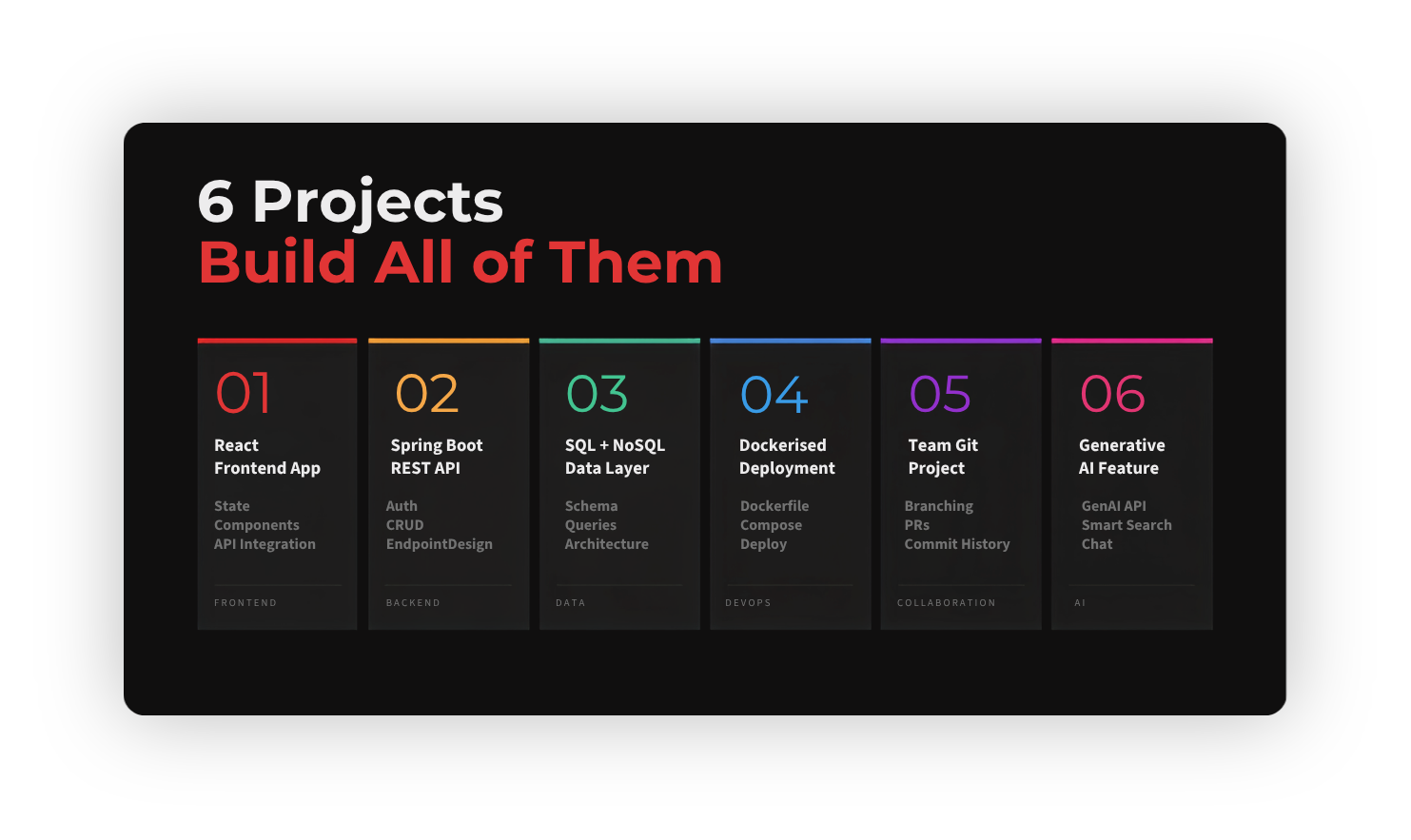
The following project tiers map directly to the tools and skills taught in the CLaaS2SaaS Bachelor’s in Software Engineering: React, Spring Boot, SQL and NoSQL, Git, Docker, and generative AI. Build across these tiers and your portfolio covers the full range from foundation to production-ready.
A React Front-End Application
Start here if you are building front-end confidence. Build a single-page application in React that goes beyond a basic component demo: a task management tool, a personal finance dashboard, or a weather application with API integration all work well. The skill it proves is your ability to manage state, handle user interactions, structure components cleanly, and connect front-end to external data. This is the entry point for projects to build as a software engineering student and the foundation everything else builds on.
A Spring Boot REST API
A back-end API project is where you move from browser to server. Build a RESTful API using Spring Boot that handles authentication, CRUD operations, and clear endpoint design. A project management API, a booking system back-end, or a product catalogue service all provide enough complexity to demonstrate real competence. The skill it proves is that you can build a structured, maintainable back end that a front-end or mobile client can consume. Pair this with your React project, and you have the core of a full stack project idea that tells a coherent technical story.
A SQL and NoSQL Data Layer
Data design is often underrepresented in early portfolios. Build a project that requires you to make a genuine choice between relational and document-based storage, or one that uses both. A social platform data model, an e-commerce inventory system, or an analytics pipeline gives you the opportunity to demonstrate schema design, query optimisation, and an understanding of when each database type is appropriate. This directly demonstrates software engineering capstone project thinking: the ability to make architectural decisions, not just write code.
A Dockerised Deployment
Knowing how to containerise and deploy an application is a practical skill that many junior developers lack. Take one of your existing projects and Dockerise it: write a Dockerfile, configure a compose file for multi-service setups, and document the deployment process clearly. The skill it proves is that you understand the gap between local development and production, and that you can bridge it. Recruiters hiring full-stack or backend roles increasingly expect this as a baseline.
A Team Project with a Clean Git History
Version control discipline is a professional signal. Collaborate on a project using Git with branching strategy, pull requests, and meaningful commit messages. Even if the collaborator is a classmate or a study partner, a repository that shows proper workflow demonstrates that you can function in a team environment. Solo projects with a clean, well-documented Git history are a close second. This is one of the clearest indicators of professional readiness a portfolio can carry.
A Feature Built with Generative AI
Generative AI integration is no longer optional in a competitive portfolio. Modern software engineers are increasingly expected to integrate AI capabilities into applications: a smart search function, a content summarisation tool, a code review assistant, or a chat interface that handles domain-specific queries. The skill it proves is that you can work with AI capabilities as a building block rather than just as an end user. This maps directly to the generative AI component of the Software Engineering curriculum and reflects what employers across sectors are actively hiring for.
How to Make Projects Recruiter-Ready
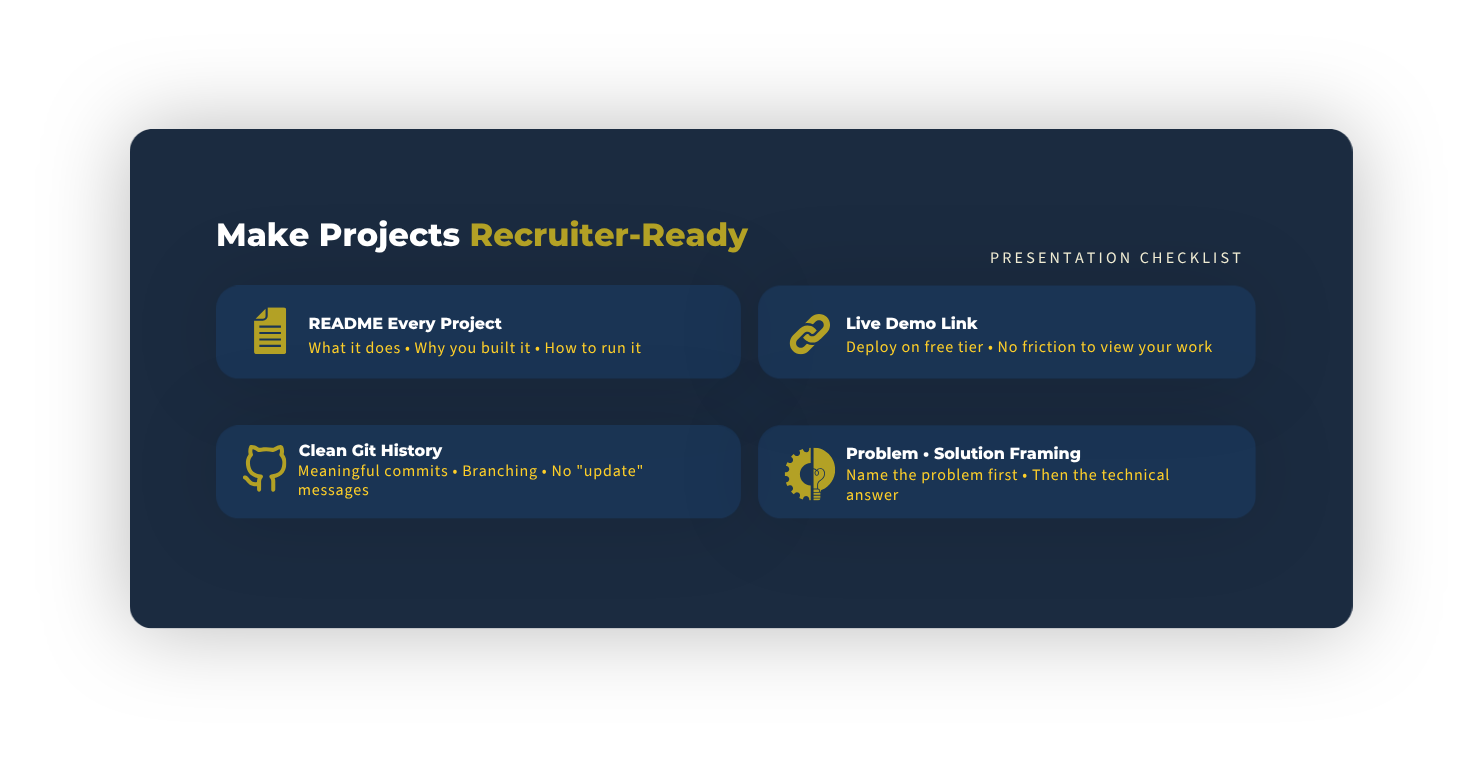
Building the project is only half of the work. How you present it determines whether a recruiter or hiring manager spends thirty seconds on it or ten minutes.
Every project in your portfolio needs a README that a non-technical reader can follow. Explain what the project does, why you built it, what problem it solves, and how to run it.
Keep it concise but complete. A repository with no README signals that you built something for yourself and did not think about the person reviewing it.
A live demo link removes friction. If a recruiter must clone your repository, install dependencies, and configure environment variables just to see your work, most will not bother. Deploy your projects, even on a free tier, and link directly from your README and your portfolio page.
Your Git history is part of the presentation. Meaningful, consistently formatted commit messages show that you understand version control as a communication tool, not just a save function. Messy histories, single commits with everything in them, or commit messages that say only ‘update’ all send the wrong signal.
Frame every project around a problem and a solution. Recruiters respond to narrative. Rather than describing a project as ‘a React app with a Spring Boot back-end’, describe it as ‘a team task management tool I built to explore real-time state management across a React client and a Spring Boot API, with role-based access control’. The technical content is similar; the framing is far more memorable.
Finally, how to build a developer portfolio is not just about the code. It is about curation. Three strong, well-documented projects with live demos outperform ten half-finished repositories every time.
Build Real Industry Projects (Not Just Toy Apps)
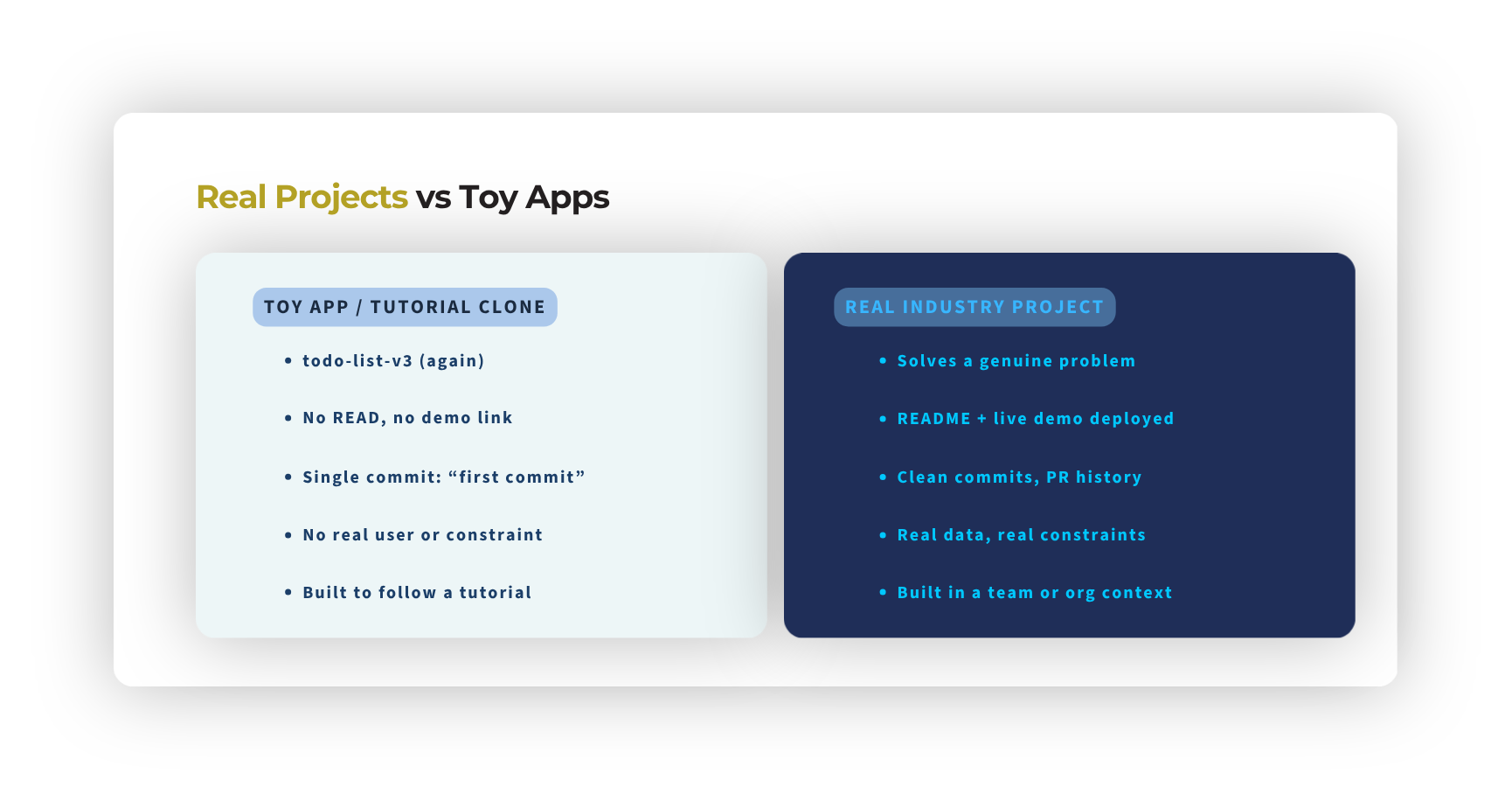
There is a meaningful difference between a project built to learn a concept and a project built to solve a real problem. Employers can usually tell which is which.
Toy apps, tutorial clones, and demonstration projects have their place during learning, but they rarely carry weight in a portfolio on their own. What moves the needle is a project with genuine constraints: a real user, a real data problem, a real deployment requirement, or a real team dynamic. These are the conditions that produce the kind of decisions and trade-offs that interviewers want to hear about.
This is the structural advantage of a degree built around real-world industry projects. Rather than building something for a hypothetical brief, you are working on actual problems with actual stakes. The portfolio that results is not a collection of exercises; it is a record of professional contribution.
CLaaS2SaaS work-study model reinforces this further. Because you are working full-time throughout the programme, the projects you complete are grounded in real organisational contexts. By graduation, your portfolio reflects two years of applied work, not two years of study. That distinction matters significantly to employers evaluating candidates at the same qualification level.
For those earlier in the decision process, the 2-Year International Bachelor’s pathway outlines how the degree structure works across both years. If you are considering a shorter, more accessible route into software engineering first, the Software Engineering bootcamp for career switchers is also worth exploring as a starting point.
Frequently Asked Questions
What projects should a software engineer have in their portfolio?
Aim for a small set of projects that prove you can ship real software end-to-end. A strong portfolio usually includes a full-stack web application (for example a React front-end with a Spring Boot REST API), a project showing database design across SQL and NoSQL, a containerised deployment using Docker, a team project with a clean Git history, and at least one feature built with generative AI. The CLaaS2SaaS Software Engineering degree teaches exactly these tools and is built around real-world industry projects, so your portfolio comes from genuine work rather than tutorials.
How many projects do I need in a software engineering portfolio?
Three to five strong, well-documented projects are more effective than ten incomplete ones. Quality and presentation matter more than volume. Each project should demonstrate a distinct skill or tool, be clearly documented, and ideally have a live demo or clean deployment that a recruiter can access without friction.
What full-stack project ideas are good for beginners?
Start with a React front-end connected to a Spring Boot REST API backed by a SQL database. A task manager, a simple booking system, or a notes application all provide enough scope to demonstrate real full-stack thinking without requiring advanced architecture. Keep the scope tight and the execution clean.
Do portfolio projects help you get hired without years of experience?
Yes. Demonstrable skill in working code consistently outweighs experience on paper at the early career stage. A portfolio that shows you can build, deploy, and document real software gives hiring managers the evidence they need to take a chance on a candidate who is earlier in their career.
Should portfolio projects use AI tools?
Yes. Generative AI features are actively in demand across the industry. Including a project that integrates a generative AI API, whether for content generation, smart search, or conversational interfaces, signals that you are working with current tools rather than learning a stack that is already dated.
The strongest portfolios in software engineering are built from real software, not toy apps. That is why the work-study Bachelor’s in Software Engineering centres on real industry projects from day one, so you graduate with a portfolio that reflects genuine professional work rather than a catalogue of tutorials.
Share


Want to check if this career is for you?