A Unified Platform for Digital and Workforce Transformation
ASEAN’s Digital Economy Has Talent and Transformation Problem
A Unified Platform for Digital and Workforce Transformation
ASEAN’s Digital Economy Has Talent and Transformation Problem
Content
Content
Across ASEAN, two issues continue to slow down digital progress.
First, education systems are not producing job-ready talent fast enough. Many programs remain fixed, theory-heavy, and disconnected from how work actually happens in companies. Graduates often enter the workforce without the ability to contribute immediately, which forces employers to spend additional time and resources on retraining.
Second, most businesses in the region are SMEs, making up nearly 97% of all enterprises. These organizations face real constraints when it comes to adopting digital solutions. High costs, lack of technical expertise, and complex implementation requirements prevent many from moving forward with transformation efforts.
These two gaps reinforce each other. Businesses cannot find the right talent, and individuals cannot access opportunities to build relevant skills.
The Real Issue: Learning, Talent, and Technology are Disconnected
The root of the problem is not just education or technology on its own.
It is the lack of connection between:
- How people learn
- How businesses operate
- How technology is implemented
For SMEs especially, this gap is critical. Without access to affordable talent pipelines and easy-to-deploy technology, transformation remains out of reach.
Education is often treated as a phase that comes before work. Digital transformation is treated as a separate initiative that requires external tools and teams. In reality, both should happen together.
Learning is less effective and transformation is more difficult to maintain in the absence of this relationship. This creates inefficiencies across the board. Technology is introduced without the workforce being prepared to use it, and skills are learned without proper execution, which leads to underutilization and ends up slowing down transformation efforts.
What is needed is a system that connects people, businesses, and technology in a way that allows them to evolve together.
A Unified Approach to Solving the Problem
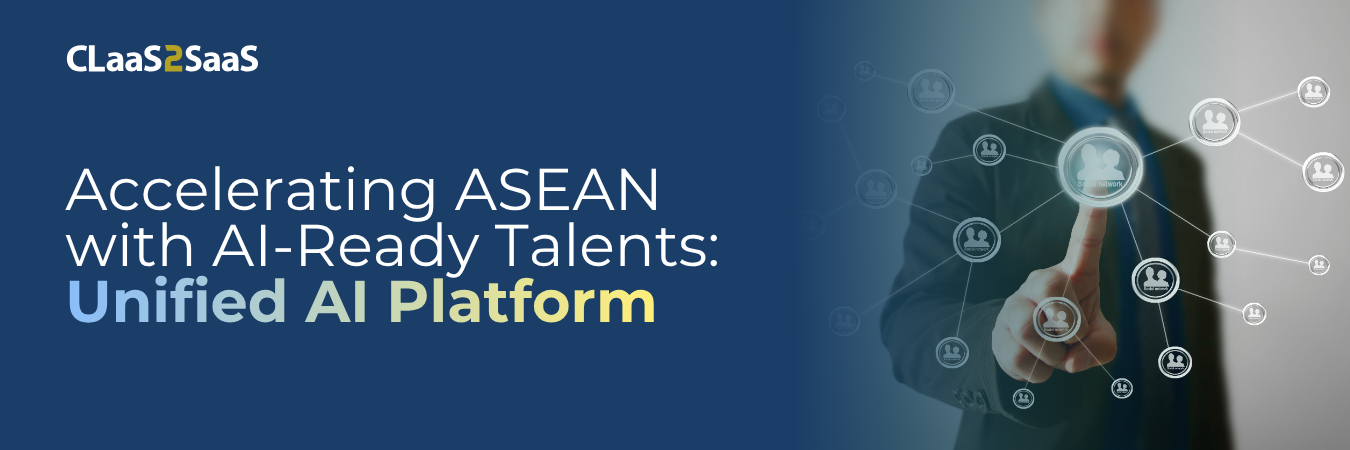
To address this, CLaaS2SaaS introduces an Inclusive Pan-ASEAN AI Acceleration Platform that connects learning, talent, technology, and enterprise execution into one unified system.
At its core, this is not just an ecosystem. It is an AI-powered platform that enables continuous skills development, real-time enterprise execution, and scalable digital transformation. All within a single environment.
At the center of this approach is a total digital and workforce transformation solution, where everything works together instead of operating in silos.
Here’s how the ecosystem is structured:
Understanding the Ecosystem: How Everything Connects
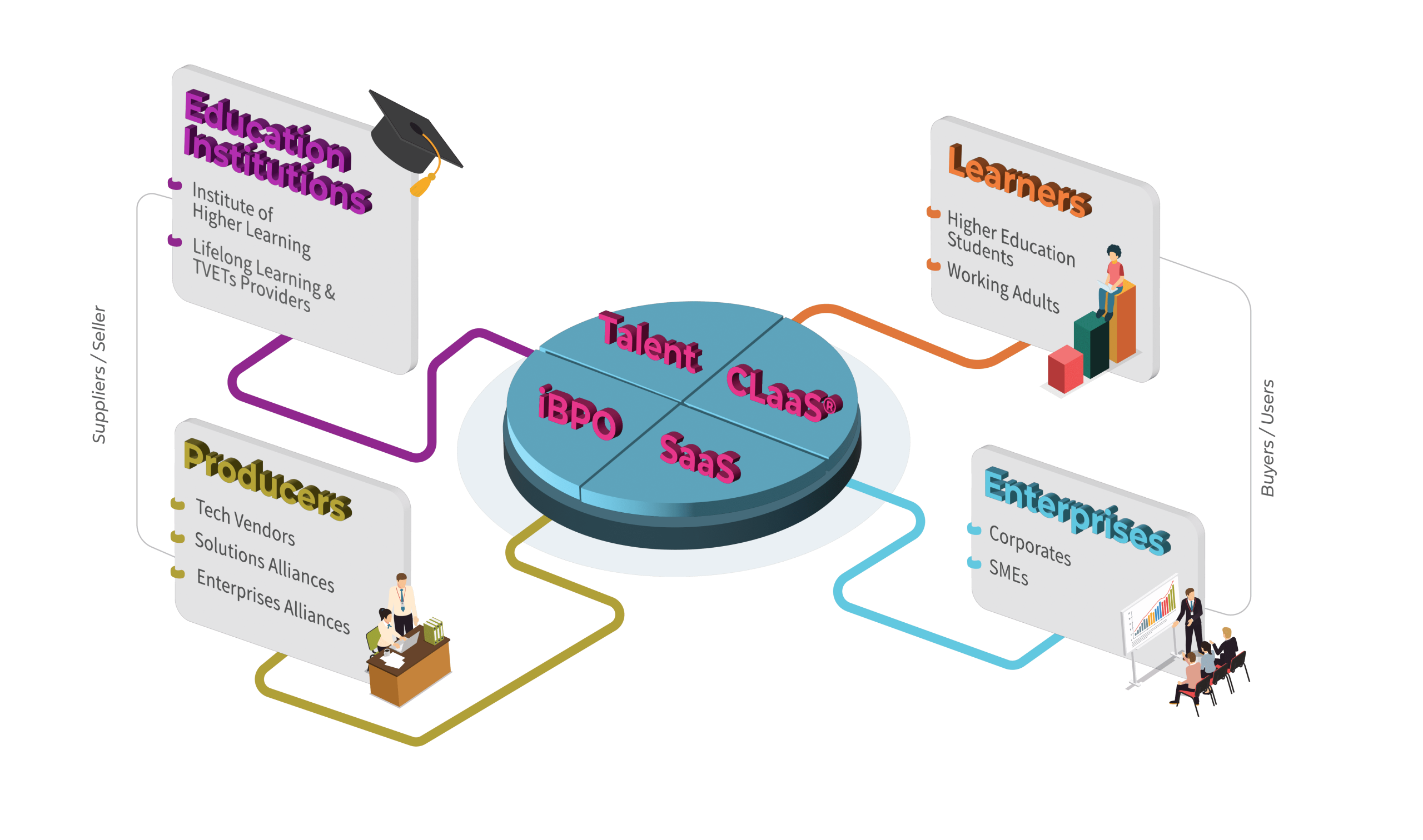
The platform brings together four key stakeholder groups and integrates them through a unified core system. This ensures that SMEs can access the same transformation capabilities as larger organizations.
- Education Institutions
- Institutes of Higher Learning
- Lifelong Learning providers
- TVET providers
- Education Institutions
These institutions supply structured learning pathways and continuously updated curricula aligned with industry needs.
- Learners
- Higher education students
- Working adults
- Learners
They’re doing more than just studying. Through practical applications incorporated into the ecosystem, they are actively developing their skills.
- Enterprises
- Corporates
- SMEs
- Enterprises
These organizations provide real business environments where transformation happens and where skills are applied directly.
- Producers
- Technology vendors
- Solution alliances
- Enterprise alliances
- Producers
They contribute tools, platforms, and solutions that enable AI and digital transformation across use cases.
The Core Engine: How Transformation Actually Happens
- CLaaS® (Learning)
- Delivers AI-adaptive, skills-first training
- Aligns learning directly with job roles and business needs
- Continuously updates based on performance and skills data
- SaaS (Technology)
- Embeds AI tools and digital solutions into workflows
- Enables automation, analytics, and real-time execution
- Supports scalable and flexible deployment across organizations
- Talent
- Connects learners to real enterprise opportunities
- Builds a continuous pipeline of AI-ready professionals
- Aligns workforce capability with actual demand
- iBPO (Execution and Support)
- Supports implementation of digital initiatives
- Combines human expertise with AI-enabled processes
- Ensures knowledge transfer so organizations build internal capability
Why This Platform Works in Practice
This integrated setup solves a common issue seen across many organizations.
Workforce development and digital transformation are often treated as separate efforts. One focuses on training, the other on systems. The result is misalignment.
This platform embeds learning directly into transformation projects.
- Individuals learn while working on real business problems
- Companies adopt technology while building internal capability
- Skills are applied immediately, not delayed
In real implementations, this has led to faster skill adoption, improved productivity, and reduced dependency on external vendors.
How This Supports the Three Core Platform Components
This ecosystem enables the three main components of the AI Acceleration Platform to function effectively.
Collaborative Digital and Workforce Transformation Ecosystem
The first component brings everything together into a connected ecosystem.
One of the major challenges in the region is fragmentation. Education providers, businesses, and technology platforms often operate independently, which limits collaboration and slows down progress.
Within this platform, these stakeholders are connected in a shared environment. Learners, companies, institutions, and solution providers interact within the same system.
This creates a continuous flow between learning and working.
Individuals gain experience through enterprise projects. Companies gain access to talent and innovation. Institutions stay aligned with real industry requirements.
As more participants join the ecosystem, the value increases. Skills development becomes more relevant, transformation becomes more accessible, and opportunities expand across the region. Crucially, this inclusivity is by design — the ecosystem is structured so that SMEs and individual learners have the same access to transformation pathways as larger enterprises, ensuring that ASEAN’s digital growth is broad-based rather than concentrated at the top.
Inclusive AI Skills Acceleration and Workforce Transformation
The second component focuses on how people build skills and transition into meaningful work.
Traditional learning models follow a fixed structure where everyone goes through the same content at the same pace. This approach does not reflect how individuals learn or how job roles evolve.
Through an AI-adaptive learning approach, individuals follow personalized pathways based on their current capabilities and career goals. Learning is aligned with specific job roles and updated continuously based on industry needs.
More importantly, learning is embedded into real work. Instead of waiting until graduation, individuals participate in live projects and practical assignments that reflect actual business challenges.
This approach allows learners to build applied skills while contributing to real outcomes. It also enables companies to access talent that is already familiar with real workflows and tools.
Over time, this creates a workforce that is not only digitally skilled but also capable of adapting to new technologies and ways of working.
Self-Service Glocalized AI Technology Implementation
The third component addresses the barriers businesses face when adopting AI and digital solutions.
Many organizations struggle with transformation because traditional approaches require significant investment and specialized expertise. This makes it difficult for SMEs to participate fully in the digital economy.
The platform introduces a self-service platform where businesses can access and deploy AI solutions based on their specific needs. These include workflow automation, AI-assisted analytics, intelligent document processing, and role-based learning tools, all deployable without requiring deep technical expertise in-house. The solutions are designed to be adaptable to different markets across ASEAN, taking into account local regulations, industry conditions, and operational realities.
Instead of large-scale transformation projects, companies can implement changes gradually. They can start with specific workflows, automate repetitive tasks, and expand as they build confidence and capability.
This reduces risk and allows organizations to see value early. It also enables teams within the company to take a more active role in transformation, rather than relying entirely on external vendors.
A More Practical Path Forward
The future of work in ASEAN requires a different approach. It is not enough to update curriculum or introduce new tools in isolation. The real change comes from connecting learning, capability building, and business execution into a single system.
The Inclusive Pan-ASEAN AI Acceleration Platform offers a way to do this at scale while remaining adaptable to local needs.
This platform changes how progress happens. It removes the gap between learning and execution. It reduces the complexity of transformation. It creates a system where individuals and organizations grow together.
Instead of relying on separate efforts for education, hiring, and technology adoption, everything is aligned within one platform.
- For individuals, it creates a clearer and more practical path to building a career in the digital economy.
- For businesses, it provides a way to move forward with transformation without the usual barriers.
- For the region, it supports a more inclusive and sustainable framework of growth where more people and organizations can participate meaningfully.