Can You Really Run a One-Person Marketing Agency?
Can You Really Run a One-Person Marketing Agency?
Content
Content
You’ve seen the video: one person, a laptop, and a marketing agency that supposedly runs on autopilot. A one-person marketing agency is no longer just a YouTube fantasy, but it isn’t automatic either. Here’s an honest look at what actually holds this model together, and where it breaks.
Why the One-Person Agency Model Is Suddenly Viable
Running a one-person marketing agency used to mean turning away work past a certain point. Content took hours to draft, campaigns needed manual reporting, and client communications ate up whatever time was left after actual delivery. That ceiling has moved.
AI and automation can reduce time spent on repeatable tasks such as first drafts, scheduling, reporting summaries, and basic administration, and no-code automation platforms connect these pieces together so a single person can run workflows that once needed a coordinator. The time saved varies by workflow and tool quality, while strategy, client communication, quality control, and sales still require direct human judgment. That combination is what makes a one-person agency with AI genuinely different from what the model looked like five years ago.
These tools generally fall into a few buckets: campaign and content generation, client relationship management, marketing automation, and reporting. None of them decide what to say to a client or how to price a project, they compress the time between deciding on an action and executing it, which is the resource a solo operator has the least of.
If you’re earlier in the decision and still weighing whether to start an agency at all, our guide on [How to Start a Digital Marketing Agency in Singapore] covers the foundational steps before you get to the one-person question.
What a Solo Agency Owner Actually Does Day to Day
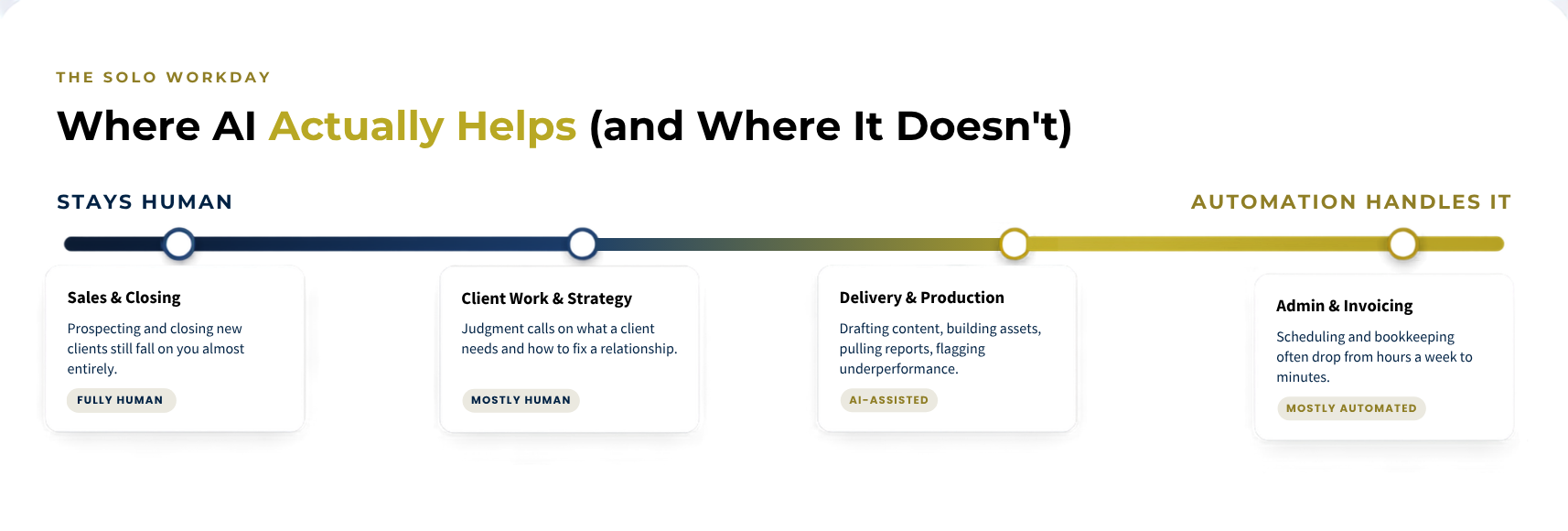
So what does it actually take to run a marketing agency alone, day to day? The role splits across four areas, client work, delivery, admin, and sales, and automation genuinely lightens some of these more than others.
Client work and strategy stay firmly human. Understanding what a client actually needs, translating that into a campaign plan, and managing the relationship when something goes wrong are judgment calls no tool makes for you. Delivery is where AI earns its keep: drafting content variations, building campaign assets from a brief, pulling performance data into a report, and flagging underperforming ads before you might have noticed manually.
Admin work, invoicing, scheduling, basic bookkeeping, tends to benefit the most from automation and can drop from hours per week to minutes once the right systems are in place. Sales is the honest exception. Prospecting, pitching, and closing new clients still fall on you almost entirely, since no AI tool reliably replaces a founder’s ability to build trust with a prospective client and close the deal.
The practical shape of a working week, then, is less hands-on production and more oversight, client conversation, and business development, with automation absorbing the repetitive middle layer that used to require a second or third hire. For many solo operators, the balance can shift further toward sales and client management as the client base grows, since each new account adds a relationship to maintain even when the delivery work behind it is largely automated.
The Real Limits of Running It Alone
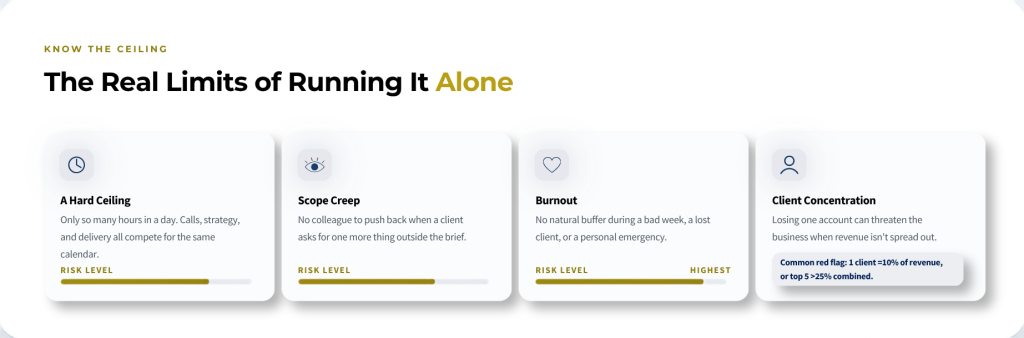
Can one person run an agency without eventually hitting a wall? Yes, but only within real limits, and pretending otherwise sets people up to fail.
A solo marketing agency has a hard ceiling that a team-based agency does not. There are only so many hours in a working day, and even with automation handling production work, client calls, strategy sessions, and delivery reviews all still compete for the same calendar. Past a certain number of active clients, quality starts to slip regardless of how good the tooling is.
Scope creep is a bigger risk alone than in a team, since there’s no colleague to push back when a client asks for one more thing outside the agreed brief. Every yes adds hours nobody else is going to absorb.
Burnout is a real possibility, not a hypothetical one. When delivery, sales, and admin all sit with the same person, there’s no natural buffer during a bad week, a lost client, or a personal emergency, and a solo operation usually can’t absorb that the way a team can.
Customer concentration is worth monitoring for the same reason: losing one large account can materially affect a solo business. One commonly cited rule of thumb flags a client above 10% of revenue, or the top five above 25%, as potential risks. Treat those figures as prompts for review rather than universal limits, since service mix, contracts, cash reserves, and industry context all matter. None of this rules the model out; it simply means planning for these boundaries up front instead of discovering them the hard way.
What Makes a Solo Agency Sustainable Long-Term
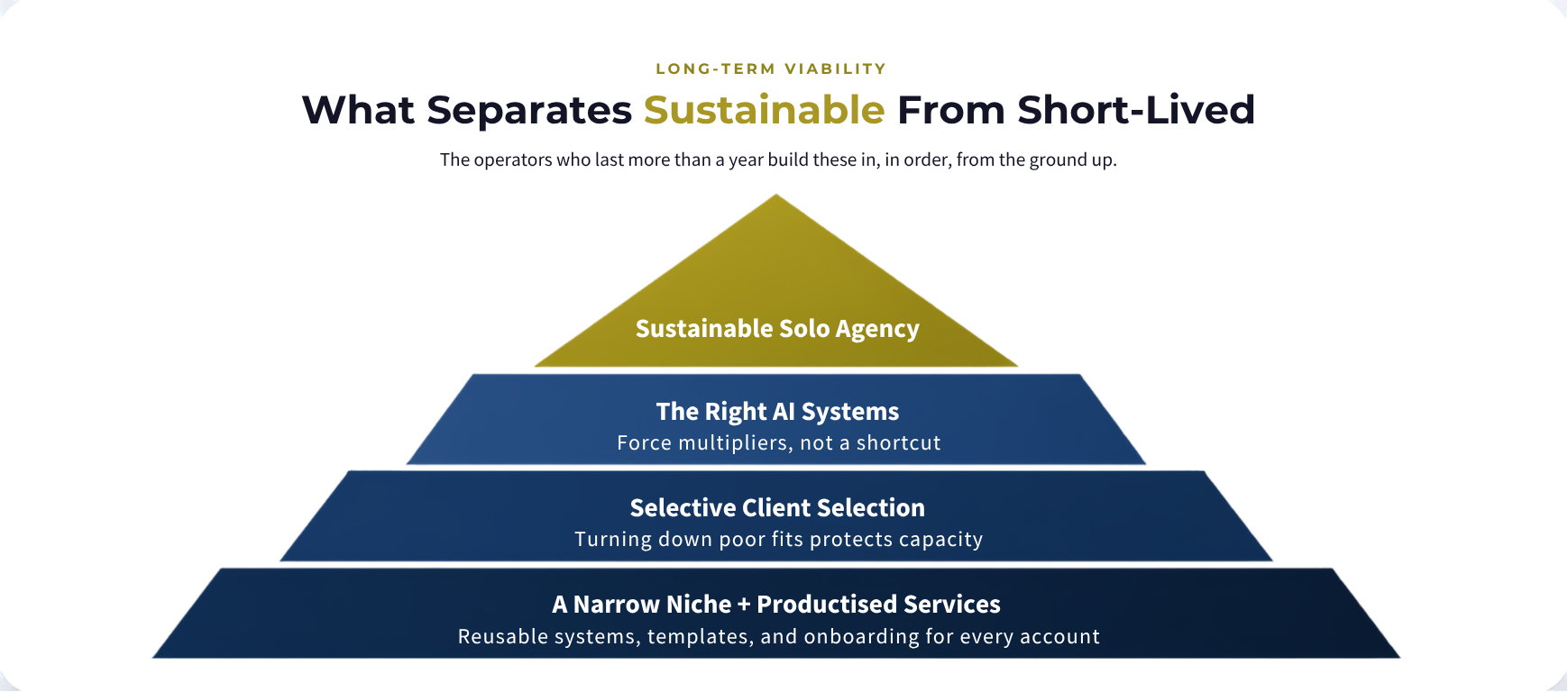
A few practices tend to separate a solo agency that lasts from one that burns out within its first year.
Niching down is the biggest lever. Serving one industry or one type of campaign well lets you reuse systems, templates, and even client onboarding steps across every new account, instead of rebuilding your approach from scratch each time. Productised services work the same way: a defined, repeatable package is far easier to deliver solo than a fully custom scope negotiated fresh for every client.
Selective client selection matters more alone than in a team setting. Turning down a poor-fit client is not lost revenue so much as protected capacity, since every difficult account takes time away from the ones that are actually sustainable.
AI tools for solo agency owners typically fall into four categories: campaign building, content creation, client relationship management, and marketing automation. Used well, this stack acts as a force multiplier rather than a shortcut, extending what one person can deliver without pretending the work disappears entirely. The combination of a narrow niche, repeatable delivery, careful client selection, and the right systems is what separates a sustainable one-person agency from a short-lived experiment.
Is This Model Right for You?
Before deciding whether this path fits, it helps to be honest about three things: your skill base, your risk tolerance, and your financial runway.
On skills: you don’t need to walk in as an expert marketer, developer, and salesperson from day one. Comfort learning fast across all three matters more, since the AI tools speed up execution and judgment calls stay with you. On risk tolerance, running solo means income that can vary month to month, especially in the first year, with no guaranteed floor. On runway, most people need a financial buffer to cover a slow ramp-up while the first few clients are being won, since results are rarely immediate.
If those three things line up for you, a one-person marketing agency is a realistic path, not just a trend. A structured program won’t remove these trade-offs, but it can shorten the learning curve and connect you with mentors who’ve made the same decisions.
The current Digital Marketing iBPO pathway also describes a possible growth step: after completing three client projects, an operator may qualify as an accredited agency and gain access to the Pan-ASEAN SME AI Marketplace. This is conditional, not automatic, and worth knowing about once you’re weighing the model seriously.
Frequently Asked Questions
Can one person really run a full marketing agency?
Yes, within limits. AI and automation now handle much of the production and admin work that once required a team, freeing one person to manage strategy, client relationships, and delivery for a focused set of clients. It works best with a narrow niche, not by serving every client a full agency would. Book a free career consultation to see if the model fits your situation.
How many clients can one person realistically manage alone?
It depends on service scope and niche rather than a fixed number. A narrow, productised service can usually support more active clients than a broad, fully custom scope. Most solo operators find their real ceiling through trial and error in the first year.
What AI tools do solo agency owners typically use?
Most rely on tools across four categories: campaign building, content creation, client relationship management, and marketing automation. Exact tools vary by provider and niche. A structured program can shorten the search for tools that fit your workflow.
How much can a one-person agency realistically earn?
Earnings vary widely based on niche, pricing model, and how many clients you can retain. There is no fixed income figure that applies across the board. A career consultation can help set realistic expectations.
Is a one-person agency more or less risky than a traditional agency?
Overhead is lower since there is no team to fund, which reduces some financial risk. Personal capacity risk is higher, since the business depends entirely on one person’s time and health. A quick consultation can help you weigh both sides for your situation.
Going solo does not mean going without support. Structured guidance exists for building a sustainable one-person marketing agency, from your first client through the systems that keep it running long after year one.
Share


Want to check if this career is for you?