LMS vs LXP vs Adaptive Learning Platform: What Enterprises Actually Need
LMS vs LXP vs Adaptive Learning Platform: What Enterprises Actually Need
Content
Content
Enterprises invest heavily in learning platforms, yet workforce capability gaps keep widening because learning stays disconnected from work. A corporate learning platform comparison usually starts with three categories — LMS, LXP, and adaptive learning platform — but rarely explains what an AI-native enterprise actually needs.
LMS vs LXP vs Adaptive Learning Platform — The Core Difference
Before comparing platforms by vendor, it helps to understand the three underlying categories — because most ‘best LMS’ lists blur them together.
What an LMS Does
A Learning Management System administers, tracks, and certifies formal training. It’s built around course completion: assigning content, recording who finished it, and issuing certificates for compliance and audit purposes. An LMS is the backbone for regulated training that needs a clean record.
A Learning Management System administers, tracks, and certifies formal training. It’s built around course completion: assigning content, recording who finished it, and issuing certificates for compliance and audit purposes. An LMS is the backbone for regulated training that needs a clean record.
What an LXP Adds
A Learning Experience Platform layers content discovery on top of that foundation. Instead of assigning fixed courses, an LXP surfaces curated content — often from multiple sources — and lets employees explore and self-direct their own learning, closer to a content-recommendation experience than a compliance tracker.
A Learning Experience Platform layers content discovery on top of that foundation. Instead of assigning fixed courses, an LXP surfaces curated content — often from multiple sources — and lets employees explore and self-direct their own learning, closer to a content-recommendation experience than a compliance tracker.
What an Adaptive Learning Platform Does
An adaptive learning platform goes further again. Rather than starting from content, it starts from the person: profiling individual skill gaps, generating curriculum with AI to address those specific gaps, and delivering it inside the actual flow of work rather than a separate system. Performance intelligence connects what was learned back to what changed on the job — a loop that traditional LMS and LXP deployments are typically not designed to close on their own.
An adaptive learning platform goes further again. Rather than starting from content, it starts from the person: profiling individual skill gaps, generating curriculum with AI to address those specific gaps, and delivering it inside the actual flow of work rather than a separate system. Performance intelligence connects what was learned back to what changed on the job — a loop that traditional LMS and LXP deployments are typically not designed to close on their own.
Platform categories overlap, and individual products may combine capabilities associated with more than one column. The table below summarizes each category’s typical primary design and use case rather than defining hard technical limits.
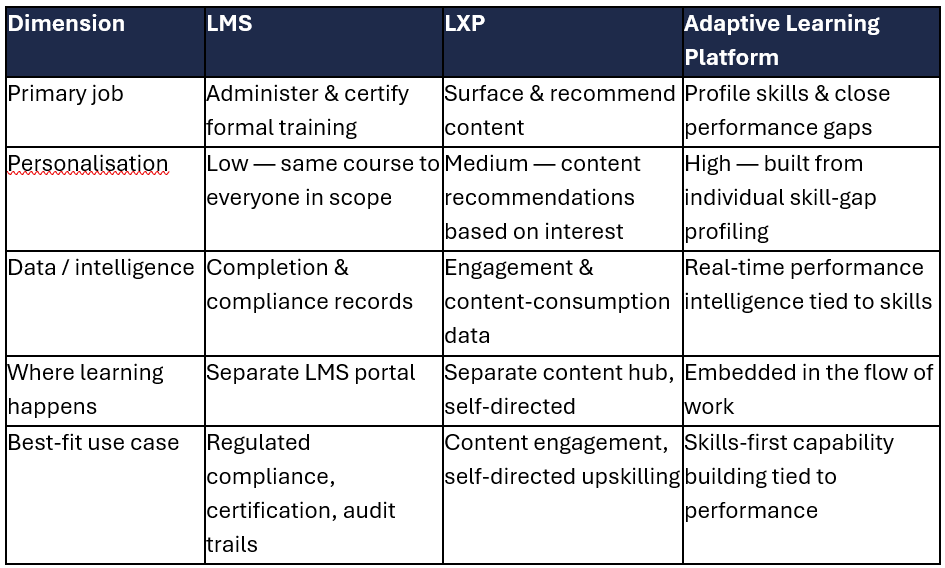
None of these categories is inherently ‘better’ — they solve different problems, and many enterprises end up running more than one at once. Buyers should verify a specific product’s actual feature depth rather than rely on the category label alone.
What Enterprises Actually Need in an AI-Native Workforce
Traditional LMS and LXP deployments often emphasise course administration, content access, completion, or engagement. Some products also include skills intelligence and adaptive features, so buyers should compare the depth of personalisation, workflow integration, and performance evidence rather than rely on the product label alone. The failure modes behind why training programs fail — the learning transfer problem — tend to show up wherever a platform is used mainly for course administration: one-size-fits-all content, learning disconnected from work, and systems that track completion rather than capability.
A simple maturity model makes the pattern clearer. At Stage 1, Static Learning, organizations run on courses, an LMS, and certificates — a model built for compliance and completion. At Stage 2, Contextualized Learning, training starts connecting to actual roles, mapped against a skills framework, organized into pathways rather than one-off courses — the territory where an LXP often adds value. At Stage 3, Learn2Work Enablement, learning is built around skills profiling, AI-generated curriculum, and delivery embedded directly in the flow of work, with performance intelligence closing the loop. See AI-First Adaptive Enterprise Transformation for the broader shift this maturity curve sits within.
Which category an enterprise needs largely depends on where it sits on this curve — and most organizations need more than a single corporate learning management system to cover both compliance and capability-building at once.
How to Choose: A Decision Framework for Enterprise Buyers
For leaders conducting an enterprise learning platform comparison, the key question is not simply the LXP vs LMS difference. It is which platform can support the organisation’s current compliance, discovery, skills, workflow, and performance-measurement needs. A few criteria tend to separate the categories cleanly, and working through them honestly is more useful than starting from a vendor shortlist.- Compliance & certification needs: if your primary requirement is a clean audit trail — who completed what, when, with a certificate to show for it — a traditional LMS is usually strongest for regulated, compliance-driven training.
- Skills visibility / capability gaps: if you don’t currently know where your organization’s real skill gaps sit, that’s a sign you need skills profiling, not just another course catalog.
- In-workflow vs classroom delivery: training that has to happen in a separate portal, on separate time, faces a harder path to actually being applied than training embedded directly in the work itself.
- AI-driven curriculum & personalisation: static content can lose relevance as skill requirements shift; if your curriculum can’t keep pace, AI-assisted curriculum generation may help close that gap, though the benefit depends on implementation quality, data, and how well it’s integrated into the workflow.
- Performance intelligence & analytics depth: if your current reporting stops at completion rates, you have limited ability to prove — or improve — whether training is actually changing performance.
- Integration with HR/work systems: learning that’s disconnected from the systems where work actually happens is harder to embed and easier to ignore.
In practice, an LMS is usually enough on its own for regulated compliance and certification. An LXP helps where the priority is content engagement and self-directed upskilling. An adaptive learning platform is worth considering when the goal is closing real skill gaps and proving the impact on performance — not just recording that training happened, and when it’s implemented with good data quality and workflow integration.
Where Adaptive CLaaS® Fits for AI-Native Enterprises
Adaptive CLaaS® is CLaaS2SaaS’s Adaptive Learning Platform, positioned in the category described above rather than as a traditional LMS. It starts with Skills Profiling to identify where each person’s real gaps sit, uses AI Curriculum Generation to build learning around those specific gaps, and delivers that learning through Adaptive Delivery in Workflow — inside the job itself, not a separate portal. Real-Time Performance Intelligence closes the loop, feeding into an Enterprise Knowledge Loop that keeps adapting as skill needs shift.
Alongside the platform, CLaaS® Academy supplies a curated catalog of role-aligned programs, so organizations aren’t building curriculum from a blank page.
This is what Stage 3, Learn2Work Enablement, looks like in practice — not a claim that it replaces every LMS or LXP an enterprise runs, since compliance tracking and content discovery still matter, but a description of where an Adaptive CLaaS® platform fits once an organization is ready to build capability, not just record completions. See Corporate Learning Transformation or CLaaS® Academy (links to be confirmed) for more.
Frequently Asked Questions
What's the difference between an LMS, an LXP, and an adaptive learning platform?
An LMS administers, tracks and certifies formal or compliance training and is built around course completion. An LXP layers content discovery and self-directed, learner-led experiences on top. An adaptive learning platform such as Adaptive CLaaS® goes further — it profiles each person’s skill gaps, generates AI curriculum, and delivers learning in the flow of work, connecting skills, learning and performance rather than just recording completions.
Is an adaptive learning platform a replacement for our LMS?
Usually not a rip-and-replace. Many enterprises keep their LMS handling compliance records and certificates while an adaptive layer adds skills profiling, personalisation, and in-workflow delivery on top.
Which platform is best for corporate compliance training?
A traditional LMS is typically strongest for regulated compliance — audit trails, certificates, and completion tracking. Adaptive and LXP layers are better framed as adding capability-building on top, not replacing that compliance backbone.
How does an adaptive learning platform use AI?
In Adaptive CLaaS®’s case, through Skills Profiling, AI Curriculum Generation, Adaptive Delivery in Workflow, and Real-Time Performance Intelligence — profiling gaps, generating curriculum around them, delivering it inside the work itself, and measuring what changed.
What does ‘Learn2Work’ mean for enterprise learning?
It’s the most advanced stage in CLaaS2SaaS’s learning maturity model — embedding adaptive learning, coaching, and performance support directly into the flow of work, so learning continuously adapts to workforce and business needs rather than sitting in a separate system.
The right platform depends on where your organisation sits on the learning maturity curve—whether it needs compliance tracking, better content discovery, or adaptive learning tied to performance. Book a 1:1 Consultation to assess the best-fit path.
Share


Want to check if this career is for you?