What Is Batch-of-One Learning? Personalizing Education at Scale
What Is Batch-of-One Learning? Personalizing Education at Scale
Content
Content
Large cohorts are hard to teach well. When hundreds of students move through the same curriculum at the same pace, some are bored, some are lost, and completion rates suffer as a result. Batch-of-one learning is the alternative: giving every student their own personalised learning journey; skills, pace, and goals, without abandoning the efficiency of teaching at scale.
What ‘Batch-of-One’ Learning Actually Means
Why ‘personalization at scale’ used to be impossible (cost of 1:1)
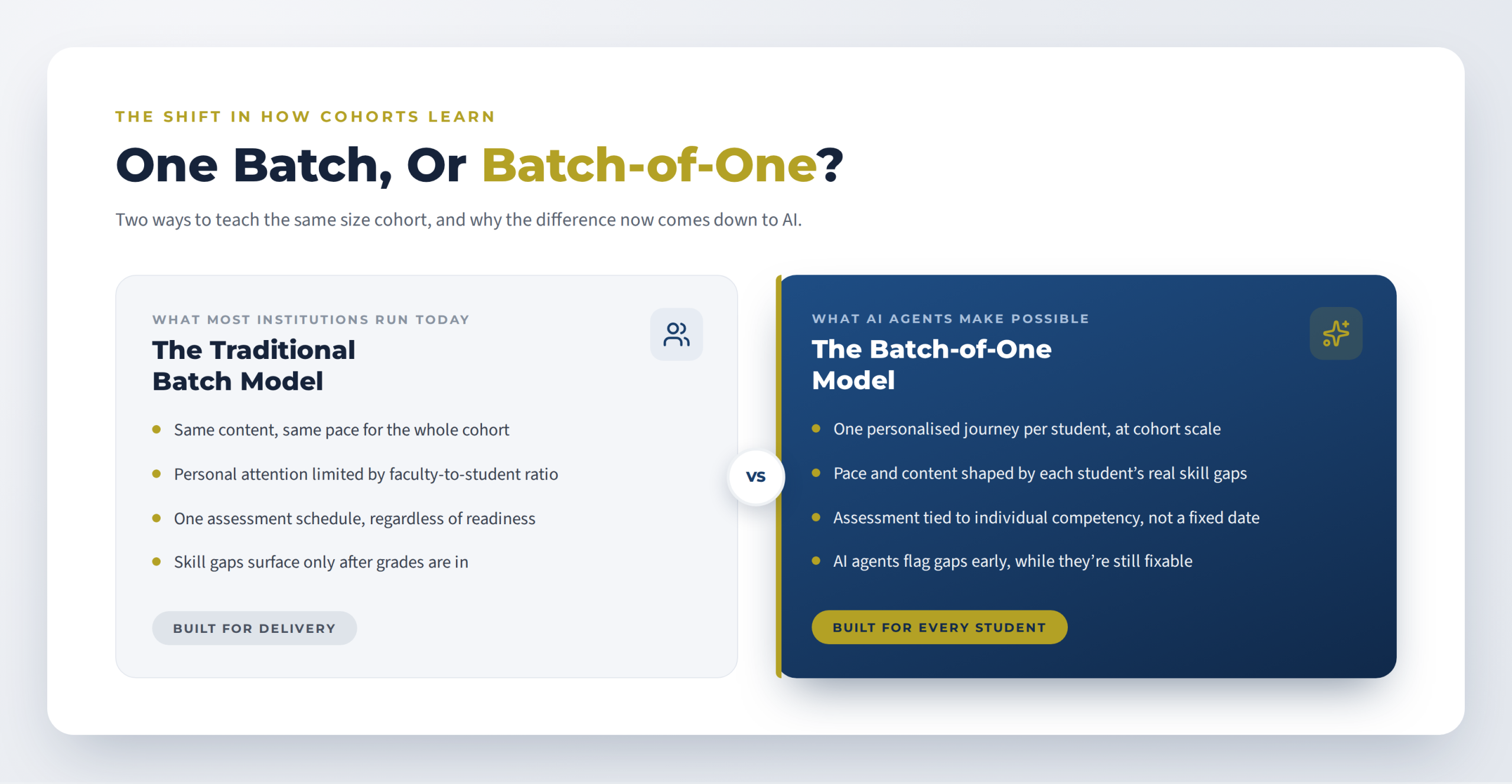
True one-to-one teaching has always existed, it’s just never been affordable outside small tutorials or private coaching. Diagnosing every student’s skill gaps individually, then adjusting content, pacing, and assessment for each of them, requires more staff time than most institutions can budget for a cohort of any real size.What changed: AI agents
What has shifted is not the ambition but the economics behind it. AI agents can now help diagnose a learner’s skill gaps, adjust curriculum sequencing and monitor progress continuously, without scaling academic staff in direct proportion to enrolment. That is what makes AI personalized learning something higher education institutions can actually deploy, rather than a theoretical ideal. CLaaS2SaaS, a Singapore-headquartered platform serving institutions across the wider ASEAN region, delivers this through its Adaptive CLaaS platform, which applies four connected AI agents to make one-to-one learning at scale operationally realistic for large cohorts. This builds on ideas covered in our earlier piece on Redefining Adaptive Learning in Higher Education, and extends the direction set out in AI-First Adaptive University into a scale-specific concept: batch-of-one learning.How AI Delivers One-to-One Learning to Thousands of Students
CLaaS Talents: mapping skills and career direction
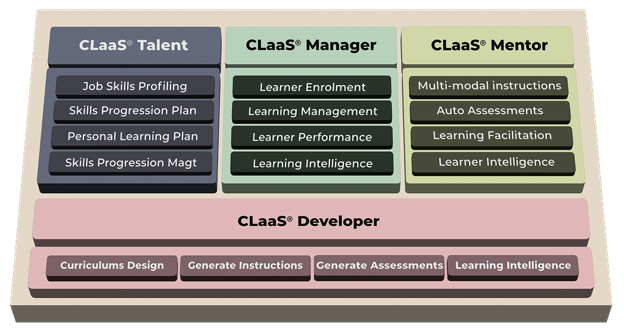
Before a learning path can be personalized, the platform needs to know where each student actually stands. CLaaS Talents maps existing skills[BS2.1] against career and program goals, surfacing the specific gaps that matter for that individual student, rather than relying on a generic cohort average to decide what everyone needs next.
CLaaS Developer: designing adaptive curriculum
CLaaS Developer turns those individual gaps into curriculum decisions. It structures competency-based education content and assessment so that each student’s sequence reflects what they still need to learn, while keeping the underlying course aligned to the program’s overall learning outcomes and academic standards.
CLaaS Manager: enrolment, learning plans and analytics
CLaaS Manager handles the operational layer that makes personalization manageable: enrolment, individual learning plans and progress analytics across the whole cohort. This is the piece that lets an adaptive learning platform for universities operate at the scale of a full intake, rather than staying limited to a small pilot group.
CLaaS Mentor: coaching and adaptive delivery
CLaaS Mentor delivers the day-to-day learning experience and coaching, adjusting pace and support in response to how each student is actually progressing, not how the average student is expected to progress. Faculty time shifts away from repeating the same lecture and toward mentoring the students who need direct support most.
Together, the four agents turn the mass personalization of education from a staffing problem into a platform capability, supporting competency-based, work-integrated and project-based learning without asking faculty to manage every student’s plan by hand.
What Batch-of-One Learning Means for Universities & Polytechnics
For provosts and academic leaders
For institutional leadership, batch-of-one learning can act as a meaningful retention and completion lever. Students who receive a path matched to their actual skill level are less likely to disengage from material that is too easy or drop out of material that is too hard. Over a full cohort cycle, that can translate into fewer students falling through the cracks between orientation and graduation, without requiring leadership to expand academic headcount to match enrolment growth. Adaptive CLaaS runs on Intelligence OS, the shared platform layer that also gives leadership a consistent data picture across learning and institutional operations, rather than a standalone tool bolted onto existing systems.
For program designers
For program and curriculum teams, the benefit is agility. Competency maps can be updated as workforce requirements shift, and because CLaaS Developer maps each student’s sequence to what they still need to learn, the same underlying content can be reorganized for a new intake without redesigning the whole program from scratch each time. That agility matters most for polytechnics and universities where industry skill requirements move faster than a traditional multi-year curriculum review cycle can keep up with. Measuring the impact responsibly means tracking indicators such as time-to-competency, completion rate and graduate workforce alignment over a full cohort cycle, rather than presenting a single projected outcome figure in advance.
Getting Started with Personalized Learning at Scale
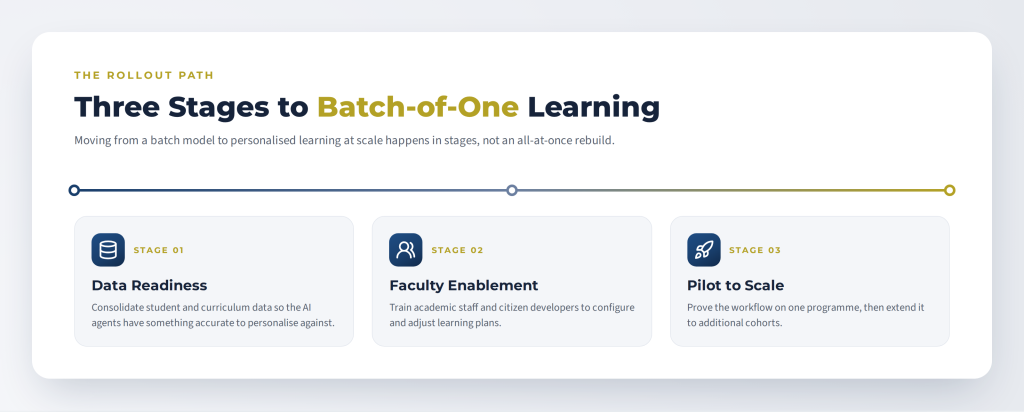
Moving from a batch model to batch-of-one learning does not require an all-at-once rebuild. Most institutions work through it in three stages, each building on the one before it.
- Data readiness: consolidating existing student and curriculum data, including records currently split across departments, so the AI agents have something accurate and complete to personalise against from day one.
- Faculty enablement: training academic and administrative staff, including citizen developers, to configure and adjust learning plans themselves rather than build everything from scratch, so ownership sits with the people closest to each program.
- Pilot to scale: starting with one program or intake, measuring outcomes such as time-to-competency and completion against a clear baseline, then extending the same competency-based approach to additional cohorts once the workflow is proven.
Frequently Asked Questions
What is batch-of-one learning?
Batch-of-one learning is the practice of giving every student their own personalized learning journey, tailored to their skill gaps, pace and goals, while still teaching them within a large cohort. Instead of delivering the same content to a whole ‘batch’ of learners, AI adapts the path for each individual, making one-to-one personalization affordable at scale. CLaaS2SaaS delivers this through its Adaptive CLaaS platform.
How is batch-of-one different from traditional adaptive learning?
Traditional adaptive tools mainly adjust content difficulty as a student progresses. Batch-of-one learning goes further, personalizing the whole journey, including skills mapping, assessment and coaching, across an entire cohort rather than a single course module.
Can personalized learning really scale to thousands of students without more staff?
Yes. AI agents handle skill diagnosis, curriculum delivery and progress analytics, which is the workload that would otherwise require additional staff. Faculty time shifts toward mentoring students who need direct support.
Is batch-of-one learning the same as competency-based education?
They are closely related. Batch-of-one learning is one way of operationalizing competency-based education at cohort scale, using AI agents to personalize how each student reaches the same standards.
How do universities measure the impact of personalized learning?
Common indicators include time-to-competency, completion rates and how well graduate skills align with workforce needs. These are tracked over a full cohort cycle rather than reported as a single projected figure.
Batch-of-one learning is no longer just a research idea. It’s something universities and polytechnics can put to work today with CLaaS2SaaS. See how Adaptive CLaaS could work for your own cohort, or call +65 6324 9730 to speak with the team directly.
Read the companion guide: How to Finish a Bachelor’s Degree in 2 Years
Share


Want to check if this career is for you?