Are Accelerated Bachelor's Degrees Worth It? Pros, Cons & Who They Suit
Are Accelerated Bachelor's Degrees Worth It? Pros, Cons & Who They Suit

Content
Content
Are accelerated degrees worth it, or does finishing faster simply mean doing more work in less time? The answer depends on program quality, workload, total investment, credential recognition, practical experience, and your career goals. This guide weighs those trade-offs so you can decide whether an accelerated bachelor’s degree suits you.
Are Accelerated Bachelor’s Degrees Worth It?
For many students, an accelerated bachelor’s degree is worth it — but the honest answer is that it depends on more than just speed. Accelerated degrees can be genuinely valuable for students who want to enter the workforce sooner, who thrive under an intensive pace, and who choose a program with credible academic structure and real career relevance.
The trade-off is straightforward, even if the decision isn’t: finishing faster generally means condensing the same academic workload into a shorter timeframe, which asks more of your schedule, focus, and time management in exchange for reaching graduation — and the workforce sooner. That can be a genuinely good trade for the right student, and a difficult one for someone who needs more breathing room to absorb material, work part-time, or manage other commitments.
Rather than asking whether accelerated degrees are worth it in general, it’s more useful to ask whether one is worth it for you specifically — which depends on your career goals, how well you handle an intensive workload, your total financial and time investment, and whether the specific program you’re considering has credible academic backing. The rest of this guide walks through each of those factors so you can weigh them for your own situation.
What Is an Accelerated Bachelor’s Degree?
An accelerated bachelor’s degree is a bachelor’s pathway structured to be completed in less time than a traditional three-to-four-year degree, typically through some combination of a condensed study period, an intensive class schedule, year-round enrollment instead of the usual academic-year breaks, and in some cases, credit recognition for relevant prior learning.
The word ‘accelerated’ refers to the pace and structure of the pathway, not the academic depth of the degree. A well-designed accelerated program still needs to satisfy the same underlying academic requirements as a traditional one — it simply organizes and delivers that content more intensively, over a shorter calendar, rather than removing coursework to save time.
Some accelerated pathways also build in work-study components, where practical or workplace-based learning is integrated alongside academic study, rather than added on afterward. The exact mechanics vary significantly by institution and program, which is why it’s worth understanding how a specific accelerated pathway achieves its shorter timeline before assuming all accelerated degrees work the same way.
Pros of an Accelerated Bachelor’s Degree
For leaders conducting an enterprise learning platform comparison, the key question is not simply the LXP vs LMS difference. It is which platform can support the organisation’s current compliance, discovery, skills, workflow, and performance-measurement needs. A few criteria tend to separate the categories cleanly, and working through them honestly is more useful than starting from a vendor shortlist.- Faster graduation. The most obvious advantage is time: an accelerated pathway gets you to a completed degree sooner than a traditional schedule, which matters if you have a clear reason to want to finish quickly.
- Earlier workforce entry. Graduating sooner generally means the option to enter the workforce, or progress in your current role, earlier — though how quickly that translates into a specific job or outcome depends on your field and the job market, not the degree pathway alone.
- Maintained academic momentum. Some students find it easier to stay focused on an intensive, continuous schedule than across a longer degree with more breaks, where it’s easier to lose momentum.
- Potential opportunity-cost advantages. A shorter pathway can reduce the time spent not earning a full-time income, though the actual financial trade-off depends on your specific costs, not simply the number of years involved.
- Earlier practical experience. Programs that integrate real-world projects, mentoring, or work-study components can give students exposure to career-relevant experience earlier than a purely classroom-based pathway.
Cons of an Accelerated Bachelor’s Degree
- Intensive workload. Compressing the same academic content into a shorter timeframe generally means a heavier week-to-week workload than a traditional pace allows.
- Less time to absorb material. Some students genuinely need more time to process complex material. An intensive pace that works for one student can leave another feeling like they’re moving too fast to properly understand it.
- Reduced flexibility. A condensed, continuous schedule generally leaves less room to pause or step back if life circumstances change, compared with a traditional pathway’s longer timeline.
- Burnout and time-management risk. An intensive pace sustained over an extended period is genuinely demanding; underestimating that demand risks burnout or struggling to balance study with other commitments.
- Faster doesn’t automatically mean cheaper. A shorter, more intensive program can cost a similar amount to — or more than a traditional one. Total cost needs to be compared directly rather than assumed from duration alone.
Who Is an Accelerated Bachelor’s Degree Best For?
An accelerated bachelor’s degree tends to suit students who already have a reasonably clear sense of their career direction, since an intensive pace leaves less natural space to explore different fields along the way.
It also tends to suit students with strong self-discipline and time-management skills — the kind of student who can sustain a demanding, continuous workload without significant breaks, and who’s comfortable prioritizing study intensively for a defined period in exchange for finishing sooner.
Students who specifically want to graduate and enter the workforce as quickly as possible are natural candidates, as are learners who value gaining practical, real-world experience alongside their academic study rather than purely classroom-based learning.
Who Might Be Better Suited to a Traditional Bachelor’s Degree?
A traditional bachelor’s degree tends to suit students who prefer a steadier pace, with more time between assessments to absorb material and more natural breaks across the academic year.
It also tends to suit students who want more flexibility to adjust their study load if circumstances change, and students who want the conventional university experience — societies, campus life, a longer runway to build a network.
It’s also a reasonable fit for students who are still exploring which field is right for them, and for anyone managing significant work or family commitments that make a highly intensive, continuous study schedule genuinely difficult to sustain.
Accelerated vs. Traditional Bachelor’s Degree
Laid out side by side, the trade-offs between an accelerated and a traditional bachelor’s degree become easier to weigh.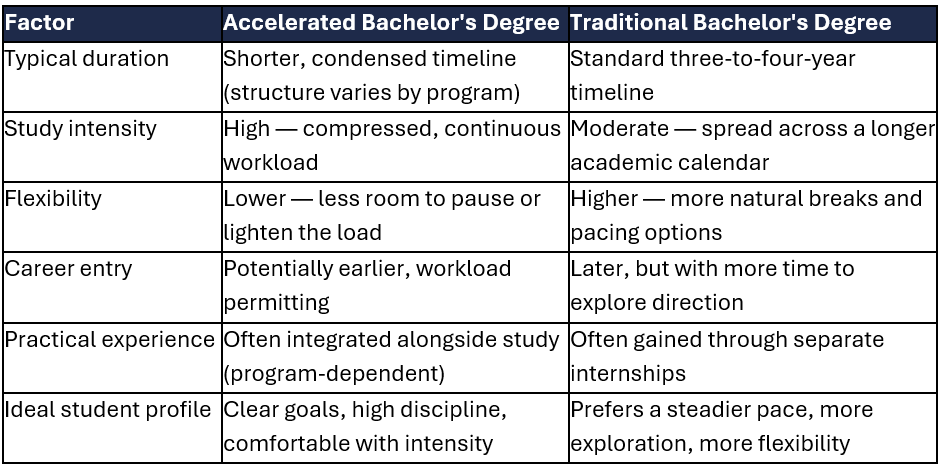
Neither format is universally better — each trades something for something else. An accelerated pathway trades flexibility for speed and earlier entry into the workforce; a traditional pathway trades a longer timeline for a steadier pace and more room to explore. The right choice depends on which trade-offs actually fit your goals and circumstances.
Are 2-Year Bachelor’s Degrees Legitimate?
It’s a fair question, and a healthy one to ask before committing to any accelerated pathway: not every program marketed as a ‘2-year bachelor’s degree’ has the same academic structure, recognition, or credibility, and it’s worth verifying the details yourself rather than assuming.
Start with the awarding institution — which university or accredited body is actually issuing the qualification, and is that institution properly recognized in the country and industry where you plan to use the degree? From there, check the specific accreditation or recognition status of the program itself, not just the institution’s general reputation.
It’s also worth understanding the entry requirements and credit structure, and asking exactly what qualification you’ll be awarded at the end, and what progression opportunities that qualification actually opens up.
CLaaS2SaaS higher education learning pathways, for example, markets a 2-year international bachelor’s pathway and describes the qualification as coming through an internationally accredited university — but the exact awarding-body wording and accreditation details should always be confirmed directly against the relevant program page before you make a decision, for this program or any other you’re considering.
How to Decide If an Accelerated Degree Is Worth It for You
Rather than relying on a general opinion about accelerated degrees, it helps to work through your own decision systematically. A few questions are worth answering honestly before you commit to either pathway.- What career do I want? Having a reasonably clear direction makes an intensive, condensed pathway easier to justify than if you’re still exploring options.
- How quickly do I need the qualification? Some situations genuinely call for speed; others don’t, and there’s no need to rush a decision that doesn’t require it.
- Can I manage the workload? Be honest about your current capacity for an intensive, continuous schedule, alongside whatever else is going on in your life.
- What qualification will I receive? Confirm the exact degree title and level you’ll be awarded, not just a general description of the program.
- Who awards it? Identify the specific institution issuing the qualification, and verify its recognition independently.
- What practical experience will I gain? Check whether real-world projects, mentoring, or work-study components are actually built into the pathway.
- What is the total financial and time investment? Compare total cost and total time realistically, rather than assuming a shorter timeline automatically means less of either.
How CLaaS Higher Education Approaches Accelerated Learning
With that decision framework in mind, here’s how CLaaS2SaaS’s Higher Education learning pathways are currently described on its own program pages, so you can weigh it against the questions above.
CLaaS2SaaS higher education offers an international bachelor’s pathway designed to be completed in around two years, with Digital Business and Software Engineering as the two published pathway options. The stated approach centers on competency-based learning rather than a purely lecture-based format, combined with real-world industry projects intended to build job-ready skills alongside academic progression.
The program also describes personalized mentoring and a flipped-classroom learning model, where students engage with core material independently and use structured class time for applied, hands-on work. Flexible study options are part of the published proposition too, including a work-study pathway and a fully online option for students who need to combine study with work or other commitments.
As with any accelerated program, the specifics — exact entry requirements, credit structure, awarding institution details, and program stages — are worth confirming directly on the relevant CLaaS Higher Education program page before enrolling, rather than relying on a summary.
Frequently Asked Questions
Are accelerated bachelor's degrees worth it?
They can be, particularly for students who have a clear career goal, can manage an intensive learning schedule, and choose a credible program that combines academic progression with relevant career preparation. The right choice depends on your goals, workload capacity, budget, and preferred learning pace.
Is an accelerated bachelor's degree harder?
It can feel more intensive, since the same coursework is compressed into a shorter timeframe. It’s worth reviewing the actual weekly schedule and workload of a specific program before enrolling, rather than assuming ‘accelerated’ automatically means ‘harder’ in the same way for every student.
Can you get a bachelor's degree in two years?
Some accelerated pathways are structured around a two-year completion timeline, depending on the program, entry requirements, and awarding institution. Not every bachelor’s degree can be completed in two years, so it’s worth confirming the specific structure of any program you’re considering.
Are accelerated bachelor's degrees cheaper?
Not necessarily. A shorter timeline doesn’t automatically mean lower total cost — compare total tuition, fees, and living costs across the full length of the program, rather than assuming fewer years means less spent overall.
What doesWho should consider an accelerated bachelor's degree? ‘Learn2Work’ mean for enterprise learning?
Students with clear career goals who can manage an intensive workload and want to combine academic study with earlier practical experience are natural candidates. Students who prefer a steadier pace, more flexibility, or more time to explore their field may be better suited to a traditional pathway.
If you’re deciding whether an accelerated bachelor’s degree fits your goals, the next step is to compare the pathway, workload, qualification, and practical experience against your own plans. Explore the CLaaS Higher Education accelerated pathway and speak with the team about your options.
Read the companion guide: How to Finish a Bachelor’s Degree in 2 Years
Share


Want to check if this career is for you?